


Software Development Articles
How to Read and Understand System Design Diagrams?
System Engineer Roles and Responsibilities: 12 Proven Duties for Growth
SAP Consultant Roles and Responsibilities: 12 Proven Duties for Growth and Success
Network Engineer Roles and Responsibilities: 12 Essential Duties for Success


Get In Touch For Details! Request More Information
Interpreter Design Pattern (2026 Guide)
Aug 05, 2026 3 Min Read 955 Views
(Last Updated)
This Interpreter Design Pattern may sound a bit abstract at first, but once you understand its use cases in software development, everything starts making sense. From the very simple rule systems and search filters to the complex and advanced complexities, you might be surprised by how often this pattern appears in the software you use in everyday life.
If you were never clear on how software can “interpret” a user’s request and translate it into actionable steps, then I believe this pattern will help you tie it all together. It is the kind of principle that completely shifts your perspective on building extensible and smarter systems.
Table of contents
- TL;DR Summary
- Interpreter Design Pattern: Definition
- Example:
- Practical Code Example
- (Code)
- Code Explanation:
- Interpreter Design Pattern: Importance
- Understanding Human-Like Input
- Converts Text Into Logic
- Makes Systems Flexible
- Used in Real-World Engines
- Separates Parsing From Execution
- Interpreter Design Pattern UML Class Diagram
- Explanation:
- Conclusion
- FAQs
- Why does the Interpreter Design Pattern feel confusing at first?
- Where is the Interpreter Design Pattern actually used in software?
- What gets interpreted in this pattern?
- Why are there multiple expression classes in this pattern?
- What is the role of the interpret() method?
- Why is the UML diagram important for this pattern?
TL;DR Summary
- This blog explains the Interpreter Design Pattern in simple terms, focusing on how interpretation actually occurs in software systems.
- You’ll understand the internal flow of the Interpreter Design Pattern through its UML structure, expressions, and interpretation process.
- A practical product filter code example helps you understand how the Interpreter Design Pattern works in real software development.
Interpreter Design Pattern: Definition
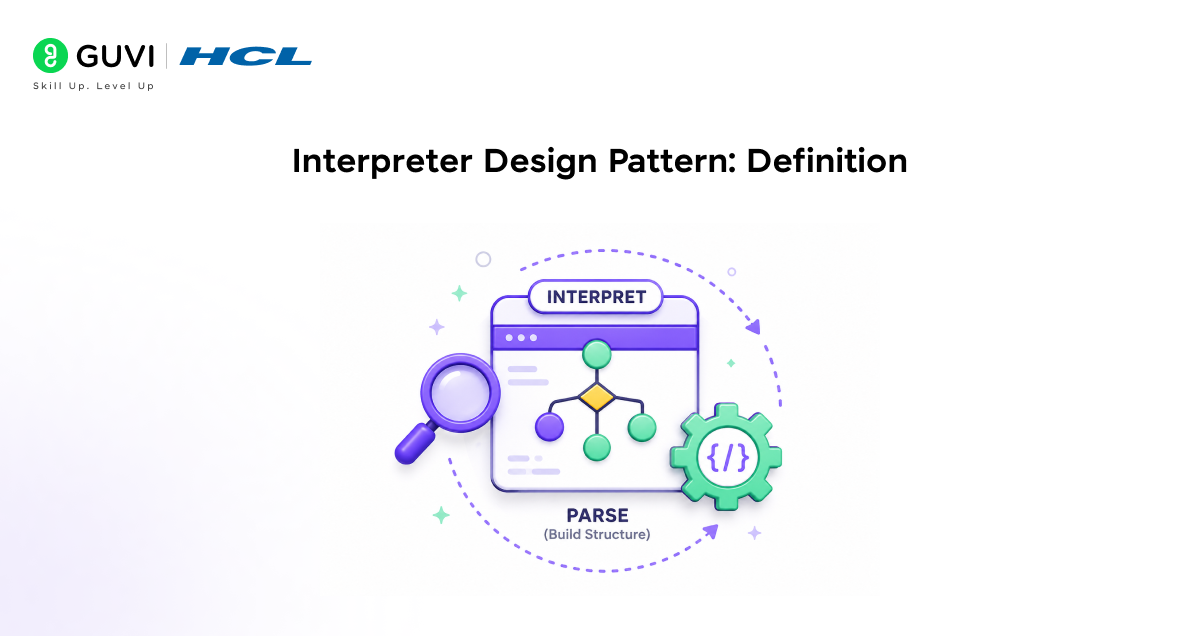
Interpreter Design Pattern is a behavioural design pattern in which a system is created to understand input text by interpreting it as a rule-based language.
So instead of a huge chunk of logic, one has expressions; the interpreter for each expression knows how to interpret it, and it uses smaller interpreters to interpret the complete sentence step-by-step. Basically, the pattern makes software “read,” “understand,” and “execute” a custom language or ruleset.
Example:
The Interpreter Design Pattern in software engineering is useful when software needs to process or interpret expressions and structures dynamically, typically involving rules or structured statements.
For instance, consider an e-commerce platform. On this platform, users can apply filters for price ranges, categories, ratings, sorting, and more. The system will interpret the rules one by one to select the product to display.
In this way, the Interpreter Design Pattern is implemented when developing the product filter features for the e-commerce platform.
Practical Code Example
Here in this section, we will be using JavaScript to demonstrate the Interpreter Design Pattern and how it comes into play when a user is filtering products on an e-commerce site:
(Code)
const products = [
{ name: “Shoes”, price: 500 },
{ name: “Watch”, price: 2000 },
{ name: “Bag”, price: 800 }
];
function interpret(query, products) {
let field = “”;
let operator = “”;
let value = “”;
let state = 0;
for (let i = 0; i < query.length; i++) {
const ch = query[i];
if (ch === ” “) {
state++;
continue;
}
if (state === 0) {
field += ch;
} else if (state === 1) {
operator += ch;
} else {
value += ch;
}
}
value = value * 1;
const result = [];
for (let i = 0; i < products.length; i++) {
const item = products[i];
if (
(operator === “<” && item[field] < value) ||
(operator === “>” && item[field] > value)
) {
result[result.length] = item;
}
}
return result;
}
console.log(interpret(“price < 1000”, products));
Code Explanation:
- When the program parses a query String such as price < 1000, it uses an Interpreter to evaluate that String as though it were its own language.
- This way, it scans one Character at a time until all three parts of that query: price (field), < (operation/rule), and 1000 (value) have been separated.
- After the 3 parts are broken down, the program can determine that the user has requested all products (in the database) with the Field ‘price’ that are less than 1000.
- Then it loops through each product and checks whether its price is < 1000.
- If true, the product will be stored in the returned value. Therefore, the interpretation is that the program converted a human-readable ‘Rule’ (price < 1000) into executable logic.

Interpreter Design Pattern: Importance
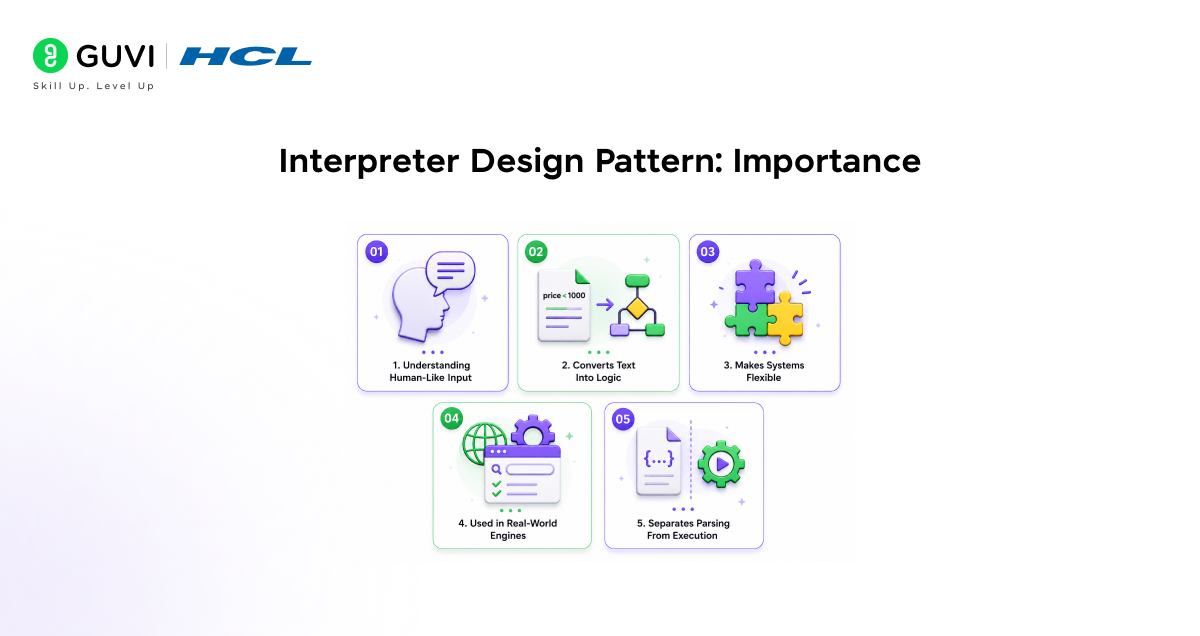
Here are some of the most vital reasons why the Interpreter Design Pattern is important in programming:
1. Understanding Human-Like Input
It helps programs dynamically understand user-written rules, commands, filters, or expressions.
2. Converts Text Into Logic
The pattern transforms readable input, such as price < 1000, into executable program behaviour.
3. Makes Systems Flexible
New commands or rules can be added without rewriting the entire application logic.
4. Used in Real-World Engines
Search filters, SQL parsers, compilers, calculators, and rule engines commonly use this pattern.
5. Separates Parsing From Execution
It cleanly divides understanding the input from performing the actual operation, improving maintainability.
Interpreter Design Pattern UML Class Diagram
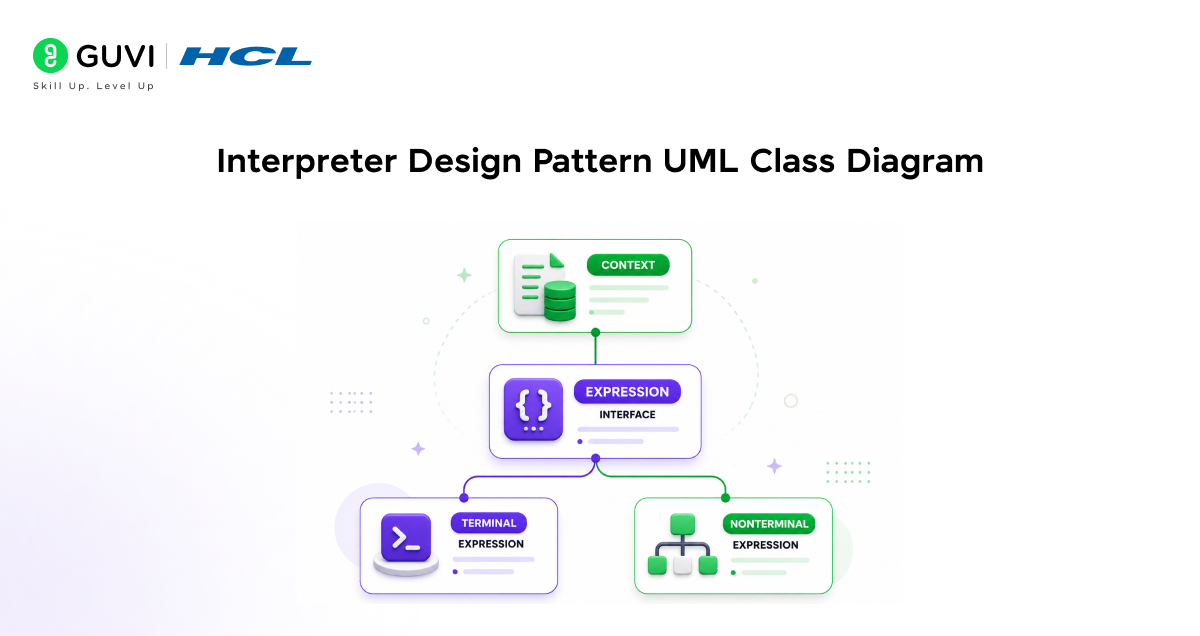
Now, let’s understand the Interpreter Design Pattern using UML (Unified Modelling Language), which provides a clear visualisation of how different expressions, rules, and classes communicate during interpretation.
Moreover, it helps developers understand the hierarchy, relationships, and execution flow of the interpretation process.
Explanation:
- The Context class begins the flow by holding the common data necessary to execute the interpretation process, but it does not execute any interpretations.
- The main part of the overall pattern is the Expression interface, as it defines an interpret() method. Every Expression Class must implement the interpret() method so that input is interpreted consistently across the entire system.
- The TerminalExpression is responsible for the smallest, final units of the language. This entity represents simple symbols or values; therefore, its task is fairly straightforward since it directly interprets atomic symbols.
- The NonTerminalExpression is responsible for handling complex rules by combining two or more expressions. Therefore, up to this point in the UML, they usually contain several Expression objects.
- Interpretation takes place sequentially throughout the inference process. Higher-level expressions will invoke lower-level expressions until a complete understanding of the entire input is achieved.
- TerminalExpression will interpret the simplest components of the input, and NonTerminalExpression will aggregate the interpreted components into some logical meaning. The overall system structure results in a clean, flexible and easily extensible solution.
Level up your dev game with HCL GUVI’s IITM Pravartak & MongoDB Certified AI Software Development Course. Build real projects, master Java, DSA, System Design, AI-powered development skills, and get job-ready without the boring grind.
Conclusion
While the Interpreter Design Pattern may seem complex in theory, when you’re really programming, it really comes down to creating smart software that can “read” and interpret structured data all on its own. After you understand the process, you’ll begin noticing the Interpreter Design Pattern in almost every application that uses rule engines, filters, queries, and dynamic code.
FAQs
Why does the Interpreter Design Pattern feel confusing at first?
It deals with language-like rules, so the flow only becomes clear after seeing real implementations.
Where is the Interpreter Design Pattern actually used in software?
It is commonly used in search filters, SQL parsers, compilers, calculators, and rule engines.
What gets interpreted in this pattern?
Structured input, such as commands, expressions, conditions, or rules, is interpreted step by step.
Why are there multiple expression classes in this pattern?
Each class handles a specific part of the language to keep the system organised and scalable.
What is the role of the interpret() method?
It contains the logic that understands and processes an expression.
Why is the UML diagram important for this pattern?
It helps developers visualise how expressions interact and how the interpretation flow works internally.
Success Stories












Did you enjoy this article?