


Software Development Articles
How to Read and Understand System Design Diagrams?
System Engineer Roles and Responsibilities: 12 Proven Duties for Growth
SAP Consultant Roles and Responsibilities: 12 Proven Duties for Growth and Success
Network Engineer Roles and Responsibilities: 12 Essential Duties for Success


Get In Touch For Details! Request More Information

How to Avoid Burnout as a Software Developer: 7 Practical Strategies
Jul 17, 2026 4 Min Read 701 Views
(Last Updated)
Burnout does not arrive suddenly. It creeps in slowly over months of late nights, unclear expectations, piling backlogs, and the constant feeling that no matter how much you ship, there is always more. For software developers especially, the line between productive intensity and damaging overwork is thin and often invisible until you have already crossed it. This guide covers the real, practical ways to avoid burnout as a software developer in 2026, including what the early warning signs look like, what causes it structurally, and what habits and boundaries actually work.
Table of contents
- TL;DR Summary
- What Does Burnout Actually Feel Like for Developers?
- Why Developers Burn Out More Than Most
- How to Avoid Burnout as a Software Developer: 7 Practical Strategies
- Protect Your Working Hours Like Code Reviews
- Batch Async Communication
- Protect At Least One Deep Work Block Daily
- Say No to Scope Creep Explicitly
- Take Your Paid Leave Seriously
- Build Something for Fun with Zero Stakes
- Name the Problem When You Notice It
- Setting Boundaries Without Damaging Your Career
- When to Ask for Help
- 💡 Did You Know?
- Common Mistakes to Avoid
- Conclusion
- FAQs
- What are the early signs of burnout for software developers?
- What causes burnout in software developers?
- How do I avoid burnout as a software developer without appearing less committed?
- How long does it take to recover from developer burnout?
- Is it normal to feel burnout as a software developer?
TL;DR Summary
- To avoid burnout as a software developer, you need to manage energy, not just time.
- The early signs are subtle: slow code reviews, dreading Monday, inability to focus on problems you used to love.
- Structural fixes matter more than willpower: set working hour boundaries, protect deep work blocks, and say no to scope creep.
- Burnout in tech is overwhelmingly caused by unclear expectations, lack of autonomy, and chronic overwork, not technical difficulty.
- Recovery from full burnout takes weeks to months. Prevention takes a few habits maintained consistently.
What Does Burnout Actually Feel Like for Developers?
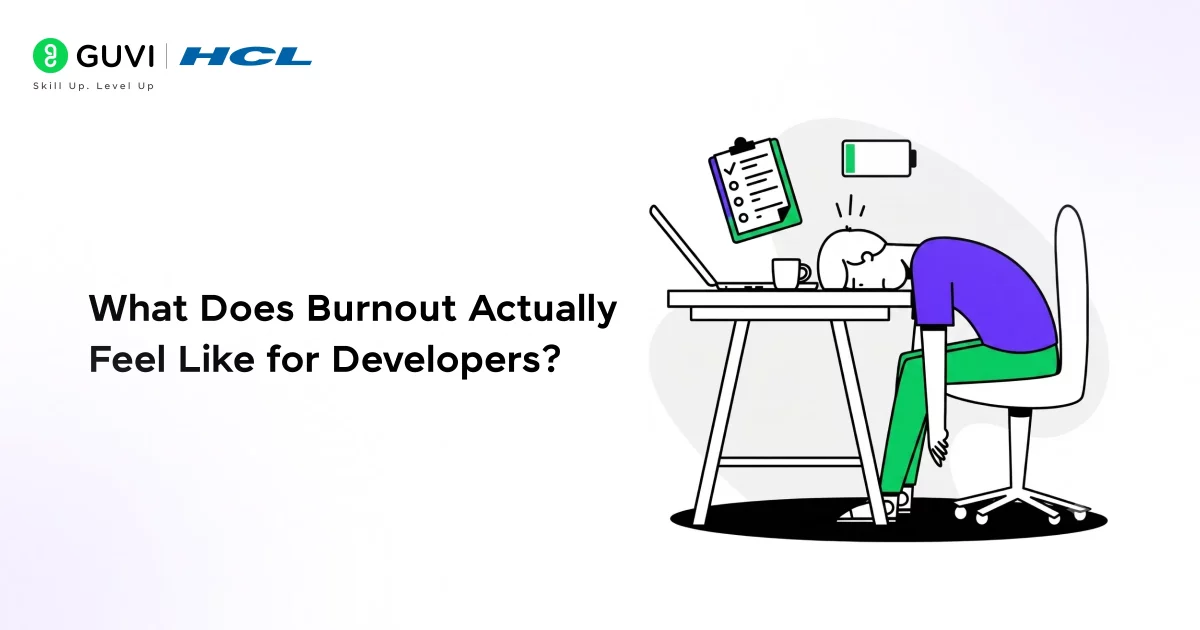
Burnout is not just being tired. Tiredness goes away with rest. Burnout is a sustained state of emotional exhaustion, cynicism, and reduced effectiveness that does not respond to a single good night of sleep.
For developers specifically, it often shows up as:
- Writing code feels mechanical and joyless when it used to feel engaging
- You avoid opening your IDE in the evenings even for projects you genuinely care about
- Code reviews take twice as long because concentration feels impossible
- You feel irritable in standups and detached from the team’s outcomes
- Small technical decisions that used to feel easy now feel overwhelming
The tricky thing about burnout for developers is that the early stage often looks like productivity. You ship more, respond to Slack faster, and take on extra tickets. The crash comes later.
Building a sustainable tech career starts with the right foundation. If you are early in your journey and want to build skills that give you options without the pressure of a mismatched role, HCL GUVI’s Full Stack Development Course and AI Software Development Course are IITM Pravartak certified and designed with that sustainability in mind.
Why Developers Burn Out More Than Most
Understanding the structural causes helps you avoid burnout as a software developer instead of just treating the symptoms.
- Always-on culture. Remote work blurred the line between being at work and being at home. A Slack notification at 10pm feels like an expectation, not a nudge.
- Undefined done. Software is never finished. There is always another bug to fix, a performance improvement to make, or a feature to spec. Without clear stopping points, developers often keep going long after they should stop.
- Imposter syndrome and perfectionism. Tech culture rewards expertise visibly. Developers often work beyond their limits to prove they belong, especially at new companies or after a promotion.
- Unclear expectations. When priorities change every sprint and nobody explains why, developers absorb the cognitive load of constant context switching without the autonomy to push back.
How to Avoid Burnout as a Software Developer: 7 Practical Strategies
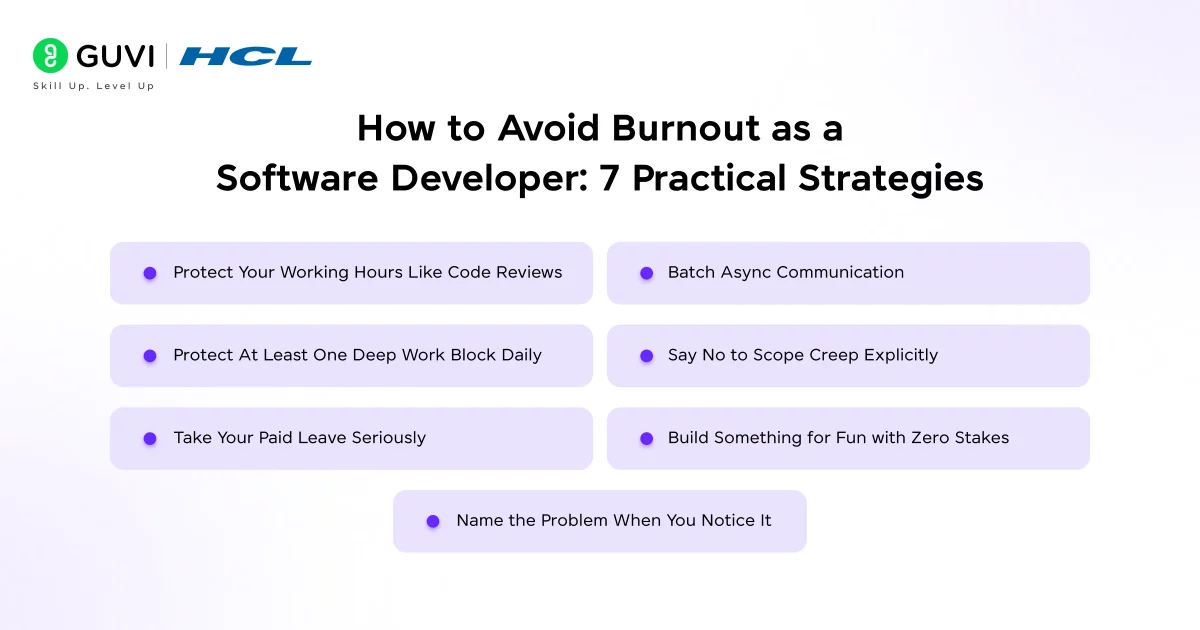
1. Protect Your Working Hours Like Code Reviews
Set a hard end time for your work day and stick to it. If your team is async, communicate it clearly in your status or profile. The developers who avoid burnout as a software developer most consistently are not the ones who care less about their work. They are the ones who treat recovery time as non-negotiable.
2. Batch Async Communication
Checking Slack and email continuously throughout the day is one of the biggest contributors to low-grade cognitive exhaustion. Set two or three fixed windows per day for async communication and close notifications the rest of the time. Your response time goes from immediate to predictable, which most teams adapt to quickly.
3. Protect At Least One Deep Work Block Daily
Context switching costs roughly 20 minutes of recovery per switch. If your day is a series of one-hour meetings, you are not doing real work, you are recovering from interruptions. Block at least 90 minutes in your calendar daily for focused technical work, first thing in the morning before standups if possible.
4. Say No to Scope Creep Explicitly
Every “quick addition” to a sprint ticket is a boundary violation in disguise. Developers who avoid burnout as a software developer learn to say “I can add that, but it means moving something else out of this sprint” rather than absorbing extra work silently. This is not aggressive. It is professional and accurate project management.
5. Take Your Paid Leave Seriously
A significant portion of developers do not take their full annual leave. Taking leave feels uncomfortable when the team is under pressure, but not taking it guarantees a worse version of that same pressure compounds month after month. Disconnecting fully, with no Slack, no code reviews, and no on-call, is not lazy. It is how you avoid burnout as a software developer structurally.
6. Build Something for Fun with Zero Stakes
Side projects with no deadlines, no users, and no one watching are some of the most effective tools to avoid burnout as a software developer. They remind you why you learned to code in the first place. The moment you make a side project feel like a job, the benefit disappears.

7. Name the Problem When You Notice It
Burnout is much easier to address at 20% than at 100%. If you notice the early signs, three consecutive days of low motivation, avoiding specific tasks, or snapping at teammates, name it out loud to someone you trust. A conversation with your manager, a colleague, or a therapist is not a sign of weakness. It is the most effective early intervention available.
Setting Boundaries Without Damaging Your Career
The fear most developers have is that setting limits will make them look less committed. In reality, developers who avoid burnout as a software developer and stay at a company for three or four years deliver more than ones who burn out and leave after eighteen months.
A few ways to set boundaries that protect your credibility:
- Frame limits in terms of quality: “I do my best debugging first thing in the morning, so I protect that time.”
- Communicate proactively: “I am not available after 7pm, but I will pick this up first thing tomorrow.”
- Be consistent: Occasional exceptions are fine. Consistent self-disregard sets an unsustainable expectation.
When to Ask for Help
If you recognise that what you are experiencing has moved beyond tiredness into sustained emotional exhaustion, numbness about work, or physical symptoms like persistent insomnia or headaches, please speak to a professional. A doctor or therapist is not a last resort, it is the appropriate response to a health situation.
💡 Did You Know?
- A Stack Overflow Developer Survey found that over 67% of developers report some experience with burnout during their career, and nearly 30% say it has caused them to leave a job. The developers who avoid burnout as a software developer most successfully almost always cite team culture and clear expectations as the primary factor, not workload alone.
Common Mistakes to Avoid
- Treating productivity as the antidote to burnout. Many developers respond to the early signs of burnout by working harder and shipping more. This is exactly the wrong response. Productivity is not what restores energy. Rest, autonomy, and meaning do.
- Waiting for permission to take a break. Your company is unlikely to tell you that you are doing too much. The responsibility to protect your own energy is yours. Waiting for a manager to notice and intervene seldom works.
- Confusing passion with endurance. Loving your work does not mean you can work without limits indefinitely. Caring deeply about what you build makes burnout more likely, not less, because you are more willing to push through early warning signs.
Conclusion
To avoid burnout as a software developer, you need structural habits, not just willpower. Set hard boundaries on your working hours, protect deep work time, batch your communications, take your leave, and build things for fun with zero stakes. The developers who last longest in this industry are not the ones who pushed hardest in year one. They are the ones who built a sustainable rhythm early and defended it even when it was uncomfortable. Start with one habit from this list today.
FAQs
1. What are the early signs of burnout for software developers?
The early signs include dreadful opening of your IDE, slow and joyless code reviews, difficulty concentrating on problems you previously found easy, irritability in team meetings, and a persistent sense of falling behind regardless of how much you ship.
2. What causes burnout in software developers?
The most common causes are unclear expectations, lack of autonomy, chronic overwork without recovery, always-on communication culture, and the cognitive load of constant context switching between tasks and meetings.
3. How do I avoid burnout as a software developer without appearing less committed?
Frame boundaries in terms of quality and output. Communicate them proactively and consistently. Developers who avoid burnout as a software developer and stay at a company long-term deliver more career value than those who burn out and leave.
4. How long does it take to recover from developer burnout?
Mild burnout with early intervention can improve within a few weeks with rest and structural changes. Full burnout that has been ignored for months can take three to six months or longer to recover from. Prevention is significantly faster than recovery.
5. Is it normal to feel burnout as a software developer?
Yes. Over 67% of developers report experiencing some form of burnout during their career. It is common, but it is also largely preventable with the right habits and team environment.
Success Stories

About the Author
Jebasta
I translate the language of data into stories that anyone can understand. As a writer with a data science background, I simplify analytics, AI, and decision-making so beginners and enthusiasts can confidently explore the world of data.
View all posts by Jebasta
Connect with me @
















Did you enjoy this article?