


Software Development Articles
How to Read and Understand System Design Diagrams?
System Engineer Roles and Responsibilities: 12 Proven Duties for Growth
SAP Consultant Roles and Responsibilities: 12 Proven Duties for Growth and Success
Network Engineer Roles and Responsibilities: 12 Essential Duties for Success


Get In Touch For Details! Request More Information

Understanding Types of Software Development Requirements?
Jul 23, 2026 4 Min Read 588 Views
(Last Updated)
Many software projects fail not because of poor coding but because of poorly defined requirements. When developers build without a clear understanding of what the system must do, the result is misaligned features, missed deadlines, and expensive rework. Understanding the types of software development requirements gives every developer, analyst, and product manager a shared language to define, discuss, and deliver the right product from the start.
Table of contents
- TL;DR Summary
- What Are Software Development Requirements?
- Types of Software Development Requirements
- How Requirements Relate to Each Other
- Common Mistakes in Software Requirements Gathering
- Conclusion
- FAQs
- What are software development requirements?
- What is the difference between functional and non-functional requirements?
- What are examples of non-functional requirements?
- What is the difference between business requirements and user requirements?
- Why do software projects fail due to poor requirements?
- What are regulatory requirements in software development?
- How should requirements be written to be testable?
- Who is responsible for gathering software requirements?
TL;DR Summary
- Software development requirements are documented descriptions of what a system must do and how it must perform.
- The main types of software development requirements include functional requirements, non-functional requirements, business requirements, user requirements, and system requirements.
- Understanding each type helps developers, product managers, and stakeholders build software that meets user needs, performs reliably, and aligns with business goals.
- Requirements gathering is the foundation of every successful software project.
Want to build strong foundations in software development, system design, and product thinking? Explore HCL GUVI’s Software Development Engineering Course, designed for developers who want to go beyond writing code and understand how great software is planned and built.
What Are Software Development Requirements?

Software development requirements are written descriptions of what a software system must do, how it must behave, and what constraints it must operate within. They bridge the gap between what stakeholders want and what developers build.
Requirements are typically documented before development begins and serve as:
- A contract between stakeholders and the development team
- A reference point for testing and validation
- A basis for estimating effort, cost, and timeline
- A guide for making design and architecture decisions
Read More: Software Development Best Practices in 2026
Types of Software Development Requirements
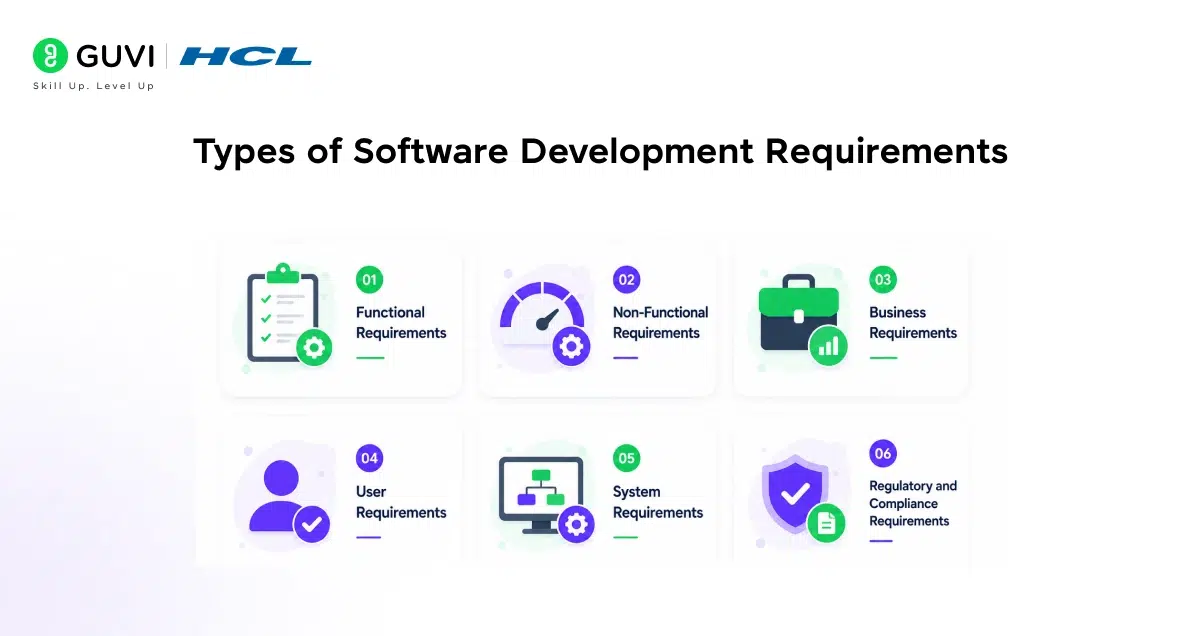
- Functional Requirements
Functional requirements define what the system must do. They describe specific behaviours, features, and functions that the software must perform in response to user actions or system events.
Examples:
- The system must allow users to register with an email and password
- The system must send an order confirmation email within two minutes of purchase
- The system must generate a monthly sales report in PDF format
- Non-Functional Requirements
Non-functional requirements define how the system must perform rather than what it must do. They set the quality standards and constraints the system must meet.
Common categories of non-functional requirements:
- Performance: The system must load the homepage in under two seconds for 95% of users
- Scalability: The system must support up to 100,000 concurrent users
- Security: All user passwords must be stored using bcrypt hashing
- Availability: The system must maintain 99.9% uptime per month
- Usability: The interface must be operable on mobile devices with screens above 4 inches
According to findings from the Standish Group’s CHAOS Report, only a minority of software projects are completed on time and within budget. One of the most common reasons for project failure is poor requirements gathering, which can lead to misunderstandings, rework, and costly delays. Along with scope creep and insufficient stakeholder involvement, unclear or incomplete requirements remain one of the leading challenges in successful software development.
- Business Requirements
Business requirements describe the high-level goals and objectives that the software must help the organisation achieve. They answer the question of why the system is being built.
Examples:
- Increase online sales conversion rate by 15% within six months of launch
- Reduce customer support ticket volume by automating common queries
- Enable the company to expand into three new regional markets by Q3
- User Requirements
User requirements describe what the end users need to accomplish using the system. They are typically captured through user stories, interviews, and usability research.
Examples:
- As a customer, I want to track my order in real time so that I know when to expect delivery
- As an admin, I want to export user data as a CSV so that I can analyse it in Excel
- As a seller, I want to receive a notification when my product goes out of stock
- System Requirements
System requirements describe the technical specifications the system must meet, including hardware, software, and integration constraints.
Examples:
- The application must run on Java 17 and above
- The system must integrate with the existing SAP ERP platform via REST API
- The database must support a minimum of 500 concurrent read operations per second
- Regulatory and Compliance Requirements
Regulatory requirements define the legal, industry, or government standards the software must comply with.
Examples:
- The system must comply with GDPR for all users in the European Union
- Patient data must be stored and transmitted in accordance with HIPAA standards
- Financial transactions must follow RBI guidelines for payment processing in India
Want to build strong foundations in software development, system design, and product thinking? Explore HCL GUVI’s Software Development Engineering Course, designed for developers who want to go beyond writing code and understand how great software is planned and built.
How Requirements Relate to Each Other
Understanding how these requirement types connect helps teams build a complete picture of what needs to be delivered.

| Requirement Type | Answers | Owner |
| Business Requirements | Why are we building this? | Executives, product owners |
| User Requirements | What do users need to do? | UX researchers, product managers |
| Functional Requirements | What must the system do? | Business analysts, developers |
| Non-Functional Requirements | How well must it perform? | Architects, senior developers |
| System Requirements | What technology must it use? | Solution architects, DevOps |
| Regulatory Requirements | What rules must it follow? | Legal, compliance teams |
Business requirements drive user requirements. User requirements drive functional requirements. Functional requirements drive system and non-functional requirements. They form a hierarchy where each level provides more technical detail than the one above it.
Example: Ethical Issues in Software Development: Challenges & Best Practices
The cost of fixing a software defect rises dramatically the later it is discovered in the development lifecycle. Research by the IBM Systems Sciences Institute found that correcting a requirements-related error after deployment can cost up to 100 times more than fixing the same issue during the requirements phase. This is why modern software development emphasizes early requirements validation, code reviews, and continuous testing to catch defects before they become expensive to resolve.
Common Mistakes in Software Requirements Gathering
1. Confusing user requirements with functional requirements: User requirements describe what users need to accomplish. Functional requirements describe how the system enables that.
2. Ignoring non-functional requirements until late in the project: Performance, security, and scalability requirements are often treated as afterthoughts. Discovering them late forces expensive architectural changes.
3. Gathering requirements from only one stakeholder group: Effective requirements gathering involves developers, product managers, users, and business stakeholders together.
4. Writing requirements that are too vague to test: A requirement like “the system should be fast” cannot be validated. “The system must respond to search queries in under 500 milliseconds for 99% of requests” is a testable requirement.
5. Treating requirements as fixed once documented: Requirements change as businesses evolve and user feedback comes in. Teams that treat requirements as immutable end up building the wrong product.
Conclusion
As software systems grow more complex and user expectations rise, getting requirements right from the start has never been more important. Understanding the difference between functional and non-functional requirements, business and user requirements, and system and regulatory requirements gives every developer and product manager a clearer framework for planning and building software that actually works.
Start by documenting requirements for your next personal or team project using these categories, and you will immediately notice fewer misunderstandings and more focused development.
FAQs
What are software development requirements?
Software development requirements are written descriptions of what a system must do, how it must perform, and what constraints it must operate within.
What is the difference between functional and non-functional requirements?
Functional requirements define what the system must do, such as allowing users to log in or generate reports. Non-functional requirements define how well the system must perform, such as response time, uptime, and security standards.
What are examples of non-functional requirements?
Common examples include performance requirements like page load time under two seconds, scalability requirements like supporting 100,000 concurrent users, security requirements like data encryption, and availability requirements like 99.9% uptime.
What is the difference between business requirements and user requirements?
Business requirements describe the high-level organisational goals the software must support, such as increasing revenue or reducing costs. User requirements describe what end users need to accomplish using the system, typically written as user stories.
Why do software projects fail due to poor requirements?
When developers build without clear specifications, they make assumptions that often do not match what stakeholders actually wanted, resulting in products that need significant changes after delivery.
What are regulatory requirements in software development?
Regulatory requirements are legal or industry standards the software must comply with, such as GDPR for data privacy, HIPAA for healthcare data, PCI-DSS for payment processing, and RBI guidelines for financial applications in India.
How should requirements be written to be testable?
Requirements must be specific and measurable. Instead of writing “the system should be fast,” write “the system must respond to all API requests in under 300 milliseconds for 99% of calls.”
Who is responsible for gathering software requirements?
Requirements are typically gathered by business analysts, product managers, and UX researchers in collaboration with developers, architects, and key stakeholders.
Success Stories

About the Author
Vishalini Devarajan
An Aerospace Engineer turned content writer, I focus on making complex concepts easy to understand through well-structured, reader-friendly blogs. Whether it’s a technical topic or a non-technical one, I love creating content that is clear, engaging, and impactful.
View all posts by Vishalini Devarajan
Connect with me @









Did you enjoy this article?