


Software Development Articles
How to Read and Understand System Design Diagrams?
System Engineer Roles and Responsibilities: 12 Proven Duties for Growth
SAP Consultant Roles and Responsibilities: 12 Proven Duties for Growth and Success
Network Engineer Roles and Responsibilities: 12 Essential Duties for Success


Get In Touch For Details! Request More Information

Key Challenges Software Developers Face
Aug 24, 2026 5 Min Read 675 Views
(Last Updated)
Software development is one of the most rewarding and most demanding careers in tech. Every project brings technical hurdles, unclear requirements, shifting deadlines, and the constant pressure to keep learning. Understanding these challenges is the first step to navigating them.
Table of contents
- TL;DRSummary
- What Are the Biggest Challenges Software Developers Face?
- Unclear Requirements and Shifting Scope
- Managing Technical Debt
- Security and Data Privacy
- Keeping Up With Rapidly Changing Technology
- Technical Complexity and System Scalability
- Unrealistic Deadlines and Delivery Pressure
- Debugging and Code Quality
- Communication and Collaboration Gaps
- Developer Burnout
- Causes (structural)
- Scale and evidence
- Workload and role creep
- Prevention (systemic fixes)
- Career Growth and Keeping Skills Relevant
- Challenges at a Glance
- Conclusion
- FAQs
- What are the most common project-level challenges?
- How do I manage technical debt effectively?
- What’s the best way to handle security risks?
- How can I keep up with rapidly changing tech?
- What practices reduce debugging time and improve quality?
- How do teams prevent developer burnout?
- What’s a practical approach to career growth and relevance?
TL;DR Summary
- Developers face three types of challenges: technical (debt, complexity, security), project-level (unclear requirements, scope creep, unrealistic deadlines), and personal (burnout, staying relevant, career growth).
- Key fixes: enforce upfront specs and user story mapping, allocate sprint capacity for refactoring, shift security left into CI/CD, use evidence-based estimation, and practice intentional, focused learning.
- Systemic support matters: modular design, load testing, observability, async documentation standards, manageable workloads, clear career paths, and protected learning time reduce burnout and keep skills relevant.
Busy debugging, tight deadlines, and constant tech changes? Become a job-ready SDE with HCL GUVI’s AI Software Development Course and master full-stack, DSA, and real projects.
What Are the Biggest Challenges Software Developers Face?

Software developers face challenges across three fronts: technical (managing complexity, technical debt, and security); project-level (unclear requirements, scope creep, and unrealistic timelines), and personal (keeping up with technology, burnout, and career growth).
In 2025, AI integration and security threats will have added new layers to an already demanding profession.
1. Unclear Requirements and Shifting Scope
- Communication failure
- 37% of software projects fail due to unclear objectives or undefined requirements; without a shared definition of “done,” teams produce wasted work, rework, and frustration.
- Scope creep
- Requirements expand as stakeholders add features or change direction mid-project; each unplanned addition brings hidden costs: development time, testing, documentation, and delayed delivery.
- Preventive practices
- Start before coding: use user story mapping, written acceptance criteria, and alignment sessions to reduce ambiguity before sprint planning.
- Controlled change process
- Use Agile checkpoints to reassess requirements, but ensure changes follow a clear process (not informal mid-sprint edits) so scope and delivery remain predictable.
2. Managing Technical Debt
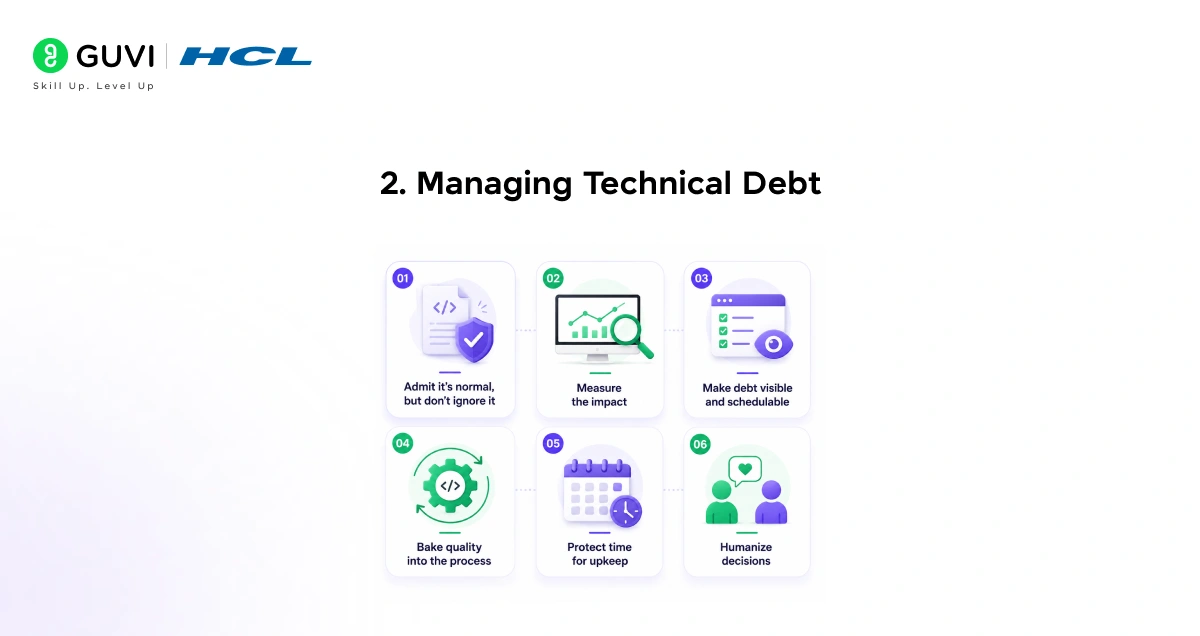
- Admit it’s normal, but don’t ignore it
- A little technical debt is a conscious trade-off to move faster. Say that out loud as a team so it doesn’t become an excuse for sloppiness.
- Measure the impact
- Developers lose roughly 23% of their time to messy code, brittle integrations, and avoidable bugs. Track where time is going so debt isn’t just a vague complaint.
- Make debt visible and schedulable
- Treat debt items like any other backlog work: log them, estimate them, and reserve a steady slice of each sprint for fixes and refactors.
- Bake quality into the process
- Use automated tests, up-to-date documentation, and strict code reviews to prevent new debt from forming and to catch problems early.
- Protect time for upkeep
- Block regular refactoring and maintenance time (for example, a fixed percent of sprint capacity) so the codebase stays healthy and future features aren’t slowed.
- Humanize decisions
- When you choose a quick fix, note why and set a clear deadline to repay the debt. That keeps accountability and prevents “we’ll fix it later” from becoming permanent.
3. Security and Data Privacy
- Security is a frontline concern in every project. In a recent industry study, 51% of developers named it their biggest challenge, and 93% of security leaders anticipated daily AI-driven attacks in 2025.
- Security threats evolve faster than most teams can track. SQL injection, cross-site scripting, insecure dependencies, and API vulnerabilities are just the surface. Distributed systems and third-party integrations dramatically expand the attack surface.
- Shifting security left means integrating vulnerability scanning into CI/CD, conducting penetration tests regularly, following OWASP guidelines, and reviewing dependencies for known CVEs as a standard release step not a final checkbox before launch.
4. Keeping Up With Rapidly Changing Technology
- The technology landscape moves faster than any developer can fully track. Frameworks, languages, cloud services, and best practices all shift within months. What was a modern stack two years ago can feel dated today.
- In 2025, 73% of tech leaders are expanding AI use, while 45% struggle with the reliability of AI-generated code. Developers must adopt tools quickly and take ownership of what those tools produce.
- The practical response is intentional learning, not exhaustive coverage. Dedicated time within working hours, small side projects with new technologies, and technical community participation are effective ways to stay current without trying to master everything at once.
Industry research has found that unclear project objectives and poorly defined requirements are among the leading causes of software project failure. Studies also show that developers spend a significant portion of their time dealing with technical debt, messy code, and fragile integrations instead of building new features. Investing in clear requirements, maintainable code, and regular refactoring can significantly improve software quality, team productivity, and on-time project delivery.
5. Technical Complexity and System Scalability
- Modern software systems are far more complex than they were a decade ago. Microservices, distributed architectures, cloud infrastructure, and AI integrations interact in ways that are difficult to reason about, test, and debug.
- Designing for scale requires architectural thinking from the start. Bottlenecks discovered in production are far more expensive to fix than those caught in design. Load testing and capacity planning are often deprioritized under delivery pressure but consistently pay dividends.
- Modular architecture and separation of concerns are the enduring answers. Loosely coupled components with clear responsibilities are easier to scale, test, and maintain than monolithic codebases.
Busy debugging, tight deadlines, and constant tech changes? Become a job-ready SDE with HCL GUVI’s AI Software Development Course and master full-stack, DSA, and real projects.
6. Unrealistic Deadlines and Delivery Pressure
- Tight deadlines are near-universal in software development. Stakeholders want software faster than it can realistically be built, and the pressure to accept impossible timelines is constant.
- The consequences are predictable: rushed code, skipped tests, mounting debt, and developers working unsustainable hours. The deadline gets met; the cost shows up for months in bugs, rework, and eroded morale.
- Accurate estimation is a skill that takes time to develop and should be treated as such. Breaking work into smaller, estimable tasks, using historical velocity data to calibrate predictions, and communicating tradeoffs clearly, “We can hit this date if we descope X,” gives teams a way to manage delivery pressure without silent overcommitment.

7. Debugging and Code Quality
- Debugging is one of the most time-consuming and hardest-to-estimate parts of development. A defect that takes five minutes to find in development might take five days to reproduce in production. Complex systems make debugging genuinely difficult.
- Nearly half of developers report they cannot release to production without risking failures, a reflection of delivery pressure and the challenge of maintaining quality across growing systems.
- TDD, strong observability, and structured code reviews reduce time spent debugging. Catching bugs early through automated tests is almost always cheaper than hunting them in production.
8. Communication and Collaboration Gaps
- Writing good code is only part of the job. Developers work within teams often distributed across time zones, communicating with product managers, designers, QA, and business stakeholders who have very different mental models of how software works.
- Misunderstandings, inconsistent documentation, unclear handoffs, and disconnected tools all create friction. Context switching and information fragmentation compound overhead daily and slow feature delivery.
- Shared documentation standards, effective async communication, and regular cross-functional syncs reduce miscommunication without adding unnecessary meeting overhead.
9. Developer Burnout
Causes (structural)
- Context switching, unrealistic deadlines, manual repetitive tasks, and insufficient recognition drive burnout; these are system-level issues, not personal failings.
Scale and evidence
- LeadDev (Mar 2025): Among 617 engineering leaders, 22% are at critical burnout levels, and only 21% are fully healthy. Harness: Over half of developers cited burnout as the main reason colleagues left.
Workload and role creep
- 65% of developers reported expanded responsibilities, and 40% managed more direct reports, yet only 3% experienced any scope reduction, showing work growth without relief.
Prevention (systemic fixes)
- Implement manageable workloads, clear career paths, protected learning time, and regular positive feedback. These organizational changes reduce burnout and support healthier developer wellbeing.
10. Career Growth and Keeping Skills Relevant
Beyond daily project challenges, developers face a longer-term one: staying relevant in a field that evolves fast while building the expertise senior roles require.
- A 2025 Stack Overflow Developer Survey found 69% of developers consider career growth the most important factor when evaluating new roles.
- Yet many are too busy shipping to invest in learning, and when organizations don’t provide structured growth paths, developers feel stagnant even while performing well.
- Developers who navigate this best specialize deliberately. They pick two or three areas of depth, a cloud platform, distributed systems, or a language ecosystem, and build genuine expertise rather than shallow familiarity across many things.
Challenges at a Glance
| Challenge | Root Cause | Practical Response |
| Unclear requirements | Communication gaps, no acceptance criteria | User story mapping, written specs upfront |
| Technical debt | Speed prioritised over quality | Dedicate sprint capacity to refactoring |
| Security threats | Evolving attack surface, AI-driven risks | Shift security left into CI/CD pipeline |
| Keeping up with tech | Rapid pace of change | Focused, intentional learning within work hours |
| System complexity | Distributed architecture, scale demands | Modular design, load testing, observability |
| Unrealistic deadlines | Pressure without engineering input | Evidence-based estimation, clear tradeoff communication |
| Debugging difficulty | Complex systems, insufficient test coverage | TDD, strong logging, automated tests |
| Communication gaps | Distributed teams, misaligned tooling | Async documentation standards, cross-functional syncs |
| Burnout | Overload, poor recognition, no growth paths | Manageable workloads, career development, protected time |
| Career stagnation | No growth structures, breadth over depth | Deliberate specialisation, structured learning plans |
Conclusion
The challenges software developers face are real and consistent, which also means they’re addressable. Technical problems like debt, complexity, and security require engineering discipline and organizational support to prioritize quality alongside speed.
Human challenges like burnout and career growth require workplaces that treat development as a long-term investment. Teams that take these challenges seriously build better software and keep the people who build it.
FAQs
What are the most common project-level challenges?
Unclear requirements, scope creep, and unrealistic deadlines; fix with acceptance criteria upfront, controlled change processes, and evidence-based estimation.
How do I manage technical debt effectively?
Make debt visible in the backlog, allocate a fixed sprint slice for refactors, use automated tests/code reviews, and set deadlines to repay quick-fix choices.
What’s the best way to handle security risks?
Shift security left: integrate vulnerability scanning in CI/CD, run regular penetration tests, follow OWASP, and review dependencies for CVEs as a standard release step.
How can I keep up with rapidly changing tech?
Do intentional, focused learning: dedicate time within work hours, build small side projects with new tools, and join technical communities rather than trying to master everything.
What practices reduce debugging time and improve quality?
Use TDD, strong observability (logging/metrics), and structured code reviews; catching bugs early via automated tests is far cheaper than production fixes.
How do teams prevent developer burnout?
Implement manageable workloads, clear career paths, protected learning time, and regular positive feedback; reduce context switching and automate repetitive tasks.
What’s a practical approach to career growth and relevance?
Specialize deliberately in 2–3 areas (e.g., cloud, distributed systems, a language ecosystem), build deep expertise, and follow structured learning plans.
Success Stories

About the Author
Vishalini Devarajan
An Aerospace Engineer turned content writer, I focus on making complex concepts easy to understand through well-structured, reader-friendly blogs. Whether it’s a technical topic or a non-technical one, I love creating content that is clear, engaging, and impactful.
View all posts by Vishalini Devarajan
Connect with me @
















Did you enjoy this article?