


Academics Articles
Is the HCL GUVI AI/ML Program Right for You? A Quick Self-Assessment
Inside the HCL GUVI AI/ML Curriculum: What You’ll Actually Build
Wipro Elite NTH Eligibility Criteria 2026: CGPA, Branch & Backlog Rules Explained
What is Wipro Elite NTH? Complete Overview for 2026 Graduates


Get In Touch For Details! Request More Information

Logic Gates Explained (2026): Types, Truth Tables, and Real-World Uses
Jul 02, 2026 4 Min Read 1559 Views
(Last Updated)
Every time you use a smartphone, calculator, or laptop, millions of tiny decisions happen inside the chip in a fraction of a second. These decisions are made by logic gates. If you are learning electronics, computer science, or digital circuits, understanding logic gates is your very first step. They are simple, powerful, and found in every digital device on the planet.
This guide breaks down all 7 types of logic gates in plain English with truth tables, real-life examples, and everything a beginner needs to understand them from scratch.
Quick Answer
Logic gates are basic electronic circuits that take one or more binary inputs (0 or 1) and produce a single output based on a logical rule. There are 7 types: AND, OR, NOT, NAND, NOR, XOR, and XNOR. They are the building blocks of all digital systems including computers, phones, and microcontrollers.
Table of contents
- What Are Logic Gates
- What Is a Truth Table
- 7 Types of Logic Gates
- AND Gate
- OR Gate
- NOT Gate
- NAND Gate
- NOR Gate
- XOR Gate
- XNOR Gate
- All 7 Logic Gates at a Glance
- What Are Universal Gates
- Where Are Logic Gates Used
- Tips for Beginners Learning Logic Gates
- 💡 Did You Know?
- Conclusion
- FAQs
- What are logic gates in simple words?
- How many types of logic gates are there?
- What is a truth table and why is it important?
- Why are NAND and NOR called universal gates?
- Where are logic gates used in real life?
What Are Logic Gates
A logic gate is an electronic circuit that processes binary signals. Binary means only two values are possible:
- 0 = LOW = OFF = False
- 1 = HIGH = ON = True
Every logic gate takes these values as inputs and follows a fixed rule to produce an output. That rule is what makes each gate different from the others.
Logic gates are built using transistors inside integrated circuits (ICs). A modern processor chip contains billions of logic gates working together at incredible speed.
What Is a Truth Table
A truth table is a simple chart that shows every possible combination of inputs and the resulting output for a logic gate. It is the easiest way to understand what a gate does.
For a gate with 2 inputs (A and B), there are 4 possible combinations:
| A | B |
| 0 | 0 |
| 0 | 1 |
| 1 | 0 |
| 1 | 1 |
Each logic gate produces a different output column for these same input combinations.
Do check out HCL GUVI’s Embedded Systems Course if you want to build a strong foundation in digital electronics, logic gates, microcontrollers, and embedded programming. This industry-focused program helps you understand how hardware and software work together through hands-on projects and real-world applications.
7 Types of Logic Gates
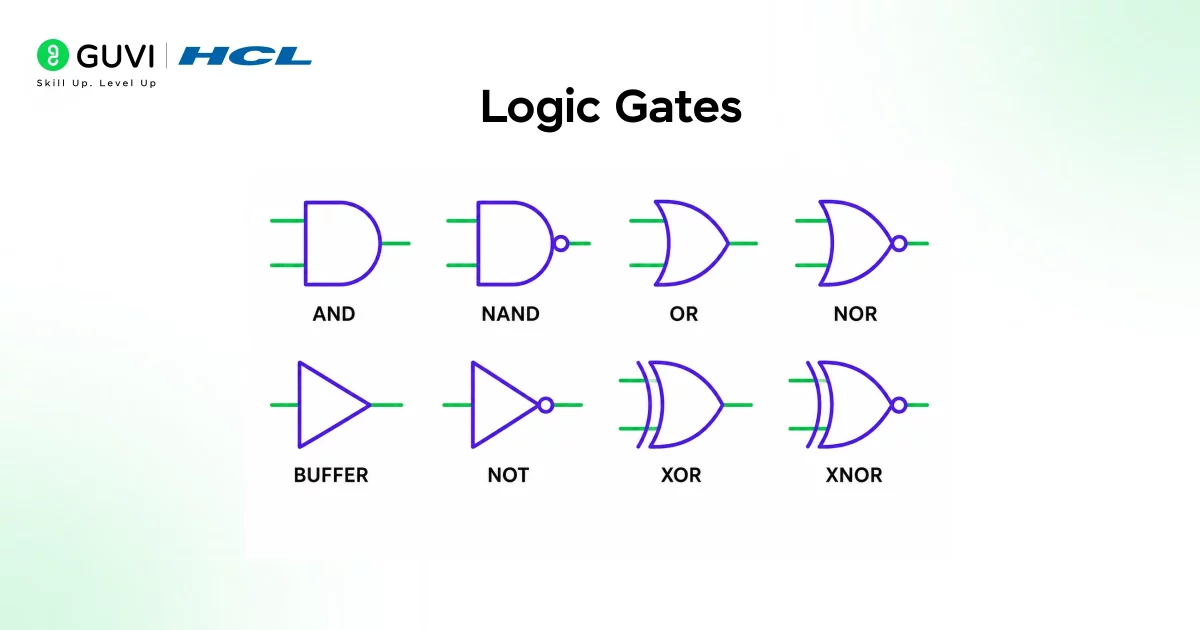
1. AND Gate
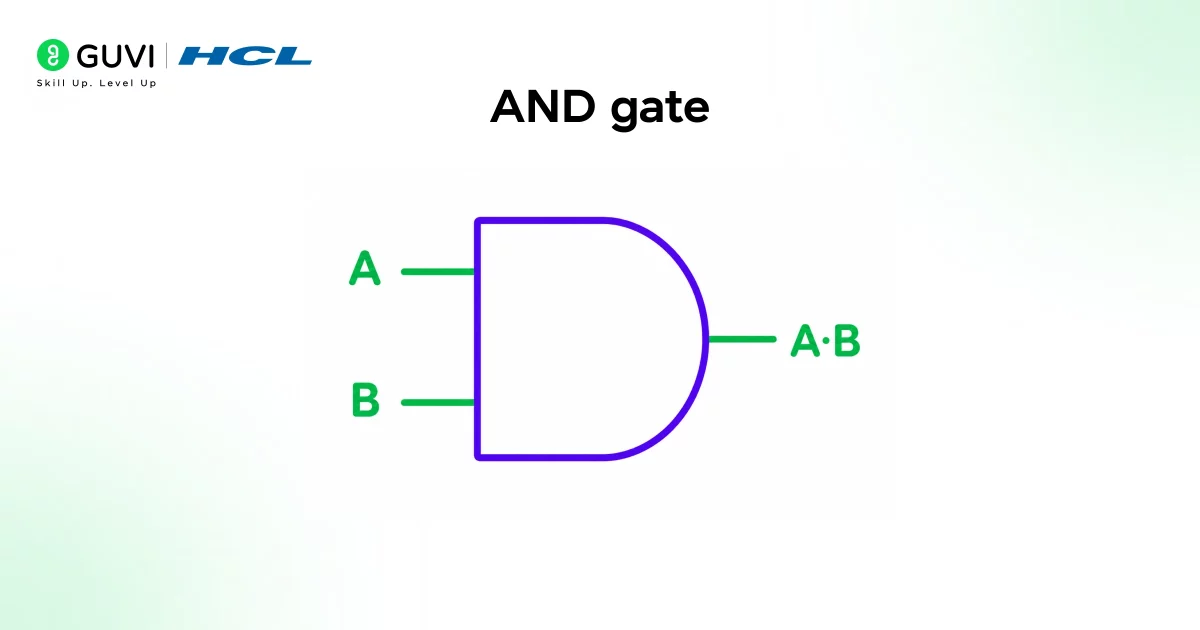
The AND gate gives an output of 1 only when ALL inputs are 1. If even one input is 0, the output is 0.
Think of it like two switches connected in series. Both switches must be ON for the light to turn on.
Truth Table:
| A | B | Output |
| 0 | 0 | 0 |
| 0 | 1 | 0 |
| 1 | 0 | 0 |
| 1 | 1 | 1 |
Real-life example: A bank vault that requires both a fingerprint AND a PIN to open. Both conditions must be true.
2. OR Gate
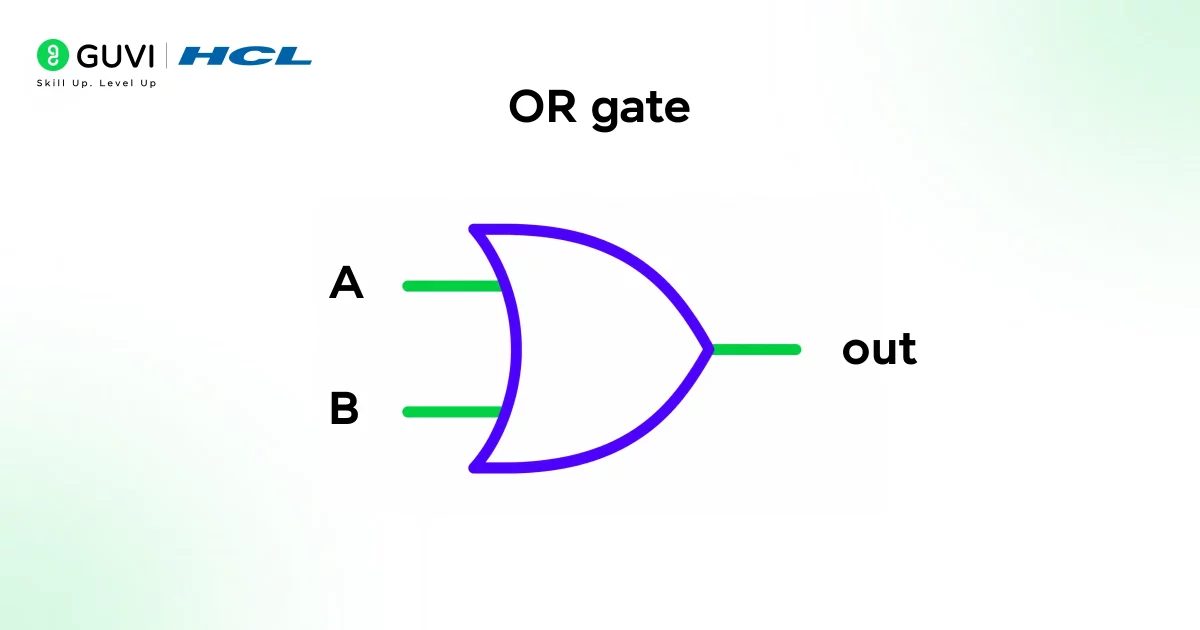
The OR gate gives an output of 1 when ANY input is 1. The output is only 0 when all inputs are 0.
Think of it like two switches connected in parallel. Either switch being ON will turn on the light.
Truth Table:
| A | B | Output |
| 0 | 0 | 0 |
| 0 | 1 | 1 |
| 1 | 0 | 1 |
| 1 | 1 | 1 |
Real-life example: A home alarm system that triggers if any sensor (door OR window) detects movement.
3. NOT Gate
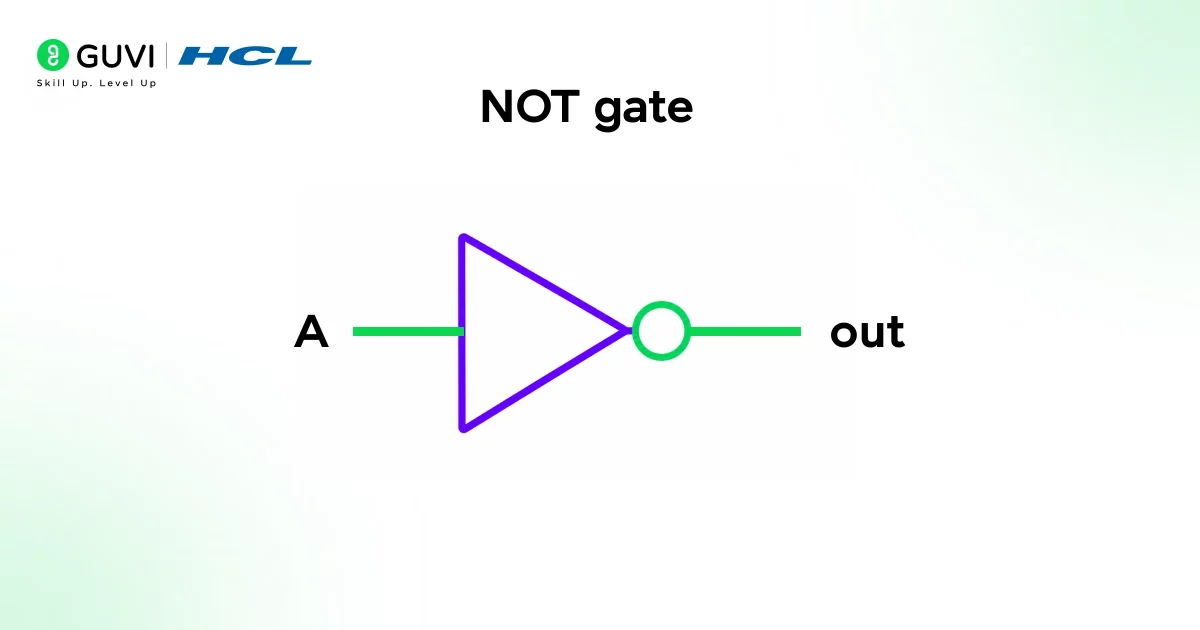
The NOT gate has only one input and one output. It simply flips the input. If you give it a 1, it outputs 0. If you give it a 0, it outputs 1.
It is also called an inverter because it inverts the signal.
Truth Table:
| A | Output |
| 0 | 1 |
| 1 | 0 |
Real-life example: A night light that turns ON when it is dark (light sensor reads 0) and turns OFF when it is bright (sensor reads 1).
4. NAND Gate
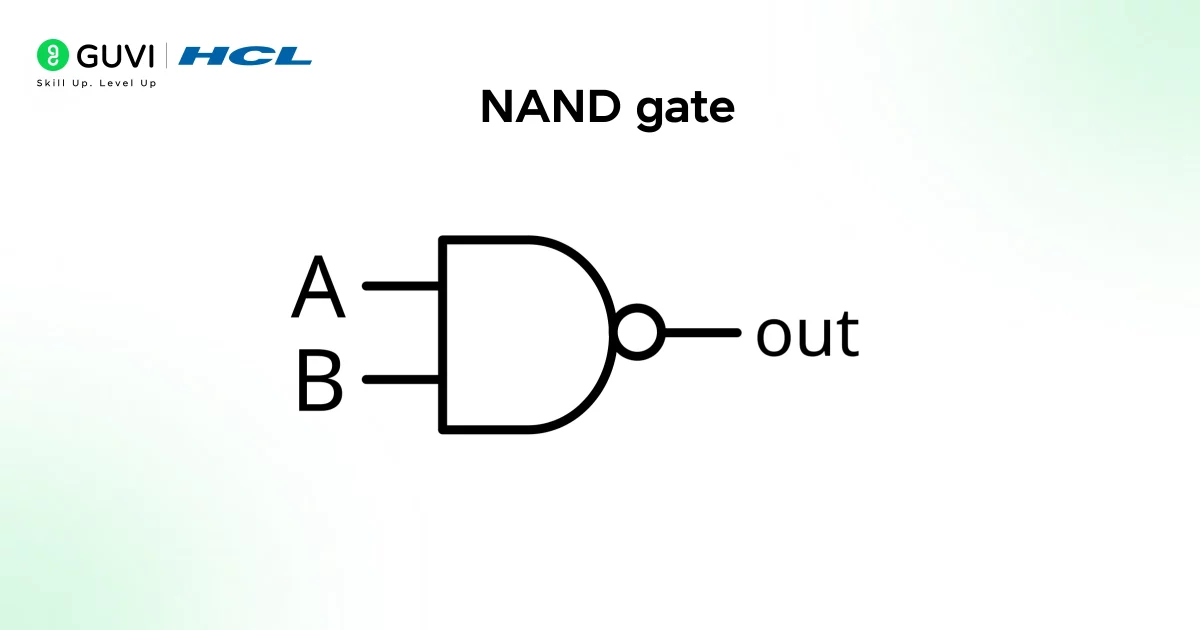
NAND stands for NOT AND. It is simply an AND gate with its output flipped. The output is 0 only when ALL inputs are 1. In every other case, the output is 1.
NAND is called a Universal Gate because you can build any other logic gate using only NAND gates.
Truth Table:
| A | B | Output |
| 0 | 0 | 1 |
| 0 | 1 | 1 |
| 1 | 0 | 1 |
| 1 | 1 | 0 |
Real-life example: A safety system that keeps a machine running UNLESS both the emergency stop button AND the overload sensor are triggered at the same time.
5. NOR Gate
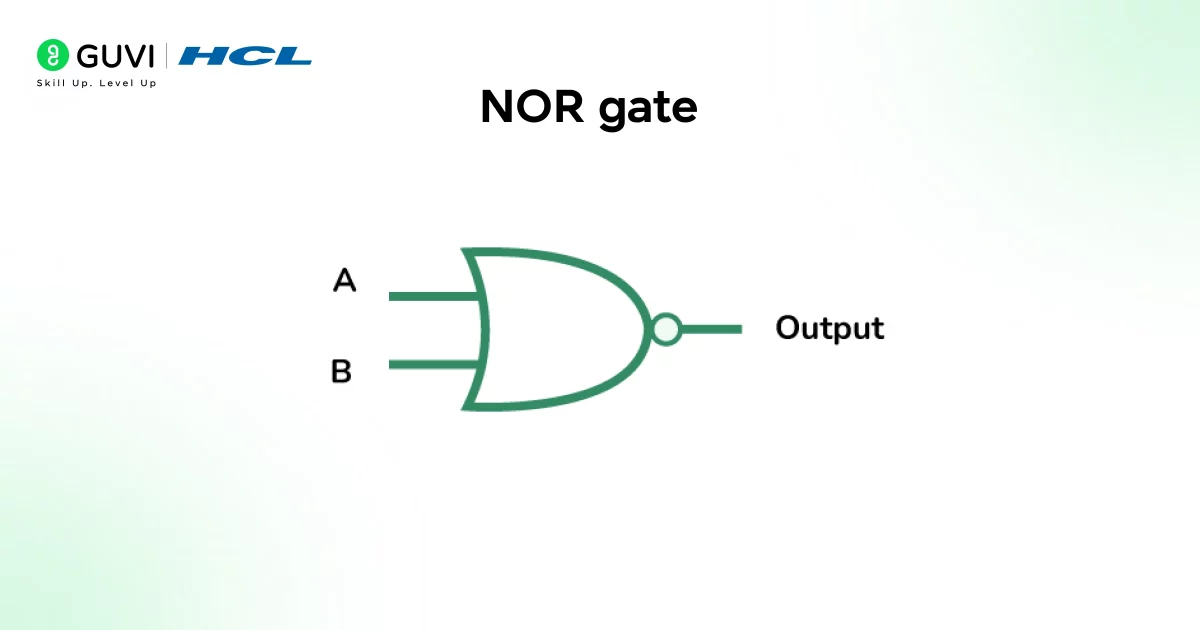
NOR stands for NOT OR. It is an OR gate with its output flipped. The output is 1 only when ALL inputs are 0. If any input is 1, the output becomes 0.
NOR is also a Universal Gate, just like NAND.
Truth Table:
| A | B | Output |
| 0 | 0 | 1 |
| 0 | 1 | 0 |
| 1 | 0 | 0 |
| 1 | 1 | 0 |
Real-life example: A system that sends an alert only when all sensors are inactive (none are reporting a problem).
6. XOR Gate
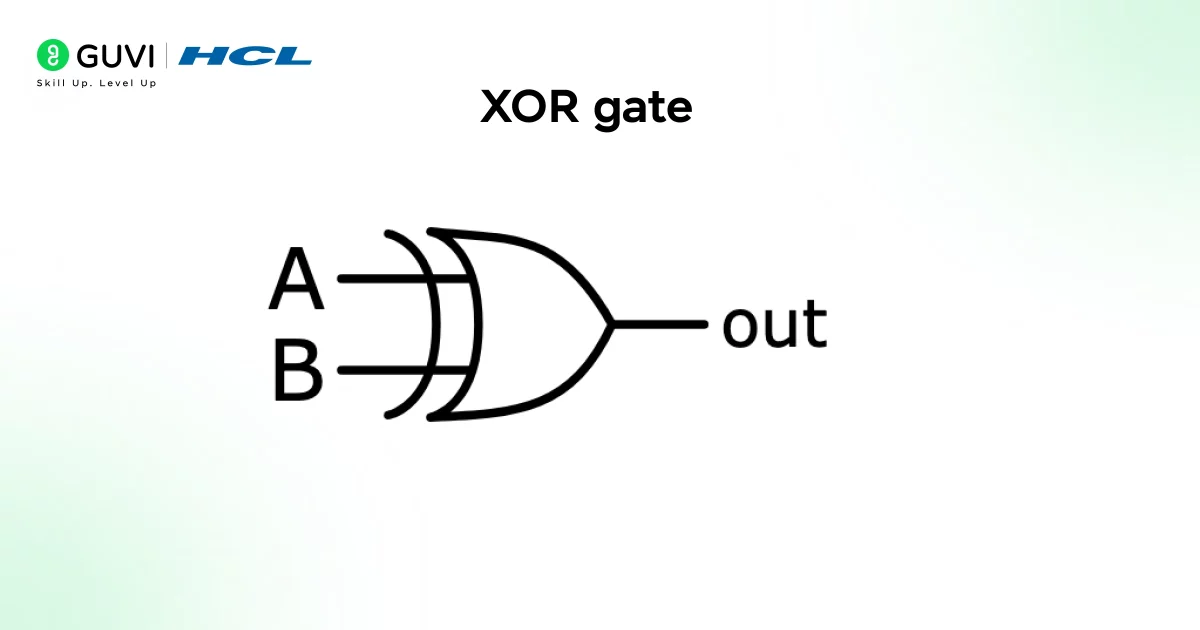
XOR stands for Exclusive OR. The output is 1 only when the two inputs are DIFFERENT. If both inputs are the same (both 0 or both 1), the output is 0.
Truth Table:
| A | B | Output |
| 0 | 0 | 0 |
| 0 | 1 | 1 |
| 1 | 0 | 1 |
| 1 | 1 | 0 |
Real-life example: XOR gates are used in binary addition circuits (called half adders) inside calculators and processors.
7. XNOR Gate
XNOR stands for Exclusive NOR. It is the opposite of XOR. The output is 1 only when both inputs are the SAME. If the inputs are different, the output is 0.
Truth Table:
| A | B | Output |
| 0 | 0 | 1 |
| 0 | 1 | 0 |
| 1 | 0 | 0 |
| 1 | 1 | 1 |
Real-life example: XNOR gates are used in error detection circuits to check whether two data signals match.
All 7 Logic Gates at a Glance
| Gate | Inputs | Output is 1 When | Universal Gate |
| AND | 2 or more | All inputs are 1 | No |
| OR | 2 or more | At least one input is 1 | No |
| NOT | 1 | Input is 0 | No |
| NAND | 2 or more | Not all inputs are 1 | Yes |
| NOR | 2 or more | All inputs are 0 | Yes |
| XOR | 2 | Inputs are different | No |
| XNOR | 2 | Inputs are the same | No |
What Are Universal Gates
NAND and NOR are called universal gates because you can build any other logic gate using only NAND gates or only NOR gates. This is extremely useful in chip manufacturing.

Why does this matter?
- Chip manufacturers can produce just one type of gate (NAND or NOR) and use it to build every other logic function
- This reduces manufacturing complexity and cost
- Most modern ICs are built primarily using NAND gate structures
Where Are Logic Gates Used
Logic gates are everywhere in digital technology. Here are the most common places you will find them:
- Computers and processors: Arithmetic operations, data comparisons, and instruction execution all rely on combinations of logic gates
- Smartphones: Every app you run depends on billions of logic gates executing decisions at high speed
- Calculators: Addition, subtraction, multiplication, and division are all done using logic gate circuits
- Memory chips (RAM and ROM): Store and retrieve binary data using gates
- Digital clocks: Keep time by counting binary pulses through gate circuits
- Industrial automation: Logic gates control machines, sensors, and safety systems in factories
- Communication systems: Encoding, decoding, and error detection in data transmission
Tips for Beginners Learning Logic Gates
- Start with AND, OR, and NOT. These three are the foundation. Every other gate is built from combinations of these three.
- Draw truth tables by hand. Writing out inputs and outputs yourself helps you remember how each gate works far better than just reading about it.
- Use real-life analogies. Think of AND as “both conditions must be met” and OR as “at least one condition must be met.” These mental shortcuts help a lot.
- Remember the universal gates. NAND and NOR can replace every other gate. This concept appears in exams and real circuit design often.
- Practice with circuit simulators. Free tools like Logisim and CircuitVerse let you drag and drop gates and test them with live inputs. Hands-on practice is the fastest way to learn.
💡 Did You Know?
- Modern processors like those in your laptop contain over 10 billion logic gates on a chip smaller than your thumbnail.
- The first logic gates were built using vacuum tubes in the 1940s before transistors replaced them and made chips possible.
- XOR gates are the backbone of binary addition, which means every calculator ever made depends on them to do basic math.
Conclusion
Logic gates look simple on the surface, one or two inputs, one output, and a fixed rule. But everything in the digital world is built from these tiny decisions stacked together in layers. A computer is essentially billions of logic gates asking “is this 0 or 1?” millions of times per second.
Once you understand how each of the 7 gates works and can read a truth table confidently, you are ready to move into the next level of digital electronics including combinational circuits, flip flops, registers, and eventually processor design. Start with the three basic gates (AND, OR, NOT), build your way up to NAND and NOR, and practice reading and writing truth tables until they feel second nature.
Logic gates are the alphabet of digital electronics. Once you know them, you can read and write any digital circuit.
FAQs
1. What are logic gates in simple words?
A logic gate is a basic electronic circuit that takes binary inputs (0 or 1) and gives one output based on a fixed rule. They are the building blocks of all digital devices like computers, phones, and calculators.
2. How many types of logic gates are there?
There are 7 basic types of logic gates: AND, OR, NOT, NAND, NOR, XOR, and XNOR. Each one follows a different logical rule to produce its output.
3. What is a truth table and why is it important?
A truth table is a chart that shows every possible input combination and the corresponding output for a logic gate. It is the standard way to describe and understand how a gate behaves.
4. Why are NAND and NOR called universal gates?
NAND and NOR are called universal gates because you can build any other logic gate (AND, OR, NOT, XOR, etc.) using only NAND gates or only NOR gates. This makes them very useful in chip design and manufacturing.
5. Where are logic gates used in real life?
Logic gates are used in computers, smartphones, calculators, digital clocks, memory chips, industrial control systems, and communication devices. Essentially any electronic device that processes digital data uses logic gates.
Success Stories

About the Author
Jebasta
I translate the language of data into stories that anyone can understand. As a writer with a data science background, I simplify analytics, AI, and decision-making so beginners and enthusiasts can confidently explore the world of data.
View all posts by Jebasta
Connect with me @
















Did you enjoy this article?