


Career Articles
Accountant vs Data Analyst Salary in India After Switching Careers - Best Guide
Finance Managers: Could Data Science Be Your Next Career Move?
Insurance Claims Executive to Data Analyst: Is It a Good Switch?
Banking Executive (Loans, KYC) to Data Analyst: Skills and Career Path


Get In Touch For Details! Request More Information
How to Address a Career Gap in Resume and Interview (India 2026 Guide)
Sep 01, 2026 6 Min Read 3495 Views
(Last Updated)
The best way to address a career gap is to keep the explanation short, honest, and focused on what came next. Three things help most: mention the reason in a line or two without over-explaining, connect the gap to something useful you did during that time, and shift the focus quickly to your current skills and readiness for the role.
Now, we’ll walk through how to handle the gap on your resume, the exact phrases to use in an interview, common mistakes to stay away from, and a few extra tips for women returning to work in India.
Table of contents
- TL;DR Summary
- What Counts as a Career Gap? (Common Reasons in 2026)
- Career Gap in Your Resume — Should You Mention It or Hide It?
- How to Format a Career Gap on Your Resume — With Examples
- Add it directly in your work timeline
- Use a short line under your resume summary
- List what you did during the gap as its own entry
- Use months, not just years, when the gap is short
- How to Address a Career Gap in an Interview — Exact Phrases to Use
- If you took a break for health reasons
- If it was due to a layoff
- If it was for family or caregiving reasons
- If it was for upskilling or a course
- If you simply needed a break
- Career Gap Reason, How to Frame It, and What NOT to Say
- Common Mistakes to Avoid While Explaining a Career Gap
- Career Gap Tips for Women Returning to Work in India
- Conclusion
- FAQs
- How do I address a career gap in my resume?
- What is the best way to address a career gap in an interview?
- Do I need to address a career gap if it was less than 6 months?
- How do I address a career gap caused by a layoff?
- Is it necessary to address a career gap for women returning to work in India?
- What should I avoid when I address a career gap?
TL;DR Summary
- The best way to address a career gap is to keep it short, honest, and focused on what you did next — not over-explain or apologise for it.
- Mention gaps over 6 months on your resume using a simple one-line entry; shorter gaps usually don’t need explaining.
- In interviews, use brief, factual phrases that end with your current skills and readiness, not the details of the break.
- Common gap reasons — layoffs, health, caregiving, upskilling, competitive exam prep, or burnout — all have a straightforward way to be framed.
- Women returning to work in India can use returnship programs and their existing network to make the comeback faster and smoother.
What Counts as a Career Gap? (Common Reasons in 2026)
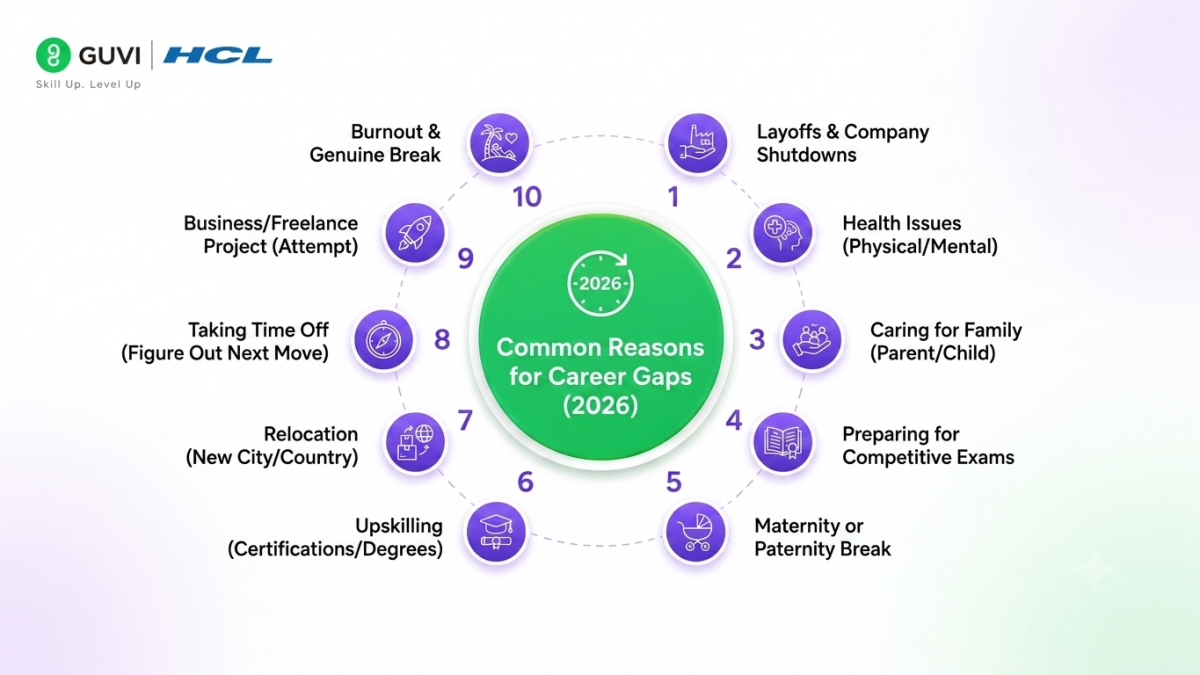
Not every break in your work history needs an explanation — but it helps to know what actually counts as a “gap” in a recruiter’s eyes. Generally, anything longer than 2-3 months without formal employment falls into this category. And honestly, the reasons behind it are more common than most people think.
Here are some of the most common ones in 2026:
- Layoffs or company shutdowns
- Health issues — physical or mental
- Caring for a parent, child, or family member
- Preparing for a competitive exam (UPSC, CAT, banking exams, etc.)
- Maternity or paternity break
- Upskilling — certifications, courses, or a degree
- Relocation to a new city or country
- Taking time off to figure out the next career move
- Starting a business or freelance project that didn’t work out
- Burnout and needing a genuine break
Also Read: How to Restart Your Professional Journey After a Career Gap in 2026
Ready to restart your career? HCL GUVI’s ZEN Class Programmes — from Data Science & Gen AI to Software & AI Engineering — help you become job-ready with flexible weekday and weekend batches. Whether you’re bridging a career gap or switching fields, explore our top courses and take the first step forward today. Explore top-rated courses and take the first step toward your comeback!
Career Gap in Your Resume — Should You Mention It or Hide It?
This is the question almost everyone gets stuck on — and honestly, there’s no one-size-fits-all answer. It depends on how long the gap is, why it happened, and how comfortable you are talking about it.
Here’s a simple way to decide:
1. Gap under 6 months — you usually don’t need to mention it. Just listing years (without exact months) works fine, and you can explain it in the interview if it comes up.
2. Gap over 6 months to a year — it’s better to add a short line. A blank space tends to raise more questions than a one-line explanation.
3. Gap over a year — address it clearly on the resume itself, so it doesn’t look like something you’re avoiding.
Also, a lot of this depends on the role you’re applying for. A stricter, more traditional company might expect a cleaner explanation upfront, while a startup or a smaller team may not even ask about it directly.
There’s no perfect formula here — just pick whichever feels less stressful for you to defend later. That’s usually the right way to address a career gap on your resume.
Also Read: Career Change at 25: Is It Too Late? A Realistic Guide
How to Format a Career Gap on Your Resume — With Examples
Once you’ve decided to mention your gap, the next question is where and how it should actually appear on the page. There are a few simple formats that work well, and picking the right one is really just another way to address a career gap without making it feel like the main headline of your resume.
1. Add it directly in your work timeline
The most straightforward way is to treat the gap like any other entry in your experience section — just with a short label instead of a job title.
Example:
Career Break — Family Health Reasons (March 2024 – July 2025)
This works well because it sits naturally between your past and current roles, and doesn’t need any extra explanation on the page itself.
2. Use a short line under your resume summary
If you don’t want a separate entry, you can slip a line into your summary at the top of the resume. This is a quieter way to address a career gap without drawing too much attention to it.
Example: “Marketing professional with 5+ years of experience, including a recent career break for higher studies, now looking to return to a full-time analytics role.”
3. List what you did during the gap as its own entry
If you used the time productively — a course, freelance work, volunteering — treat it like a mini work entry instead of leaving it blank.
Example:
Self-Study & Certification — Google Data Analytics (January 2025 – June 2025 )
Completed certification while preparing to re-enter the workforce
4. Use months, not just years, when the gap is short
Sometimes the simplest fix is just being specific. Writing “Jan 2023 – Aug 2023” instead of just “2023” avoids making a 6-month gap look bigger than it is, so recruiters don’t have to guess.
None of these formats is the “correct” one — it really depends on your situation. But picking one and sticking with it is a much better way to address a career gap than leaving a resume that looks incomplete or rushed.
How to Address a Career Gap in an Interview — Exact Phrases to Use
This is usually the part people dread the most — saying it out loud, in real time, to someone who’s evaluating you.
But once you have a couple of lines ready, it stops feeling like a big moment and just becomes another answer in the conversation. The key to address a career gap well in an interview is keeping it short, factual, and quickly moving into what you’re bringing now.
Here’s how you can frame it depending on your situation:
If you took a break for health reasons
“I took some time off in 2024 to focus on my health, which needed my full attention at the time. I’m in a good place now and ready to get back to full-time work.”
If it was due to a layoff
“My previous company had layoffs in early 2024, and my role was affected. I used the time to sharpen my skills and explore the right next opportunity, which is what brought me here.”
If it was for family or caregiving reasons
“I took a break to care for a family member who needed support during that time. Things are settled now, and I’m fully ready to commit to a full-time role again.”

If it was for upskilling or a course
“I stepped away from work for a few months to complete a certification in data analytics, since I wanted to move into a more analytical role. I’ve now applied that learning in a few freelance projects and I’m ready to bring it into a full-time position.”
If you simply needed a break
“After a few intense years at work, I took some time off to recharge. It helped me get clarity on what I want next, which is why I’m excited about this role.”
There’s no single “correct” way to address a career gap — the phrasing just needs to match what actually happened. What matters more is the tone: matter-of-fact, not apologetic, and always ending on what you’re ready to do now, not what you left behind.
Career Gap Reason, How to Frame It, and What NOT to Say
Here’s a quick reference to help you frame the most common gap reasons the right way, without saying something that unintentionally raises a red flag.
| Gap Reason | How to Frame It | What NOT to Say |
|---|---|---|
| Layoff / Company Shutdown | “My role was impacted by company-wide layoffs, and I used the time to upskill and find the right fit.” | “I got fired and it’s been hard to find something since.” |
| Health Issues | “I took time off to focus on my health, and I’m in a good place now to return full-time.” | “I was dealing with a lot of personal health problems, it was a tough phase.” |
| Caring for Family | “I took a break to support a family member during a difficult time, which is now resolved.” | “My family situation was overwhelming and I couldn’t focus on work at all.” |
| Maternity / Paternity Break | “I took time off after my child was born and I’m ready to return to full-time work now.” | “It’s been hard managing a baby and I’m still figuring things out.” |
| Upskilling / Certification | “I stepped away to complete a certification in [field] to move into a more relevant role.” | “I just wanted to try studying something for a while.” |
| Preparing for a Competitive Exam | “I spent this time preparing for competitive exams, and I’ve since decided to focus on building a career in this field.” | “I was trying for a government job but it didn’t work out, so now I’m back to this.” |
| Burnout / Needed a Break | “I took some time off to recharge after a demanding stretch, and I’m returning with a lot more clarity and focus.” | “I was just burnt out and exhausted, I needed to escape work completely.” |
Common Mistakes to Avoid While Explaining a Career Gap
There are a few slip-ups that tend to happen more often than they should, so here’s what to watch out for:
- Over-explaining — Giving too many personal details when a line or two would’ve done the job. It ends up drawing more attention to the gap than needed.
- Sounding apologetic — Talking about the gap like it was something to be ashamed of. It wasn’t a mistake, so there’s no need to sound like it was.
- Being vague or dodging the question — This usually backfires, since recruiters tend to assume the worst when they don’t get a clear answer.
- Badmouthing a previous employer — Even if the layoff or exit wasn’t handled well, bringing that up in the explanation reflects more on you than on them.
- Forgetting to connect the gap to today — Leaving out what you’re bringing to the table now, which is really the part that matters most to the interviewer.
Career Gap Tips for Women Returning to Work in India
For women stepping back into the workforce, here are a few things worth keeping in mind:
- Look into returnship programs — Many Indian companies like Tata, Accenture, and JPMorgan now run these specifically for women restarting their careers, often with training built in.
- Don’t undersell your break — Managing a household or raising a child also builds skills like multitasking and time management, and it’s completely fine to say so.
- Start with your network first — Reconnecting with old colleagues or managers often works faster than cold applying to job listings.
- Brush up on tools and trends — A couple of years off can mean a lot has changed in your field, so a quick refresher before interviews helps.
- Be upfront but brief — When you address a career gap in interviews, keep it short and confident. Indian recruiters are far more used to this now than they were even five years ago.
Conclusion
A career gap doesn’t need to be a source of stress once you know how to talk about it. Whether it’s on your resume or in an interview, the goal is the same — keep it short, stay honest, and shift focus to what you’re ready for now. Learning how to address a career gap the right way can turn what feels like a weak point into just another normal part of your career story.
FAQs
1. How do I address a career gap in my resume?
Keep it to a short one-line entry if the gap is over 6 months — mention the reason briefly without going into detail.
2. What is the best way to address a career gap in an interview?
State the reason in one or two lines, then quickly shift focus to your current skills and readiness for the role.
3. Do I need to address a career gap if it was less than 6 months?
Not usually. Short gaps can simply be listed by year and rarely need a separate explanation.
4. How do I address a career gap caused by a layoff?
Mention that your role was affected by layoffs, and briefly note what you did with the time, like upskilling or job searching.
5. Is it necessary to address a career gap for women returning to work in India?
Yes, briefly. A short, confident explanation works better than leaving it unaddressed, and many recruiters today are used to this.
6. What should I avoid when I address a career gap?
Avoid over-explaining, sounding apologetic, or badmouthing a previous employer — keep it factual and brief.
Success Stories
















Did you enjoy this article?