


Artificial Intelligence and Machine Learning Articles
Finance Manager to Data Analytics: Career Growth, Salary and Seniority
How to Evaluate LLM Outputs in Production Deployments
AI/ML Skills Gap 2026: Why Companies Can't Find Job-Ready Talent
20 AI/ML Interview Questions Recruiters Can Use Without a Tech Background - Best Guide


Get In Touch For Details! Request More Information
How Natural Language Generation Works in AI
Aug 19, 2026 5 Min Read 698 Views
(Last Updated)
The next time you see an AI chatbot answer a question, a smart assistant summarize a meeting, or a coding copilot write the next line of code for you, it’s all Natural Language Generation at work.
Today’s AI isn’t only about understanding the words that humans speak. Now it also works on writing emails, reports, conversations, summaries, explanations, and even fiction in an increasingly human-like way. Because of this, Natural Language Generation, or NLG, has become one of the most important technologies in AI today.
This article explains how Natural Language Generation works in AI, how language models generate human-like text, why NLG became important in modern AI systems, and where this technology is heading next.
Table of contents
- TL;DR
- Why Natural Language Generation Matters
- Understanding NLG, NLP, and NLU
- NLP(Natural Language Processing)
- NLU(Natural Language Understanding)
- NLG(Natural Language Generation)
- How AI Generates Human-Like Text
- The Role of Language Models in NLG
- How Transformers Revolutionized AI Text Generation
- Real-World Applications of Natural Language Generation
- AI Chatbots
- AI Meeting Summaries
- Healthcare Documentation
- AI Coding Assistants
- E-commerce Recommendations
- Voice Assistants
- NLG vs Traditional Automated Writing
- Challenges and Risks of AI Text Generation
- Hallucinations
- Bias in Outputs
- Misinformation Risks
- Overautomation
- Tone Manipulation
- Agentic AI and the Future of NLG
- Practical Python Example of AI Text Generation
- Why Natural Language Generation Still Matters
- Conclusion
- FAQs
- What is Natural Language Generation in AI?
- What is the difference between NLP and NLG?
- How do AI systems generate text?
- What are the applications of Natural Language Generation?
- What are the risks of AI-generated content?
- Why are transformers important in NLG?
TL;DR
- Natural Language Generation(NLG) enables AI to generate human-like text and communicate like humans.
- The technology behind AI copilots, chatbots, virtual assistants, automated reports, and content generation tools is modern NLG.
- LLMs and transformer architectures have greatly improved AI text generation quality.
- The process behind NLG is token prediction based on probability and language modeling.
What is Natural Language Generation in AI?
Natural Language Generation (NLG) in AI is the process through which artificial intelligence systems create human-like text from structured data, prompts, or contextual information. It is a branch of Natural Language Processing (NLP) that enables machines to generate meaningful sentences, summaries, responses, and narratives automatically. NLG is widely used in AI chatbots, virtual assistants, language models, automated reporting systems, and content generation applications.
Why Natural Language Generation Matters
Older AI systems focused mostly on commands or finding language patterns. Today’s AI can do much more than that. Now, AI systems generate explanations, responses, and summaries that feel natural to users.
This has changed how humans communicate with technology. Instead of using complex menus and commands, users can now interact with AI in natural language.
Because humans generate massive amounts of data every day, NLG helps systems summarize, process, and communicate information efficiently.
Today, AI communication appears almost everywhere, including:
- Customer support chatbots answer queries in real-time.
- AI systems that summarize meetings and highlight key details.
- E-commerce AI recommending products to users.
- Healthcare AI is generating doctors’ notes.
- Coding assistants suggest code for developers.
These are some of the reasons why NLG is becoming a central part of modern AI communication.
Understanding NLG, NLP, and NLU
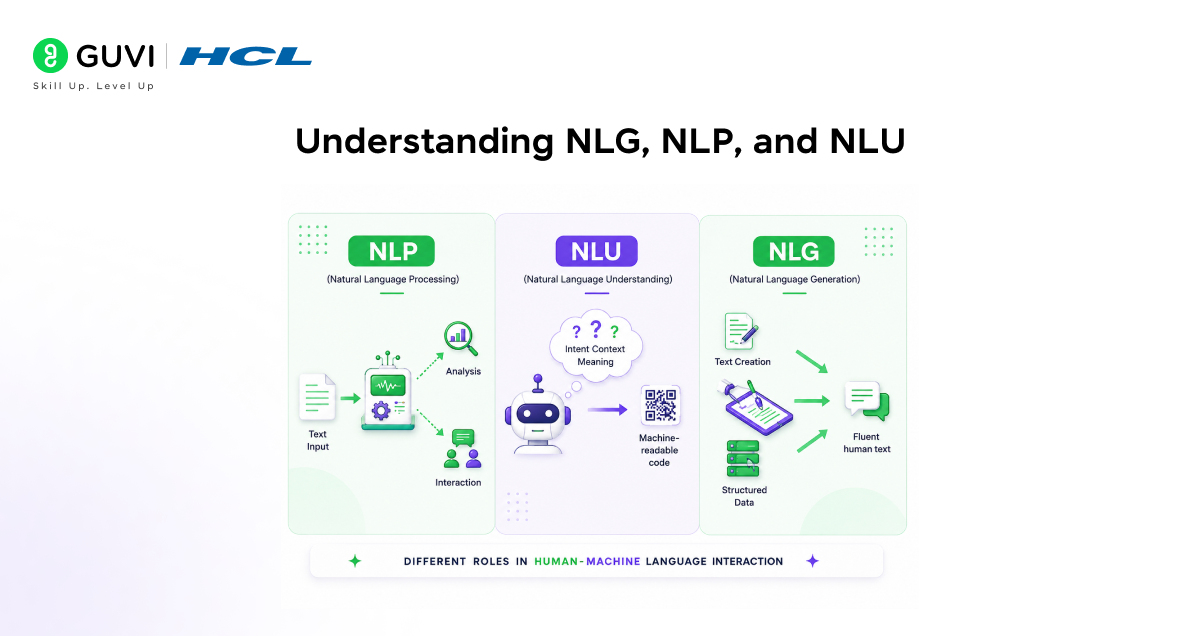
The reason behind the confusion between NLG and NLU is that both are quite complex and interconnected processes. They operate differently within AI systems:
1. NLP(Natural Language Processing)
NLP is the broader discipline responsible for enabling machines to understand human language and speech. The techniques within this include;
- understanding of language
- sentiment analysis
- translation of language
- speech recognition
- generating text
2. NLU(Natural Language Understanding)
The primary role of NLU is to enable AI systems to understand meaning, context, and intent. Examples are:
- identifying human emotion from text
- understanding the user’s aim or intent
- identifying entities and topics within text
3. NLG(Natural Language Generation)
The role of NLG is to enable machines to generate human-like output based on the data they are fed. Examples are:
- producing a generated email
- generating a conversational output from a chatbot
- producing automatic summaries of documents
- explaining a recommendation
- AI writer assisting users with writing tasks.
Here is a simple breakdown of the differences: NLP enables AI to understand language, NLU helps AI to know the meaning behind the words spoken, and NLG enables the AI to communicate back.
How AI Generates Human-Like Text
While AI appears to be intelligent, human-like text generation relies on probability prediction. By analyzing large volumes of language data, modern language models learn word patterns, sentence structure, word relationships, and the probability of individual words.
When a prompt is entered into a system, the language model calculates the most probable subsequent token of language and repeats the process to build out a full response. This allows it to;
- Predict the next word to appear in a sentence
- maintain coherent and conversational flows
- dynamically alter the writing tone
- generate summaries or explanations for complex concepts
Because LLMs simply work with probability data, they do not think in human terms; they learn language from the large bodies of data they analyze, leading to natural-sounding outputs but potential factual inaccuracies.
To improve prompt quality and generate better AI responses, explore Best Practices for Writing Better AI Prompts
The Role of Language Models in NLG
Language models are the foundation of modern NLG. These models learn word relationships and language patterns by analyzing large amounts of text, which then enables them to produce natural-sounding responses, not just arbitrary sequences of words.
Early systems for Natural Language Generation depended heavily on:
- templates with preset wordings
- preprogrammed rules for grammar
- repeated phraseology
Modern AI language models can:
- communicate in an interactive conversational style
- summarize large chunks of text
- answer user questions with context
- write in numerous languages
- change writing style dynamically
How Transformers Revolutionized AI Text Generation
Some of the biggest advances in Natural Language Generation came from transformer architectures. The limitations of previously established architectures included:
- Poor context memory and understanding over time
- Difficulty with processing information sequentially
- slow training times
Transformer-based models overcome these obstacles by using attention mechanisms, enabling AI models to better understand word relationships within sentences. This improved;
- context understanding
- quality of generated responses
- multilingual capabilities
- generation of long-form text
- coherent conversation flow
Current leading LLMs, such as Gemini, Claude, ChatGPT, and AI coding assistants, utilize transformer architectures as the backbone of their abilities. This transition marks a significant leap for NLG, transitioning from a basic system that generated content to the dynamic and contextual form of AI communication we see today.
Readers interested in understanding how transformer architectures power modern language models can also explore What Are NLP Transformers?.
Real-World Applications of Natural Language Generation
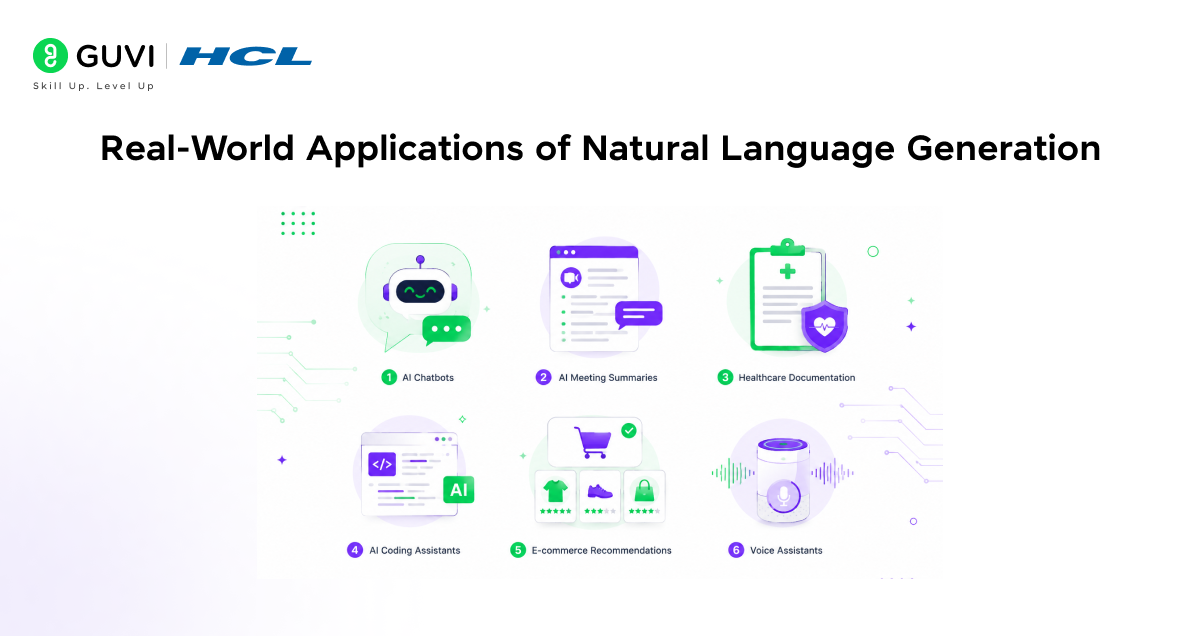
Natural Language Generation is now widely implemented across various industries and digital platforms:
1. AI Chatbots
AI-driven chatbots are deployed to assist customers with their inquiries and solve issues in real time.
2. AI Meeting Summaries
Workplace applications now automatically generate meeting summaries along with identified action items.
3. Healthcare Documentation
AI systems that generate clinical notes, summaries of patients’ medical history, and other administrative documents are used to ease the workload in healthcare.
4. AI Coding Assistants
These assistants assist developers by generating code snippets, explanations, and even suggestions to fix coding errors.

5. E-commerce Recommendations
The technology helps generate customized product recommendations along with explanations for shoppers.
6. Voice Assistants
This application is powered by both speech recognition and NLG, enabling natural voice interactions with AI.
These examples show that NLG has evolved beyond simple content generation and has become an integral communication layer within many AI systems. For an introduction on how systems handle context, users may also want to read about Introduction to NLP and Language Models.
NLG vs Traditional Automated Writing
Traditional automated writing systems existed long before modern AI.
Older systems usually relied on:
- rigid templates
- fixed sentence patterns
- rule-based generation
- repetitive outputs
This made the generated content predictable and limited.
Modern NLG systems are far more dynamic because they generate language contextually instead of simply filling templates.
For example, older systems might generate:
“Sales increased by 10% this quarter.”
Modern NLG systems can:
- explain trends
- summarize insights
- adapt tone
- answer follow-up questions
- personalize responses
This is one reason why AI communication tools feel significantly more human today compared to earlier automated writing software.
Challenges and Risks of AI Text Generation
Despite major advancements, Natural Language Generation still faces several important challenges.
1. Hallucinations
AI systems can confidently generate incorrect information even when the output sounds convincing.
2. Bias in Outputs
Language models may inherit biases from training data, which can influence generated responses.
3. Misinformation Risks
AI-generated content can spread inaccurate or misleading information at scale.
4. Overautomation
Excessive dependence on AI-generated communication may reduce human review and critical thinking.
5. Tone Manipulation
Some AI systems can imitate persuasive or emotional language patterns in ways that raise ethical concerns.
These limitations are important because modern NLG systems increasingly influence communication, decision-making, and information flow.
Agentic AI and the Future of NLG
Natural Language Generation is evolving beyond simple text generation.
Modern AI agents can now:
- communicate autonomously
- execute workflows
- summarize information
- interact with software tools
- generate contextual decisions
This shift is often referred to as Agentic AI.
In these systems, NLG acts as the communication layer that allows AI agents to explain actions, interact with users, and coordinate tasks dynamically.
This is a major reason why NLG is becoming more important in enterprise AI systems, automation platforms, and AI copilots.
New language generation systems are also becoming:
- multimodal
- multilingual
- context-aware
- voice-enabled
- memory-enhanced
This suggests that future AI communication systems may become significantly more adaptive and interactive than today’s chatbot interfaces.
Practical Python Example of AI Text Generation
A simple way to understand NLG is by generating text using a transformer pipeline in Python.
from transformers import pipeline
generator = pipeline(“text-generation”, model=”gpt2″)
response = generator(
“Artificial intelligence is transforming communication because”,
max_length=40
)
print(response[0][“generated_text”])
This example uses a pretrained transformer model to generate text based on a starting prompt.
Readers interested in building practical NLP and AI text generation systems can also explore Natural Language Processing Project Ideas to understand how NLG concepts are applied in real-world projects.
Also, to learn more about Generative AI and modern NLP workflows, explore this Generative AI eBook.
Modern large language models (LLMs) can generate text across hundreds of languages, tones, and writing styles using the same underlying neural network architecture. Instead of building separate systems for each language, these models learn shared statistical patterns from massive multilingual datasets, allowing them to generalize across grammar, vocabulary, and writing conventions. This is why a single LLM can switch between tasks such as translation, coding, storytelling, summarization, and conversational dialogue while adapting its style to different audiences and contexts.
Why Natural Language Generation Still Matters
Natural Language Generation continues to grow because modern AI systems increasingly depend on communication.
Whenever AI systems:
- explain results
- summarize information
- generate reports
- answer questions
- interact conversationally
New language generation systems inspired by transformer architectures are also improving rapidly in contextual understanding, reasoning, and multilingual communication.
If you want practical experience working with language models, NLP systems, and AI communication workflows, HCL GUVI’s AI and ML Course can help you build hands-on projects using modern frameworks such as TensorFlow and PyTorch.
Conclusion
Natural Language Generation transformed AI from systems that simply process language into systems that can actively communicate with humans. From chatbots and copilots to AI agents and automated summaries, NLG now powers many of the communication experiences people interact with daily.
As language models continue evolving, Natural Language Generation will likely become one of the most important building blocks behind future AI communication systems.
FAQs
1. What is Natural Language Generation in AI?
Natural Language Generation in AI is a branch of artificial intelligence that enables machines to generate human-readable text or communication from data, prompts, or contextual inputs.
2. What is the difference between NLP and NLG?
NLP is the broader field focused on processing human language, while NLG specifically focuses on generating human-like text and communication.
3. How do AI systems generate text?
Modern AI systems generate text using language models that predict the most probable next token or word based on context and training data.
4. What are the applications of Natural Language Generation?
NLG is used in chatbots, AI assistants, automated reports, healthcare documentation, recommendation systems, and AI coding assistants.
5. What are the risks of AI-generated content?
Some major risks include hallucinations, misinformation, biased outputs, and excessive dependence on automated communication systems.
6. Why are transformers important in NLG?
Transformers improved contextual understanding, long-form generation, and conversational quality, making modern AI text generation significantly more advanced.
Success Stories

About the Author
Vishalini Devarajan
An Aerospace Engineer turned content writer, I focus on making complex concepts easy to understand through well-structured, reader-friendly blogs. Whether it’s a technical topic or a non-technical one, I love creating content that is clear, engaging, and impactful.
View all posts by Vishalini Devarajan
Connect with me @












Did you enjoy this article?