


Artificial Intelligence and Machine Learning Articles
Finance Manager to Data Analytics: Career Growth, Salary and Seniority
How to Evaluate LLM Outputs in Production Deployments
AI/ML Skills Gap 2026: Why Companies Can't Find Job-Ready Talent
20 AI/ML Interview Questions Recruiters Can Use Without a Tech Background - Best Guide


Get In Touch For Details! Request More Information

Hill Climbing Algorithm: How AI Finds Better Solutions
Jul 15, 2026 7 Min Read 1796 Views
(Last Updated)
Imagine you are blindfolded on a hilly landscape. Your goal is to reach the highest peak. You cannot see the full terrain, and the only move you can make is to feel the ground around you and step in whichever direction goes up.
That is hill climbing in a nutshell. This straightforward idea powers optimization systems across artificial intelligence, from scheduling problems to neural network training to robotics path planning. The elegance is in the simplicity: always move toward better, and stop when nothing around you is better than where you are.
This guide unpacks what makes hill climbing one of the most interesting algorithms in all of AI, including the core tension between its simplicity and its well-known limitations.
Table of contents
- Quick TL;DR Summary
- Why Optimization Problems Need a Different Kind of Search
- How Hill Climbing Actually Works
- Role of Heuristics and Optimization in Hill Climbing Algorithms
- The Three Problems That Break Basic Hill Climbing
- What These Three Problems Mean in Practice
- Hill Climbing Variants That Fix the Core Problems: Step-by-Step
- Step 1: Simple Hill Climbing
- Step 2: Steepest Ascent Hill Climbing
- Step 3: Stochastic Hill Climbing
- Step 4: Random Restart Hill Climbing
- Step 5: Sideways Moves
- Step 6: Simulated Annealing
- Step 7: Combining Variants for Real Problems
- Common Mistakes When Implementing Hill Climbing
- Getting the Best Results From Hill Climbing
- Where Hill Climbing Is Used in Real AI Systems
- Conclusion
- FAQs
- Is hill climbing guaranteed to find the optimal solution?
- When should I use hill climbing over other search algorithms?
- How many random restarts should I use?
- What is the difference between hill climbing and gradient descent?
- Can hill climbing handle problems with multiple objectives?
Quick TL;DR Summary
- This guide explains what the hill climbing algorithm is and how it uses iterative improvement to solve optimization problems in AI.
- You will learn how hill climbing works step by step, why it is fast, and exactly where and why it fails on real problems.
- The guide covers the different variants of hill climbing and how each one addresses the weaknesses of the basic approach.
- Practical examples show you where hill climbing is used in real AI systems and why it remains relevant despite its limitations.
- You will finish with a clear, grounded understanding of one of the most foundational local search techniques in artificial intelligence.
What Is the Hill Climbing Algorithm?
Hill climbing is a local search and optimization algorithm that starts from an initial solution, evaluates neighboring states using a heuristic function, and moves to the best neighboring state until no further improvement is possible. It is one of the simplest and most computationally efficient approaches for solving optimization problems in artificial intelligence.
Why Optimization Problems Need a Different Kind of Search

- Not every problem has a clear path to trace
State space search algorithms like A* find paths from a start to a goal. But some problems do not have paths. They have configurations. The goal is not to reach a specific state by following a sequence of actions. It is to find the configuration that scores highest on some measure of quality. These are optimization problems and they need a different approach entirely.
- The search space is too large for exhaustive exploration
A scheduling problem with a hundred tasks and twenty time slots has an astronomical number of possible arrangements. Exploring all of them is not just slow. It is computationally impossible in any useful timeframe. You need an algorithm that finds good solutions without looking at everything.
- You often need good enough, not perfect
In many real applications, finding a provably optimal solution is less important than finding a very good solution quickly. Hill climbing trades optimality guarantees for speed and simplicity. In practice, the solutions it finds are often good enough to be genuinely useful even when they are not mathematically perfect.
- The landscape metaphor maps perfectly to optimization
Thinking of solutions as positions on a landscape where height represents quality is not just a metaphor. It is a precise mathematical description of how evaluation functions work. Hill climbing navigates this landscape systematically, always moving toward higher ground, which is exactly the right intuition for optimization.
Read More: Escaping the Trap: A Beginner’s Guide to Local Search Algorithms in AI
How Hill Climbing Actually Works
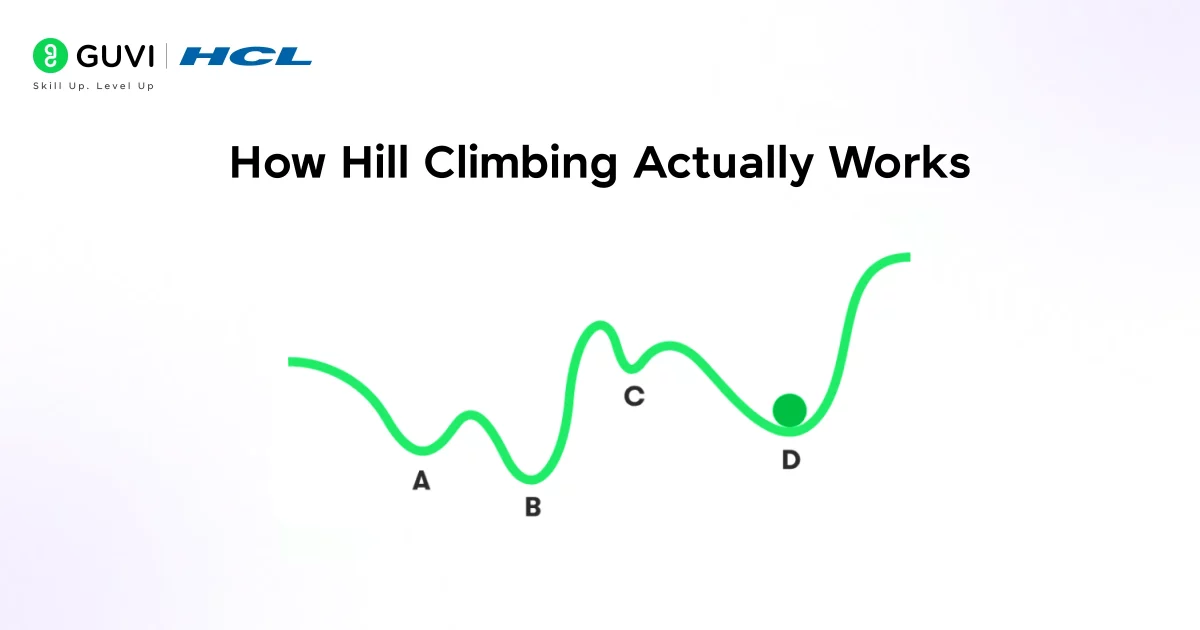
- The Starting Point
Every hill climbing run begins with an initial state. This could be a random configuration, a handcrafted starting point, or the output of another algorithm used as a warm start. The quality of this starting point matters more in hill climbing than in many other algorithms because the algorithm only ever moves to better neighbors. Where you start determines which part of the landscape you explore.
- The Evaluation Function
Every state gets a score from the evaluation function, the heuristic that measures how good a solution is. In a scheduling problem this might be the number of conflicts. In a neural network it might be a prediction error. In a traveling salesman problem it might be total route distance. The evaluation function is the algorithm’s only guide to what better means and its design is as important as the algorithm itself.
- The Neighbor Generation
From the current state, the algorithm generates a set of neighboring states, solutions that are one small change away from the current one. Swap two scheduled tasks. Adjust one neural network weight. Reverse a segment of the route. The definition of a neighbor determines the structure of the search and has a huge impact on which solutions the algorithm can find.
- The Move Decision
The algorithm evaluates all neighbors and decides which one to move to. In simple hill climbing, it moves to the first neighbor that is better than the current state. In steepest ascent hill climbing, it evaluates all neighbors and moves to the best one. This single design choice creates meaningfully different behavior in practice.
- The Termination Condition
The algorithm stops when no neighboring state is better than the current one. This is called a local maximum. The algorithm believes it has found the best solution because nothing immediately around it is better. Whether this is actually the global best solution or just a locally good one is the central question the algorithm cannot answer for itself.
Role of Heuristics and Optimization in Hill Climbing Algorithms
The Hill Climbing Algorithm is widely used in artificial intelligence for solving optimization problems by continuously moving toward a better solution based on heuristic evaluation. Since the algorithm depends heavily on selecting the best neighboring state, efficient data interpretation and presentation also become important in AI-powered applications. Similarly, modern content creators use AI-based tools like Clideo Auto Subtitle Generator to automate subtitle creation and improve video accessibility with intelligent speech recognition and text synchronization.
Hill climbing forms the conceptual basis of many hyperparameter optimization systems in machine learning. When data scientists iteratively adjust settings like learning rates, regularization strength, or network architectures to improve performance, they are effectively exploring a search landscape and moving toward better-performing configurations. Modern automated optimization systems, including techniques used in neural architecture search, build on hill climbing variants and related search strategies to automate this process at scale.
The Three Problems That Break Basic Hill Climbing

- Local Maxima: The Biggest Problem
A local maximum is a state that is better than all its neighbors but not the best possible state overall. The algorithm arrives here, sees nothing better around it, and stops. It has no mechanism to escape. From the algorithm’s perspective, it has succeeded. From the problem’s perspective, it found a mediocre solution and called it done. This is the fundamental limitation of pure hill climbing and the reason so much research has focused on overcoming it.
- Plateaus: Flat Ground With No Direction
A plateau is a region of the search space where many neighboring states have identical scores. The algorithm has no gradient to follow. Every direction looks equally good or equally bad. The algorithm can wander aimlessly across a plateau for many iterations without making meaningful progress toward a better solution or finding a way off the flat ground.
- Ridges: Narrow Paths That Are Hard to Follow
A ridge is a sequence of states that lead to a high peak but where no single move improves the score significantly. The optimal path runs diagonally across the landscape but the algorithm can only move horizontally or vertically. It sees no uphill direction from its current position even though a good solution lies nearby. Ridges are particularly frustrating because the global optimum is close but structurally difficult to reach.
What These Three Problems Mean in Practice
These three failure modes mean that basic hill climbing cannot reliably solve complex optimization problems on its own. It finds good solutions when the landscape is smooth and unimodal. It fails on rugged landscapes with many local maxima, plateaus, and ridges. Understanding which type of landscape your problem has is essential for deciding whether hill climbing alone is sufficient or whether you need a more sophisticated variant.
To strengthen your foundations in AI algorithms including hill climbing and beyond, download HCL GUVI’s free DSA eBook and build the problem-solving fundamentals that every serious AI practitioner needs.
Hill Climbing Variants That Fix the Core Problems: Step-by-Step
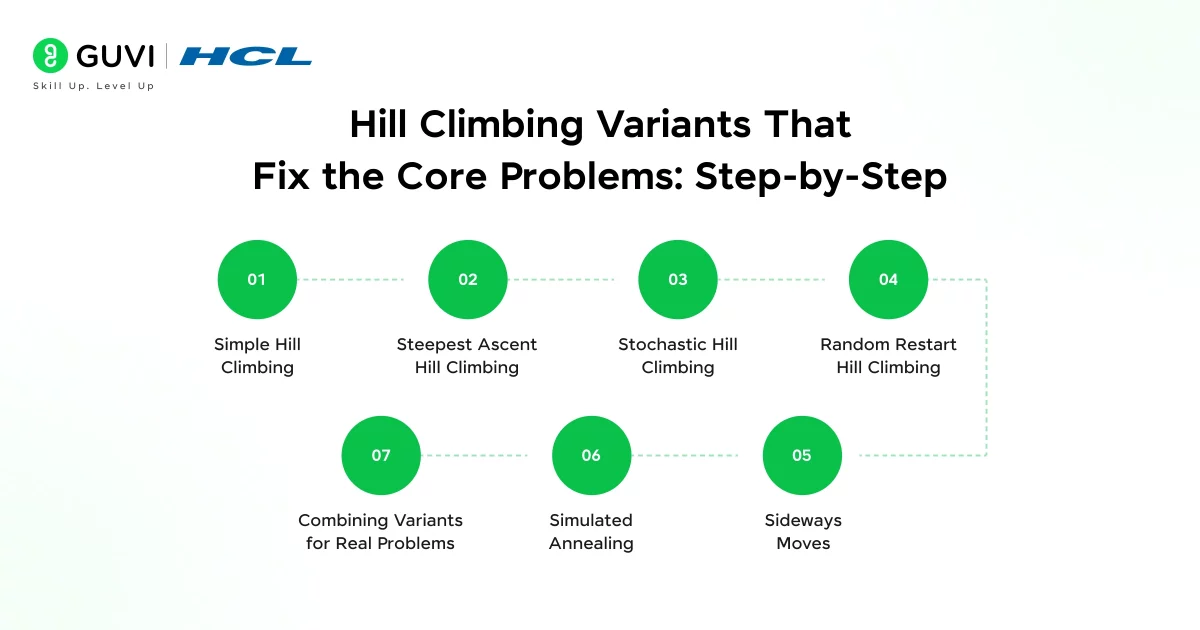
Here is how each major variant of hill climbing addresses the weaknesses of the basic algorithm.
Step 1: Simple Hill Climbing
The baseline that everything else improves on
Simple hill climbing evaluates neighbors one at a time and moves to the first one that is better than the current state. It does not look at all neighbors before deciding. This makes it fast per iteration but potentially wasteful overall since it might move to a mediocre neighbor when an excellent one was just around the corner. It is the right starting point for understanding the algorithm family.
Step 2: Steepest Ascent Hill Climbing
Always taking the best available step
Steepest ascent evaluates all neighbors before moving and always selects the one with the highest score. This is more expensive per iteration but tends to make better progress with each step. The name comes from the analogy of always stepping in the direction of steepest uphill slope rather than just any uphill direction. It still gets trapped in local maxima but it gets there via a better path.

Step 3: Stochastic Hill Climbing
Introducing randomness to escape predictability
Stochastic hill climbing selects randomly among the neighbors that are better than the current state rather than always picking the best one. This randomness means different runs of the algorithm explore different paths through the search space, reducing the chance that every run ends at the same local maximum. Running stochastic hill climbing multiple times and keeping the best result is a simple but effective strategy.
Step 4: Random Restart Hill Climbing
Starting over when you get stuck
When the algorithm reaches a local maximum, instead of stopping, random restart hill climbing generates a completely new random starting state and runs the algorithm again from there. After many restarts, it keeps the best solution found across all runs. This is surprisingly effective on many problems because it trades the risk of local maxima for the statistical benefit of exploring many different regions of the search space.
Step 5: Sideways Moves
Allowing movement across plateaus
Allowing the algorithm to make sideways moves to states with equal scores rather than strictly requiring improvement helps it traverse plateaus. Without sideways moves, the algorithm stops immediately on a plateau. With them, it can cross the flat region and find the uphill slope on the other side. The risk is getting into an infinite loop on a true flat region, which is handled by setting a maximum number of consecutive sideways moves.
Step 6: Simulated Annealing
Accepting worse solutions to escape local traps
Simulated annealing extends hill climbing by occasionally accepting moves to worse states with a probability that decreases over time. Early in the search, the algorithm accepts bad moves frequently, exploring broadly. Later, it becomes increasingly selective, converging on the best solution found. This mimics the physical process of annealing metal and is one of the most effective ways to escape local maxima while still benefiting from the efficiency of local search.
Step 7: Combining Variants for Real Problems
The practical approach that actually works
In real applications, the best results usually come from combining variants. Random restarts with steepest ascent catches many local maxima issues. Adding sideways moves handles plateaus. Incorporating occasional random jumps addresses ridge problems. The combination is more robust than any single variant and remains computationally efficient compared to global search methods.
Common Mistakes When Implementing Hill Climbing
- Designing an evaluation function that does not accurately reflect what a good solution actually looks like
- Defining neighbors too narrowly so the algorithm cannot explore enough of the search space
- Running the algorithm only once and accepting the first local maximum found as the final answer
- Not setting a maximum iteration limit and letting the algorithm run indefinitely on a plateau
- Assuming hill climbing will find the global optimum without testing whether the problem’s landscape supports this
- Choosing the wrong variant for the problem type without considering the landscape characteristics
- Ignoring the quality of the starting state when the search landscape has many local maxima
Getting the Best Results From Hill Climbing
- Design the evaluation function with obsessive care
- Use random restarts as the default strategy
- Visualize the search trajectory when possible
- Match the neighbor definition to the problem structure
- Know when to switch to a different algorithm entirely
The n-queens problem, which involves placing n chess queens on an n×n board so that no two attack each other, is a classic benchmark for hill climbing algorithms. For extremely large instances like the 1,000,000-queens problem, techniques such as steepest ascent hill climbing with random restarts can find valid solutions in under a minute on modern hardware, whereas an exhaustive search would take longer than the age of the universe, highlighting the power of heuristic search over brute force.
Where Hill Climbing Is Used in Real AI Systems

- Neural network training
Gradient descent, the algorithm at the heart of training every modern neural network, is a continuous version of hill climbing. It computes the gradient of the loss function and takes steps in the direction of steepest descent, which is equivalent to hill climbing toward lower loss. The connection between hill climbing and deep learning is direct and fundamental.
- Job and resource scheduling
Assigning jobs to machines, shifts to workers, or tasks to time slots involves enormous combinatorial search spaces. Hill climbing finds good schedules quickly by starting from a feasible assignment and iteratively swapping tasks to reduce conflicts or improve efficiency. It is fast enough to run in real-time as schedules change.
- Game playing and puzzle solving
Hill climbing solves constraint satisfaction puzzles by iteratively moving toward configurations with fewer violated constraints. It handles Sudoku, graph coloring, and similar problems effectively when combined with random restarts to escape local optima where some violations cannot be resolved without making others temporarily worse.
- Robotics and motion planning
Robot configuration optimization often uses hill climbing to find joint angle configurations that position the end effector accurately while satisfying constraints on joint limits and collision avoidance. The continuous search space of robot configurations is well suited to hill climbing with small step sizes as the neighbor generation strategy.
If you want to learn more on Hill Climbing Algorithm, do not miss the chance to enroll in HCL GUVI’s Intel & IITM Pravartak Certified Artificial Intelligence & Machine Learning course. Endorsed with Intel certification, this course adds a globally recognized credential to your resume, a powerful edge that sets you apart in the competitive AI job market.
Conclusion
Hill climbing is one of those algorithms that looks too simple to matter until you realize how much of AI is built on top of it.
The core idea, always move toward better and stop when nothing around you improves on where you are, is elegant, fast, and surprisingly effective on well-structured problems. The limitations, local maxima, plateaus, and ridges, are real but manageable with the right variant and the right problem selection.
What makes hill climbing worth understanding deeply is not just its direct applications. It is the way it frames the entire problem of optimization.
FAQs
1. Is hill climbing guaranteed to find the optimal solution?
No. Hill climbing only guarantees finding a local optimum, a solution better than its immediate neighbors. Whether that local optimum is the global best solution depends entirely on the structure of the problem’s search landscape.
2. When should I use hill climbing over other search algorithms?
Use hill climbing when you need fast approximate solutions, when the problem landscape is relatively smooth with few local maxima, or when the problem is too large for exhaustive search. For problems requiring guaranteed optimal solutions, use exact methods instead.
3. How many random restarts should I use?
It depends on the problem. Start with ten to twenty restarts and measure how much the best solution improves with each additional restart. When additional restarts stop producing meaningful improvements, you have enough. On complex problems with many local maxima, hundreds of restarts may be warranted.
4. What is the difference between hill climbing and gradient descent?
Gradient descent is the continuous mathematics version of hill climbing used for differentiable functions. Hill climbing works on discrete or non-differentiable search spaces where gradients cannot be computed. Both follow the same core principle of moving iteratively toward better solutions.
5. Can hill climbing handle problems with multiple objectives?
Standard hill climbing optimizes a single evaluation function. Multi-objective problems require either combining objectives into a single weighted score or using multi-objective optimization algorithms like Pareto-based evolutionary approaches. Hill climbing can work with a weighted combination but loses the ability to explore tradeoffs between objectives.
Success Stories

About the Author
Vishalini Devarajan
An Aerospace Engineer turned content writer, I focus on making complex concepts easy to understand through well-structured, reader-friendly blogs. Whether it’s a technical topic or a non-technical one, I love creating content that is clear, engaging, and impactful.
View all posts by Vishalini Devarajan
Connect with me @


















Did you enjoy this article?