


Artificial Intelligence and Machine Learning Articles
AI/ML Skills Gap 2026: Why Companies Can't Find Job-Ready Talent
20 AI/ML Interview Questions Recruiters Can Use Without a Tech Background - Best Guide
How Industry-Backed AI/ML Bootcamps Are Changing the AI/ML Hiring Pipeline - Best Guide 2026
From IT Support to AI Engineer: A Realistic Career Switch Guide 2026


Get In Touch For Details! Request More Information
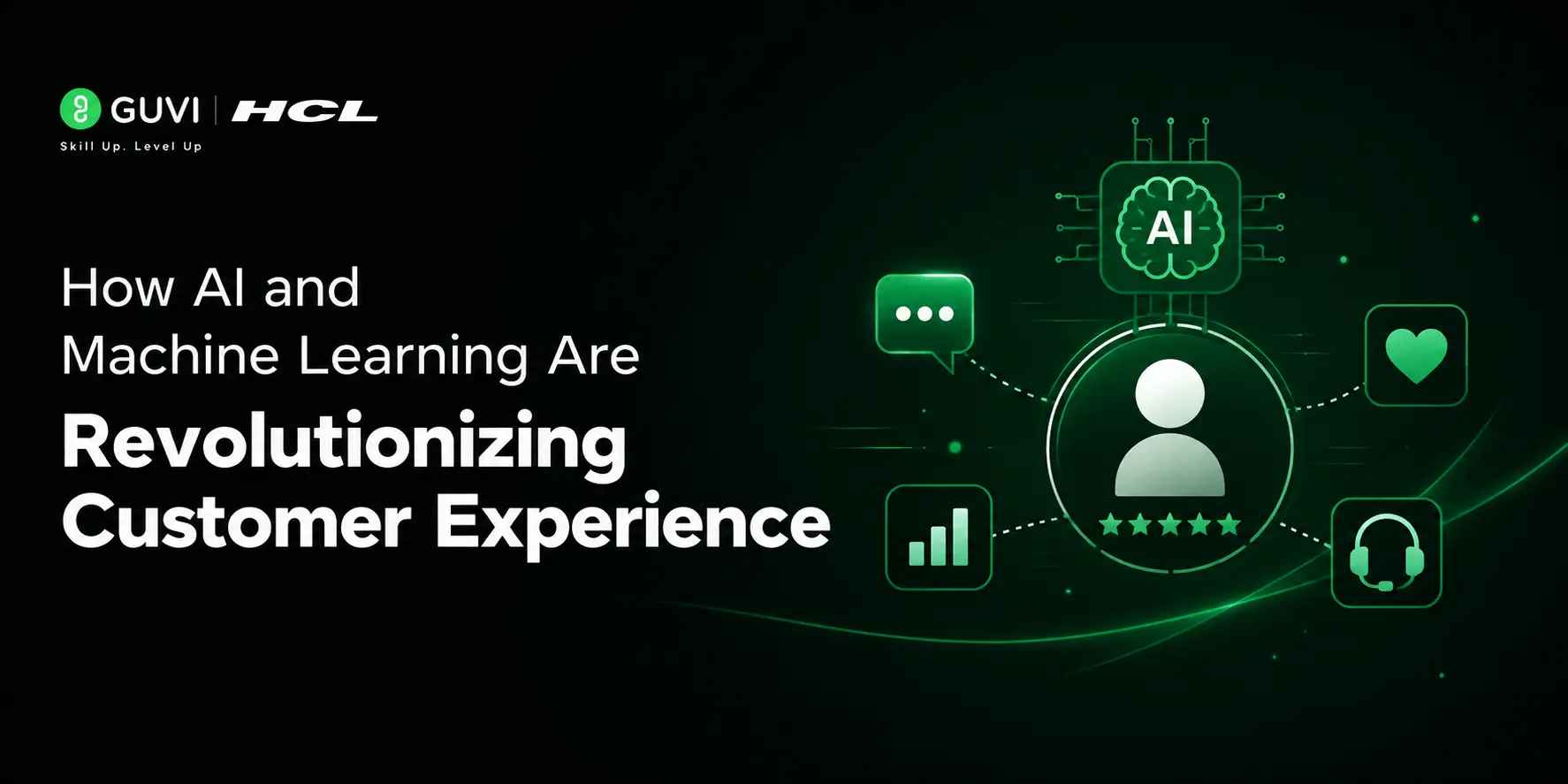
How AI and Machine Learning Are Revolutionizing Customer Experience
May 14, 2026 4 Min Read 479 Views
(Last Updated)
Customer expectations have never been higher, and the gap between a good experience and a great one is now measured in milliseconds. According to McKinsey, AI-driven customer interactions are projected to increase customer satisfaction by 10–20%, yet most businesses are still playing catch-up. If your team is still relying on static FAQs and reactive support queues, you’re already behind. How AI and Machine Learning are revolutionizing customer experience is not a future story, it’s happening right now, across every industry, at scale. This blog breaks down exactly how, with real data and practical implications you can act on.
Table of contents
- TL;DR
- What Does It Mean for AI to Revolutionise Customer Experience?
- How Is AI Personalising Customer Interactions at Scale?
- Hyper-Personalisation Through Predictive ML
- How Are AI-Powered Chatbots and Virtual Assistants Changing Support?
- From Scripts to Intelligence
- What Role Does Predictive Analytics Play in Customer Experience?
- How Does Sentiment Analysis Help Businesses Understand Customers Better?
- Real-Time Emotion Detection in Customer Interactions
- The Business Case: ROI of AI in Customer Experience
- Key Takeaways
- Conclusion
- FAQs
- What is AI in customer experience?
- How does Machine Learning improve customer experience?
- What are the benefits of AI-powered customer support?
- What is the difference between AI and Machine Learning in a customer experience context?
- How does sentiment analysis work in AI customer service?
TL;DR
• AI and Machine Learning enable businesses to shift from reactive to predictive customer engagement by analysing real-time behavioural data.
• By 2025, Gartner reported that over 80% of customer service teams had adopted AI-powered chatbots, a 16x increase from 2020.
• Hyper-personalisation driven by ML can generate up to 40% more revenue for retailers compared to generic experiences, per McKinsey.
• Sentiment analysis tools powered by AI can increase customer satisfaction by 40–50%, according to Gartner.
• The AI customer service market is projected to reach $15.12 billion in 2026, making AI adoption no longer optional for competitive businesses.
What Does It Mean for AI to Revolutionise Customer Experience?
How AI and Machine Learning are revolutionizing customer experience comes down to one core shift: moving from guessing what customers need to knowing it before they ask. AI analyses enormous volumes of customer data, purchase history, browsing patterns, support tickets, and feedback in real time, allowing businesses to personalise interactions at a scale no human team could manage alone.
| Data Point According to a McKinsey survey, AI usage across business functions rose from 72% in early 2024 to 78% by late 2024, with the most significant adoption in marketing, sales, and service operations. Source |
The practical implication is direct: companies that integrate AI into their customer experience strategy are not just improving CSAT scores; they are building a structural competitive advantage that compounds over time.
How Is AI Personalising Customer Interactions at Scale?
Personalisation is the single most powerful lever in modern customer experience. But traditional rule-based personalisation, ‘if customer bought X, show Y’ , falls flat when your customer base grows into the millions. This is where Machine Learning changes the game entirely.
Hyper-Personalisation Through Predictive ML
ML algorithms continuously learn from each customer interaction, building individual preference profiles that update in real time. Netflix, Amazon, and Spotify built empires on this capability. The same infrastructure is now accessible to mid-market businesses through cloud AI platforms
Real-time experimentation is another breakthrough. AI doesn’t just personalise, it continuously tests and refines which content, timing, and format drives the highest engagement. This is like having an A/B testing team that never sleeps and never makes statistical errors.
48% of consumers have left a brand’s website and purchased elsewhere simply because the experience felt generic and non-personalised, according to Accenture. One bad interaction is all it takes.
How Are AI-Powered Chatbots and Virtual Assistants Changing Support?
Traditional customer support is expensive, slow, and inconsistent. A customer calling in at 11 pm gets a different experience than one calling at 2 pm, same issue, wildly different outcome. AI-powered chatbots and virtual assistants eliminate that inconsistency.
From Scripts to Intelligence
Early chatbots ran on rigid decision trees. Modern ML-powered assistants understand context, detect intent, handle multi-turn conversations, and escalate intelligently to human agents when needed. The experience has transformed from frustrating to genuinely helpful.
- Instant, 24/7 resolution: AI chatbots handle queries in real time, any hour. This dramatically reduces first-response time, one of the top drivers of customer satisfaction, and lets human agents focus on complex, high-value interactions where empathy and judgement matter most.
- Cost efficiency at scale: The average cost of a human customer service interaction is $6.00, versus $0.50 for an AI chatbot interaction, a 12x difference. For high-volume businesses, the economics are impossible to ignore.
- Consistency across every touchpoint: Unlike human agents who vary in tone and knowledge, AI maintains uniform quality across every conversation. That consistency is what builds the kind of trust that retains customers long-term.
| Pro Tip Don’t deploy a chatbot and abandon it. The businesses seeing the best results treat their AI chatbot as a product, they review conversation logs weekly, identify drop-off points, and continuously retrain the model on real customer language. |
What Role Does Predictive Analytics Play in Customer Experience?
Reactive support is the old model: customer has a problem, customer contacts you, you solve it. Predictive analytics flips this on its head. ML models analyse historical behaviour to identify which customers are likely to churn, which are ready to upgrade, and which need proactive outreach, before any of those events occur.
Gartner’s 2024 CX trends report noted that proactive service interactions are on track to outnumber reactive ones, a signal that the industry is fundamentally shifting how it defines ‘good service.’ When you fix a problem before the customer notices it, you don’t just delight them, you earn loyalty that marketing budgets can’t buy.
| Data Point Companies using AI report a 25% increase in customer satisfaction, and 50% of customers now expect companies to anticipate their needs and provide relevant suggestions before they make contact. Source |
Predictive models are only as good as the data they train on. If your customer data is siloed across CRM, support, and billing systems, your ML predictions will be unreliable. Data unification is a prerequisite, not an afterthought.
How Does Sentiment Analysis Help Businesses Understand Customers Better?
Customer feedback exists everywhere: support tickets, reviews, social media, post-call surveys, and live chat transcripts. The problem is volume. No human team can read 50,000 reviews a month and extract meaningful patterns. Sentiment analysis powered by Natural Language Processing (NLP) can.

Real-Time Emotion Detection in Customer Interactions
Advanced AI systems can now analyse tone in real-time during voice calls and live chats. If a customer’s language signals frustration, the system can automatically escalate to a senior agent or shift to a more empathetic response template. The customer feels heard; the business avoids a churn event.
Beyond individual interactions, sentiment analysis provides macro-level visibility. Product teams can identify feature pain points. Marketing teams can detect messaging that resonates or falls flat. Leadership can track brand sentiment trends before they show up in revenue numbers. This is strategic intelligence, not just operational efficiency.
73% of consumers say AI enhances their experience with brands, according to Capgemini. The fear that AI makes interactions feel robotic is increasingly at odds with what customers actually report experiencing.
The Business Case: ROI of AI in Customer Experience
Investing in AI for customer experience is not just a technology decision, it’s a business strategy decision. The returns are measurable and compound over time.
| Metric | Without AI | With AI |
|---|---|---|
| Cost per interaction | $6.00 | $0.50 (chatbot) |
| CSAT improvement | Baseline | +25% (Gartner) |
| Revenue from personalisation | Baseline | +5–15% (McKinsey) |
| Churn detection | Reactive | Proactive (ML prediction) |
| Support availability | Business hours | 24/7 autonomous |
Key Takeaways
- AI shifts support from reactive to predictive: By analysing historical and real-time data, ML models can anticipate customer needs, preventing churn events before they occur and transforming service into a proactive function.
- Personalisation at scale is now achievable: ML-powered recommendation engines and dynamic content systems allow businesses of any size to deliver individual-level experiences across millions of customers simultaneously.
- Chatbots have evolved far beyond scripts: Modern NLP-powered assistants handle complex, multi-turn conversations and escalate intelligently, delivering consistent service quality 24/7 at a fraction of human cost.
- Sentiment analysis is a strategic asset: Understanding how customers feel, in real time and at scale, enables faster intervention, better product decisions, and long-term brand trust.
- The financial case is unambiguous: From 25% CSAT gains to 40% revenue uplift through personalisation, the ROI data on AI in customer experience is now well-established and growing.
Conclusion
How AI and Machine Learning are revolutionising customer experience is not a speculative future; it’s the operational reality of every market-leading company right now. From hyper-personalised recommendations that drive 40% more revenue, to chatbots that handle 80% of routine queries at $0.50 per interaction, to sentiment tools that detect frustration before an escalation becomes a churn event, the evidence is clear, and the returns are measurable. The question for any business leader today is not whether to adopt AI in your customer experience strategy, but how fast and how well. Those who build the capability now will compound the advantage. Those who wait will spend the next five years catching up. Start with one use case, unify your data, and build from there.
If you’re ready to learn AI and ML, the Artificial Intelligence and Machine Learning Courses by HCL GUVI is your perfect gateway. Gain hands-on experience, learn from industry experts, and get endless opportunities in one of the most exciting fields today. Enroll now and start your journey toward becoming an AI and ML expert!
FAQs
What is AI in customer experience?
Artificial Intelligence (AI) in customer experience refers to the use of smart technologies like chatbots, recommendation systems, predictive analytics, and virtual assistants to improve customer interactions, personalize services, and provide faster support.
How does Machine Learning improve customer experience?
Machine Learning helps businesses analyze customer behavior, preferences, and purchase history to deliver personalized recommendations, targeted marketing, faster issue resolution, and improved customer satisfaction.
What are the benefits of AI-powered customer support?
AI-powered customer support offers several benefits, including:
1. 24/7 customer assistance
2. Faster response times
3. Reduced operational costs
4. Personalized interactions
5. Improved customer satisfaction
6. Automated ticket handling
What is the difference between AI and Machine Learning in a customer experience context?
Artificial Intelligence is the broader discipline of machines performing tasks that normally require human intelligence. Machine Learning is a subset where systems learn from data patterns without being explicitly reprogrammed. In CX, AI is the umbrella strategy (e.g., deploying a chatbot), while ML is the engine that makes it smarter over time (e.g., the chatbot learning which responses resolve issues fastest).
How does sentiment analysis work in AI customer service?
Sentiment analysis uses Natural Language Processing (NLP) to evaluate the emotional tone in customer communications, whether in text (reviews, chats) or voice (support calls). The AI classifies sentiment as positive, negative, or neutral, and can trigger actions like escalation or empathetic response templates
Success Stories

About the Author
Kirupa
An avid fiction reader and a health science graduate who found writing most at home. I have worked as a freelancer with a diverse range of brands and projects, turning complex ideas into relatable content. You can find me at GUVI, in the exciting world of EdTech, where I continue to blend my words with creativity and clarity.
View all posts by Kirupa
Connect with me @









Did you enjoy this article?