


Career Articles
How I Switched from Web Developer to ML Engineer (A Web Developer's Real Story)
PHP Developer Resume: Writing Guide & Key to Landing Your Dream Job
My Frontend Developer Interview at Google: What Really Happens Behind Closed Doors
Future of Electric Vehicle Course: Fast-Track Your EV Career


Get In Touch For Details! Request More Information

15 Highest-Paying IT Skills in 2026: Boost Your Tech Career
Feb 19, 2026 5 Min Read 5193 Views
(Last Updated)
The tech sector has entered its new phase in 2026, one where skills will be favoured over degrees and real knowledge will be the only true advantage. Businesses are re-creating their operations, upgrading their digital offerings, ensuring their systems are secure, and leveraging smarter technologies. Thus, they are looking for people who can offer specific and high-impact skills.
More than ever, this shift has made some technical skills incredibly valuable. By learning the Highest-Paying IT Skills, you will not only earn a good living, but you will also have the ability to take advantage of better job roles, work with modern technology, and grow in an ever-expanding market. Whether you are a beginner or someone looking to upskill, the knowledge of these skills will help you pursue a stronger tech career in 2026 and beyond.
Quick answer:
- 2026’s top-paying IT skills include AI, ML, Cloud, Cybersecurity, DevOps, Data Science, and Full-Stack Development.
- These skills are in high demand because they help companies innovate, automate, and stay secure.
- Learning them can lead to better salaries, stronger job roles, and a future-proof tech career.
Table of contents
- Top 15 Highest-Paying IT Skills in 2026
- Artificial Intelligence (AI)
- Machine Learning (ML)
- Cloud Computing (AWS, Azure, GCP)
- Cybersecurity
- DevOps
- Data Science
- Full-Stack Development
- Blockchain Development
- UI/UX Design
- Big Data Engineering
- Internet of Things (IoT)
- Product Management (Tech)
- AR/VR Development
- Software Testing (Automation + Selenium)
- Networking and Network Security
- Wrapping it up:
- FAQs
- Which IT skill offers the highest salary in 2026?
- Can beginners learn high-paying IT skills?
- How long does it take to learn these skills?
- Do I need a technical degree to land an IT job?
Top 15 Highest-Paying IT Skills in 2026
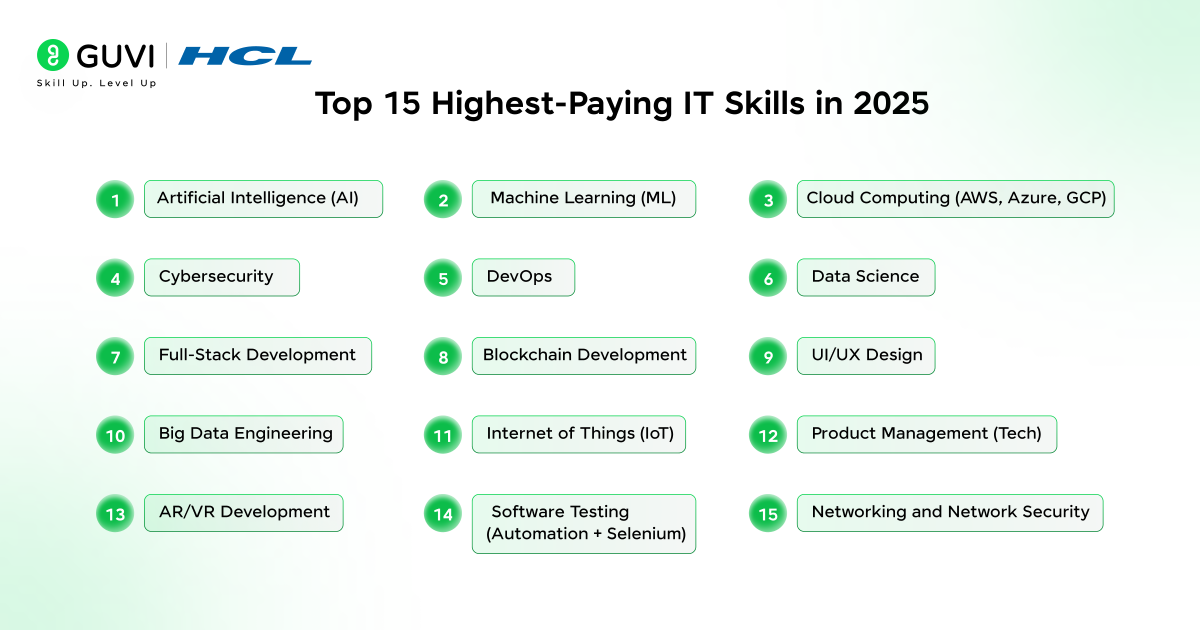
1. Artificial Intelligence (AI)
AI is still a tech industry leader, used in the fields of automation, healthcare, finance, retail, and others. AI skills are in demand among professionals who can build intelligent systems to create AI agents.
Why it pays well:
AI assists companies in saving time, lessening human effort, and enhancing productivity. Organizations are willing to pay a significant amount to those professionals who are capable of solving actual business problems with the help of AI.
Skills needed:
You will need a strong knowledge of Python, machine learning, neural networks, and also experience with PyTorch and TensorFlow. The skills may differ depending on the job role.
Roles:
- AI Engineer
- Machine Learning Engineer
- AI Researcher
- NLP Engineer
Average Salary Range: ₹12 LPA – ₹45+ LPA
2. Machine Learning (ML)
Machine Learning is a fundamental aspect of AI and one that focuses on building systems that learn from data. ML powers recommendation systems, fraud detectors, prediction tools, and robots.
Why it pays well:
Organisations require ML engineers with the capability to create high-performing models that enhance accuracy and minimize risks.
Skills needed:
You will need Machine learning algorithms, Python, strong analytical, statistical, deep learning, and MLOps, along with soft skills like good communication, critical thinking and collaboration skills.
Roles:
- ML Engineer
- Data Scientist
- Research Analyst
Average Salary: ₹10 LPA – ₹40+ LPA
3. Cloud Computing (AWS, Azure, GCP)
The modern-day business is now powered by cloud computing. Firms are moving to cloud computing solutions in an effort to gain improved security, scalability, and cost-effectiveness.
Why it pays well:
Companies rely on cloud experts to take care of their infrastructure, decrease the cost of operation and deploy secure cloud infrastructure.
Skills needed:
You must know cloud architecture, compute services, storage, networking, and cloud security. Hands-on experience with AWS/Azure/GCP and tools like Docker, Kubernetes, and Terraform is also important.
Roles:
- Cloud Architect
- Cloud Engineer
- DevOps Cloud Specialist
Average Salary: ₹9 LPA – ₹35+ LPA
4. Cybersecurity
As cyberattacks are on the increase, organizations are spending a lot on security professionals who can secure systems, networks, and valuable information.
Why it pays well:
It can cost companies crores due to the failure of cybersecurity. Trained security experts keep the attacks off and make people obey.
Skills needed:
You must have strong knowledge of network security, firewalls, encryption, threat detection, and vulnerability testing tools.
Roles:
- Ethical Hacker
- Security Analyst
- Security Architect
Average Salary: ₹8 LPA – ₹30+ LPA

5. DevOps
DevOps is focused at enhancing interaction between the operations and development teams. It is based on automation tools such as Docker, Kubernetes, Jenkins, and CI/CD pipelines.
Why it pays well:
DevOps enhances the rate of delivery, precision of deployment, and productivity.
Skills needed:
You should know about CI/CD pipelines, Linux, Git, Docker, Kubernetes, Jenkins, and cloud deployment. Having Automation and scripting skills is an add-on.
Roles:
- DevOps Engineer
- Cloud DevOps Specialist
- Release Manager
Average Salary: ₹9 LPA – ₹35+ LPA
6. Data Science
Data Science remains among the Highest-Paying IT Skills as companies make their decisions on the information.
Why it pays well:
Data scientists help companies to interpret trends, streamline business, and increase profits.
Skills needed:
You need Python/R, data cleaning, SQL, Power BI or Tableau, data visualisation, and ML basics. Python libraries and frameworks such as pandas, numpy, and matplotlib are also essential.
Roles:
- Data Scientist
- Data Analyst
- BI Specialist
Average Salary: ₹10 LPA – ₹40+ LPA
7. Full-Stack Development
Full-stack developers that can work in both frontend and backend are highly valuable due to the preference of multi-skilled developers by the companies.
Why it pays well:
They minimise the necessity of several recruitments and provide solutions that are quick and scalable.
Skills needed:
You must have basic knowledge of HTML, CSS, and JavaScript, and you must also know about React, Node.js, and databases like MySQL/MongoDB. API building, Git, and deployment skills are a plus.
Roles:
- Full-Stack Developer
- MERN Developer
- Software Engineer
Average Salary: ₹6 LPA – ₹25+ LPA
8. Blockchain Development
Crypto is not the only thing that can be blockchain. It is applied in supply chain, banking, identity management, cybersecurity, and automation.
Why it pays well:
It is a new technology, and talented individuals are hard to find.
Skills needed:
You must know Solidity, Ethereum, cryptography, smart contract development, and Web3 frameworks.
Roles:
- Blockchain Developer
- Smart Contract Developer
- Blockchain Architect
Average Salary: ₹10 LPA – ₹40+ LPA
9. UI/UX Design
With the shift to customer experience, firms require designers to create user-friendly and appealing online products.
Why it pays well:
An effective design enhances customer satisfaction and increases revenues.
Skills needed:
You must know wireframing, prototyping, user research, and design principles. Tools such as Figma, Adobe XD, and usability testing methods are required.
Roles:
- UI Designer
- UX Researcher
- Product Designer
Average Salary: ₹5 LPA – ₹22+ LPA
- Over 70% of tech employers now focus on skill-based hiring rather than academic degrees — emphasizing practical expertise over theoretical knowledge.
- Cybersecurity roles have zero unemployment globally, making it one of the most secure and in-demand career paths in the tech world.
- Organizations adopting AI and Machine Learning report up to 40% faster decision-making and significantly reduced operational costs.
- Cloud Computing is projected to create over 1 million new jobs in India by 2026, redefining the future of digital transformation and tech employment.
10. Big Data Engineering
Big data tools help companies to handle extremely huge and complex datasets that cannot be handled using traditional databases. Skilled data engineers are in high demand to build and maintain these complex data systems.
Why it pays well:
They help organizations store, manage, and analyse data at scale.
Skills needed:
You need Hadoop, Spark, Kafka, SQL, and knowledge of distributed systems. ETL pipeline building and cloud data services are highly valuable.
Roles:
- Big Data Engineer
- Data Architect
- Hadoop Developer
Average Salary: ₹10 LPA – ₹35+ LPA
11. Internet of Things (IoT)
Smart homes, connected cars, industrial sensors, and healthcare devices are all operated through IoT.
Why it pays well:
The IoT systems are not as simple as they entail a combination of hardware, networking, and software capabilities.
Skills needed:
You must know embedded systems, microcontrollers, networking protocols, and programming in Python or C/C++.
Roles:
- IoT Engineer
- Embedded Systems Developer
- IoT Architect
Average Salary: ₹8 LPA – ₹28+ LPA
12. Product Management (Tech)
Product Managers collaborate with the team of developers, designers, and the business team. IT-skilled tech PMs are extremely well paid.
Why it pays well:
They control product roadmap, features, and strategy-having a direct impact on the business success.
Skills needed:
You must enhance your skills in problem solving, product strategy understanding, wireframing basics, and communication skills. Understanding of Agile, Scrum, and analytics tools also helps.
Roles:
- Technical Product Manager
- Product Owner
Average Salary: ₹12 LPA – ₹45+ LPA
13. AR/VR Development
AR and VR are emerging in the gaming, education, medical training, and real estate.
Why it pays well:
It demands the skills of 3D modeling and simulation, and immersion design that are rare.
Skills needed:
You must know Unity/Unreal Engine, C#/C++, 3D modeling, and immersive design principles. Understanding rendering, animations, and user interaction is necessary.
Roles:
- AR Developer
- VR Developer
- XR Specialist
Average Salary: ₹8 LPA – ₹30+ LPA
14. Software Testing (Automation + Selenium)
The automation testing is rising because companies require bug-free software that is delivered at a higher rate.
Why it pays well:
Automation saves time for testing and enhances the quality of products.
Skills needed:
You need Selenium, Java/Python, test case writing, debugging, and CI/CD knowledge. Frameworks such as TestNG or JUnit add value.
Roles:
- QA Engineer
- Automation Tester
- Test Architect
Average Salary: ₹5 LPA – ₹20+ LPA
15. Networking and Network Security
Cloud adoption leads to a demand for professionals who are knowledgeable about network infrastructure and the secure flow of data.
Why it pays well:
Losses can be enormous in case of network failures, hence skilled engineers are required.
Skills needed:
You need strong knowledge of network protocols, routers, firewalls, and troubleshooting. Skills in network monitoring, VPNs, and security practices are essential.
Roles:
- Network Engineer
- Network Security Specialist II
Average Salary: ₹6 LPA – 25+ LPA
Join the AI Software Development Course by HCL GUVI, IITM Pravartak, MongoDB, a 9-month industry-ready program covering Java, System Design, Generative AI, 15+ hands-on projects, and 4 globally recognized certifications.
Wrapping it up:
The need for specialized tech talent will continue to grow, and those specialists who invest in the necessary skills will be at the forefront. It doesn’t matter if you choose AI, cloud computing, cybersecurity, full-stack development, or any of the other burgeoning areas of practice in tech all that matters is your commitment to gaining new skills and constantly improving. Each new skill gives you confidence, opens new doors, and brings you closer to a rewarding and stable career.
FAQs
1. Which IT skill offers the highest salary in 2026?
IT skills that are among the highest paying include AI, Machine Learning, Cloud Computing, and Cybersecurity. These skills will pay the most because there is a need for workers with these skills and very few workers are available with these skills.
2. Can beginners learn high-paying IT skills?
Yes. Many skills like Full-Stack Development, UI/UX, Cloud basics, and Data Analytics are beginner-friendly and provide solid starting points.
3. How long does it take to learn these skills?
It depends on the skill and on how much time you will practice. Most learners make it job-ready within 3-6 months, if they have the right certifications and projects.
4. Do I need a technical degree to land an IT job?
Not necessarily. Many companies will look at skills/certification and real-world projects before looking at someone’s degree.
Success Stories

About the Author
Vishalini Devarajan
An Aerospace Engineer turned content writer, I focus on making complex concepts easy to understand through well-structured, reader-friendly blogs. Whether it’s a technical topic or a non-technical one, I love creating content that is clear, engaging, and impactful.
View all posts by Vishalini Devarajan
Connect with me @














Did you enjoy this article?