


Career Articles
Financial Analyst to Data Scientist Salary: What Can You Expect in India?
Accountant vs Data Analyst Salary in India After Switching Careers - Best Guide
Finance Managers: Could Data Science Be Your Next Career Move?
Insurance Claims Executive to Data Analyst: Is It a Good Switch?


Get In Touch For Details! Request More Information

How to Become a Network Engineer in 2026: A Beginner’s Step-by-Step Career Guide
Aug 17, 2026 12 Min Read 7513 Views
(Last Updated)
Every video call you take, every cloud app you open, every payment that goes through, all of it depends on a network someone designed, built, and keeps running. That someone is a network engineer.
A network engineer is an IT professional who designs, builds, implements, and manages computer networks, including LANs, WANs, and cloud infrastructure. The role combines hardware configuration, such as routers, switches, and firewalls, with software automation using tools like Python and Ansible, along with security protocols such as zero-trust architecture and SASE.
This guide covers the exact roadmap, certifications, salary data, and where the jobs actually are in India in 2026.
Table of contents
- TL;DR Summary
- What Is a Network Engineer?
- Day-to-Day Responsibilities
- Real Network Engineer Job Posting Example (2026):
- Network Engineer vs Network Administrator: What's the Difference?
- Is Network Engineering Becoming Obsolete Due to AI?
- Network Engineering Specializations: Which Pays Best?
- Why Is Network Engineering a Good Career in 2026?
- Five Reasons Network Engineering Offers Exceptional Opportunities
- What Education Do You Need to Become a Network Engineer?
- Education Path Options:
- Essential Technical Skills (Must-Have):
- Emerging 2026 Skills (High-Value Differentiators):
- Soft Skills (Equally Important):
- Skills Timeline (What to Learn When)
- How to Become a Network Engineer: 6 Steps
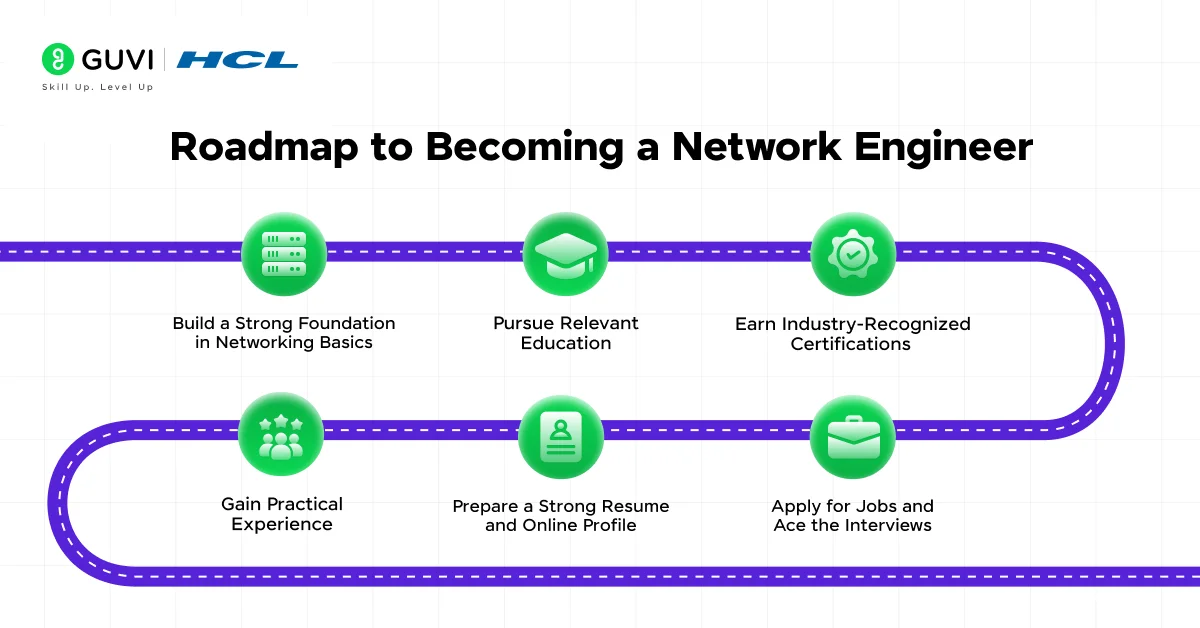
- Step 1: Build a Strong Foundation in Networking Basics
- Step 2: Pursue Relevant Education (Degree or Courses)
- Step 3: Earn Industry-Recognized Certifications
- Step 4: Gain Practical Experience (Projects, Internships, or Labs)
- Step 5: Prepare a Strong Resume and Online Profile
- Step 6: Apply for Jobs and Ace the Interviews
- Companies That Pay the Most
- Top Companies Hiring Network Engineers in India (2026)
- IT Services Giants
- Where the Jobs Are: Top Cities & Companies Hiring Network Engineers in India (2026)
- Beyond Metro Cities: Remote and Tier 2 Opportunities in India (2026)
- Recommended Learning Resources (India-Friendly)
- Free Resources:
- Books:
- Professional Associations Worth Joining
- 💡 Did You Know?
- Conclusion
- Frequently Asked Questions
- What qualifications are required to become a network engineer in India?
- Which certifications are most beneficial for aspiring network engineers?
- What is the average salary of a network engineer in India?
- How long does it take to become a proficient network engineer?
- What are the career advancement opportunities for network engineers?
- Do I need a home lab to get a network engineer job?
- What is the salary of a network engineer in India in 2026?
- Should I specialize or stay a generalist?
- What programming languages do network engineers need?
- What’s the difference between a network engineer and a network administrator?
- What tools do network engineers use?
- How often do I need to recertify?
TL;DR Summary
- Build TCP/IP fundamentals, then get certified (CompTIA Network+ or CCNA) and gain hands-on lab experience.
- No degree required; self-study, a bootcamp, or a degree all work, so pick based on your timeline and budget.
- Global salaries run $95,000 to $145,000, with 5% job growth projected through 2033.
- India entry-level salaries run ₹4-8 LPA, with cloud, security, and automation specializations paying the biggest premium.
What Is a Network Engineer?
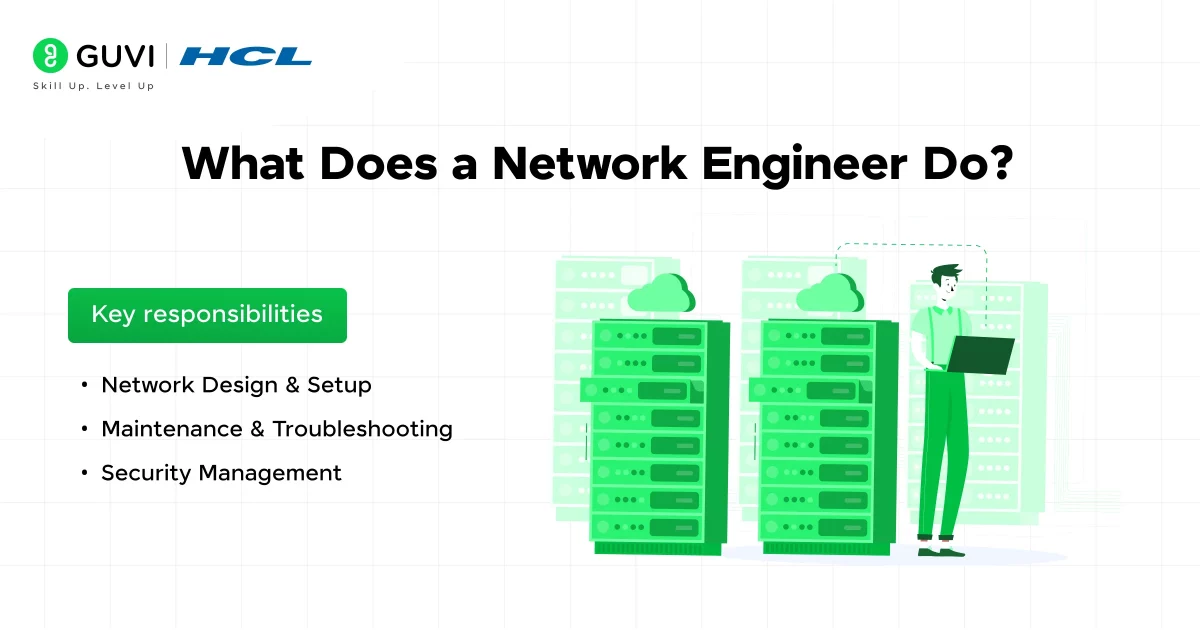
A network engineer is an information technology professional who supports computer networks for businesses and organizations. They may build new networks or maintain existing ones. Their goal is to ensure that networks can support hundreds or even thousands of users while staying secure, reliable, and high-performing.
Day-to-Day Responsibilities
- Monitor and maintain networks
Track network performance using tools like SolarWinds, Datadog, and Nagios. Identify slowdowns or failures and fix them early. - Troubleshoot issues
Diagnose connectivity problems using packet analysis tools such as Wireshark, along with command-line tools and structured debugging methods. - Configure equipment
Set up and manage routers, switches, firewalls, and network interfaces to ensure smooth performance. - Implement security
Apply security measures like VLANs, access control lists, and firewalls to protect systems and data. - Plan upgrades
Design and roll out network improvements, software updates, and technology migrations. - Document changes
Keep clear records of network diagrams, configurations, and updates for future reference. - Collaborate with teams
Work closely with IT teams, security teams, and business stakeholders to align network solutions with company goals.
Real Network Engineer Job Posting Example (2026):
Position: Junior Network Engineer
Company: Wipro
Location: Bengaluru
Salary: ₹4.9 LPA to ₹5.6 LPA
Key Requirements:
- CompTIA Network+ or equivalent certification
- 1-2 years of IT support experience (help desk acceptable)
- Experience with Cisco routers/switches (OR willingness to learn)
- Proficiency in TCP/IP, VLAN configuration, and basic troubleshooting
Key Daily Tasks from Actual Postings:
- Monitor network performance using SolarWinds or Datadog
- Configure and test new network equipment (switches, routers, firewalls)
- Troubleshoot connectivity issues for 200+ users
- Implement security policies and VLAN segmentation
- Document network changes and maintain current network diagrams
This shows you exactly what employers expect on day one—not theoretical knowledge, but hands-on troubleshooting and configuration skills.
Also Read: Network Engineer Roadmap: From Beginner to Expert
Network Engineer vs Network Administrator: What’s the Difference?
People often use these titles interchangeably, but they’re fundamentally different roles with different career paths and salaries.
Network Engineer designs, builds, and optimizes networks. They focus on architecture (planning large-scale systems for hundreds of users), emerging technologies, and strategic improvements. Engineers typically make architectural decisions about how to structure an entire network infrastructure.
Network Administrator monitors, maintains, and supports existing networks. They focus on day-to-day operations (user support, applying patches, and troubleshooting recurring issues). Administrators keep the network running smoothly, but don’t typically design new infrastructure.
| Aspect | Network Engineer | Network Administrator |
|---|---|---|
| Primary Focus | Design, build, optimize | Maintain, monitor, support |
| Scope | Architecture and strategy | Day-to-day operations |
| Salary (India) | ₹6 to 20+ LPA | ₹4 to 10 LPA |
| Certifications | CCNP, CCIE, cloud certs | CCNA, CompTIA Network+ |
| Career Path | Architect, CIO | Senior Admin, Network Manager |
Is Network Engineering Becoming Obsolete Due to AI?
No, but the role is genuinely changing, and it’s worth understanding exactly how before you commit years to this path.
What AI is actually automating. AI agents and tools now handle first-pass configuration drafting, ticket triage, anomaly detection, and routine troubleshooting, the repetitive work that used to eat most of an engineer’s week. In NOC (Network Operations Center) environments especially, AI-powered monitoring is becoming the default, not the exception.
What AI structurally can’t do. Deciding the right architecture for a specific business context, weighing performance against cost and security trade-offs, approving risky production changes, leading incident response when signals conflict, and owning accountability when something breaks, none of this is something current AI tools do reliably. That gap is, functionally, the job.
The clearest evidence the role isn’t disappearing: certification bodies are adapting, not retiring. Cisco updated the CCNA exam in 2024 (version 1.1) to add generative AI and automation/programmability topics directly into the core curriculum. You don’t add a skill to an entry-level certification for a job you believe is going away.
Where the real risk sits. Entry-level roles built purely around manual configuration and basic troubleshooting are shrinking; that part is genuinely true and worth taking seriously. At the same time, demand for network architects, automation engineers, and AI-integration specialists is climbing fast, and these roles pay significantly more. The U.S. Bureau of Labor Statistics lists computer network architects among the top-paid IT roles, with a national average salary around $130,390.
New roles this shift is creating, not eliminating: AI Network Architect, Network Automation Engineer, and AI Operations Specialist are all real, increasingly common job titles that didn’t exist in this form a few years ago.
The practical takeaway: if you’re learning network engineering in 2026, don’t stop at manual CLI configuration. Build automation (Python, Ansible), cloud networking, and enough AI literacy to supervise and validate AI-driven systems, not just execute manual configs by hand. Engineers who make that shift are seeing better pay, not worse job security.
Network Engineering Specializations: Which Pays Best?
Once you’ve built core networking fundamentals, choosing a specialization has a bigger impact on your salary trajectory than almost any other decision you’ll make. Here’s how the main paths compare.
| Specialization | Entry Barrier | Typical Salary Premium | Best For |
|---|---|---|---|
| Cloud Networking (AWS/Azure) | Moderate; needs core networking + one cloud cert | +15-20% over generalist roles | Engineers comfortable with hybrid and multi-cloud environments |
| Network Security | Moderate to high; often needs Security+ or CCNP Security | +15-25% over generalist roles | Those interested in zero-trust, SASE, and firewall-heavy work |
| SD-WAN | Moderate; vendor-specific training (Cisco Meraki, Fortinet) | Strong; specialized roles pay significantly above generalist CCNA-level pay | Engineers who enjoy WAN architecture and multi-site deployments |
| Network Automation / DevNetOps | High; requires Python plus networking depth | Among the highest; automation-skilled engineers consistently out-earn manual-only peers | Engineers who want to combine coding with infrastructure work |
| Traditional Enterprise Networking | Low; CCNA is usually sufficient to start | Baseline, no premium | Freshers building initial experience before specializing |
Cloud networking, security, and automation consistently pay the highest premiums, and increasingly, employers want engineers who combine at least two of these rather than staying a pure generalist long-term.
Why Is Network Engineering a Good Career in 2026?
Five Reasons Network Engineering Offers Exceptional Opportunities
1. High Demand & Job Growth (+5% Through 2033)
The network engineering field is expected to grow by 5% from 2023 to 2033, reflecting steady demand for skilled professionals. This outpaces most other IT roles and means you’ll have job options across industries, geographies, and companies.
2. Strong Compensation
As of 2026, entry-level (fresher) roles typically start between ₹4 to 7 LPA, mid-level professionals with 3 to 6 years of experience earn ₹8 to 18 LPA, and senior engineers command ₹20 to 35 LPA.
At the top end, senior network engineers and architects can earn ₹20L to ₹40L+, with total compensation packages reaching ₹2 crore in specialized or leadership roles.
Cloud networking roles pay even higher: the average salary for a Cloud Network Engineer in India is ₹12.5 LPA, with top earners reaching ₹36.8 LPA. The highest-paying employers include companies such as Cisco, IBM, HCL Technologies, Tata Communications, Wipro, and Infosys.
3. Remote Work Opportunities
The shift to cloud-based infrastructure means you don’t need to be in a server room. Most companies now offer fully remote network engineer positions, giving you geographic flexibility and work-life balance advantages.
4. Career Security & Indispensability
Networks are critical infrastructure. Businesses cannot function without them. Email stops flowing, video calls freeze, cloud applications become inaccessible, and productivity crashes when networks fail. This makes network engineers indispensable; your job is secure even during economic downturns.
5. Clear Advancement Paths to High-Paying Roles
Network engineering offers a well-defined career ladder in India, with compensation rising sharply at each stage:
- Senior Network Engineer: ₹20L to ₹35L | 5 to 7 years experience
- Network Architect: ₹26L to ₹40L+ | 8 to 10 years experience
- CIO / Chief Infrastructure Officer: ₹45L+ | Senior leadership
Specialization unlocks a further 20-40% premium. Cloud Security Architects earn ₹30 to 60 LPA, with GCC roles often crossing ₹70 LPA. PCNSE-certified professionals earn 20-40% more than non-certified peers, and multi-vendor trained engineers consistently earn 30-50% more than CCNA-level counterparts.
What Education Do You Need to Become a Network Engineer?
A degree is NOT required. Many successful network engineers use the certification path instead. However, education (degree or bootcamp) provides structure, credibility, and foundational knowledge that speeds up career advancement.
Education Path Options:
Option 1: Bachelor’s Degree (4 Years)
Degrees provide broad IT knowledge beyond just networking. Common majors include:
- Computer Science
- Information Technology
- Network Engineering (specialized degree)
- Electrical/Computer Engineering
Advantages:
- Comprehensive IT knowledge (covers systems, databases, security, beyond just networking)
- Employer preference (85% of enterprise jobs mention a degree)
- Eligibility for government/military IT roles
- Graduate school access if you want to advance to management/architecture
Disadvantages:
- Long timeline (4 years, while not earning)
- Expensive
- Outdated curriculum (universities lag industry by 1-2 years)
- Generic knowledge (you study things you’ll never use in networking)
Best For: Students with 4 years of availability; those pursuing advanced leadership roles; those seeking a comprehensive IT foundation.
Option 2: Bootcamp + Certifications (6-12 Months)
Bootcamps are intensive programs focused specifically on job-ready networking skills. Examples: CodePath, Coursera Google IT Support, GUVI Network Engineering Program.
Advantages:
- Fast timeline (6-12 months vs 4 years)
- Job-focused curriculum (learn what employers actually need)
- Hands-on labs (practice on real equipment simulators)
- Affordable
- Mentorship & community support
Disadvantages:
- Intense commitment (20-40 hours/week)
- Narrower knowledge base (only networking, not full IT stack)
- Some employers still prefer degrees
- Less rigorous than university programs
Best For: Career switchers with an IT background; budget-conscious learners; those who want to start working in 6-12 months.
Option 3: Self-Study + Certifications)
Pure self-directed learning using free resources (Professor Messer YouTube, subnetting simulators) + paid certifications (CompTIA Network+, CCNA).
Advantages:
- Lowest cost
- Completely flexible timeline (learn at your pace)
- Abundant free resources (YouTube, open-source tools)
- Forced self-discipline (proves motivation to employers)
Disadvantages:
- The highest dropout rate (70% don’t finish without structure)
- Steepest learning curve (no mentors to clarify confusion)
- Longer timeline if you’re learning from zero
- Harder to demonstrate skills without portfolio projects
Best For: Self-motivated learners; those with existing IT backgrounds; those on strict budgets; those who learn well independently.
Option 4: Combination (Degree + Bootcamp, 2.5-3 Years)
Start with a 2-year IT degree (cheaper than 4-year, covers fundamentals) + 6-month bootcamp (networking specialization). This combines the credibility of a degree with the job-ready focus of a bootcamp.
Best For: Those wanting both credibility (degree) and specialization (bootcamp); those wanting the fastest legitimate path to senior roles.
Essential Technical Skills (Must-Have):
1. TCP/IP & Network Protocols (Foundation)
- Understanding IP addressing, subnetting, and CIDR notation
- TCP vs UDP, packet structure, routing protocols
- DNS, DHCP, ARP (how devices communicate)
- Why it matters: Everything in networking builds on this
2. Routing & Switching (Core)
- Configure routers and switches (Cisco IOS command line)
- Understand VLAN, spanning tree, and port security
- Static vs dynamic routing (OSPF, BGP)
- Why it matters: 80% of network engineer jobs require this
3. Network Security: There has also been a huge uptick in the importance of cybersecurity within networking, with security becoming inseparable from networking work; it’s not just about keeping the network running; it’s about safeguarding it.
Zero trust, secure access service edge (SASE), and integration with security platforms are major technologies throughout 2026 and into the next year.
- Firewall configuration (Palo Alto, Cisco, Fortinet)
- Zero-trust architecture (microsegmentation, identity verification)
- SASE (Secure Access Service Edge)
- Intrusion detection/prevention (IDS/IPS)
- Why it matters: Security premium = +15-25% salary; mandatory for modern networks
4. Automation & Scripting (2026 Essential Skill) Network engineers who embrace automation tools like Ansible, Terraform, and Python scripting will thrive.
AI-powered network monitoring and troubleshooting tools are becoming standard, augmenting human capabilities and freeing engineers for strategic work.
- Python basics (the most important programming language for network engineers)
- Ansible, Terraform (infrastructure as code)
- Bash scripting (automate repetitive tasks)
- Why it matters: Gartner forecasts 30% of enterprises automating >50% of network tasks by 2026; engineers without automation skills will be obsolete
5. Cloud Networking (Now Baseline, Not Optional) Organizations that haven’t moved to the cloud need engineers who can manage the transition.
Many organizations have adopted cloud-first strategies, creating significant demand for professionals who can architect hybrid and multi-cloud environments.
- AWS VPC, security groups, route tables, CloudFront
- Azure VNet, network security groups, ExpressRoute
- GCP VPC, firewall rules, Cloud Interconnect
- Hybrid cloud (on-premise + cloud integration)
- Why it matters: Cloud networking jobs +20% growth; salary +15% premium
6. Network Troubleshooting & Packet Analysis
- Wireshark (packet analyzer, diagnose connectivity issues)
- Command-line tools (ping, tracert, netstat, nslookup)
- Systematic debugging methodology
- Why it matters: Employers expect you to troubleshoot issues independently on day one
Emerging 2026 Skills (High-Value Differentiators):
1. AI & Network Monitoring
- Understand AI-powered monitoring tools (Cisco Crosswork, Datadog, SolarWinds)
- Predictive analytics (AI predicts failures before they happen)
- Why it matters: AI monitoring is becoming standard; engineers who understand it earn a premium
2. SD-WAN (Software-Defined WAN)
- Cisco Meraki SD-WAN configuration
- Arista CloudVision
- Fortinet SD-WAN
- Why it matters: SD-WAN jobs +25% growth; specialized salary: $110K-$155K
3. 5G Network Engineering
- 5G architecture fundamentals and network slicing
- Jio and Airtel 5G rollout creating active hiring in India
- Why it matters: 5G is generating a new wave of infrastructure jobs across India
4. Intent-Based Networking
- Cisco Intent-Based Networking (IBN)
- Juniper AI-driven networking
- Why it matters: Future of networking; early adopters are highly valued
Soft Skills (Equally Important):
1. Problem-Solving & Analytical Thinking
- Ability to diagnose complex issues under pressure
- Systematic debugging (not random guessing)
- Why it matters: Sets senior engineers apart from junior techs
2. Communication Skills
- Explain technical problems to non-technical stakeholders
- Write clear documentation
- Why it matters: Network engineers work with business teams, not just IT teams
3. Project Management
- Plan and execute network upgrades
- Manage timelines, budgets, and team coordination
- Why it matters: Senior roles require project leadership
4. Teamwork & Collaboration
- Work with security teams (network security integration)
- Coordinate with cloud teams (hybrid cloud architecture)
- Why it matters: Modern networks require cross-functional collaboration
Skills Timeline (What to Learn When)
| Timeframe | What to Focus On |
|---|---|
| Month 1 to 2 | TCP/IP, subnetting, IP addressing, basic routing concepts, network architecture overview |
| Month 3 to 4 | Cisco IOS (router and switch configuration), VLAN, spanning tree, Access Control Lists |
| Month 5 to 6 | Firewall configuration, Python scripting basics, network troubleshooting with Wireshark |
| Month 7 to 8 | Cloud networking (AWS/Azure), Ansible automation, zero-trust architecture |
To start building your fundamentals, explore this beginner-friendly guide.
How to Become a Network Engineer: 6 Steps
Many successful network engineers have no degree and no prior IT background. The path exists; it just requires 12 to 18 months of focused effort. Here is the complete roadmap.
Step 1: Build a Strong Foundation in Networking Basics
Every journey begins with learning the fundamentals. Start by strengthening your understanding of basic computer networking concepts. This step is crucial whether you’re a first-year engineering student or someone switching to networking from another field.
- Learn how networks work: Familiarize yourself with the core concepts like the OSI model, TCP/IP protocols, and basic networking terminology (LAN, WAN, router, switch, firewall, etc.).
- Understand network devices: Learn about the hardware that makes networking possible – routers, switches, modems, access points, and cables.
- Familiarize with IP addressing: Every device on a network needs an address. Get comfortable with IPv4 addressing (e.g., 192.168.1.1) and the idea of subnet masks, which define network segments
- Basic network services: Understand services like DNS, DHCP, and VPN. These services are part of everyday network operations.
Step 2: Pursue Relevant Education (Degree or Courses)
While it’s possible to enter networking from any background, having a formal education in a related field will significantly boost your chances. Most network engineers start with at least a Bachelor’s degree in engineering or computer science.
However, if you’re not from a CS/IT background, don’t be discouraged. Networking is a field open to anyone willing to learn. Here’s how you can acquire the necessary knowledge:
- College courses: If you are in college, take up electives related to Computer Networks, Network Security, or Telecommunications. Pay attention to labs where you might configure simple networks.
- Networking Academies and Institutes: Consider enrolling in reputable networking courses. Cisco Networking Academy offers courses aligned with certifications like CCNA, often through local partner colleges or online

Step 3: Earn Industry-Recognized Certifications
In the networking world, certifications are highly valued. They serve as proof that you have certain knowledge and skills, and they can significantly enhance your job prospects in India. Here are some key certification paths to consider:
| Certification | Level | What It Covers | Who It Is For |
|---|---|---|---|
| CompTIA Network+ | Entry | Networking fundamentals, troubleshooting | Absolute beginners |
| CCNA (Cisco) | Entry to Mid | Routing, switching, basic security | Most entry-level jobs in India |
| CCNP (Cisco) | Mid | Enterprise networking, advanced routing | 2 to 3 years experience |
| CCIE (Cisco) | Expert | Full network architecture | Senior engineers |
| AWS/Azure Networking | Mid to Senior | Cloud networking, hybrid environments | Cloud-focused engineers |
| CompTIA Security+ | Mid | Network security fundamentals | Security-focused engineers |
| JNCIA (Juniper) | Entry | Juniper networking | Telecom and enterprise roles |
Start with CompTIA Network+ if you are an absolute beginner. Move to CCNA as your first serious certification. Then plan your path toward CCNP or a cloud networking cert based on your specialization.
Step 4: Gain Practical Experience (Projects, Internships, or Labs)
With knowledge and certifications in hand, the next step is to get real-world experience. This can sometimes be the chicken-and-egg problem for freshers: “Jobs want experience, but you need a job to get experience.” However, there are ways around this for a budding network engineer:
- Academic projects: If you’re still in college, leverage academic projects or your final year project to do something network-related. Perhaps design a campus network for your college or simulate a network security attack vs. defense scenario.
- Internships: Try to secure internships while studying or right after. Many companies offer internships in networking or IT infrastructure teams.
- Freelance or volunteer work: If formal opportunities are scarce, consider volunteering to manage networks for a small business, NGO, or even your college fest event. Setting up the Wi-Fi and LAN for a college festival or helping a local business secure its network can be a real experience.
- Lab assistant or campus network assistant: If your university has an IT department, sometimes they take student volunteers or part-timers to help with the campus network or computer labs. This can be a convenient way to get experience during your studies.
When you’re just starting, any exposure is good exposure. Over time, aim to accumulate at least 6-12 months of practical experience (through internships, projects, or that first job). This will make you much more confident and employable as you step fully into the professional world.
Step 5: Prepare a Strong Resume and Online Profile
By this point, you know, maybe a certification or two, and some hands-on experience – now you need to present all that to potential employers. It’s time to market yourself:
- Craft your resume: Make a concise, clear resume tailored for network engineering roles. Highlight your education, any certifications, and the skills you’ve acquired, Network Troubleshooting, TCP/IP, Linux, Network Security Basics, etc..
- Create a LinkedIn profile: In India, LinkedIn is widely used by recruiters for IT roles. Ensure you have a professional LinkedIn profile that mirrors your resume.
- Showcase your projects: If you have done lab projects or written case studies, consider creating a simple portfolio. This could be a personal website or even a GitHub repository where you write a README about your project and include network diagrams or configuration snippets.
This preparation will ensure that when you start applying (next step), you make a good impression on paper (or screen). Make it neat, use action verbs to describe experiences (“managed,” “configured,” “implemented”), and keep it relevant to networking.
Step 6: Apply for Jobs and Ace the Interviews
Now comes the moment of truth – landing a job. With all your preparation, you are ready to enter the job market as an aspiring network engineer. Here’s how to go about it:
- Job search strategy: Look for entry-level network engineer positions or related roles. Popular Indian job portals like Naukri.com, LinkedIn Jobs, Indeed, and Glassdoor are great places to start. Use keywords like “Network Engineer – Fresher”, “CCNA fresher”, “Network Support Engineer”, etc.
- Leverage campus placements: If you’re in a college that has campus recruitment, see if companies offering network roles visit. Sometimes, big network equipment companies or IT services firms come for campus hiring of network engineers.
- Networking (the career kind!): Use your network of contacts to discover opportunities. Let professors, mentors, or former internship colleagues know you are job hunting. They might refer you if they hear of openings.
- Prepare for technical interviews: Network engineering interviews for freshers in India typically include both technical questions and, sometimes, practical tests. Be ready to answer fundamentals: What is the OSI model? Explain how ARP works. What’s the difference between a router and a switch? How does a ping work? – These are common questions to test your basic knowledge.
- Hands-on or written tests: Some interviews might have a written test or an online quiz, which could include subnetting problems (e.g., “Given this IP and mask, determine the network range”) or simple troubleshooting scenarios.
- Soft skills and attitude: While technical skill is core, companies also look for problem-solving approaches and communication. As a network engineer, you might be working in a team or helping non-technical people. So expect a few HR or behavioral questions as well.
Hiring trends in India indicate that entry-level network engineers who have certification plus some internship/project experience are seen as ideal hires. There’s also a growing demand for those who, besides core networking, have exposure to related areas like cloud or cybersecurity.
Career Growth in Networking (India)
| Role | Primary Focus | Salary (India) | Growth |
| Help Desk | User support, troubleshooting | ₹2–4 LPA | Stable |
| Network Technician | Setup and testing | ₹3–6 LPA | Stable |
| Network Administrator | Maintain networks | ₹5–10 LPA | Growing |
| Network Engineer | Design & optimization | ₹6–15 LPA | High |
| Network Architect | Enterprise design | ₹20–40 LPA | Very high |
| Cloud Network Engineer | Cloud infra | ₹10–25 LPA | Very high |
| Security Engineer | Network security | ₹10–25 LPA | Highest |
| SD-WAN Engineer | Advanced networking | ₹12–30 LPA | |
| DevOps Engineer | Automation & infra | ₹8–25 LPA | High |
| IT Manager | Team leadership | ₹12–30 LPA | Stable |
Companies That Pay the Most
IT services majors, TCS, Infosys, Wipro, and HCL, are the largest volume hirers, with salaries ranging ₹3 to 18 LPA depending on experience and certifications. Best for freshers building enterprise exposure.
Telecom operators pay more at the mid-level. Airtel network engineers average ₹5.11 LPA, with top earners reaching ₹17.88 LPA.
Jio mirrors this range, with 5G rollout driving active hiring.
MNCs pay the most. Cisco India’s network engineers earn ₹6L–₹15L base, averaging ₹10.3 LPA, nearly double the IT services average. IBM, Accenture, and Tata Communications follow closely for experienced hires.
Rule of thumb: Start in IT services → move to telecom or MNCs at 3–5 years → target GCCs and product companies for senior roles.
Top Companies Hiring Network Engineers in India (2026)
IT Services Giants
| Company | Fresher Salary | Mid-Level (3–6 yrs) | What They Look For |
| TCS | ₹3–4.8 LPA | ₹6–12 LPA | CCNA, network monitoring (SolarWinds/Datadog), BFSI & telecom client projects |
| Infosys | ₹3.2–5 LPA | ₹7–13 LPA | Cisco networking, cloud (AWS/Azure), and global client exposure |
| Wipro | ₹3.2–5 LPA | ₹7–12 LPA | Azure/AWS networking, domestic + international infrastructure projects |
| HCL Technologies | ₹3.5–5 LPA | ₹7.7–15 LPA | Multi-vendor environments, remote/onsite project flexibility |
Where the Jobs Are: Top Cities & Companies Hiring Network Engineers in India (2026)
Cities That Hire the Most
- Bangalore leads with the highest volume and pay, average ₹6.1 LPA, with top earners reaching ₹17.7 LPA, driven by GCCs, product companies, and hyperscalers. Best city for mid to senior roles.
- Hyderabad is the fast-rising second hub. Microsoft, Google, and Amazon anchor HITEC City.
Salaries run 5–10% below Bangalore with noticeably lower living costs, and strong value for mid-career engineers.
- Pune suits entry-to-mid-level roles, dominated by IT services campuses.
- Chennai is the go-to for telecom roles (Ericsson, Nokia, Airtel).
- Mumbai leads in BFSI networking, banks, and fintech firms offer ₹5–15 LPA with a strong cybersecurity focus.
- Delhi NCR is strong for government and large enterprise infrastructure.
If you want to learn Networking that happens predominantly in Cloud Computing deeply through Azure, consider enrolling in HCL GUVI’s Cloud Computing with Azure Course, which will arm you with the skills and knowledge to engage with the power of Microsoft Azure’s cloud services.
Beyond Metro Cities: Remote and Tier 2 Opportunities in India (2026)
Bangalore, Hyderabad, and the other metros above get most of the attention, but they’re no longer the only paths into this career.
Tier 2 cities are a genuine option, not just a fallback. Cities like Indore, Jaipur, Coimbatore, and Chandigarh are seeing rising demand for network engineers, especially as more IT services companies open delivery centres outside the traditional metro hubs to manage costs.
Remote-first roles are increasingly real, not rare. Engineers with cloud networking and automation skills (AWS/Azure networking combined with Python and Ansible) are increasingly location-independent. Professionals based in Tier 2 cities like Indore or Jaipur can earn ₹12-20 LPA working fully remotely for Bangalore-based firms, a genuine shift from just a few years ago when networking roles almost always required on-site presence.
What this means practically: if relocating to a metro isn’t an option for you, focus your learning specifically on cloud networking and automation. These are the skills that travel well, since remote networking roles are far more common for cloud and automation specialists than for engineers doing purely on-premise, hands-on-hardware work.
Recommended Learning Resources (India-Friendly)
Free Resources:
- YouTube: Professor Messer (Network+ and CCNA)
- Simulators: GNS3, Cisco Packet Tracer
- Communities: Reddit (r/ccna), Cisco Learning Network
Books:
- CCNA 200-301 Official Cert Guide – Wendell Odom
- Mastering CompTIA Network+
- Network Warrior – Gary A. Donahue
Professional Associations Worth Joining
Joining a professional association is something most blogs skip and most beginners never think about. It gives you access to networking events, job boards, forums, certifications guidance, and industry reports that are not available anywhere else.
- Network Professional Association (NPA): Focused entirely on networking professionals. Offers certification guidance, webinars, and a job board.
- IEEE (Institute of Electrical and Electronics Engineers): One of the world’s largest technical professional organizations. Excellent for research, publications, and advanced networking topics.
- ISACA: Relevant if you are moving toward network security and governance. Offers the CISM and CISA certifications.
- NASSCOM (India-specific): India’s premier tech industry body. Great for staying updated on hiring trends, policy, and networking events in the Indian IT ecosystem.
💡 Did You Know?
- The 2021 global outage of Facebook, Instagram, and WhatsApp was caused by a Border Gateway Protocol (BGP) network misconfiguration during maintenance, showing how critical network engineers are to modern internet infrastructure.
- The global networking market is projected to grow from USD 436.88 billion in 2023 to USD 577.56 billion by 2028, according to GlobalData.
- Python is the most widely used programming language for network automation in 2026, and learning Python scripting can significantly increase a network engineer’s career opportunities and salary potential.
Conclusion
Becoming a network engineer in 2026 is more accessible than ever, even if you don’t have a degree or prior IT experience. What matters most is building the right mix of fundamentals, certifications like CCNA, and hands-on experience through labs or projects.
The path is clear. You can choose self-study, a structured bootcamp, or start from a help desk role. Each route leads to the same goal if you stay consistent and focus on real-world skills like troubleshooting, network configuration, and basic automation.
In India, the career offers strong entry-level salaries (₹4–8 LPA), steady growth, and clear pathways into high-paying roles in cloud networking, security, and DevOps. As companies continue to move to the cloud and prioritize cybersecurity, skilled network engineers will remain in high demand.
If you stay updated with trends like automation, zero-trust security, and cloud networking, this career can take you from a fresher role to ₹20 LPA+ and beyond within a few years.
The opportunity is there. The roadmap is proven. What matters now is execution.
Frequently Asked Questions
What qualifications are required to become a network engineer in India?
To embark on a career as a network engineer in India, a bachelor’s degree in Computer Science, Information Technology, or Electronics & Communication Engineering is typically preferred.
Which certifications are most beneficial for aspiring network engineers?
Several certifications can bolster your credentials:
– Cisco Certified Network Associate (CCNA)
– CompTIA Network+
– Juniper Networks Certified Associate (JNCIA)
– Microsoft Certified: Azure Network Engineer Associate
What is the average salary of a network engineer in India?
The average salary for a network engineer in India varies based on experience and location. Entry-level positions may start at around ₹3.65 lakhs per annum, while experienced professionals can earn up to ₹21 lakhs annually.
How long does it take to become a proficient network engineer?
The timeline to become a proficient network engineer depends on your educational background and dedication. Typically, it takes about 2 to 4 years, encompassing a bachelor’s degree and the acquisition of relevant certifications.
What are the career advancement opportunities for network engineers?
Network engineering offers diverse career paths. With experience, professionals can advance to roles such as Network Analyst, Network Administrator, or Network Manager. Specializations in areas like cybersecurity, cloud networking, or network architecture are also viable, often accompanied by certifications like CCNP or CCIE for higher-level positions.
Do I need a home lab to get a network engineer job?
Not mandatory, but highly recommended. A home lab proves you can configure, troubleshoot, and work with real networking scenarios, which gives you an edge in interviews.
What is the salary of a network engineer in India in 2026?
Entry-level salaries typically range from ₹4 to ₹8 LPA. With experience and specialization, this can grow to ₹10 to ₹20 LPA or more, especially in cloud and security roles.
Should I specialize or stay a generalist?
Start with core networking fundamentals. After 2 to 3 years, specialize in areas like cloud networking, network security, or SD-WAN to increase your earning potential.
What programming languages do network engineers need?
You don’t need deep coding skills, but basic knowledge of Python is very useful for automation. Familiarity with Bash, PowerShell, and APIs is also helpful.
What’s the difference between a network engineer and a network administrator?
Network administrators handle daily operations and maintenance. Network engineers focus on designing, building, and optimizing network systems.
What tools do network engineers use?
Common tools include Wireshark for packet analysis, Cisco Packet Tracer or GNS3 for simulations, and remote access tools like PuTTY. Monitoring tools are also widely used in real-world roles.
How often do I need to recertify?
Most certifications need renewal every 3 years through exams or continuing education. Staying updated is essential in the fast-changing networking field.
Success Stories

About the Author
Jebasta
I translate the language of data into stories that anyone can understand. As a writer with a data science background, I simplify analytics, AI, and decision-making so beginners and enthusiasts can confidently explore the world of data.
View all posts by Jebasta
Connect with me @















Did you enjoy this article?