


Artificial Intelligence and Machine Learning Articles
How Generative AI in Business is Changing Operations
Claude + Obsidian: AI-Powered Note-Taking Setup


Get In Touch For Details! Request More Information
Gaussian Mixture Model: A Probabilistic Clustering Method
Jun 15, 2026 6 Min Read 357 Views
(Last Updated)
Imagine you have data about customer heights in a clothing store. When you plot the data, you notice two peaks instead of one smooth curve. One peak is around 5’4″ and another around 5’10”. This suggests you actually have two different groups mixed together, perhaps women and men.
A Gaussian Mixture Model (GMM) is designed to find these hidden groups in your data. Unlike regular clustering that assigns each point to exactly one group, GMM says each point has a probability of belonging to each group. It assumes your data comes from multiple bell curves (Gaussians) mixed together.
If you are working with clustering problems, analyzing data distributions, or building recommendation systems, understanding Gaussian Mixture Models is valuable. They are more flexible than simple clustering methods and work well when groups overlap.
This guide explains what Gaussian Mixture Models are, how they find hidden patterns in data, and when you should use them instead of other clustering methods.
Table of contents
- Quick TL;DR Summary
- Understanding Gaussian Distributions
- How Gaussian Mixture Models Work
- The EM Algorithm: How GMM Learns
- The chicken-and-egg problem
- Step 1: Initialization
- Step 2: Expectation step (E-step)
- Step 3: Maximization step (M-step)
- Step 4: Repeat until convergence
- Why EM works
- Choosing the Number of Clusters
- Covariance Types in GMM
- Implementing GMM in Python
- Real-World Applications of GMM
- Conclusion
- FAQs
- What is the difference between GMM and K-means?
- How do I choose the number of clusters for GMM?
- What is the EM algorithm?
- When should I use GMM instead of K-means?
- What does covariance type mean in GMM?
Quick TL;DR Summary
- This guide explains Gaussian Mixture Models, a probabilistic clustering method that assumes your data comes from multiple normal distributions mixed together.
- You will learn how GMM differs from hard clustering methods like K-means by assigning probability scores instead of forcing each point into exactly one cluster.
- The guide covers the Expectation-Maximization (EM) algorithm, the two-step process GMM uses to find the best cluster parameters by iterating between assigning probabilities and updating cluster properties.
- Step-by-step examples show you how GMM works in practice, from understanding Gaussian distributions to implementing models in Python with scikit-learn.
- You will understand when to use GMM versus other clustering methods, how to choose the number of clusters, and how to interpret the probability outputs for real-world applications.
What Is a Gaussian Mixture Model?
A Gaussian Mixture Model (GMM) is an unsupervised machine learning algorithm that assumes a dataset is generated from a combination of multiple Gaussian (normal) distributions. Each Gaussian distribution represents a cluster within the data, and the model estimates the probability that each data point belongs to a particular cluster. Unlike hard clustering methods such as K-Means, GMM performs soft clustering, allowing a data point to belong to multiple clusters with different probabilities. This flexibility makes GMM useful for clustering, density estimation, anomaly detection, and pattern recognition tasks.
Instead of saying “this point belongs to cluster 1,” GMM says “this point has a 70% chance of being in cluster 1, 25% chance in cluster 2, and 5% chance in cluster 3.” This is called soft clustering or probabilistic clustering.
GMM learns three things for each cluster: where the center is (mean), how spread out it is (variance), and what proportion of the data belongs to it (mixing coefficient).
Understanding Gaussian Distributions
- What is a Gaussian distribution?
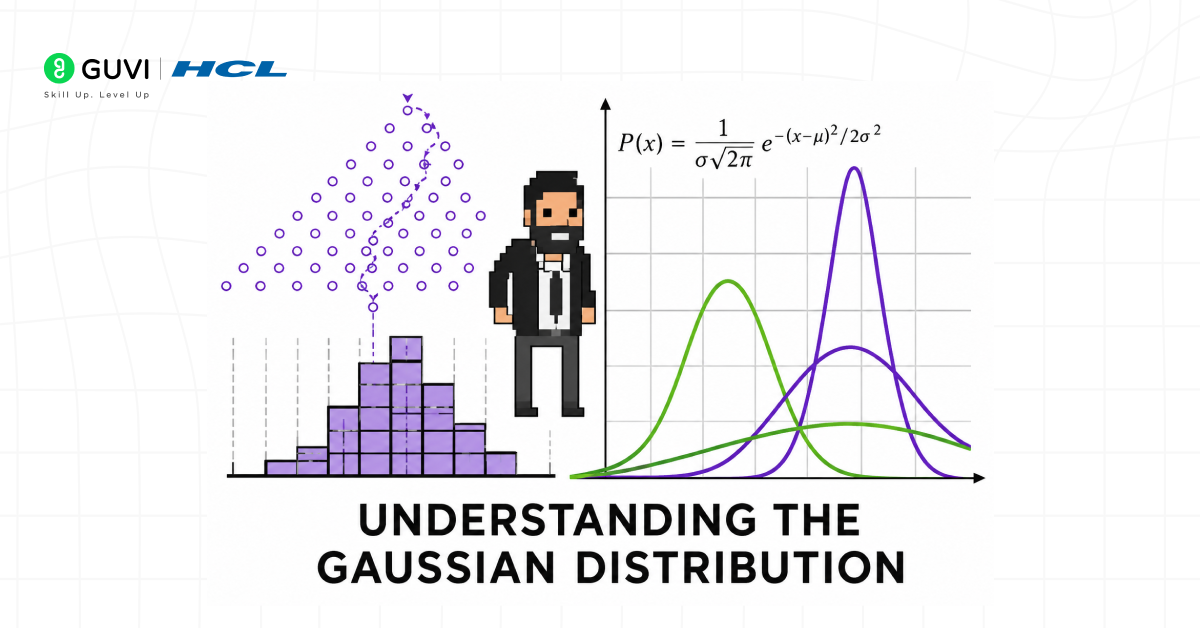
A Gaussian distribution, also called a normal distribution, is the familiar bell-shaped curve. It is defined by two parameters: the mean (center of the bell) and the variance (how wide the bell is). Most values cluster around the mean, with fewer values farther away.
- The bell curve in everyday life
Heights, test scores, and measurement errors often follow Gaussian distributions. If you measure the heights of adult women, you get a bell curve centered around the average height. Most women are close to average, with fewer very short or very tall women.
- Gaussian in multiple dimensions
In one dimension, you have a simple bell curve. In two dimensions, the Gaussian becomes a circular or elliptical blob. In three or more dimensions, it becomes a blob in high-dimensional space. The shape can be round (same variance in all directions) or stretched (different variances in different directions).
- Why Gaussians matter for GMM
GMM assumes each cluster in your data follows a Gaussian distribution. Real-world data often looks approximately Gaussian for each natural group. Even when individual clusters are not perfectly Gaussian, the model often works reasonably well.
The Gaussian distribution is named after Carl Friedrich Gauss, the renowned mathematician who studied the pattern while analyzing errors in astronomical observations during the early 19th century. Because this bell-shaped distribution appears so frequently in natural phenomena, measurement errors, and statistical data, it eventually became known as the normal distribution. Interestingly, the name does not imply that other distributions are unusual—it simply reflects how commonly the Gaussian pattern occurs in practice. Today, the normal distribution remains one of the most important concepts in statistics, probability theory, machine learning, and data science.

How Gaussian Mixture Models Work
- Multiple Gaussians combined
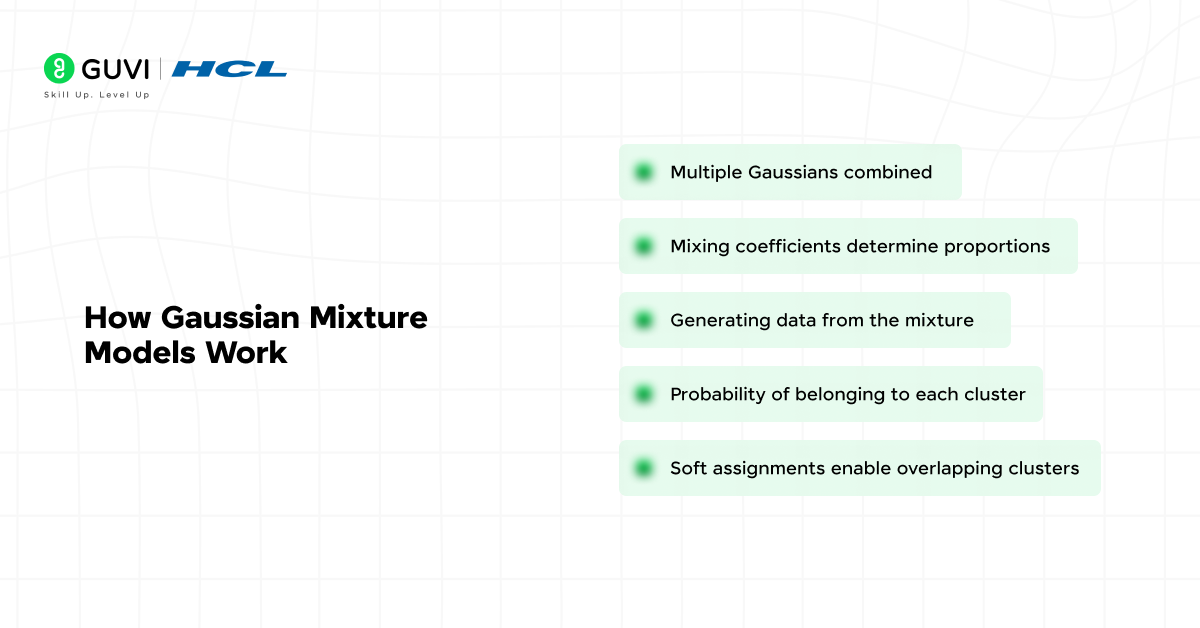
GMM models your data as coming from K different Gaussian distributions mixed together. Each Gaussian has its own mean (center), covariance (shape and spread), and mixing coefficient (how much of the data comes from this cluster).
- Mixing coefficients determine proportions
The mixing coefficients (also called weights) are probabilities that sum to 1. If you have 3 clusters with weights 0.5, 0.3, and 0.2, then 50% of your data comes from cluster 1, 30% from cluster 2, and 20% from cluster 3.
- Generating data from the mixture
Think of GMM as a generative model. To generate a new data point: first, randomly pick which Gaussian to use based on the mixing coefficients. Then, randomly sample a point from that chosen Gaussian. Your observed data is the result of this two-step random process.
- Probability of belonging to each cluster
For any data point, GMM calculates the probability it came from each Gaussian. These probabilities are called responsibilities or posterior probabilities. A point near the center of cluster 1 has high probability for cluster 1 and low probabilities for other clusters.
- Soft assignments enable overlapping clusters
Unlike K-means which force each point into one cluster, GMM acknowledges uncertainty. Points between clusters get split probabilities. This is more realistic for overlapping groups, like customer segments that share characteristics.
Read More: The Gaussian Function: Powering Modern AI with Curves
The EM Algorithm: How GMM Learns
The chicken-and-egg problem
To find cluster assignments, you need to know cluster parameters (means, variances). But to find cluster parameters, you need to know which points belong to which clusters. This circular dependency is solved by the Expectation-Maximization (EM) algorithm.
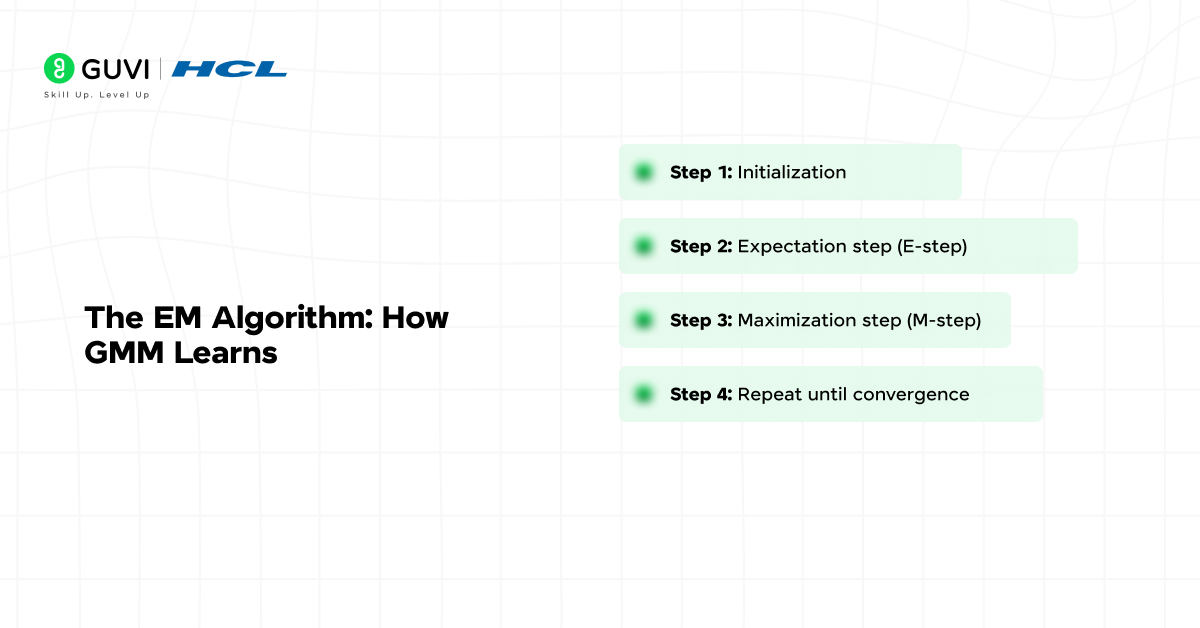
Step 1: Initialization
Start with random initial guesses for the parameters of each Gaussian. You might randomly pick K data points as initial means, assume spherical covariances (same variance in all directions), and set all mixing coefficients equal.
Step 2: Expectation step (E-step)
Given the current cluster parameters, calculate the probability that each data point belongs to each cluster. These are the responsibilities. Points close to a cluster center get high responsibility for that cluster.
Step 3: Maximization step (M-step)
Given the responsibilities from the E-step, update the cluster parameters. The new mean for each cluster is the weighted average of all points, weighted by their responsibilities. The new covariance measures the weighted spread. The new mixing coefficient is the average responsibility.
Step 4: Repeat until convergence
Alternate between E-step and M-step. Each iteration, the parameters improve and the model fits the data better. Continue until the parameters stop changing significantly (convergence) or you reach a maximum number of iterations.
Why EM works
Each E-step and M-step is guaranteed to increase (or at least not decrease) the likelihood of the data. The algorithm climbs uphill toward a local maximum likelihood. This guarantees you find a reasonable solution, though not necessarily the global best solution.
The Expectation-Maximization (EM) algorithm was formally introduced in a landmark 1977 paper by Arthur Dempster, Nan Laird, and Donald Rubin, although related ideas had appeared earlier in statistical research. EM became one of the most influential algorithms in statistics and machine learning because it provides a systematic way to estimate model parameters when data contains hidden, latent, or missing variables. While it is widely known for training Gaussian Mixture Models (GMMs), EM is also used in areas such as clustering, topic modeling, hidden Markov models, medical data analysis, and probabilistic inference, making it a foundational technique across modern data science and AI.
Choosing the Number of Clusters
- The model selection problem
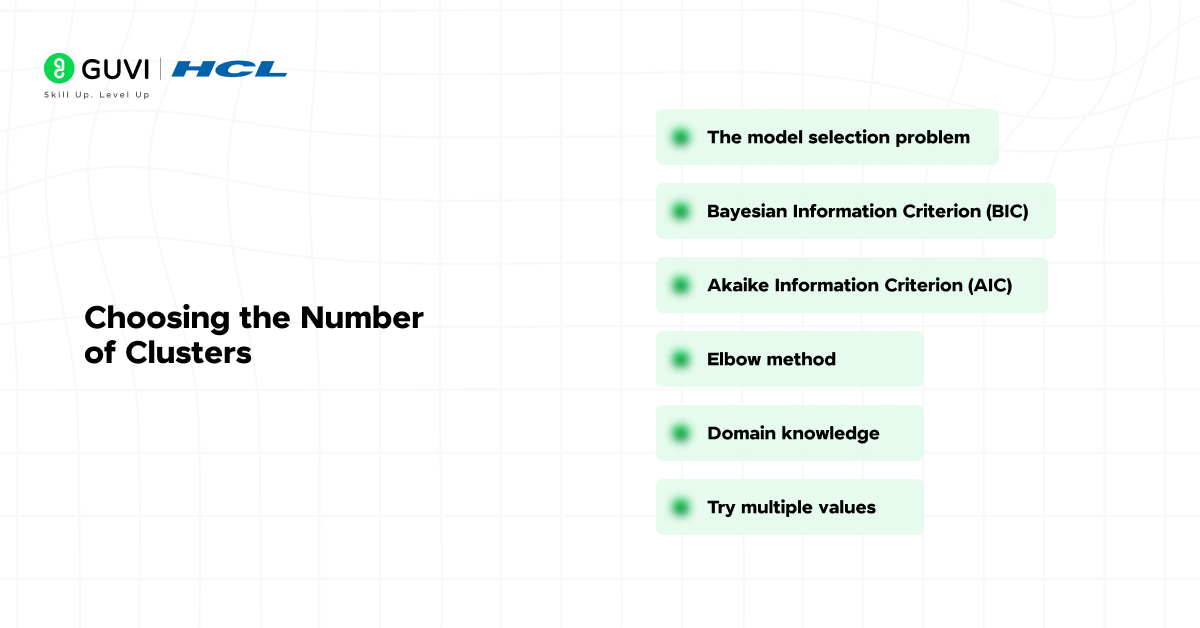
GMM requires you to specify how many clusters K exist in your data. Too few clusters and you miss real groups. Too many clusters and you overfit noise. Finding the right K is crucial.
- Bayesian Information Criterion (BIC)
BIC balances model fit against model complexity. Lower BIC is better. Calculate BIC for different values of K (like K = 1, 2, 3, 4, 5) and choose the K with the lowest BIC. BIC penalizes complex models (more clusters) to prevent overfitting.
- Akaike Information Criterion (AIC)
AIC is similar to BIC but penalizes complexity less severely. It often suggests more clusters than BIC. Lower AIC is better. Try both AIC and BIC to see if they agree on the best K.
- Elbow method
Plot the log-likelihood or BIC versus number of clusters. Look for an “elbow” where the improvement slows down dramatically. Before the elbow, adding clusters helps a lot. After the elbow, you get diminishing returns.
- Domain knowledge
Sometimes you know how many clusters should exist based on your problem. If you are analyzing customer types and your business has identified 4 customer segments, use K = 4 even if statistical criteria suggest different values.
- Try multiple values
Fit GMM with different K values and examine the results. Do the clusters make sense? Are they interpretable? Sometimes the “best” statistical K is not the most useful for your application.
Covariance Types in GMM
- Full covariance
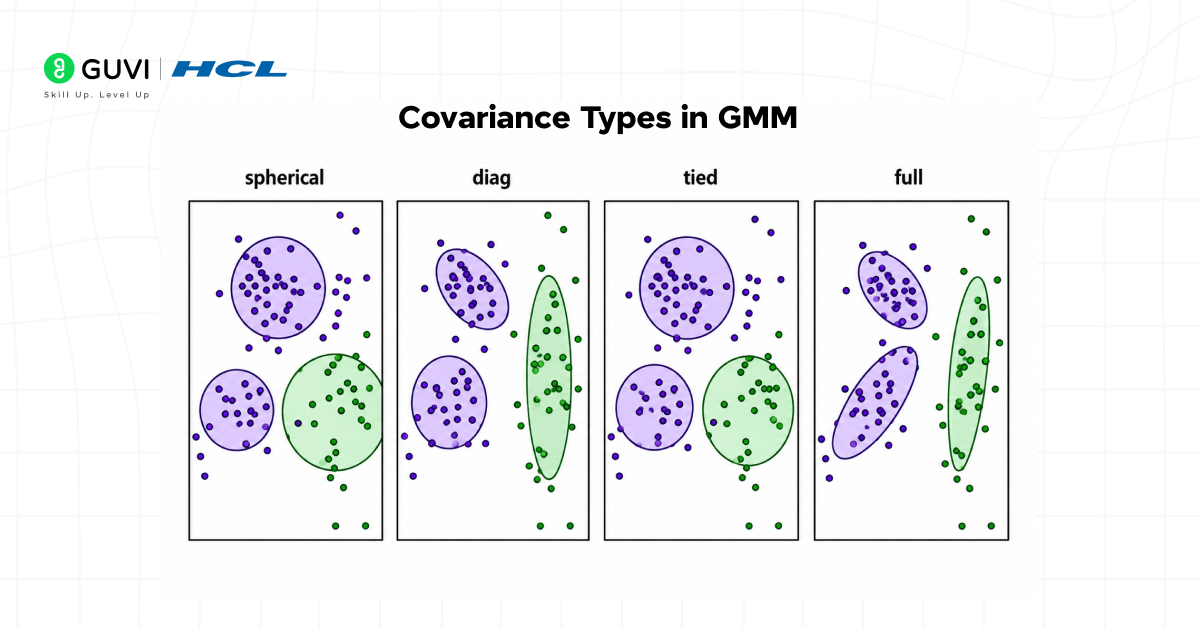
Each cluster has its own full covariance matrix that can be any elliptical shape, oriented in any direction. This is the most flexible but requires estimating the most parameters. Use when clusters have different shapes and you have enough data.
- Diagonal covariance (tied)
Each cluster can have different spreads along each dimension but the axes are aligned with the coordinate axes (no rotation). This is less flexible than full but requires fewer parameters. Use when you believe clusters are axis-aligned ellipsoids.
- Spherical covariance
Each cluster is a sphere (same variance in all directions) but can have different sizes. This is more flexible than K-means which forces all clusters to have the same size. Use when clusters are roughly round but different sizes.
- Tied covariance
All clusters share the same covariance matrix, meaning they all have the same shape and orientation, just different centers. Use when you believe all clusters have the same shape but are located in different places.
- Choosing covariance type
Start with full covariance if you have enough data (at least hundreds of points per cluster). If you have limited data or many dimensions, use diagonal or spherical to prevent overfitting. Compare model performance with different types using BIC or AIC.
Implementing GMM in Python
- Using scikit-learn’s GaussianMixture
from sklearn.mixture import GaussianMixture
import numpy as np
import matplotlib.pyplot as plt
# Generate sample data (two overlapping clusters)
np.random.seed(42)
X1 = np.random.randn(300, 2) + [2, 2]
X2 = np.random.randn(300, 2) + [6, 6]
X = np.vstack([X1, X2])
# Fit GMM with 2 components
gmm = GaussianMixture(n_components=2, covariance_type=’full’, random_state=42)
gmm.fit(X)
# Get cluster assignments (highest probability cluster)
labels = gmm.predict(X)
# Get probabilities for each cluster
probabilities = gmm.predict_proba(X)
print(f”Cluster centers:\n{gmm.means_}”)
print(f”Mixing coefficients: {gmm.weights_}”)
- Choosing the optimal number of clusters
# Try different numbers of clusters
n_components_range = range(1, 7)
bic_scores = []
aic_scores = []
for n in n_components_range:
gmm = GaussianMixture(n_components=n, covariance_type=’full’, random_state=42)
gmm.fit(X)
bic_scores.append(gmm.bic(X))
aic_scores.append(gmm.aic(X))
# Plot results
plt.plot(n_components_range, bic_scores, label=’BIC’)
plt.plot(n_components_range, aic_scores, label=’AIC’)
plt.xlabel(‘Number of clusters’)
plt.ylabel(‘Information Criterion’)
plt.legend()
plt.show()
# Best number of clusters (lowest BIC)
best_n = n_components_range[np.argmin(bic_scores)]
print(f”Best number of clusters: {best_n}”)
- Getting probability scores for new data
# Fit the model
gmm = GaussianMixture(n_components=2, random_state=42)
gmm.fit(X)
# New data point
new_point = np.array([[4, 4]])
# Get probabilities for each cluster
probs = gmm.predict_proba(new_point)
print(f”Probabilities: Cluster 1: {probs[0][0]:.3f}, Cluster 2: {probs[0][1]:.3f}”)
# Get the most likely cluster
cluster = gmm.predict(new_point)
print(f”Most likely cluster: {cluster[0]}”)
Real-World Applications of GMM
- Customer segmentation
Businesses use GMM to identify customer groups based on purchasing behavior, demographics, or engagement metrics. The soft clustering reveals customers who share characteristics of multiple segments, helping tailor marketing strategies.
- Image segmentation
GMM segments images by modeling pixel colors or intensities as mixtures of Gaussians. Each cluster represents a different region or object type. This works better than hard clustering for images with gradual transitions between regions.
- Anomaly detection
Fit GMM to normal data, then calculate the probability of new observations. Points with very low probability under all clusters are anomalies. This works for fraud detection, manufacturing defect detection, and network intrusion detection.
To learn more about Gaussian Mixture Model, do not miss the chance to enroll in this HCL GUVI’s AI and Machine Learning course covering machine learning fundamentals, feature engineering, deep learning, and practical implementation through hands-on projects and expert guidance with certification.
Conclusion
Gaussian Mixture Models are probabilistic clustering algorithms that model data as coming from multiple Gaussian distributions mixed together. Unlike hard clustering, GMM assigns probability scores indicating how likely each point belongs to each cluster.
GMM uses the Expectation-Maximization algorithm to learn cluster parameters iteratively by calculating cluster probabilities and updating cluster parameters.
GMM is more flexible than K-means because it handles elliptical clusters, provides probability estimates, and naturally handles overlapping clusters.
Choose the number of clusters using BIC or AIC. Use GMM when you need soft clustering, probability estimates, or density estimation.
FAQs
1. What is the difference between GMM and K-means?
GMM provides soft probabilistic cluster assignments while K-means gives hard assignments. GMM can model elliptical clusters of different shapes and sizes while K-means assumes spherical clusters. GMM is slower but more flexible and provides probability interpretations.
2. How do I choose the number of clusters for GMM?
Use information criteria like BIC or AIC. Fit GMM with different numbers of clusters and choose the one with the lowest BIC or AIC. Also consider the elbow method and domain knowledge about how many groups should exist in your data.
3. What is the EM algorithm?
EM stands for Expectation-Maximization. It is an iterative algorithm that alternates between the E-step (calculating probabilities each point belongs to each cluster) and M-step (updating cluster parameters based on those probabilities). It converges to a local maximum likelihood solution.
4. When should I use GMM instead of K-means?
Use GMM when clusters overlap, when you need probability estimates, when clusters have different shapes or sizes, or when doing density estimation. Use K-means when you need speed and simplicity with well-separated spherical clusters.
5. What does covariance type mean in GMM?
Covariance type controls the shape each cluster can have. Full allows any elliptical shape. Diagonal allows axis-aligned ellipses. Spherical forces circular clusters. Tied makes all clusters share the same shape. Choose based on your data and how much data you have to estimate parameters.
Success Stories

About the Author
Vishalini Devarajan
An Aerospace Engineer turned content writer, I focus on making complex concepts easy to understand through well-structured, reader-friendly blogs. Whether it’s a technical topic or a non-technical one, I love creating content that is clear, engaging, and impactful.
View all posts by Vishalini Devarajan
Connect with me @













Did you enjoy this article?