


Artificial Intelligence and Machine Learning Articles
AI/ML Skills Gap 2026: Why Companies Can't Find Job-Ready Talent
20 AI/ML Interview Questions Recruiters Can Use Without a Tech Background - Best Guide
How Industry-Backed AI/ML Bootcamps Are Changing the AI/ML Hiring Pipeline - Best Guide 2026
From IT Support to AI Engineer: A Realistic Career Switch Guide 2026
Get In Touch For Details! Request More Information
Vibe Coding Data Apps with Replit and Databricks
Jul 23, 2026 5 Min Read 590 Views
(Last Updated)
Creating enterprise data apps typically involves slow development, cumbersome processes, and dependency on the engineering team. Even an internal app can take weeks, as it involves creating data pipelines and backend systems along with compliance and governance processes.
At the same time, platforms like Replit have been reducing the time taken for app development to minutes using AI. However, there was a missing link: these apps were limited to prototype or hobby project levels because they could not connect to real enterprise data in a secure way.
In this article, you will learn how using Vibe Coding Data Apps with Replit and Databricks overcomes this barrier and allows enterprise data app development in minutes without compromising on security and governance.
TL;DR
- With Replit and Databricks, you can build real, enterprise-grade data apps directly on governed data without moving it.
- Vibe coding democratizes app development beyond engineers, allowing PMs and analysts to build apps.
- This integration removes the complexity around data access by using a direct connection between data platforms and the app development platform.
- You can build production-ready applications in minutes, with AI agents leveraging your real data.
- This is not just faster development; it’s a shift in enterprise software creation.
Table of contents
- Why Traditional Enterprise App Development Is Slow
- The Rise of Vibe Coding
- What Databricks Brings to the Table
- The Breakthrough: Replit + Databricks Integration
- How the Workflow Actually Works
- Example: Querying Databricks Data
- Frontend Fetch Example
- Real Example: Building a Customer Churn Analysis App
- The Role of Databricks Genie
- When Should You Use Replit + Databricks?
- When Should You NOT Use This?
- Key Insight: Who Can Build Software Is Changing
- Comparison: Traditional vs Modern Approach
- Common Mistakes to Avoid
- The Future of Enterprise App Development
- Conclusion
- FAQs
- What is vibe coding in enterprise applications?
- How does Replit connect to Databricks?
- Can non-developers build apps using Replit and Databricks?
- Is enterprise data secure when using this integration?
- What kind of applications can be built with this setup?
- Do you still need coding knowledge for vibe coding?
Why Traditional Enterprise App Development Is Slow
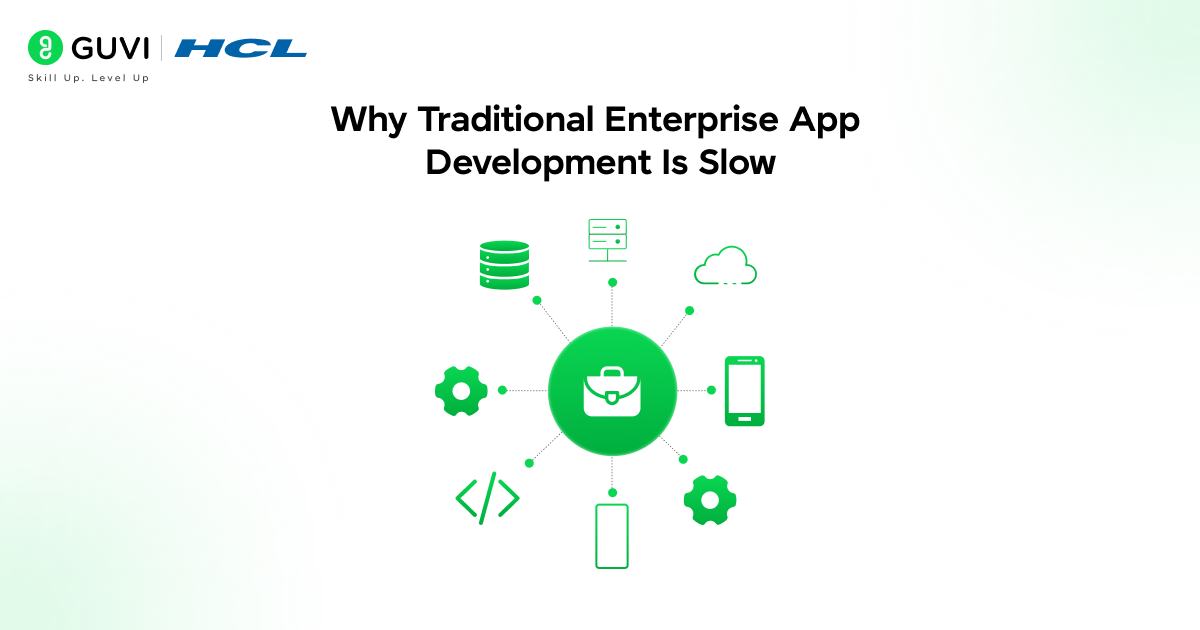
The complexity of building enterprise applications does not arise solely from coding. Data governance remains a primary challenge and is closely tied to enterprise systems.
Most enterprise organizations keep their most valuable data in a central system like Databricks, which enforces stringent governance rules. Engineers are not able to simply pull this data, and moving it around requires multiple approval workflows and technical steps to ensure data integrity and compliance.
This complexity in managing data access means that even an internal tool like a dashboard requires data engineers to develop pipelines and support them, backend engineers to build APIs for the application, and frontend engineers to build the UI. This typically leads to a delayed and complicated workflow.
Therefore, business teams often experience a prolonged wait for tools they require urgently.
The Rise of Vibe Coding

Vibe coding redefines how software is built. Instead of coding, describe what you’d like and let AI create it.
It’s a method that’s allowed developers, designers, and product managers to build applications rapidly, and Replit is key here, providing an AI-powered place where applications can be generated, edited, and deployed very quickly using vibe coding with Replit.
Vibe coding’s downfall, however, was in prototyping; it was fine for prototyping, but failed where real enterprise data was involved. Without access to real data, apps were simply isolated from business processes.
This is where Databricks comes into play.
What Databricks Brings to the Table
Databricks isn’t just a database. It’s an enterprise data and AI platform where businesses house their data, models, and analytics. These are enterprise-grade datasets, which can include revenue, customer information, operational logs, performance reports, and many more. Due to their sensitivity, Databricks provides tight control and security. However, it acts as a single source of truth, and any application can connect directly, taking away the worry of copying and duplicating data.
The Breakthrough: Replit + Databricks Integration
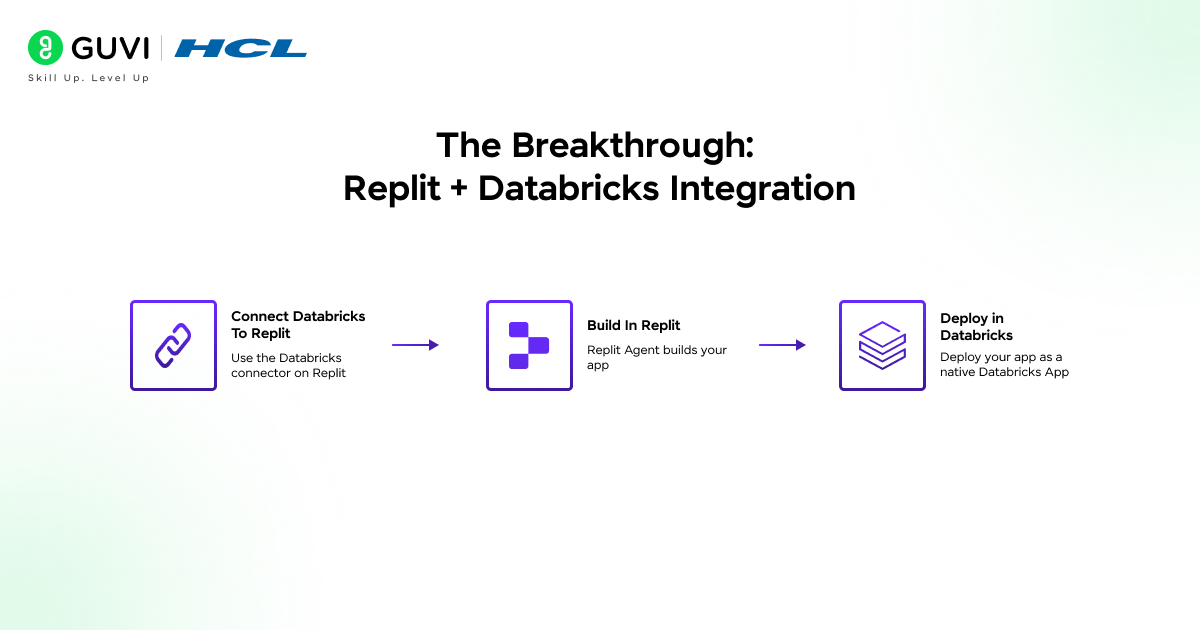
The breakthrough that allows enterprise applications to be built rapidly as well as securely is the connection of Replit and Databricks.
How the Workflow Actually Works
Instead of complicated setups, the flow works as follows.
- Add the Databricks connector inside Replit.
- Connect to your Databricks workspace in a secure way.
- Let Replit Agent find datasets available in the Databricks workspace.
- Describe your app using natural language.
- Generate UI + backend automatically.
- Query your Databricks data directly in real time.
No pipelines, no manual backend settings, no data duplication.
Example: Querying Databricks Data
from databricks import sql
connection = sql.connect(
server_hostname=”your-databricks-host”,
http_path=”your-http-path”,
access_token=”your-token”
)
cursor = connection.cursor()
cursor.execute(“SELECT * FROM weather_data LIMIT 10”)
rows = cursor.fetchall()
for row in rows:
print(row)
Frontend Fetch Example
async function fetchData() {
const response = await fetch(‘/api/weather’);
const data = await response.json();
console.log(data);
}
Real Example: Building a Customer Churn Analysis App
Let’s consider a more specific use case with real enterprise data in Databricks, for instance, building a customer churn analysis app. A user starts by describing what they want in the Replit chat.
“Build a dashboard that identifies customers likely to churn based on usage patterns, transaction history, and engagement metrics stored in Databricks. Highlight high-risk users and show churn trends over time.”
The Replit agent will generate the UI, backend application, and hook directly to your Databricks tables. The application will then query your customer data and apply simple logic or models on top of it in order to show high-risk users and churn trends. This uses your governed Databricks data directly without exporting any data or building any pipeline. What would usually take weeks to build can be built in a few minutes, allowing you to make faster decisions based on your data.
The Role of Databricks Genie
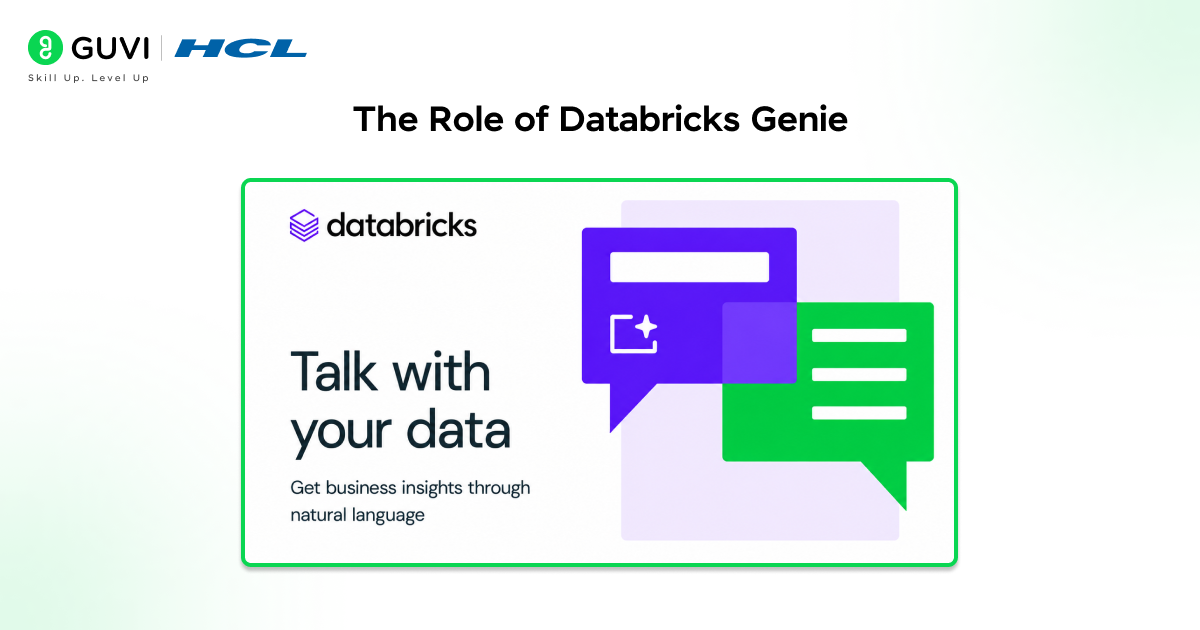
An additional piece is Databricks Genie, a data copilot.
It lets users query their data in natural language and responds with answers showing what datasets and tables were used to create them.
This addresses one of the largest blockers in data-driven development, which is figuring out what data should be used.
When combined with Replit, Genie can help you figure out the data you should use while the AI agent builds the app on top of it. This helps to create an end-to-end loop between discovering data and building an application.
To take this further and better understand how AI-driven workflows power enterprise data applications, you can explore this GenAI ebook.
Also Read: Genie 3: Google DeepMind’s New World Model Explained
Enterprise data applications that once took weeks to build can now be created in minutes using AI-driven tools like Replit combined with direct connections to governed data platforms like Databricks.

When Should You Use Replit + Databricks?
This configuration works well when you need to build applications that use actual enterprise data.
This would be ideal for internal dashboards, workflows, analytics applications, and decision-support systems, and would be beneficial to teams such as Sales, Finance, Operations, and Marketing.
It is also an optimal solution for high-velocity requirements. Instead of relying on engineering teams, the end users themselves are building.
When Should You NOT Use This?
This may not be appropriate for highly customized applications that require a lot of control over the backend, or for systems that involve complex infrastructure.
It would also not be appropriate for teams that do not use Databricks or that lack a centralized platform for their data, where more traditional development methodologies may be better.
Key Insight: Who Can Build Software Is Changing
What’s most important isn’t the technology itself. It’s about how organizations structure their software development.
Today, rather than just engineers being able to build software, anyone who knows the problem well and can communicate it properly can.
This means product managers, analysts, and operations teams are able to build applications to address their own problems. The engineering team isn’t a bottleneck anymore; instead, they can take care of the infrastructure while everyone else builds their tools.
Comparison: Traditional vs Modern Approach
If you wanted to build data applications in the old way, you would need to deal with many abstraction layers. You have data pipelines, APIs, backend, and frontend to take care of. In the modern way, you use Replit and Databricks; this gets distilled down into a single layer: you describe the app, the AI builds it, and the data platform feeds it. The complexity decreases while keeping enterprise-grade standards.
Common Mistakes to Avoid
First, do not assume the AI is going to build the app in a fully perfect way; it definitely speeds up development, but you will have to check and refine its result.
Do not neglect data understanding. Even with tools abstracting access, data is still data. You need to be careful about what you are using.
Finally, do not over-automate without validation; you do not want wrong insights to lead to wrong applications.
The Future of Enterprise App Development
Replit and Databricks are only two pieces of the story. The real trend is that enterprise applications become thin layers over powerful data engines. Instead of building everything from scratch, developers and organizations start assembling them from tools with AI and data platforms.
This significantly reduces development time while allowing more people to build. This approach is likely to become the default method in the enterprise world.
To effectively use tools like Replit and Databricks, understanding data workflows, precise query formulation, and how AI interacts with structured datasets is essential. Programs like HCL GUVI’s Artificial Intelligence and Machine Learning Course can help you build these skills through hands-on experience with real-world data and AI-driven systems.
Conclusion
Replit and Databricks provide an exciting new paradigm for creating enterprise data applications. Together, they eliminate the largest bottlenecks that exist in traditional data development by uniting AI-powered development with governed data access.
This is more than just building faster; it’s expanding who can create software and how fast great ideas can be turned into real applications.
If you are looking to create secure, scalable, and data-intensive applications without complicated infrastructure, this duo will provide you with an exciting solution.
FAQs
1. What is vibe coding in enterprise applications?
Vibe coding is a development approach where you describe what you want in natural language, and AI generates the application. In enterprises, it allows faster app creation without writing everything manually.
2. How does Replit connect to Databricks?
Replit connects to Databricks using a built-in connector. After authentication, it can access available datasets, tables, and models directly without needing manual setup or data movement.
3. Can non-developers build apps using Replit and Databricks?
Yes, business users like product managers, analysts, and operations teams can build applications by describing requirements. AI handles most of the coding and integration work.
4. Is enterprise data secure when using this integration?
Yes, data remains inside Databricks and is accessed through governed permissions. This ensures compliance and avoids copying sensitive data into external systems.
5. What kind of applications can be built with this setup?
You can build dashboards, analytics tools, workflow automation apps, and decision-support systems that rely on real enterprise data.
6. Do you still need coding knowledge for vibe coding?
Basic understanding helps, but it is not mandatory. The main skill is clearly defining the problem and validating the output generated by AI.
Success Stories

About the Author
Vishalini Devarajan
An Aerospace Engineer turned content writer, I focus on making complex concepts easy to understand through well-structured, reader-friendly blogs. Whether it’s a technical topic or a non-technical one, I love creating content that is clear, engaging, and impactful.
View all posts by Vishalini Devarajan
Connect with me @








Did you enjoy this article?