


Artificial Intelligence and Machine Learning Articles
AI/ML Skills Gap 2026: Why Companies Can't Find Job-Ready Talent
20 AI/ML Interview Questions Recruiters Can Use Without a Tech Background - Best Guide
How Industry-Backed AI/ML Bootcamps Are Changing the AI/ML Hiring Pipeline - Best Guide 2026
From IT Support to AI Engineer: A Realistic Career Switch Guide 2026


Get In Touch For Details! Request More Information

Does Claude Store Conversations?
Aug 07, 2026 3 Min Read 422 Views
(Last Updated)
Artificial intelligence assistants are transforming how people write, code, research, and improve productivity. As AI adoption grows, many users ask: Does Claude store conversations? Understanding Anthropic’s data retention practices helps you use Claude more confidently.
Table of contents
- TL;DR Summary
- Direct Answer Box
- How Claude Handles Conversations
- Common Reasons Conversations May Be Stored
- Does Claude Store Conversations? Understanding the Data Retention Process
- Step 1: User Sends a Prompt
- Step 2: Claude Processes the Request
- Step 3: Operational and Security Checks
- Step 4: Data Handling Depends on Your Account
- Step 5: Review Privacy Controls
- Step 6: Avoid Sharing Sensitive Information
- Step 7: Verify Privacy Policies Regularly
- ⚠️ Warning
- Understanding Claude's Data Retention Policies
- Conclusion
- FAQs
- Does Claude store conversations?
- Are all Claude plans subject to the same data policies?
- Does Claude Enterprise use customer conversations to train AI models?
- Should I share confidential business information with Claude?
- Can I control how my data is handled?
- How can I learn more about Claude's privacy practices?
- What is the safest way to use Claude?
TL;DR Summary
- Claude may retain conversations for operational, security, and service-related purposes depending on the product you use.
- Data handling differs across Claude Free, Pro, Team, Enterprise, and API offerings.
- Enterprise and API customers receive stronger privacy protections than consumer users.
- Users should review Anthropic’s privacy policy before sharing sensitive information.
- Understanding Claude’s data retention practices helps you use the AI assistant more safely.
📊 Data Point
Anthropic provides different privacy and data handling policies for its consumer products, Team plans, Enterprise offerings, and API services. Enterprise customers also receive additional administrative controls and privacy protections designed for business use.
Source: https://www.anthropic.com/legal/privacy
Direct Answer Box
| Does Claude store conversations? Yes, Claude may temporarily retain conversations to operate its services, maintain security, investigate misuse, comply with legal obligations, and improve platform reliability. However, how conversations are stored, retained, or used depends on whether you’re using Claude’s consumer plans, Team, Enterprise, or API products. Reviewing Anthropic’s privacy policy helps you understand which data practices apply to your account. |
How Claude Handles Conversations
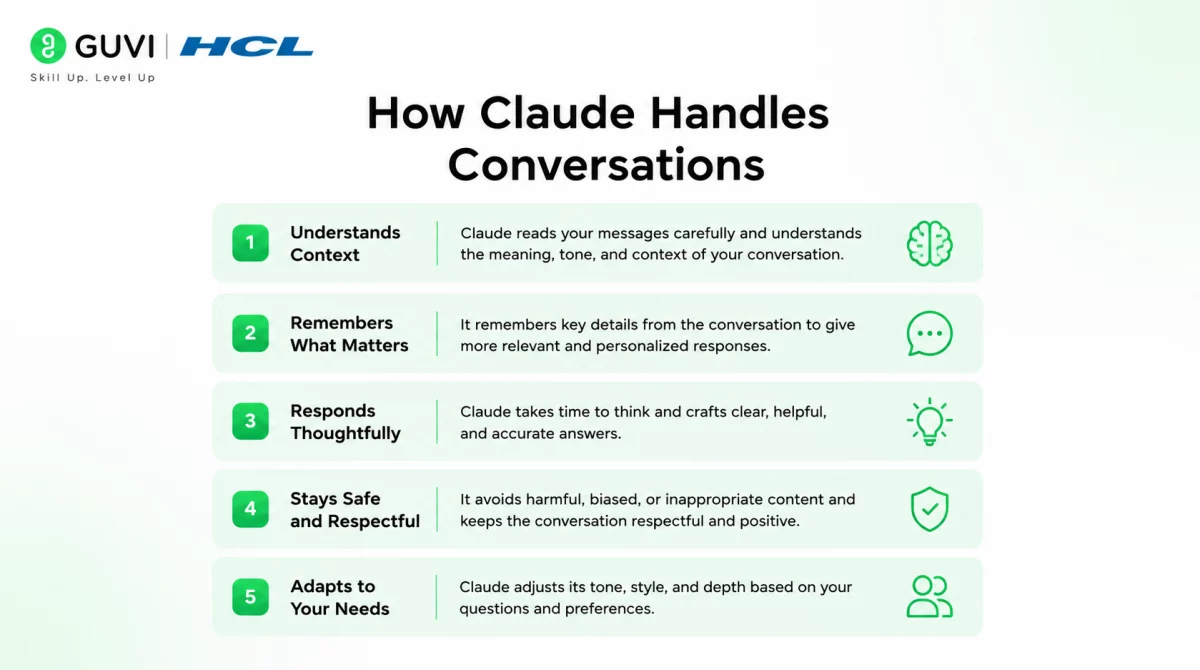
When you interact with Claude, your prompts and responses pass through Anthropic’s systems so the AI can generate relevant answers. Depending on your account type and applicable policies, some conversations may be temporarily retained for operational purposes such as maintaining platform reliability, detecting abuse, improving security, and complying with legal requirements.
However, Anthropic does not apply the same data practices to every product. Consumer users, Team plans, Enterprise customers, and API users each have different privacy protections and administrative controls. Understanding these differences helps you decide how to use Claude appropriately for personal or professional work.
Common Reasons Conversations May Be Stored
- Operating and maintaining Claude’s services
- Detecting abuse, fraud, or malicious activity
- Improving platform reliability and security
- Meeting legal and regulatory obligations
- Supporting customer service and troubleshooting
If you’re learning how AI platforms manage user information, HCL GUVI’s AI Ebook explains data handling, machine learning, and responsible AI concepts through practical examples.
Does Claude Store Conversations? Understanding the Data Retention Process
Let’s explore how Anthropic manages conversation data across different Claude products.
Step 1: User Sends a Prompt
Every interaction begins when a user submits a prompt or uploads information to Claude. The system processes this request to generate an appropriate response.
Step 2: Claude Processes the Request
Claude analyzes the prompt using its AI model and generates a response based on the information provided. During this process, the request passes through Anthropic’s infrastructure.
Step 3: Operational and Security Checks
Some conversations may be temporarily retained to help maintain platform stability, investigate misuse, detect harmful activity, improve security, and comply with applicable legal obligations.
Step 4: Data Handling Depends on Your Account
Anthropic applies different privacy practices depending on the Claude product you’re using. Consumer accounts, Team plans, Enterprise customers, and API users have different policies regarding conversation handling, administrative controls, and model training protections.
Step 5: Review Privacy Controls
Before sharing sensitive information, review the privacy settings and documentation available for your account. Understanding these controls helps you determine what information is appropriate to share with Claude.
Step 6: Avoid Sharing Sensitive Information
Regardless of the account type you use, avoid entering confidential information such as:
- Passwords
- Banking details
- Government identification numbers
- Medical records
- Confidential legal documents
- Proprietary business information

Step 7: Verify Privacy Policies Regularly
Privacy policies and data handling practices may evolve as AI services continue to develop. Reviewing Anthropic’s latest documentation helps ensure you understand how your conversations are managed.
⚠️ Warning
Although Claude includes multiple privacy and security safeguards, users should avoid treating any AI assistant as a secure repository for highly confidential personal or business information. Always review the applicable privacy policy before sharing sensitive data.
To better understand responsible AI development and privacy-aware machine learning, HCL GUVI’s AI & Machine Learning Course provides practical, project-based learning aligned with real-world AI applications.
Anthropic provides a dedicated Trust Center where organizations can review its security certifications, compliance information, privacy documentation, and enterprise security practices. This helps businesses evaluate Claude’s security and compliance posture before adopting it for enterprise use.
Understanding Claude’s Data Retention Policies
Claude’s data retention policies vary depending on the product you use. While all versions prioritize platform security and responsible AI usage, Enterprise and API customers receive additional privacy protections and administrative controls designed for business environments.
Understanding these differences helps users choose the right Claude plan based on their privacy and compliance requirements.
| Claude Product | Data Handling Focus |
| Free & Pro | Consumer privacy with operational data handling |
| Team | Shared workspace with additional administrative controls |
| Enterprise | Enhanced privacy, governance, and security features |
| API | Customer-controlled integrations with stronger data protections |
| All Products | Security monitoring, abuse prevention, and service reliability |
Conclusion
Whether Claude stores conversations depends on the product you use and Anthropic’s applicable privacy policies. While conversations may be retained for operational, security, and legal purposes, Enterprise and API offerings provide stronger privacy protections. Understanding Claude’s data handling practices, reviewing privacy controls, and avoiding sensitive information help you use the AI assistant more safely and confidently.
FAQs
1. Does Claude store conversations?
Yes. Claude may temporarily retain conversations for operational, security, abuse prevention, and legal compliance purposes, depending on the product you use.
2. Are all Claude plans subject to the same data policies?
No. Data handling differs across Free, Pro, Team, Enterprise, and API offerings, with Enterprise and API products providing stronger privacy protections.
3. Does Claude Enterprise use customer conversations to train AI models?
No. According to Anthropic, Claude Enterprise customer prompts and outputs are not used to train generative AI models by default.
4. Should I share confidential business information with Claude?
Only after reviewing your organization’s policies and the privacy protections associated with your Claude plan. Avoid sharing highly sensitive information unless appropriate safeguards are in place.
5. Can I control how my data is handled?
The available privacy controls depend on the Claude product you’re using. Enterprise customers receive additional administrative and governance features.
6. How can I learn more about Claude’s privacy practices?
Review Anthropic’s official Privacy Policy, Trust Center, and Enterprise documentation to understand how conversation data is collected, retained, and protected.
7. What is the safest way to use Claude?
Use Claude for writing, coding, research, and productivity tasks while avoiding passwords, financial information, confidential legal documents, medical records, and other highly sensitive data unless you fully understand the applicable privacy protections.
Success Stories

About the Author
Vishalini Devarajan
An Aerospace Engineer turned content writer, I focus on making complex concepts easy to understand through well-structured, reader-friendly blogs. Whether it’s a technical topic or a non-technical one, I love creating content that is clear, engaging, and impactful.
View all posts by Vishalini Devarajan
Connect with me @










Did you enjoy this article?