


Data Science Articles
Data Analyst or Data Scientist: Which Has Better Demand for Mid-Career BPO Professionals?
BPO Workforce Management Analyst to Data Analyst: What Skills Transfer?
CFA Charterholders: Are You Missing Out on Data Science Opportunities?

Get In Touch For Details! Request More Information
Data Science Course for Customer Support Professionals
Oct 22, 2026 3 Min Read 29 Views
(Last Updated)
Working in customer support helps you understand customer behaviour, recurring complaints, service quality, and business processes. But if you want to move beyond handling customer queries and explore a technical career, data science may offer an alternative path.
The challenge is knowing which data science course for customer support professionals is worth your time and money. You need a program that matches your current skills, fits around your work schedule, and teaches practical concepts you can demonstrate to employers.
Table of contents
- TL;DR
- Quick Answer
- Why Should Customer Support Professionals Learn Data Science?
- What Should a Data Science Course for Beginners Include?
- Python Programming
- Statistics and Mathematics
- Data Cleaning and Analysis
- Data Visualization
- Machine Learning Fundamentals
- Which Data Science Course Should You Choose?
- For Complete Beginners
- For Working Professionals
- For Career Switchers
- What Data Science Projects Can Beginners Build?
- How Much Does a Data Science Course Cost in India?
- Does a Data Science Course With Placement Assistance Guarantee a Job?
- Conclusion
- FAQs
- Can customer support professionals learn data science without a technical degree?
- Which data science course is suitable for customer support professionals?
- Can I take an online data science course in India while working?
- How long does it take to learn data science?
- What projects should customer support professionals build?
- Is a data science certification course enough to get a job?
- Should customer support professionals learn data analytics or data science first?
TL;DR
- Customer support experience can provide useful context for analysing customer behaviour and service performance.
- Start with Python, statistics, data analysis, and SQL before moving into machine learning.
- Look for a data science course for working professionals with flexible learning options and practical projects.
- Compare the syllabus, course fees, certification, and placement assistance before enrolling.
- Build projects using customer support data to demonstrate your analytical skills.
Quick Answer
| Customer support professionals can explore data science by learning Python, statistics, data analysis, and machine learning. These skills can help them investigate customer behaviour, identify service trends, and support data-driven decisions. IBM’s guide explains how data science combines statistical methods, programming, and domain knowledge to uncover insights and solve business problems. |
Why Should Customer Support Professionals Learn Data Science?
Customer support teams generate valuable information through tickets, customer feedback, response times, complaint categories, satisfaction scores, and resolution records.
Data science helps professionals examine these datasets, identify patterns, and investigate potential causes behind business problems.
For example, instead of simply handling repeated complaints, you could analyse ticket categories to identify the most common issues. You might also investigate whether resolution time affects customer satisfaction or which types of queries generate the most repeat contacts.
What Should a Data Science Course for Beginners Include?
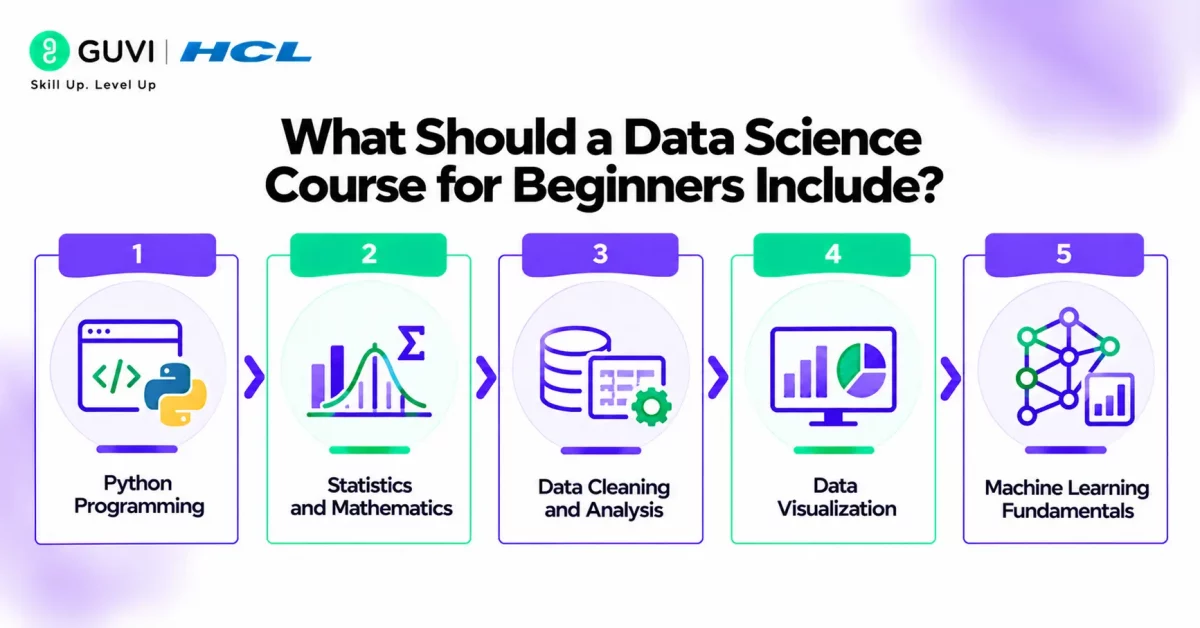
Before enrolling in a data science certification course, examine its syllabus carefully. A suitable program should introduce foundational concepts before progressing to more advanced topics.
1. Python Programming
Learn variables, data types, loops, functions, and basic programming logic. Python is widely used in data science for processing datasets and building machine learning models.
2. Statistics and Mathematics
Understand averages, distributions, probability, correlation, and basic statistical reasoning. These concepts help you interpret data instead of relying on charts or model outputs without understanding them.
3. Data Cleaning and Analysis
Learn how to handle missing values, remove duplicates, identify inconsistencies, and prepare datasets for analysis. Libraries such as pandas and NumPy are useful for these tasks.
4. Data Visualization
Learn to communicate findings through charts and graphs. Python libraries such as Matplotlib and Seaborn can help you explore patterns and explain results.
5. Machine Learning Fundamentals
Once you understand the basics, progress to supervised and unsupervised learning, model evaluation, and introductory predictive analytics.
A good data science course syllabus should explain these topics clearly and include exercises that allow you to apply them.
Which Data Science Course Should You Choose?
The best option depends on your experience, available time, budget, and career goal.
For Complete Beginners
Choose a course that starts with programming fundamentals, basic statistics, and data handling. Avoid programs that assume you already understand Python or mathematical concepts.
For Working Professionals
A data science course for working professionals should offer flexible access to lessons, manageable modules, practice exercises, and a clear learning sequence. Check whether the schedule realistically fits around your shifts.
For Career Switchers
Look for structured projects, resume guidance, technical interview preparation, and transparent information about career support. A certificate alone does not demonstrate that you can solve practical problems.
Customer support datasets can be useful for both descriptive and predictive analysis. Descriptive analysis can show which issues occur most frequently, while predictive modelling can explore whether historical patterns help estimate future ticket volumes or customer churn.
What Data Science Projects Can Beginners Build?
Projects help you apply course concepts to problems that employers can understand.
Start with customer support scenarios that connect your existing knowledge to analytical work.
- Customer Ticket Analysis: Use Python to identify the most frequent complaint categories and changes in ticket volume.
- Customer Satisfaction Analysis: Explore relationships between satisfaction scores, response times, and resolution times without assuming that correlation proves causation.
- Support Volume Forecasting: Use historical ticket counts to explore basic forecasting methods.
- Customer Churn Prediction: Build an introductory classification model using a suitable public dataset and evaluate its performance carefully.
For each project, document the business question, dataset, cleaning process, methods used, findings, and limitations. Use public or synthetic data rather than confidential customer information from your workplace.

How Much Does a Data Science Course Cost in India?
Data science course fees vary depending on course depth, duration, instructor support, project work, and career services.
Before paying, compare the total fee rather than relying only on a discount or advertised starting price. Check whether certification, assessments, mentoring, and placement assistance are included or charged separately.
Also compare the amount of practical work offered. A lower-cost course may suit you if you can learn independently, while a structured program may be more useful if you need regular guidance.
Does a Data Science Course With Placement Assistance Guarantee a Job?
No. Placement assistance and job placement are different.
Placement assistance may include resume reviews, mock interviews, career guidance, or access to hiring opportunities. It does not automatically guarantee an interview, job offer, or particular salary.
Before enrolling, ask the provider what support is included, whether eligibility conditions apply, and how placement outcomes are reported. Prioritize courses that help you develop demonstrable skills rather than relying on employment promises.
Conclusion
A data science career transition from customer support is possible, but choosing the right course is only the first step. You need a structured syllabus, consistent practice, relevant projects, and realistic expectations about the job search.
Compare course fees, certification, flexibility, project opportunities, and placement assistance before enrolling. If your main goal is to enter analytics quickly, consider building a foundation in Excel, SQL, and visualization alongside Python. Then progress toward statistics and machine learning as your skills develop.
FAQs
1. Can customer support professionals learn data science without a technical degree?
Yes. You can begin learning programming, statistics, and data analysis without a technical degree. However, job requirements vary, and practical skills remain essential.
2. Which data science course is suitable for customer support professionals?
Choose a beginner-friendly course that covers Python, statistics, data analysis, visualization, machine learning fundamentals, and hands-on projects.
3. Can I take an online data science course in India while working?
Yes. An online course with flexible lessons and a manageable schedule can help you study alongside your job.
4. How long does it take to learn data science?
The timeline depends on your starting skills, study hours, and course depth. Learning foundational tools takes less time than becoming proficient in machine learning and building a strong project portfolio.
5. What projects should customer support professionals build?
Customer ticket analysis, satisfaction analysis, support volume forecasting, and introductory churn prediction are relevant projects to explore.
6. Is a data science certification course enough to get a job?
No. Certification can document course completion, but employers may also assess your technical knowledge, projects, problem-solving ability, and communication skills.
7. Should customer support professionals learn data analytics or data science first?
If you are new to technical work, data analytics can be a practical starting point because it builds skills in spreadsheets, SQL, and visualization. You can progress to Python, statistics, and machine learning if your career goals require data science.
Success Stories

About the Author
HCL GUVI
This article was selected and published as part of the HCL GUVI AI Blogathon 2026, an initiative designed to encourage students, AI enthusiasts, and aspiring tech writers to simplify complex AI concepts through impactful technical content. The contest recognized high-quality, original, and insightful AI-focused blogs, with selected authors receiving publication opportunities on the HCL GUVI blog platform along with official author credits and recognition.
View all posts by HCL GUVI
Connect with me @






Did you enjoy this article?