


Artificial Intelligence and Machine Learning Articles
Finance Manager to Data Analytics: Career Growth, Salary and Seniority
How to Evaluate LLM Outputs in Production Deployments
AI/ML Skills Gap 2026: Why Companies Can't Find Job-Ready Talent
20 AI/ML Interview Questions Recruiters Can Use Without a Tech Background - Best Guide


Get In Touch For Details! Request More Information

Data Labeling Best Practices for Supervised Learning
Sep 07, 2026 4 Min Read 286 Views
(Last Updated)
Supervised learning depends on labeled examples to teach machine learning models how to recognize patterns and make predictions. If labels are inconsistent, inaccurate, or incomplete, even a well-designed model can produce unreliable results. Data Labeling is therefore a critical step in the machine learning lifecycle. This guide explains what data labeling involves, why label quality matters, common labeling approaches, and best practices for creating reliable datasets for supervised learning.
Table of contents
- TL;DR Summary
- Why Data Labeling Matters
- What Is Data Labeling?
- Types of Data Labeling
- Image Labeling
- Text Labeling
- Audio Labeling
- Video Labeling
- Data Labeling Workflow
- Step 1: Define the Objective
- Step 2: Create Labeling Guidelines
- Step 3: Select Representative Data
- Step 4: Label the Data
- Step 5: Review Labels
- Step 6: Measure Quality
- Common Data Labeling Challenges
- Inconsistent Labels
- Ambiguous Data
- Human Error
- Class Imbalance
- Changing Requirements
- Benefits of High-Quality Data Labeling
- Better Model Performance
- Improved Generalization
- More Reliable Evaluation
- Reduced Rework
- When Should You Use Different Data Labeling Approaches?
- Image Classification
- Object Detection
- Image Segmentation
- Text Classification
- Speech Recognition
- Key Concepts to Remember
- A Practical Data Labeling Workflow
- Define the ML Objective
- Establish Label Definitions
- Create Annotation Guidelines
- Run a Pilot
- Scale Annotation
- Perform Quality Checks
- Update Guidelines
- Real-World Applications
- Healthcare
- Retail
- Autonomous Vehicles
- Customer Service
- Best Practices
- Conclusion
- FAQs
- What is Data Labeling?
- Why is Data Labeling important?
- What types of data can be labeled?
- What are labeling guidelines?
- How can labeling errors be reduced?
- What is a pilot labeling phase?
- How does data labeling affect supervised learning?
TL;DR Summary
- Data labeling assigns meaningful labels to raw data.
- High-quality labels are essential for supervised learning.
- Clear annotation guidelines improve consistency.
- Multiple annotators can reduce individual labeling errors.
- Regular quality checks help maintain dataset reliability.
Direct Answer
| Data Labeling is the process of assigning meaningful labels or annotations to raw data so supervised learning models can learn from examples. Labels may identify objects in images, classify text, mark audio content, or represent numerical outcomes. Accurate and consistent labeling improves training data quality, helping machine learning models learn reliable patterns and produce better predictions. |
Why Data Labeling Matters
Supervised learning models learn relationships between input data and labeled outcomes. Poor labels can teach the model incorrect patterns.
High-quality labeling helps provide:
- Accurate training examples
- Consistent annotations
- Better model performance
- Reduced labeling errors
- Reliable evaluation datasets
- Stronger model generalization
What Is Data Labeling?
Data Labeling involves adding information to raw datasets so machine learning algorithms can learn from them.
Depending on the application, labels can include:
- Categories
- Object locations
- Sentiment
- Transcriptions
- Numerical values
- Semantic regions
For example, an image dataset for detecting vehicles could contain images where cars, buses, and trucks are assigned appropriate labels.
Types of Data Labeling
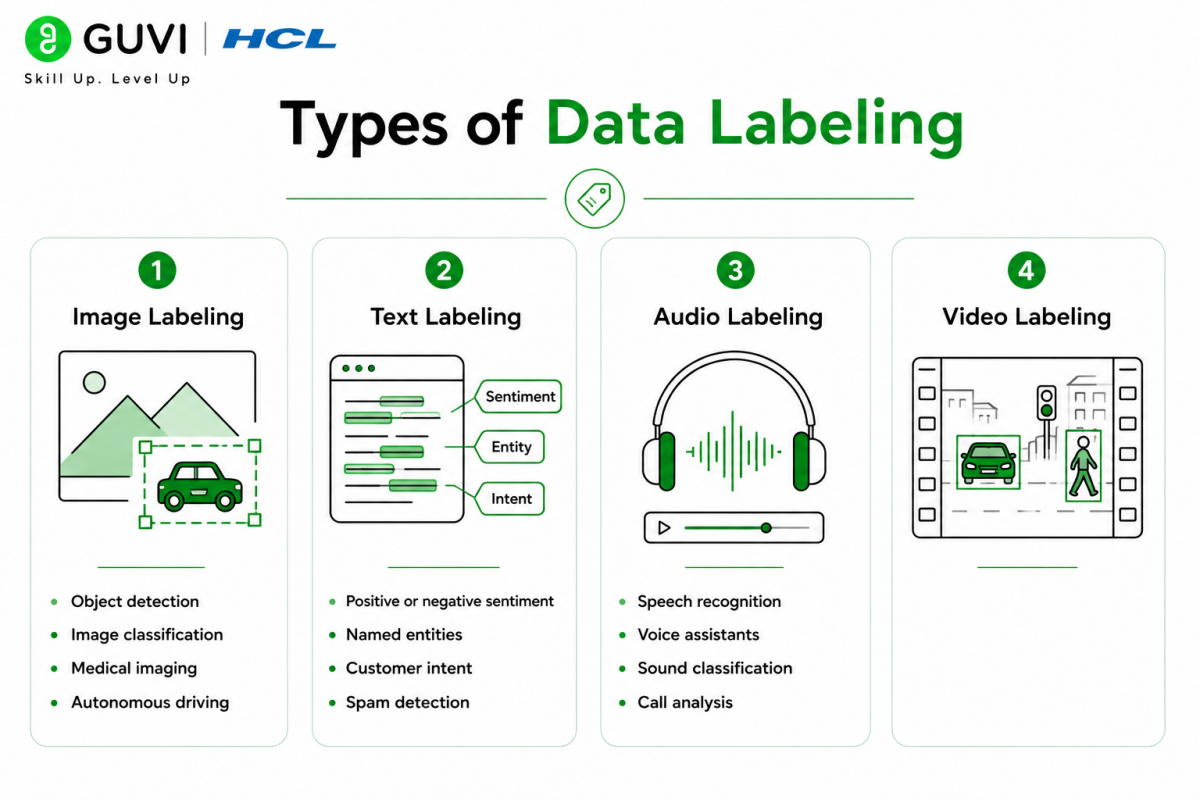
Different machine learning tasks require different annotation approaches.
Image Labeling
Images can be labeled using categories, bounding boxes, polygons, or segmentation masks.
Common applications include:
- Object detection
- Image classification
- Medical imaging
- Autonomous driving
Text Labeling
Text can be annotated for sentiment, topics, entities, intent, or other linguistic characteristics.
Examples include:
- Positive or negative sentiment
- Named entities
- Customer intent
- Spam detection
Audio Labeling
Audio data can be labeled with transcriptions, speakers, sounds, or events.
Applications include:
- Speech recognition
- Voice assistants
- Sound classification
- Call analysis
Video Labeling
Video annotation can identify objects, actions, events, or movements across frames.
Data Labeling Workflow
A structured labeling process helps create consistent training datasets.
Step 1: Define the Objective
Clearly identify what the machine learning model needs to learn.
Step 2: Create Labeling Guidelines
Document how annotators should handle different data examples and edge cases.
Step 3: Select Representative Data
Ensure the dataset contains examples that reflect the conditions the model will encounter.
Step 4: Label the Data
Annotators assign labels according to the established guidelines.
Step 5: Review Labels
Check annotations for mistakes, inconsistencies, and missing information.
Step 6: Measure Quality
Use quality-control processes to identify disagreements and recurring labeling problems.
Common Data Labeling Challenges
Inconsistent Labels
Different annotators may interpret the same example differently.
Ambiguous Data
Some examples may not clearly belong to a single category.
Human Error
Manual annotation can introduce mistakes, especially in large datasets.
Class Imbalance
Some categories may have far fewer examples than others.
Changing Requirements
Label definitions may need to evolve as the machine learning project develops.
Do not start large-scale annotation before testing your labeling guidelines. Label a small sample first, review disagreements, clarify ambiguous cases, and then scale the process. This can prevent thousands of examples from being labeled incorrectly under unclear instructions.
Benefits of High-Quality Data Labeling
Better Model Performance
Accurate labels help models learn meaningful patterns from training data.
Improved Generalization
Representative and consistent labels can help models perform better on unseen examples.
More Reliable Evaluation
High-quality validation and test labels make model performance measurements more trustworthy.
Reduced Rework
Clear guidelines and quality checks can prevent expensive relabeling later.
Professionals interested in supervised learning, machine learning workflows, data preparation, and AI development can strengthen their expertise through HCL GUVI’s Artificial Intelligence and Machine Learning Course.
When Should You Use Different Data Labeling Approaches?
The right Data Labeling approach depends on the type of data, the ML task, and the level of detail the model needs to learn.
Image Classification
Use simple category labels when the goal is to identify what an entire image contains.
Object Detection
Use bounding boxes when the model needs to identify objects and locate them within an image.

Image Segmentation
Use pixel-level masks when precise object boundaries are important, such as in medical imaging or autonomous driving.
Text Classification
Use category labels when training models to identify sentiment, intent, topics, spam, or other text characteristics.
Speech Recognition
Use transcriptions when the goal is to train a model to convert spoken audio into written text.
Key Concepts to Remember
Understanding these principles helps create better labeled datasets.
- Define labels clearly before annotation begins.
- Use consistent labeling rules across the dataset.
- Include representative examples.
- Document ambiguous cases and edge cases.
- Review annotations for errors.
- Monitor disagreements between annotators.
- Keep training, validation, and test labels reliable.
A Practical Data Labeling Workflow
A structured workflow can improve both annotation consistency and dataset quality.
1. Define the ML Objective
Determine exactly what the model needs to predict before creating labels.
2. Establish Label Definitions
Create clear descriptions for every category, annotation type, or class.
3. Create Annotation Guidelines
Explain how annotators should handle normal examples, difficult cases, and ambiguous data.
4. Run a Pilot
Label a small sample first and identify disagreements or unclear instructions.
5. Scale Annotation
Once the guidelines are stable, label the larger dataset.
6. Perform Quality Checks
Review annotations and investigate systematic errors or disagreements.
7. Update Guidelines
If recurring problems appear, refine the guidelines and apply the updated rules consistently.
Real-World Applications
Healthcare
- Medical image annotation
- Disease classification
- Clinical text labeling
- Medical entity recognition
Retail
- Product classification
- Customer sentiment labeling
- Product image annotation
- Recommendation data preparation
Autonomous Vehicles
- Vehicle detection
- Pedestrian annotation
- Road segmentation
- Traffic sign labeling
Customer Service
- Intent classification
- Sentiment analysis
- Conversation labeling
- Support ticket categorization
The HCL GUVI’s Artificial Intelligence eBook introduces the fundamentals of artificial intelligence, machine learning, generative AI, and intelligent automation. It helps learners develop a broader understanding of AI concepts and the data-driven processes behind modern intelligent systems.
Best Practices
- Start with precise labeling guidelines.
- Train annotators before large-scale labeling.
- Use pilot datasets to identify ambiguity early.
- Measure inter-annotator agreement where appropriate.
- Regularly audit labeled samples.
- Track and resolve recurring annotation errors.
- Keep label definitions consistent throughout the project.
- Recheck labels when the ML objective or class definitions change.
Conclusion
Data Labeling is one of the most important foundations of supervised learning. Accurate labels help models learn meaningful relationships, while inconsistent annotations can introduce errors that affect training and evaluation. By defining clear guidelines, using representative data, reviewing annotations, and continuously monitoring quality, teams can build reliable datasets that support better machine learning performance and stronger real-world generalization.
FAQs
1. What is Data Labeling?
Data Labeling is the process of assigning meaningful annotations or labels to raw data so supervised machine learning models can learn relationships between inputs and expected outputs.
2. Why is Data Labeling important?
High-quality labels help machine learning models learn accurate patterns, improve generalization, and produce more reliable predictions on unseen data.
3. What types of data can be labeled?
Images, text, audio, and video can all be labeled. The specific annotation method depends on the machine learning task.
4. What are labeling guidelines?
Labeling guidelines are documented instructions that explain how annotators should assign labels and handle ambiguous or unusual examples.
5. How can labeling errors be reduced?
Errors can be reduced through clear guidelines, annotator training, pilot labeling, regular quality reviews, and systematic resolution of disagreements.
6. What is a pilot labeling phase?
A pilot phase involves labeling a small sample before starting large-scale annotation. It helps identify unclear categories, inconsistent interpretations, and problems in the guidelines.
7. How does data labeling affect supervised learning?
Data Labeling directly influences what a supervised learning model learns. Accurate, consistent, and representative labels provide stronger training signals and help models generalize more reliably to new data.
Success Stories

About the Author
HCL GUVI
This article was selected and published as part of the HCL GUVI AI Blogathon 2026, an initiative designed to encourage students, AI enthusiasts, and aspiring tech writers to simplify complex AI concepts through impactful technical content. The contest recognized high-quality, original, and insightful AI-focused blogs, with selected authors receiving publication opportunities on the HCL GUVI blog platform along with official author credits and recognition.
View all posts by HCL GUVI
Connect with me @


















Did you enjoy this article?