


Artificial Intelligence and Machine Learning Articles
AI/ML Skills Gap 2026: Why Companies Can't Find Job-Ready Talent
20 AI/ML Interview Questions Recruiters Can Use Without a Tech Background - Best Guide
How Industry-Backed AI/ML Bootcamps Are Changing the AI/ML Hiring Pipeline - Best Guide 2026
From IT Support to AI Engineer: A Realistic Career Switch Guide 2026


Get In Touch For Details! Request More Information
How Journalists Use Claude for Investigative Research
Aug 06, 2026 3 Min Read 250 Views
(Last Updated)
Table of contents
- TL;DR Summary
- How Claude Works for Investigative Process
- Core Use Cases
- Background Research
- Document And Data Analysis
- Interview Preparation
- Story Structuring
- A Typical Investigative Workflow
- Step 1: Gather And Ingest
- Step 2: Ask For Gaps And Contradictions
- Step 3: Build Interview Questions
- Step 4: Generate Tipsheets And Leads
- Step 5: Structure The Story
- Standards And Ethics
- Set Your Standards Early
- Protect Sources And Sensitive Data
- Verify Everything
- Comparison Table
- Common Mistakes
- Real-World Example
- What To Do Next
- Conclusion
- FAQs
- What is Claude best at in investigative journalism?
- Should journalists upload confidential documents to Claude?
- Can Claude replace fact-checking?
- How do journalists use Claude for interviews?
- What are investigative tipsheets?
- Is it ethical to use Claude in investigative work?
TL;DR Summary
- Use Claude to summarize reports, transcripts, and data before writing.
- Ask it to find gaps, contradictions, and follow-up questions in your notes.
- Feed sources’ public statements to uncover inconsistencies for interviews.
- Let Claude propose story structures, not final copy.
- Keep all sensitive source material protected and verify every claim.
| Direct Answer Box: Journalists use Claude to speed up background research, analyze large documents, prepare sharper interviews, and structure stories without outsourcing editorial judgment. The strongest workflows treat Claude as a research assistant that finds gaps, flags contradictions, and proposes structures, while the reporter remains responsible for sourcing, verification, and final writing. |
How Claude Works for Investigative Process
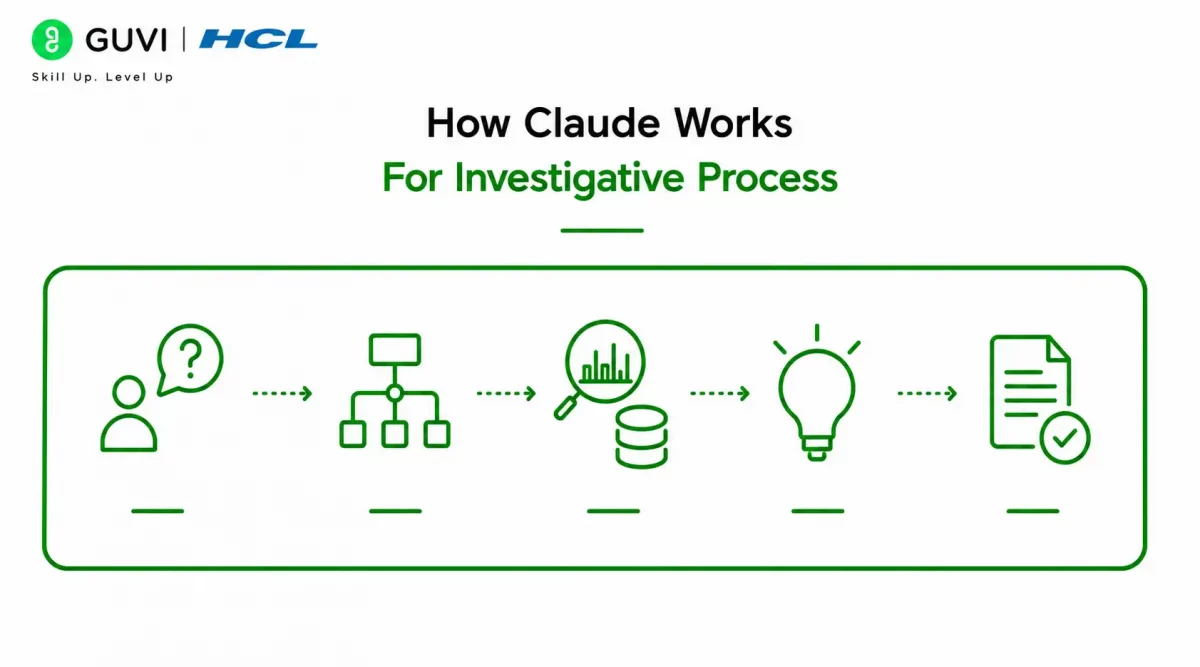
Investigative journalism depends on reading a lot, connecting dots, and asking precise questions. Claude can help with the heavy lifting of synthesis and organization so reporters can focus on judgment, sourcing, and narrative.
1. Core Use Cases
Claude fits best in the middle of the reporting process: after you have material but before you finalize your story. It is especially useful when you are dealing with large volumes of text and need clarity on what matters.
2. Background Research
Reporters can paste notes, articles, and public records into Claude and ask for structured summaries, timelines, and key players. This helps compress days of reading into a clearer starting point.
3. Document And Data Analysis
Claude can scan long reports, court filings, or transcripts and highlight:
- Important sections.
- Repeated names and entities.
- Apparent contradictions or anomalies.
- Questions worth pursuing.
That makes it easier to decide where to dig deeper.
4. Interview Preparation
Claude can review a source’s recent statements, social posts, or past quotes and identify the following:
- Shifts in position.
- Inconsistencies.
- Pressure points for follow-up questions.
This lets journalists walk into interviews with a sharper line of questioning.
5. Story Structuring
Once reporting is done, Claude can help turn notes and quotes into a proposed structure:
- Lede options.
- Nut graf.
- Supporting sections.
- Suggested flow.
The reporter then writes the actual story on top of that skeleton.
A Typical Investigative Workflow
A common pattern is to move from raw material to structured understanding, then to targeted reporting, and finally to drafting.
Step 1: Gather And Ingest
Collect your existing material:
- Notes from calls and meetings.
- Public records and reports.
- Prior articles and press releases.
- Data dumps or transcripts.
Paste or upload these into Claude Projects or a dedicated workspace so the context is consistent.
Step 2: Ask For Gaps And Contradictions
Instead of only asking for summaries, ask Claude to act like an editor:
- What is missing from this picture?
- What claims seem contradictory?
- What questions should I be asking next?
This turns Claude into a thinking partner rather than just a summarizer.
Step 3: Build Interview Questions
Give Claude the source’s recent public statements and ask it to:
- Highlight inconsistencies.
- Suggest specific follow-up questions.
- Identify moments that need clarification.
Use the output to refine your interview plan, not as a script.
Step 4: Generate Tipsheets And Leads
Some journalists use Claude Code skills to generate investigative tipsheets from raw data. These can suggest:
- Outliers and patterns.
- Entities that appear repeatedly.
- Angles worth investigating further.
The reporter then validates these leads through traditional reporting.
Step 5: Structure The Story
When you have enough reporting, give Claude:
- Key findings.
- Important quotes.
- Your angle or thesis.
Ask for a structure with a strong lede, nut graf, and supporting sections. You write the final copy yourself, keeping control of tone and narrative.
Standards And Ethics
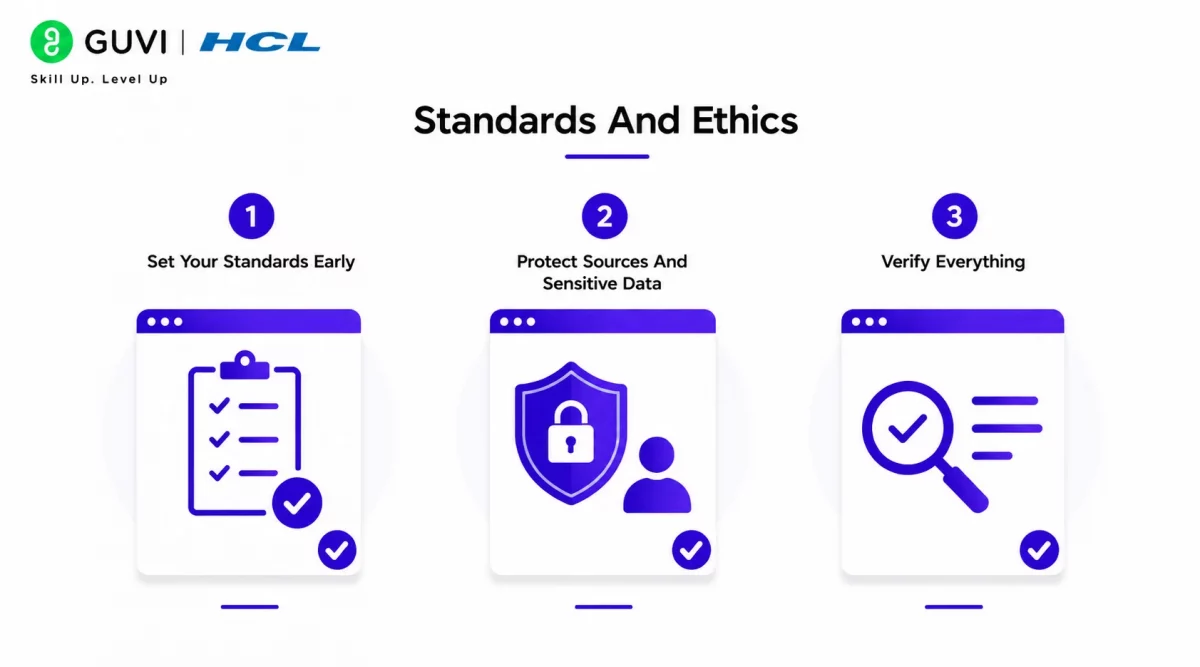
Because investigative work involves sensitive sources and high-stakes claims, clear standards are essential when using AI.
1. Set Your Standards Early
Before using Claude, decide:
- What material is safe to paste.
- What must never be uploaded.
- How you will verify AI-assisted insights.
- How you will document AI use internally.
Clear rules protect sources and maintain editorial integrity.
2. Protect Sources And Sensitive Data
Avoid uploading:

- Unpublished confidential documents.
- Identifiable source details.
- Sensitive personal data.
Treat Claude as a tool that may store or process input according to its terms, and act accordingly.
3. Verify Everything
Claude can:
- Summarize well.
- Spot patterns.
- Suggest questions.
It cannot:
- Replace fact-checking.
- Guarantee accuracy.
- Stand in for human judgment.
Always verify claims, numbers, and interpretations before publication.
Comparison Table
| Task | How Journalists Use Claude | Human Role |
| Background research | Summarize articles, reports, and notes | Decide what to trust and pursue |
| Document analysis | Highlight sections, entities, anomalies | Validate and investigate further |
| Interview prep | Find inconsistencies, propose questions | Conduct the interview and follow instincts |
| Tipsheets and leads | Generate data-driven angles from raw data | Report out and confirm findings |
| Story structure | Propose lede, nut graf, sections | Write the story and shape the narrative |
Common Mistakes
The biggest mistake is treating Claude’s output as reporting. It can suggest ideas, but it cannot replace sourcing and verification.
Avoid:
- Pasting sensitive or confidential material.
- Using AI-generated text as final copy without heavy editing.
- Skipping independent fact-checking.
- Over-relying on AI for editorial judgment.
- Not documenting how AI was used in the process.
⚠️ Warning: Investigative stories can have legal and ethical consequences. AI should assist, not drive, key decisions about sources, claims, and publication.
Real-World Example
An investigative reporter might:
- Upload a batch of public reports and prior coverage into Claude.
- Ask for a timeline of events and a list of key entities.
- Request a set of contradictions and open questions.
- Use that to plan interviews and records requests.
- After reporting, ask Claude to propose a story structure.
- Write the final story themselves, fact-check every claim, and disclose internal AI use as per newsroom policy.
That workflow can save time on synthesis while keeping the core journalism human-led.
Use Claude to spot gaps, contradictions, and key angles in investigative research faster. Build your analytics edge with HCL GUVI’s Complete Business Analytics Professional Program.
What To Do Next
Start with a single project: gather your notes and public documents, ask Claude to summarize and identify gaps, and use the output to refine your reporting plan. As you get comfortable, extend the workflow to interview prep, tipsheets, and story structuring.
Conclusion
Journalists use Claude to accelerate the unglamorous parts of investigative work: reading, organizing, and connecting information. It is most valuable as a research and structuring assistant, not as a source of truth or a ghostwriter.
The strongest practice is to set clear standards, protect sources, and verify every AI-assisted insight through traditional reporting. That keeps the speed benefits of AI without compromising journalistic rigor.
FAQs
1. What is Claude best at in investigative journalism?
Claude is best at summarizing large documents, finding gaps and contradictions, and helping structure stories and interviews.
2. Should journalists upload confidential documents to Claude?
No. Sensitive or confidential material should not be uploaded; stick to public records and your own notes.
3. Can Claude replace fact-checking?
No. Claude can suggest patterns and questions, but all claims must be independently verified by the journalist.
4. How do journalists use Claude for interviews?
They feed Claude a source’s public statements and ask it to identify inconsistencies and propose sharp follow-up questions.
5. What are investigative tipsheets?
Tipsheets are data-driven leads and angles generated from raw data that suggest where to look for potential stories.
6. Is it ethical to use Claude in investigative work?
Yes, if you set clear standards, protect sources, verify everything, and follow your newsroom’s policies on AI use.
Success Stories

About the Author
HCL GUVI
This article was selected and published as part of the HCL GUVI AI Blogathon 2026, an initiative designed to encourage students, AI enthusiasts, and aspiring tech writers to simplify complex AI concepts through impactful technical content. The contest recognized high-quality, original, and insightful AI-focused blogs, with selected authors receiving publication opportunities on the HCL GUVI blog platform along with official author credits and recognition.
View all posts by HCL GUVI
Connect with me @











Did you enjoy this article?