


Artificial Intelligence and Machine Learning Articles
AI/ML Skills Gap 2026: Why Companies Can't Find Job-Ready Talent
20 AI/ML Interview Questions Recruiters Can Use Without a Tech Background - Best Guide
How Industry-Backed AI/ML Bootcamps Are Changing the AI/ML Hiring Pipeline - Best Guide 2026
From IT Support to AI Engineer: A Realistic Career Switch Guide 2026


Get In Touch For Details! Request More Information
How to Use LlamaIndex to Build a RAG Pipeline in Python
Jul 09, 2026 3 Min Read 301 Views
(Last Updated)
Table of contents
- TL;DR
- What Is LlamaIndex and Why Use It for RAG?
- What is LlamaIndex?
- Why Build a RAG Pipeline?
- How to Build a RAG Pipeline Using LlamaIndex in Python
- Step 1: Install Required Libraries
- Step 2: Load Your Data
- Step 3: Create an Index
- Step 4: Query the RAG System
- Understanding RAG Pipeline Architecture
- Data Ingestion
- Retrieval
- Generation
- Comparison Table: Traditional LLM vs LlamaIndex RAG
- Real-World Examples
- Customer Support Assistant
- Internal Knowledge Assistant
- Education Platforms
- Common Mistakes Developers Make
- Using Poor Quality Data
- Ignoring Chunking Strategy
- Choosing the Wrong Embedding Model
- Not Testing Retrieval Quality
- Overcomplicating the First Version
- Career Roadmap: Learning RAG Development
- Conclusion
- Frequently Asked Question
- What is LlamaIndex used for?
- Is Python required for LlamaIndex?
- What is a RAG pipeline?
- Is LlamaIndex better than LangChain?
- Can LlamaIndex work with PDFs?
- Do I need machine learning experience to build RAG apps?
- What industries use RAG applications?
TL;DR
Building AI applications that answer questions from your own data has become one of the most in-demand skills in modern AI engineering. LlamaIndex helps developers connect large language models with private data sources through Retrieval Augmented Generation (RAG). This guide explains how to use LlamaIndex to build a RAG pipeline in Python, covering data loading, indexing, retrieval, querying, real-world applications, common mistakes, and a practical learning roadmap.
AI systems are moving beyond simple chatbots. Today, companies are building intelligent assistants that can search internal documents, analyze knowledge bases, and provide accurate answers using their own data.
The demand for RAG (Retrieval Augmented Generation) developers is increasing because businesses need AI systems that reduce hallucinations and provide context-aware responses.
According to a 2024 report by Gartner, organizations are rapidly adopting generative AI solutions across customer service, software development, and business operations.
A RAG pipeline solves a major limitation of large language models: they do not automatically know your private or updated information. With LlamaIndex and Python, you can create applications that retrieve relevant information first and then generate better responses.
What Is LlamaIndex and Why Use It for RAG?
What is LlamaIndex?
LlamaIndex is an open-source framework that helps developers connect large language models with external data sources.
It acts as a bridge between your data and an LLM by managing data loading, indexing, retrieval, and response generation.
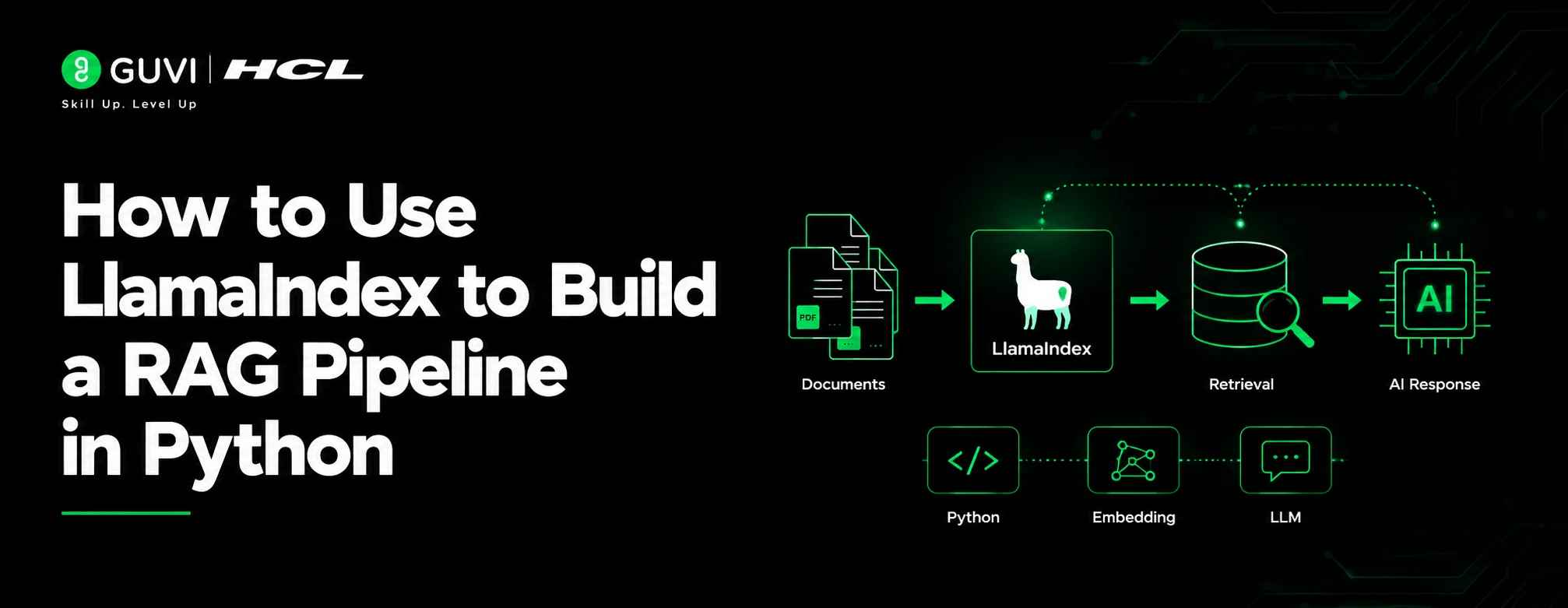
A typical LlamaIndex RAG workflow includes:
- Collecting documents
- Converting data into searchable indexes
- Finding relevant information
- Sending context to an LLM
- Generating an accurate response
Explore: Applied AI: A Guide to Real-World Innovation
Why Build a RAG Pipeline?
Large language models have limitations:
- They may generate outdated answers
- They may not know private company information
- They can produce incorrect responses without context
RAG improves AI accuracy by grounding answers in retrieved information.
How to Build a RAG Pipeline Using LlamaIndex in Python
Step 1: Install Required Libraries
Start by installing LlamaIndex and supporting packages.
Example:
pip install llama-index
You can also connect it with different LLM providers depending on your project requirements.
Step 2: Load Your Data
The first step in a RAG pipeline is adding your knowledge source.
Your data can include:
- PDFs
- Websites
- Text files
- Business documents
- Product manuals
Example:
from llama_index.core import SimpleDirectoryReader
documents = SimpleDirectoryReader(“data”).load_data()
This loads documents from a folder and prepares them for processing.
Step 3: Create an Index
LlamaIndex converts your documents into a searchable structure.
Example:
from llama_index.core import VectorStoreIndex
index = VectorStoreIndex.from_documents(documents)
The index stores document information in a way that allows efficient retrieval.
Step 4: Query the RAG System
Now you can ask questions from your data.
Example:
query_engine = index.as_query_engine()
response = query_engine.query(
“Explain the main points from this document”
)
print(response)
The system retrieves relevant sections and generates an answer using the available context.
Understanding RAG Pipeline Architecture
A basic RAG architecture contains three major stages:
Data Ingestion
Your raw information is collected and processed.
Examples:
- Company documents
- Research papers
- Customer FAQs
Retrieval
The system searches for the most relevant information based on the user query.
This step improves accuracy by giving the model the right context.
Generation
The LLM uses the retrieved information to generate a response.
This creates a more reliable AI assistant.
Read More: Top AI Tools for Software Development: Revolutionize Coding
Comparison Table: Traditional LLM vs LlamaIndex RAG
| Feature | Traditional LLM | LlamaIndex RAG |
| Uses private data | No | Yes |
| Reduces hallucination | Limited | Better control |
| Updates knowledge easily | Difficult | Easier |
| Suitable for business data | Limited | Highly suitable |
| Requires retrieval layer | No | Yes |
Real-World Examples
Customer Support Assistant
A company can use LlamaIndex with product documentation to create an AI chatbot that answers customer questions instantly.

Instead of training a model from scratch, the company connects existing documents and retrieves relevant information.
Internal Knowledge Assistant
Large organizations can create employee assistants that search policies, HR documents, and technical guides.
This reduces time spent manually searching through information.
Education Platforms
Learning platforms can use RAG pipelines to build AI tutors that answer questions from course materials.
Want to build more advanced AI applications beyond basic chatbots? Explore HCL GUVI Artificial Intelligence and Machine Learning Career Program to master Python, Generative AI, Machine Learning, LLMs, and real-world AI projects with hands-on learning and an industry-recognized certificate.
Common Mistakes Developers Make
1. Using Poor Quality Data
A RAG system is only as good as its data.
Messy or outdated documents reduce answer quality.
2. Ignoring Chunking Strategy
Large documents should be divided into meaningful sections.
Poor chunking can cause retrieval problems.
3. Choosing the Wrong Embedding Model
Embeddings decide how information is searched.
Selecting an unsuitable model may reduce relevance.
4. Not Testing Retrieval Quality
Developers often focus only on the final answer.
Testing whether the right context is retrieved is equally important.
5. Overcomplicating the First Version
Start with a simple pipeline before adding advanced features.
Career Roadmap: Learning RAG Development
If you want to build AI applications professionally, focus on:
- Python programming fundamentals
- APIs and backend development
- Machine learning basics
- LLM concepts
- Vector databases
- Frameworks like LlamaIndex and LangChain
- Deployment and monitoring
Learning these skills can help you move toward roles such as:
- AI Engineer
- Generative AI Developer
- Machine Learning Engineer
- LLM Application Developer
Want to build practical AI projects instead of only learning theory?
Explore HCL GUVI AI and machine learning course to strengthen Python, Generative AI, and real-world application development skills.
Conclusion
Learning how to use LlamaIndex to build an RAG pipeline in Python is an important step toward creating modern AI applications. RAG helps developers build smarter systems that can work with private data, reduce incorrect responses, and deliver useful answers.
With Python, LlamaIndex, and LLM technologies, you can move from experimenting with AI models to building real-world solutions. Start with a simple document-based chatbot, understand retrieval workflows, and gradually build production-ready AI applications.
Frequently Asked Question
1. What is LlamaIndex used for?
LlamaIndex helps developers connect large language models with external data sources to build context-aware AI applications.
2. Is Python required for LlamaIndex?
Yes, Python is one of the most commonly used languages for building applications with LlamaIndex.
3. What is a RAG pipeline?
A RAG pipeline retrieves relevant information from a knowledge source and provides it to an LLM before generating an answer.
4. Is LlamaIndex better than LangChain?
Both frameworks solve different problems. LlamaIndex focuses strongly on connecting LLMs with data, while LangChain provides broader application-building tools.
5. Can LlamaIndex work with PDFs?
Yes, LlamaIndex can load and process PDF documents for creating searchable AI applications.
6. Do I need machine learning experience to build RAG apps?
Basic Python and AI concepts are helpful, but beginners can start with tutorials and gradually learn advanced concepts.
7. What industries use RAG applications?
Healthcare, finance, education, customer support, and software companies use RAG-based AI solutions.
Success Stories

About the Author
Salini Balasubramaniam
A curious, information-savvy writer loves to turn deep insights into authentic and engaging content that connects. With experience in writing for brands and driving audience engagement, I believe that words can make a powerful difference.
View all posts by Salini Balasubramaniam
Connect with me @










Did you enjoy this article?