


Career Articles
Financial Analyst to Data Scientist Salary: What Can You Expect in India?
Accountant vs Data Analyst Salary in India After Switching Careers - Best Guide
Finance Managers: Could Data Science Be Your Next Career Move?
Insurance Claims Executive to Data Analyst: Is It a Good Switch?


Get In Touch For Details! Request More Information
Best Non-Coding Tech Jobs in 2026: High Salary Without Writing Code
Jul 21, 2026 10 Min Read 10042 Views
(Last Updated)
As India’s digital economy continues to grow, companies need more than just developers. They need thinkers, planners, designers, analysts, and communicators who can keep things running, make decisions, and build user-friendly solutions. Not all Non-Coding Tech Jobs today require programming skills.
In fact, there’s a huge window of opportunity for working professionals who want to make a switch without starting from scratch. So if you’re exploring Non-Coding Tech Jobs, looking for tech jobs without programming, or just curious how upskilling for professionals works, this blog is for you.
Table of contents
- TL;DR Summary
- Top Non-Coding Tech Jobs for Professionals
- AI and Emerging Tech Roles
- AI Product Manager
- Prompt Engineer / AI Content Designer
- AI Ethicist / Responsible AI Advisor
- AI UX/UI Designer
- AI Behavioural Researcher
- AI Trainer / Human-in-the-Loop Specialist
- AI Project Coordinator
- AI Policy Analyst
- AI Content Strategist
- Core Non-Coding Tech Roles
- Product Manager
- IT Project Manager
- UX Designer
- UI Designer
- Business Analyst
- Technical Writer
- QA Tester / Software Quality Tester
- Data Analyst
- Cybersecurity Analyst
- Cybersecurity Risk & Compliance Officer
- Infrastructure and Strategy Roles
- IT Manager
- Systems Analyst
- Network Administrator
- GIS Specialist
- Digital Transformation Consultant
- Creative and Interdisciplinary Roles
- Creative Technologist
- Learning Experience Designer (LX Designer)
- Policy and Governance Roles
- Tech Policy & Regulation Analyst
- Salary and Skills Comparison Table
- Non-Coding Tech Jobs for Non-Tech Graduates Entering IT
- Non-Coding Tech Jobs at Google, Microsoft, Amazon India
- Before You Make the Switch: Key Skills to Build
- Upskilling Options for Non‑Coding Tech Roles
- Final Thoughts
- Frequently Asked Questions
- Can I get into non-coding tech roles with a non-technical degree?
- Which non-coding tech careers are best for someone with strong communication skills?
- Is it harder to grow in non-coding tech roles compared to coding roles?
- How do I explain a non-tech background in tech interviews?
- Are there any non-coding roles that involve working with developers?
- Can I move from a non-coding to a coding role later?
TL;DR Summary
- Non-Coding Tech Jobs span five broad categories: AI and emerging tech, core tech roles, infrastructure and strategy, creative/interdisciplinary work, and policy and governance.
- AI Product Manager, Prompt Engineer, and AI Trainer are three of the fastest-growing Non-Coding Tech Jobs specifically created by the GenAI boom.
- Salaries for Non-Coding Tech Jobs in India range from roughly ₹4-8 LPA at entry-level roles like QA Testing up to ₹25-50+ LPA for experienced Product Managers and AI Product Managers.
- Non-tech graduates (commerce, arts, humanities) have realistic entry points into IT through roles like Business Analyst, Technical Writer, and QA Tester.
- Google, Microsoft, and Amazon India all hire heavily for non-coding roles like Program Manager, Technical Program Manager, and UX Researcher, not just software engineers.
Let’s break down some real options and help you figure out which tech careers without coding might actually suit your strengths.
Top Non-Coding Tech Jobs for Professionals
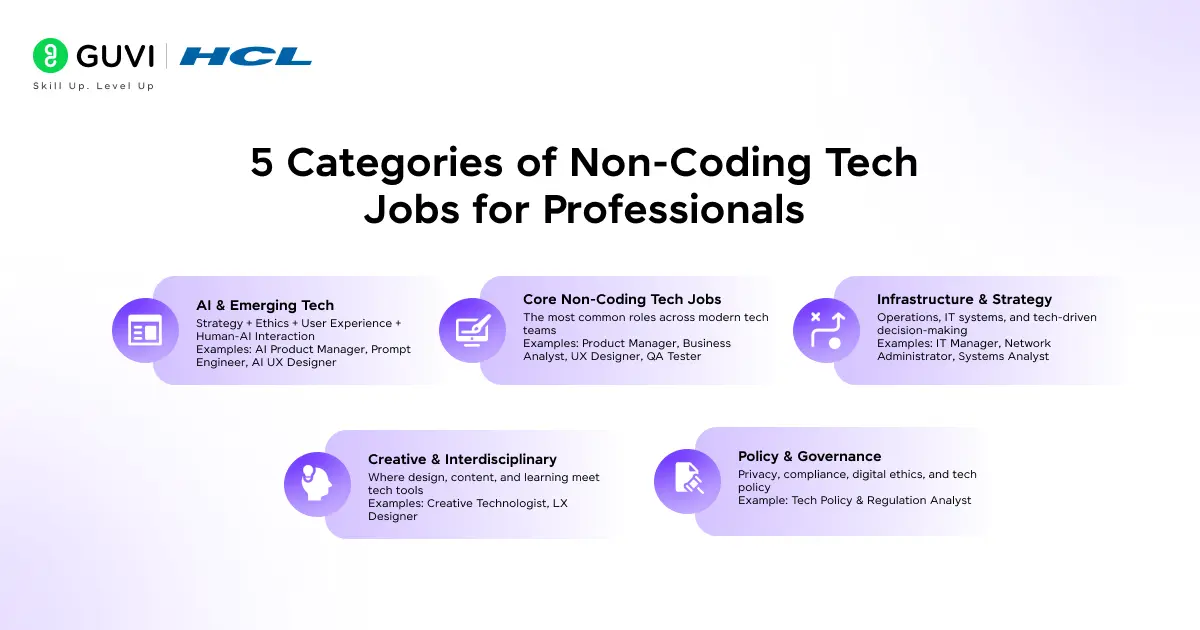
There’s no shortage of Non-Coding Tech Jobs opportunities for those who aren’t into programming. In fact, some of the most in-demand roles today don’t involve writing a single line of code.
To make it easier to explore, we’ve grouped 25 high-potential Non-Coding Tech Jobs into five broad categories based on exactly what they involve day to day. Let’s start with a category that’s booming fast, that is, AI and emerging tech.
AI and Emerging Tech Roles
AI is transforming how modern teams work, and it’s directly responsible for several brand-new Non-Coding Tech Jobs that didn’t exist five years ago. Companies are no longer just focused on building tools, they’re thinking about how those tools are used, understood, and trusted.
That’s why there’s a growing demand for professionals who can guide AI development through smart planning, ethical thinking, and user-friendly design. The roles below offer real opportunities for people from non-technical backgrounds, especially with the right upskilling.
1. AI Product Manager
AI Product Managers act as the bridge between data scientists, designers, and business teams, shaping what features to build, how models integrate, and how users interact with them.
It’s one of the more strategic Non-Coding Tech Jobs for professionals who understand business, tech, and product development, even without writing code.
Skills Needed:
- Strong product sense and user empathy
- Basic knowledge of machine learning concepts
- Data literacy and experimentation mindset
- Communication and stakeholder alignment
- Project ownership and roadmap planning
Industries Hiring: SaaS, HealthTech, FinTech, EdTech, and enterprise platforms driving digital transformation roles
2. Prompt Engineer / AI Content Designer
Prompt Engineers write precise, creative instructions that guide AI tools like ChatGPT or Midjourney. They shape how AI responds and fine-tune it for tone, clarity, and relevance, thus making this one of the most hands-on Non-Coding Tech Jobs, especially for those coming from writing, design, or training backgrounds.
Skills Needed:
- Strong command of language and tone
- Creative and analytical thinking
- Understanding of AI prompt structures
- Testing and iteration mindset
- Attention to output quality
Industries Hiring: EdTech, GenAI startups, Marketing, MediaTech
3. AI Ethicist / Responsible AI Advisor
Responsible AI professionals work closely with developers and product teams to ensure ethical decision-making across AI systems. They assess risks, reduce bias, and help align product goals with public good, making them vital in Non-Coding Tech Jobs that focus on impact rather than implementation.
Skills Needed:
- Knowledge of AI ethics frameworks
- Research and writing ability
- Analytical and critical thinking
- Risk assessment and mitigation planning
- Cross-functional collaboration
Industries Hiring: AI labs, public policy think tanks, consulting firms, and healthtech platforms
4. AI UX/UI Designer
AI UX/UI Designers are responsible for making machine learning features easy and intuitive for end users, simplifying technical complexity through thoughtful design.
For professionals exploring Non-Coding Tech Jobs with a creative edge, this role offers a great blend of tech and design.
Skills Needed:
- User research and usability testing
- Visual hierarchy and interaction design
- Wireframing and prototyping
- Accessibility and human-centered design
- Collaboration with developers and data teams
Industries Hiring: SaaS, FinTech, Consumer Apps, EdTech
5. AI Behavioural Researcher
This role focuses on studying how users interact with AI systems, from how they interpret outputs to where confusion or hesitation kicks in. Behavioral researchers help teams build smarter, more user-aware AI products. It’s one of the more research-driven Non-Coding Tech Jobs, ideal for those with psychology, UX, or cognitive science backgrounds.
Skills Needed:
- User observation and interview methods
- Survey design and behavioural analysis
- Data interpretation and pattern recognition
- Cross-functional communication
- Report writing and presentation
Industries Hiring: UX research firms, AI startups, healthcare platforms
6. AI Trainer / Human-in-the-Loop Specialist
AI Trainers support model development by giving consistent human feedback, rating answers, labeling data, and improving content accuracy. They play a key role in making AI tools smarter through structured, hands-on input. This role suits those looking to step into Non-Coding Tech Jobs from teaching, operations, or content backgrounds.
Skills Needed:
- Task accuracy and attention to detail
- Domain-specific knowledge (if required)
- Labeling and annotation tools
- Reading comprehension and evaluation
- Patience and consistency
Industries Hiring: AI startups, EdTech platforms, content moderation teams
7. AI Project Coordinator
Project Coordinators working with AI teams help manage daily workflows, coordinate timelines, and keep teams aligned. While they don’t work on the code itself, they ensure that complex AI initiatives stay organized and on track. It’s a solid choice for anyone interested in digital transformation roles without switching to programming.
Skills Needed:
- Project planning and resource tracking
- Communication and team coordination
- Familiarity with basic AI development phases
- Time management
- Use of tools like Jira, Trello, Asana
Industries Hiring: AI consultancies, enterprise tech, healthcare innovation
8. AI Policy Analyst
As governments and industries try to regulate AI safely, policy analysts play a major role in tracking global trends, researching compliance laws, and helping organizations stay ahead of ethical or legal risks. This role offers a future-forward space within Non-Coding Tech Jobs for those from law, political science, or social research backgrounds.
Skills Needed:
- Policy analysis and regulation tracking
- Critical reading and synthesis
- Technical writing and briefing documents
- Collaboration with legal teams
- Awareness of data privacy standards
Industries Hiring: Public policy think tanks, legal tech, corporate compliance teams
Explore: Project Manager Transition to Technical Coding Role Guide
9. AI Content Strategist
AI Content Strategists focus on how AI-generated content fits into a brand’s voice and workflow. They plan, evaluate, and guide how tools like ChatGPT are used by teams or embedded into customer-facing content. It’s a great fit for those exploring tech upskilling without shifting into technical roles.
Skills Needed:
- Editorial judgment and content planning
- Understanding of generative AI tools
- SEO and audience targeting
- Collaboration with prompt engineers and marketers
- Brand voice alignment
Industries Hiring: EdTech, Media, Content Platforms, Marketing Agencies
Core Non-Coding Tech Roles
Now let’s talk about some of the most foundational Non-Coding Tech Jobs. These are the foundational roles that support almost every tech company, regardless of product or industry. If you’ve worked in business, operations, design, writing, or analysis, chances are you’re already familiar with some of these responsibilities.
With a little tech upskilling, you can confidently move into these high-demand Non-Coding Tech Jobs.
10. Product Manager
Product Manager is arguably the best-known of all Non-Coding Tech Jobs, and for good reason. Product Managers lead the planning and execution of tech products from start to finish, gathering user needs and translating them into features.
It’s a strong role for professionals who enjoy decision-making, collaboration, and solving customer problems.
Skills Needed:
- Product lifecycle knowledge
- User research and feedback synthesis
- Roadmapping and prioritization
- Communication across teams
- Strategic thinking and business alignment
Industries Hiring: SaaS, FinTech, EdTech, E-commerce
11. IT Project Manager
This is one of the more structured Non-Coding Tech Jobs available. IT Project Managers handle the execution of technical projects, whether it involves setting up systems, deploying software, or managing migrations. They ensure everything runs smoothly, on time, and within budget.
Skills Needed:
- Project scoping and scheduling
- Risk and resource management
- Agile or Scrum methodology
- Team coordination and reporting
- Familiarity with basic IT infrastructure
Industries Hiring: Consulting firms, IT services, enterprise tech, healthcare tech
12. UX Designer
UX Designers focus on making digital products usable, accessible, and enjoyable. They run user interviews, design wireframes, and test interactions to ensure the product meets real needs.
Skills Needed:
- User research and persona creation
- Wireframing and prototyping
- Journey mapping
- Usability testing
- Accessibility design
Industries Hiring: Product startups, fintech apps, edtech, media platforms
13. UI Designer
This is one of the more visually creative Non-Coding Tech Jobs. UI Designers handle the look and feel of apps and websites. They create the visual interface, such as colors, typography, buttons, layouts, so as to ensure the design is both attractive and functional.
Skills Needed:
- Typography and color theory
- Layout and component design
- UI kits and design systems
- Collaboration with UX and frontend teams
- Figma, Adobe XD, or Sketch
Industries Hiring: SaaS, lifestyle apps, e-commerce, gaming
14. Business Analyst
Business Analyst roles are consistently among the most accessible Non-Coding Tech Jobs for career switchers. Business Analysts identify gaps, trends, and improvement areas by reviewing data, processes, and stakeholder needs. They act as a link between technical teams and business goals.
Skills Needed:
- Data interpretation and reporting
- Process mapping and documentation
- Requirement gathering
- Functional specs writing
- Stakeholder communication
Industries Hiring: Banking, insurance, IT services, healthtech, public sector
15. Technical Writer
Technical Writing is consistently underrated among Non-Coding Tech Jobs, despite strong demand. Technical Writers create clear, concise documentation for users, developers, or internal teams. From user manuals to API guides, they simplify complex ideas and make tech accessible.
Skills Needed:
- Structured writing and editing
- Research and interviewing subject matter experts
- Organizing technical content
- Tools like Markdown, Git, or Docs-as-Code platforms
- Visual communication (diagrams, screenshots)
Industries Hiring: SaaS companies, open-source projects, hardware firms, developer platforms
16. QA Tester / Software Quality Tester
QA Testing is one of the most accessible entry-level Non-Coding Tech Jobs available. QA Testers ensure that software products work as expected. They write test cases, identify bugs, and report usability issues before features go live.
Skills Needed:
- Manual testing methods
- Writing and executing test cases
- Bug tracking tools (like JIRA or Bugzilla)
- Regression and acceptance testing
- Basic knowledge of software development lifecycles
Industries Hiring: IT services, product companies, healthtech, fintech
17. Data Analyst
Data Analyst work is one of the fastest-growing Non-Coding Tech Jobs categories right now. Data Analysts collect, clean, and interpret data to help teams make informed decisions. They use dashboards, queries, and reports to highlight what’s working and what’s not.
Skills Needed:
- Excel, SQL, and data visualization tools
- Statistical analysis
- Business reporting
- Storytelling with data
- Tools like Tableau, Power BI, Google Data Studio
Industries Hiring: Finance, healthcare, e-commerce, retail analytics
18. Cybersecurity Analyst
Cybersecurity Analysts protect company systems from breaches and attacks. They monitor suspicious activity, conduct audits, and implement security best practices.
Skills Needed:
- Threat monitoring and incident response
- Risk assessment
- Network security basics
- Tools like Wireshark, Nessus, or Splunk
- Knowledge of compliance standards (ISO, NIST)
Industries Hiring: IT security firms, banking, telecom, cloud service providers
19. Cybersecurity Risk & Compliance Officer
This is one of the more specialised Non-Coding Tech Jobs in the compliance space. This role focuses on policy and process rather than threat detection. Compliance Officers ensure that teams follow security protocols and government standards.
Skills Needed:
- Regulatory understanding (GDPR, HIPAA, etc.)
- Risk assessment frameworks
- Internal audits and checklists
- Policy creation and training
- Communication with legal and leadership teams
Industries Hiring: Healthcare, BFSI, public sector, IT compliance firms
Infrastructure and Strategy Roles
When it comes to these particular Non-Coding Tech Jobs in infrastructure and strategy, they may not be flashy, but they’re essential to keeping tech operations secure, stable, and scalable.
From managing systems and networks to supporting data-driven decision-making, these careers offer long-term growth and are often ideal for professionals looking for tech jobs without programming.
20. IT Manager
IT Manager roles round out the infrastructure-focused Non-Coding Tech Jobs on this list. IT Managers oversee the technology backbone of an organization. They’re responsible for ensuring systems are running smoothly, software is up to date, and internal teams have the technical support they need to work efficiently.
Skills Needed:
- IT infrastructure knowledge (servers, storage, networks)
- Vendor and team management
- Security awareness
- Budgeting and procurement
- Strategic planning
Industries Hiring: Corporations, EdTech, FinTech, healthcare, consulting
21. Systems Analyst
This is another of the steady, dependable Non-Coding Tech Jobs in enterprise IT. Systems Analysts evaluate an organization’s current IT setup and recommend ways to improve workflows and performance.

Skills Needed:
- Systems documentation and analysis
- Requirement gathering
- Communication and coordination
- Process mapping
- Familiarity with enterprise software (ERP, CRM)
Industries Hiring: Government, manufacturing, retail, IT services
22. Network Administrator
Network Administration remains one of the more traditional Non-Coding Tech Jobs, still in steady demand. Network Administrators manage the daily operations of computer networks, ensuring connectivity, data flow, and security. They install, maintain, and troubleshoot network components.
Skills Needed:
- LAN/WAN management
- Router, switch, and firewall configuration
- Network security basics
- Monitoring tools (Nagios, SolarWinds)
- Troubleshooting and support
Industries Hiring: Telecom, education, government IT, and cloud infrastructure companies
23. GIS Specialist
This is one of the more niche Non-Coding Tech Jobs on this list. GIS (Geographic Information Systems) Specialists work with location data to create maps, analyze spatial patterns, and support urban planning, logistics, and environmental monitoring.
Skills Needed:
- GIS software (ArcGIS, QGIS)
- Data interpretation and visualization
- Cartography and spatial analysis
- Scripting knowledge (optional)
- Attention to detail
Industries Hiring: Urban planning, logistics, environment, government projects
24. Digital Transformation Consultant
This is one of the highest-paying Non-Coding Tech Jobs in the consulting space. Digital Transformation Consultants help organizations move from traditional operations to tech-enabled workflows. They assess business processes, suggest automation tools, and manage transitions that require both strategy and technical awareness.
Skills Needed:
- Business process analysis
- Change management
- Tool and platform evaluation
- Client communication
- Strategic planning
Industries Hiring: Consulting firms, BFSI, healthcare, IT services
Creative and Interdisciplinary Roles
Next up are the creative-domain Non-Coding Tech Jobs. Some of the most exciting tech careers today blend creativity, storytelling, learning, and design with modern tools.
These roles are perfect for professionals coming from teaching, media, marketing, or design backgrounds who are exploring a switch into tech. With the right upskilling for professionals, you can step into these spaces without needing any coding experience.
25. Creative Technologist
This is one of the most unconventional Non-Coding Tech Jobs on this whole list. Creative Technologists experiment with new digital formats, such as AR/VR, interactive websites, and AI-powered storytelling, to create immersive brand or product experiences.
Skills Needed:
- Conceptual thinking and storytelling
- Visual and motion design
- Interactive media tools (Three.js, Unity, etc.)
- Collaboration with creative and tech teams
- Comfort with rapid prototyping
Industries Hiring: Advertising, gaming, media-tech, experiential design firms
26. Learning Experience Designer (LX Designer)
This is a strong pick among Non-Coding Tech Jobs for anyone with a teaching or training background. LX Designers craft engaging digital learning journeys, be it for students, employees, or customers. They combine pedagogy, content structuring, and tech tools to build online courses, simulations, and interactive modules.
Skills Needed:
- Instructional design principles
- Content mapping and chunking
- Tools like Articulate, Captivate, or LMS platforms
- UX thinking for learners
- Visual communication and editing
Industries Hiring: EdTech, L&D teams, universities, HR tech platforms
Policy and Governance Roles
Lastly, as companies adopt more digital tools and AI-based solutions, this final category of Non-Coding Tech Jobs, governance and compliance, has grown significantly.
This area offers meaningful opportunities for professionals from legal, public policy, or administrative backgrounds who want to shift into digital transformation roles within the tech space.
27. Tech Policy & Regulation Analyst
This is one of the most future-relevant Non-Coding Tech Jobs as AI regulation expands globally. Tech Policy Analysts research emerging laws and industry standards around data privacy, AI ethics, cybersecurity, and digital adoption. They help companies stay compliant, avoid regulatory risks, and align their practices with global frameworks.
Skills Needed:
- Policy research and comparative analysis
- Awareness of regulations like GDPR, DPDP Bill, etc.
- Report writing and documentation
- Collaboration with legal and compliance teams
- Strategic thinking and risk assessment
Industries Hiring: Government bodies, policy think tanks, consulting firms, enterprise tech
Salary and Skills Comparison Table
Here’s how these Non-Coding Tech Jobs compare on salary, required skills, and growth potential in India for 2026, all in one place:
| Role | Avg Salary (India) | Required Skills | Coding Needed? | Growth |
|---|---|---|---|---|
| AI Product Manager | ₹15-35 LPA | Product sense, ML literacy, stakeholder management | No | Very High |
| Prompt Engineer | ₹6-20 LPA | Language precision, prompt structures, iteration | No | Very High |
| AI Ethicist | ₹10-22 LPA | AI ethics frameworks, research, risk assessment | No | High |
| AI UX/UI Designer | ₹8-20 LPA | User research, wireframing, accessibility design | No | High |
| AI Trainer | ₹4-10 LPA | Domain knowledge, annotation, attention to detail | No | Very High |
| Product Manager | ₹12-30 LPA | Roadmapping, user research, business alignment | No | High |
| IT Project Manager | ₹9-22 LPA | Agile/Scrum, risk management, coordination | No | Moderate |
| UX Designer | ₹6-18 LPA | Wireframing, usability testing, journey mapping | No | High |
| UI Designer | ₹5-15 LPA | Figma/Adobe XD, design systems, typography | No | Moderate |
| Business Analyst | ₹6-16 LPA | Process mapping, requirement gathering, SQL basics | No | High |
| Technical Writer | ₹5-14 LPA | Structured writing, Markdown/Git, SME interviews | No | Moderate |
| QA Tester | ₹4-9 LPA | Manual testing, bug tracking tools, test cases | No | Moderate |
| Data Analyst | ₹5-15 LPA | Excel, SQL, Tableau/Power BI, storytelling with data | No | High |
| Cybersecurity Analyst | ₹6-18 LPA | Threat monitoring, Wireshark/Splunk, compliance | No | Very High |
| IT Manager | ₹10-25 LPA | Infrastructure knowledge, vendor management, budgeting | No | Moderate |
| Digital Transformation Consultant | ₹10-24 LPA | Process analysis, change management, client comms | No | High |
| Creative Technologist | ₹6-18 LPA | Interactive media tools, prototyping, storytelling | No | Moderate |
| Tech Policy Analyst | ₹8-20 LPA | Policy research, GDPR/DPDP awareness, report writing | No | High |
Figures will vary by city, company type, and years of experience.
Non-Coding Tech Jobs for Non-Tech Graduates Entering IT
If you’re coming from a commerce, arts, or humanities background with zero programming experience, certain Non-Coding Tech Jobs are genuinely realistic entry points into these Non-Coding Tech Jobs, not just theoretical possibilities.
- Business Analyst: commerce and economics graduates already have the process-thinking and stakeholder-communication instincts this role needs; SQL basics can be picked up in a few weeks.
- Technical Writer: English, journalism, or mass communication graduates often transition here faster than technical hires, since clear writing is the actual bottleneck skill, not coding.
- QA Tester: one of the lowest-barrier entry points into a product team; manual testing skills are teachable in a short bootcamp, and the role puts you inside real engineering workflows from day one.
- UX Designer: psychology, sociology, and design graduates bring genuine user-research instincts that are hard to teach; tools like Figma are learnable, empathy for users isn’t.
- Digital Marketing Analyst-adjacent Data Analyst roles: commerce and statistics graduates can move into basic data analyst work with Excel and Power BI skills alone, no SQL required at entry-level.
The realistic path for most non-tech graduates: pick one of these five, complete a focused 2-4 month upskilling course, build 1-2 portfolio projects, and apply specifically for “associate” or “junior” titles rather than mid-level openings, since that’s where non-traditional backgrounds get the most genuine consideration.
Non-Coding Tech Jobs at Google, Microsoft, Amazon India
It’s a common myth that FAANG and Big Tech companies in India only hire engineers, when in fact all three run real Non-Coding Tech Jobs pipelines. All three of these companies run substantial non-coding hiring pipelines specifically for the roles covered in this guide.
- Google India: hires heavily for Program Manager, Technical Program Manager (TPM, coordination-focused rather than coding-focused), UX Researcher, and Partnerships/Policy roles across its Bangalore and Hyderabad offices.
- Microsoft India: regularly hires Product Managers, Technical Writers, Business Program Managers, and Customer Success roles, several of which sit directly inside engineering orgs without requiring hands-on coding.
- Amazon India: runs large-scale hiring for Program Managers, Business Analysts, Risk & Compliance roles, and UX Designers across its Bangalore, Hyderabad, and Chennai campuses, alongside its well-known operations and logistics-adjacent tech roles.
The common thread across all three: these companies increasingly separate “builds the system” roles from the “decides what to build” roles, and the second category is exactly where Non-Coding Tech Jobs live.
Landing one of these roles at a company this size typically still requires strong analytical and communication skills equivalent to what a CS degree would signal, even without the coding itself.
Ready to move into product, no-code, or AI-adjacent tech roles? HCL GUVI’s product management and no-code learning paths are built specifically for professionals switching into Non-Coding Tech Jobs, with mentor-led projects and placement support, no programming background required.
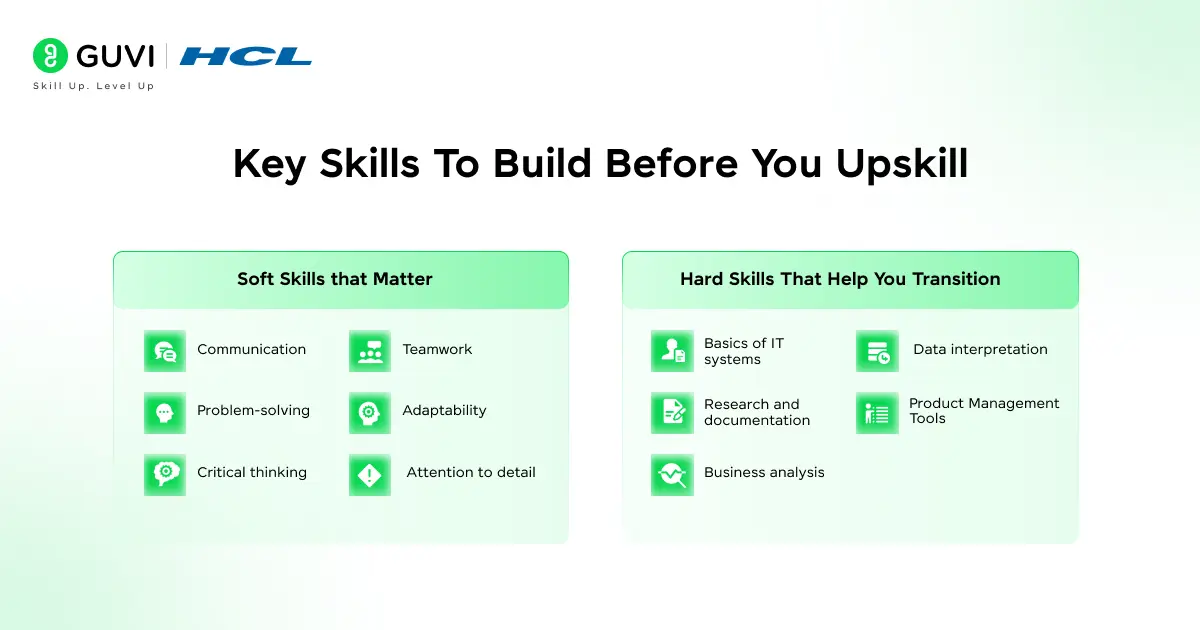
Before You Make the Switch: Key Skills to Build
Before jumping into a new tech role, it helps to know what strengths matter. Here’s a quick look at the soft and hard skills that make the biggest difference.
Upskilling Options for Non‑Coding Tech Roles
If you’re wondering how to get started without a technical background, HCL GUVI’s self‑paced courses offer a great launchpad. These are beginner-friendly, crafted by industry experts, and available in multiple Indian languages like Hindi, Tamil, Telugu, Malayalam, and more.
In case you’re confused about the difference between choosing between online and offline skilling, it really comes down to your learning style, schedule, and comfort with tech. Many learners start with online modules and then explore offline options for mentorship or peer learning.
And if you’re starting from scratch or shifting from a completely unrelated domain, there are practical ways to break in, even if you think you’re not qualified. Here’s our guide you can refer to when considering tech jobs in India without prior experience.
Final Thoughts
Breaking into tech no longer means becoming a programmer, thanks to the sheer range of Non-Coding Tech Jobs now available. With so many Non-Coding Tech Jobs now available across areas like design, analysis, and strategy, professionals from different fields can make the switch without starting over. What matters most is picking the right direction and building the right skills.
There are roles similar to those seen among popular non-coding IT jobs that continue to see high demand, especially when paired with focused upskilling and real-world exposure. The sooner you begin building relevant skills, the easier it becomes to transition into work that feels aligned with your strengths and interests.
Frequently Asked Questions
1. Can I get into non-coding tech roles with a non-technical degree?
Absolutely. Most tech jobs without programming prioritize skills like communication, analysis, research, and design. If you come from backgrounds like commerce, humanities, or even education, transitioning into roles like UX design, business analysis, or tech writing is very doable with the right training.
2. Which non-coding tech careers are best for someone with strong communication skills?
If communication is your strength, consider roles like Technical Writer, Learning Experience Designer, AI Content Strategist, or Product Manager. These non-coding tech jobs rely on translating complex information into clear ideas for users, teams, and stakeholders.
3. Is it harder to grow in non-coding tech roles compared to coding roles?
Not really. Growth depends on how well you understand product goals, user needs, and business impact. Many professionals in non-coding tech jobs move into senior roles like Product Head, Strategy Lead, or Customer Experience Director over time.
4. How do I explain a non-tech background in tech interviews?
Focus on transferable skills, like planning, communication, problem-solving, or documentation, and back them up with project-based proof from your upskilling for professionals journey. Many hiring managers value fresh perspectives.
5. Are there any non-coding roles that involve working with developers?
Yes. Business Analysts, Project Managers, Technical Writers, and QA Testers all collaborate closely with dev teams while focusing on workflows, clarity, or quality assurance, thus making them great tech careers without coding.
6. Can I move from a non-coding to a coding role later?
Of course. Starting with non-coding tech jobs often builds a strong foundation in product and user understanding. If you later choose to learn coding, your context and communication edge will give you an advantage in collaborative tech environments.
Success Stories

About the Author
Jebasta
I translate the language of data into stories that anyone can understand. As a writer with a data science background, I simplify analytics, AI, and decision-making so beginners and enthusiasts can confidently explore the world of data.
View all posts by Jebasta
Connect with me @












Did you enjoy this article?