


Programming Languages Articles
Product Manager Portfolio: How to Build The Best One That Gets You Hired in 2026
Code Review Best Practices: How to Give and Receive Feedback Effectively

Get In Touch For Details! Request More Information
Best Java IDE in 2026: IntelliJ vs Eclipse vs VS Code — Full Comparison
Sep 09, 2026 10 Min Read 29878 Views
(Last Updated)
Writing Java code requires more than a place to type commands. Developers also need tools to compile programs, identify errors, debug issues, and manage project files efficiently. A Java Integrated Development Environment brings these capabilities into one application.
The right IDE can make coding faster and reduce avoidable errors. Features such as code completion, syntax highlighting, debugging, refactoring, and version-control integration support both beginners and experienced developers.
However, every Java IDE serves a different purpose. Some tools offer powerful features for enterprise projects, while others provide a simple environment for learning object-oriented programming. This guide compares popular Java IDEs to help developers choose the right option for their experience and project requirements.
Table of contents
- TL;DR
- What is an IDE?
- Best Java IDE for Java Programming Language
- NORMAL TEXT EDITOR AND COMMAND PROMPT
- NETBEANS IDE
- ECLIPSE IDE FOR JAVA DEVELOPERS
- JETBRAINS
- JCREATER
- BLUEJ
- DRJAVA
- JEDIT
- MYECLIPSE
- Java IDE Comparison Table
- Best Free Java IDE for Beginners
- Why Beginners May Prefer BlueJ
- IntelliJ IDEA vs Eclipse: Detailed Pros and Cons Comparison
- IntelliJ IDEA Pros
- IntelliJ IDEA Cons
- Eclipse Pros
- Eclipse Cons
- Which One Should You Choose?
- Best Java IDE for Android Development Specifically
- Why Not Use Eclipse or Standard IntelliJ IDEA?
- How to Set Up Java in VS Code: Step by Step
- Step 1: Install a Java Development Kit
- Step 2: Install Visual Studio Code
- Step 3: Install the Extension Pack for Java
- Step 4: Create a Java Project
- Step 5: Create a Java File
- Step 6: Run the Program
- Step 7: Debug the Program
- Step 8: Add Maven or Gradle When Required
- Common VS Code Java Setup Problems
- Wrapping Up
- FAQs
- Q1. Which is the best Java IDE?
- Q2. What is IDE in Java programming?
- Q3. What are the three most popular IDE used in Java?
TL;DR
- A Java IDE combines code editing, compilation, debugging, testing, and project management tools.
- IntelliJ IDEA, Eclipse, and NetBeans suit professional Java development and larger projects.
- BlueJ, DrJava, and jGRASP provide simpler interfaces for students and beginners.
- Lightweight editors help developers practise syntax without depending heavily on automatic suggestions.
- The best Java IDE depends on experience, project size, system resources, and required integrations.
What is an IDE?
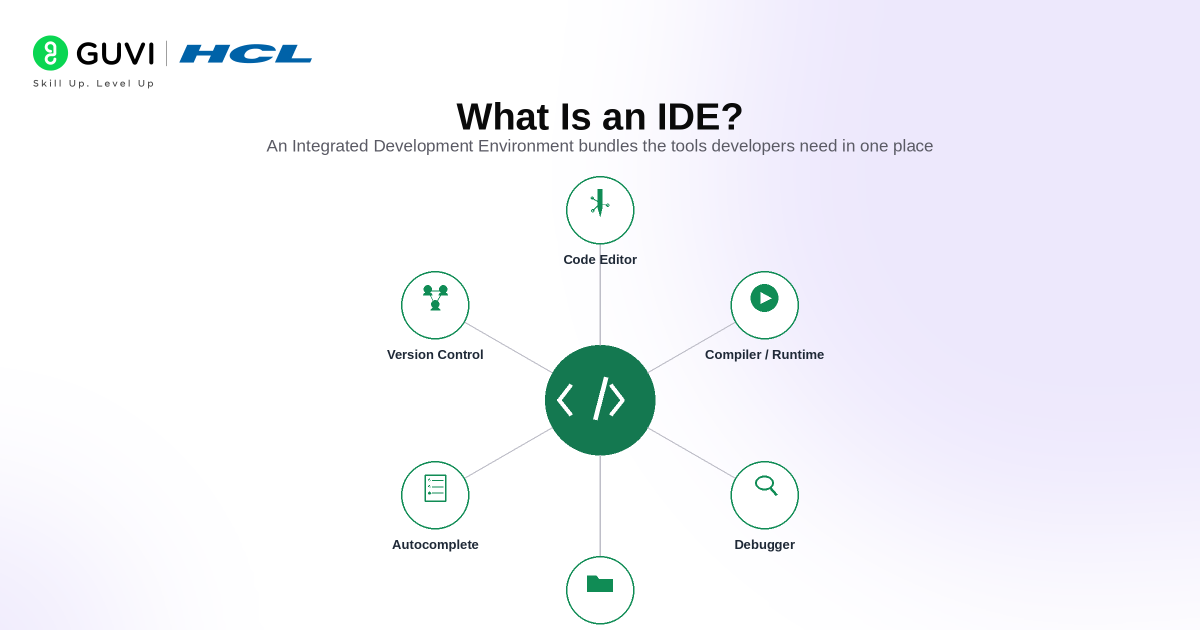
An IDE is nothing but an integrated development environment, sometimes called an interactive development environment, which provides you a well-built environment to write your code, compile your code, debug your code, and run your code. Many IDEs provide various facilities like “on page error checking and correction” such as Net Beans IDE and Eclipse IDE.
IDE is a combination of a text editor along with a compiler and some other plugins attached to it. Which helps us to code more efficiently. There is also a debugger in IDE so you can also debug your code line by line.
Best Java IDE for Java Programming Language
Now let’s look at the available Java IDE where you can start developing your Java application. You can decide on your own which will be the best Java IDE for your development.
1. NORMAL TEXT EDITOR AND COMMAND PROMPT
A normal text editor and command prompt provide the most basic way to write and run Java programs. This setup is not technically an IDE because the editor, compiler, and runtime operate separately.
Developers write code in an editor such as Notepad, TextEdit, Vim, or another plain-text tool. The javac command then compiles the source file into Java bytecode, and the java command runs the compiled program on the Java Virtual Machine. Oracle confirms that javac converts Java source files into class files that can run on the JVM.
Create a file named Main.java:
public class Main {
    public static void main(String[] args) {
        System.out.println("Hello, Java!");
    }
}
Compile and run it using:
javac Main.java
java Main
Modern Java versions can also run a simple source file directly:
java Main.javaThe Java launcher compiles the source in memory and runs it without creating a visible class file first.
Why developers may use it:
- It helps beginners understand how Java compilation works.
- There are no automatic suggestions or hidden build steps.
- It encourages learners to remember basic syntax.
- It works well for small programs and coding practice.
- It requires very little system memory.
Limitations:
Manual compilation becomes inconvenient once a project contains packages, dependencies, tests, and many source files. Professional applications generally require an IDE or build tool such as Maven or Gradle.
2. NETBEANS IDE
Apache NetBeans is a free, open-source IDE for Java and other development technologies. It provides editors, project templates, refactoring tools, debugging, code navigation, and support for different application types.
The old reference to NetBeans 7.4 is outdated. Apache NetBeans 30 was released on May 18, 2026, and the project follows a regular release schedule.
NetBeans can support Java SE, Maven, Gradle, JavaFX, PHP, JavaScript, HTML, and other technologies. Its project wizards make it easier to create structured applications without manually configuring every file.
Key advantages:
- Free and open source
- Strong Java project support
- Built-in code completion and refactoring
- Maven and Gradle integration
- Visual debugging and breakpoint support
- Useful project and package navigation
- Cross-platform availability
Best suited for:
NetBeans works well for students, Java beginners, desktop application developers, and programmers who want a complete IDE without purchasing a subscription.
Possible limitations:
The interface may feel heavier than a lightweight editor. Developers working in very large enterprise codebases may prefer IntelliJ IDEA or Eclipse because their teams already use those ecosystems.
Download Link: NetBeans
3. ECLIPSE IDE FOR JAVA DEVELOPERS
Eclipse is a free and open-source development environment widely used for Java and enterprise application development. Its modular structure allows developers to add tools through plugins and configure the workspace around different projects.
The current Eclipse IDE for Java Developers package includes Java Development Tools, Git integration, XML editing, Maven integration, and Gradle support.
Developers building web and enterprise applications can use the Enterprise Java and Web Developers package. It adds tools for web services, Jakarta technologies, persistence, data tools, Maven, Gradle, and Git.
Key advantages:
- Completely free and open source
- Mature Java Development Tools
- Large plugin ecosystem
- Maven, Gradle, and Git support
- Strong debugging and testing features
- Flexible workspaces and perspectives
- Suitable for enterprise Java projects
Best suited for:
Eclipse is useful for students, professional Java developers, enterprise teams, and programmers who want deep customization.
Possible limitations:
The workspace, perspectives, and plugin system can initially confuse beginners. Installing too many plugins may also affect performance or create compatibility issues.
Eclipse should no longer be presented as the main Android development environment. Android Studio is Google’s official IDE for modern Android development.
Download Link: Eclipse
3. JETBRAINS
IntelliJ IDEA is a professional IDE developed by JetBrains for Java, Kotlin, and other JVM-based technologies. It is known for intelligent code completion, detailed code inspections, quick fixes, navigation, refactoring, testing, and debugging.
JetBrains now distributes IntelliJ IDEA as one unified product. Developers receive core Java and Kotlin features for free, while an Ultimate subscription unlocks advanced professional integrations.
The IDE can identify code problems before compilation and suggest safer or cleaner alternatives. It also helps developers move quickly between interfaces, implementations, tests, methods, and dependent classes.
Key advantages:
- Intelligent and context-aware completion
- Strong code inspections
- Advanced navigation and search
- Reliable refactoring tools
- Maven and Gradle support
- Built-in testing and debugging
- Large plugin marketplace
- Core Java development available for free
Best suited for:
IntelliJ IDEA is suitable for students, backend developers, Spring developers, Kotlin programmers, and professionals working with large Java codebases.
Possible limitations:
Some framework, database, web, and enterprise tools require a paid subscription. Indexing large projects can also consume considerable memory.
Download Link: Jetbrains
Whichever tool you choose — IntelliJ, Eclipse, NetBeans, or VS Code — the fastest way to get comfortable with it is by solving real problems. HCL GUVI’s Code Kata gives you Java coding challenges with hints along the way, so you can build muscle memory in your new IDE from day one.
5. JCREATER
JCreator is a lightweight Java development environment historically associated with Windows. Older documentation describes Lite and Professional editions with project creation, editing, compilation, and additional completion features in the paid version.
However, reliable current maintenance and official download information are difficult to verify. Most available references come from older educational material or third-party download websites. For that reason, JCreator should be treated as a legacy option rather than a primary recommendation for a new Java setup.
Traditionally offered features include:
- Java source-code editing
- Syntax highlighting
- Project management
- Compilation support
- Code-folding features
- Code completion in selected editions
- A Windows-focused interface
Best suited for:
JCreator may still appear in older classrooms or existing Windows-based setups where it has already been installed.
Possible limitations:
- Current maintenance status is unclear.
- Official download availability is difficult to confirm.
- It is not a strong choice for modern Maven, Gradle, Spring, or enterprise workflows.
- New learners have better-supported alternatives.
Recommendation: Choose NetBeans, IntelliJ IDEA, Eclipse, BlueJ, jGRASP, or VS Code for a new Java installation.
6. BLUEJ
BlueJ is a free Java development environment designed specifically for beginners. It reduces interface complexity and helps students understand classes, objects, methods, inheritance, and other object-oriented concepts.
BlueJ describes itself as a full Java environment rather than a simplified imitation. It runs on OpenJDK and uses the standard Java compiler and virtual machine.
One of BlueJ’s most useful features is its visual class diagram. Learners can see the classes in a project, create objects interactively, call methods, and inspect values without writing a complete user interface.
Key advantages:
- Designed for Java beginners
- Simple and focused interface
- Visual class relationships
- Interactive object creation
- Built-in editor and compiler
- Debugging and variable inspection
- Free to use
- Suitable for classroom learning
Best suited for:
BlueJ is ideal for school students, college learners, teachers, and anyone studying object-oriented programming for the first time.
Possible limitations:
It is not designed for large Spring Boot systems, enterprise applications, complex dependency management, or major team projects. Developers should move to NetBeans, IntelliJ IDEA, Eclipse, or VS Code after mastering the fundamentals.
Download Link: BlueJ
Do check out, our codekata platform which offers you problems to solve based on various concepts. You’ll also be provided with some hints in case you face challenge while solving.
7. DRJAVA
DrJava is a lightweight integrated development environment that is best designed for students. For any beginner, this tool is best to start with. As already said it is specially designed for students, so you can find more of intuitive interface in this IDE. It’s free software and also open-sourced under BSD license. Currently, it is under JavaPLT group at Rice University and going through the development phase.
Download Link: DrJava
jGRASP is a lightweight development environment built around software visualization. It helps learners understand source-code structure, objects, and data structures through visual representations.
The environment can generate control-structure diagrams and visual object views. These features can help students understand loops, conditions, linked lists, trees, and other structures that may feel difficult when viewed only as text.
jGRASP is implemented in Java and runs on systems with a compatible Java Virtual Machine. Its July 2026 release also provides current bundled development components.
Key advantages:
- Lightweight development environment
- Visual representation of code structure
- Object and data-structure viewers
- Useful debugging tools
- Supports Java learning
- Runs across major operating systems
- Helpful for algorithms and data structures
- Continues to receive updates
Best suited for:
jGRASP works well for students learning Java, object-oriented programming, algorithms, linked structures, trees, and program flow.
Possible limitations:
It does not provide the same enterprise framework support, plugin ecosystem, or project automation available in IntelliJ IDEA, Eclipse, or NetBeans.
Download Link: JGRASP
Before proceeding further, make sure you have a strong grasp of essential concepts in Java Full Stack Development, including front-end frameworks, back-end technologies, and database management. If you’re looking for a professional future in Java Full Stack Development, consider joining HCL GUVI’s Java Full Stack Development Career Program. With placement assistance included, you’ll master the Java stack and build real-world projects to enhance your skills.
9. JEDIT
jEdit is a mature programmer’s text editor written in Java. It is not a complete Java IDE by default, although plugins can add features that make it behave more like one.
The editor provides syntax highlighting for more than 200 languages, code folding, macros, multiple encodings, keyboard shortcuts, and an integrated plugin manager.
Because jEdit runs on the Java Virtual Machine, it can work across different operating systems with a compatible Java installation.
Key advantages:
- Lightweight compared with large IDEs
- Supports many programming languages
- Syntax highlighting
- Code folding
- Macro support
- Extensible plugin system
- Cross-platform compatibility
- Highly customizable editing experience
Best suited for:
jEdit may suit experienced developers who prefer text editors and want to configure their own tools. It can also help programmers working across several languages.
Possible limitations:
Java compilation, debugging, dependency management, testing, and project tools are not as integrated as they are in a complete IDE. Beginners may spend more time configuring plugins than learning Java.
Recommendation: Use jEdit as a flexible editor. Choose IntelliJ IDEA, Eclipse, or NetBeans when a complete Java workflow is required.
Downlaod Link: JEdit
You must also be aware of the popular Java tools for every phase of development.
10. MYECLIPSE
MyEclipse is a commercial Java IDE built on the Eclipse platform. It adds an integrated set of enterprise tools for Java, Spring, application servers, databases, Maven, web development, and deployment.
Unlike the free Eclipse IDE, MyEclipse follows a paid licensing model after its trial period. Its current download page lists MyEclipse 2026.2.0 and provides access to all features during the trial.
MyEclipse aims to reduce the need to find, install, and maintain many separate Eclipse plugins. It provides coding, debugging, server deployment, database management, and enterprise project tools in one package.

Key advantages:
- Built on the Eclipse ecosystem
- Strong enterprise Java support
- Spring development tools
- Maven integration
- Application-server connectors
- Database development tools
- Web application support
- Centralized professional toolset
- Free trial available
Best suited for:
MyEclipse is suitable for professional teams building enterprise Java, Spring, Jakarta, database-driven, and web applications. It may be particularly useful when a company wants a standardized Eclipse-based environment.
Possible limitations:
- It requires payment after the trial.
- Beginners may not need its enterprise features.
- The large toolset can consume more system resources.
- Free alternatives already cover many standard Java requirements.
Recommendation: Choose MyEclipse when the enterprise integrations justify the subscription. Eclipse, NetBeans, or free IntelliJ IDEA features may be sufficient for students and smaller projects.
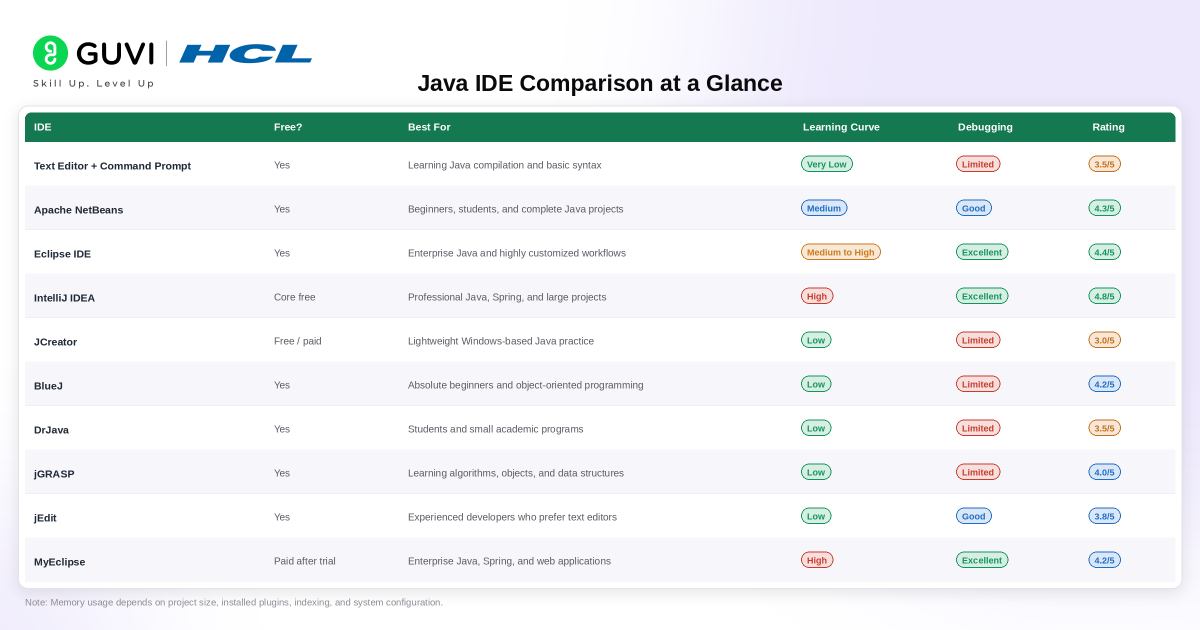
Java IDE Comparison Table
| IDE or Editor | Free? | Best For | Memory Usage | Plugin Support | Rating |
|---|---|---|---|---|---|
| Text Editor and Command Prompt | Yes | Learning Java compilation and basic syntax | Very Low | Limited | 3.5/5 |
| Apache NetBeans | Yes | Beginners, students, and complete Java projects | Medium | Good | 4.3/5 |
| Eclipse IDE | Yes | Enterprise Java and highly customized workflows | Medium to High | Excellent | 4.4/5 |
| IntelliJ IDEA | Core features are free | Professional Java, Spring, and large projects | High | Excellent | 4.8/5 |
| JCreator | Free and paid editions historically available | Lightweight Windows-based Java practice | Low | Limited | 3.0/5 |
| BlueJ | Yes | Absolute beginners and object-oriented programming | Low | Limited | 4.2/5 |
| DrJava | Yes | Students and small academic programs | Low | Limited | 3.5/5 |
| jGRASP | Yes | Learning algorithms, objects, and data structures | Low | Limited | 4.0/5 |
| jEdit | Yes | Experienced developers who prefer text editors | Low | Good | 3.8/5 |
| MyEclipse | Paid after trial | Enterprise Java, Spring, and web applications | High | Excellent | 4.2/5 |
Note: Memory usage depends on project size, installed plugins, indexing, and system configuration. Ratings are editorial estimates based on features, usability, maintenance, and suitability for modern Java development.
Downlaod Link: MyEclipse
Now you can build your application from scratch by following a guided course that helps you with the practical implementation of the fundamentals. This course will cover all the basics to advanced-level concepts and will also provide certification of completion after solving project board problems.
Begin your career journey with HCL GUVI’s Java Full Stack Development Career Program, providing placement assistance. Master essential technologies including Java, Maven, Eclipse, HTML, CSS, MongoDB, and more while working on practical real-world projects to enhance your expertise.
Best Free Java IDE for Beginners
BlueJ is the best free Java IDE for absolute beginners who are learning Java syntax, classes, objects, and object-oriented programming for the first time.
Its interface is intentionally smaller and simpler than professional tools such as Eclipse or NetBeans. BlueJ also displays classes and their relationships visually, which helps students understand how objects interact inside a Java program. It uses a standard Java Development Kit, so learners still write and run real Java code.
Why Beginners May Prefer BlueJ
- Simple interface with fewer distracting tools
- Visual representation of classes and objects
- Built-in editor, compiler, and debugger
- Suitable for schools, colleges, and self-learning
- Free to download and use
BlueJ becomes limiting when developers begin working with Spring Boot, Maven, Gradle, databases, or large applications. At that stage, moving to IntelliJ IDEA, Eclipse, NetBeans, or VS Code makes more sense.
Recommendation: Start with BlueJ to understand Java fundamentals. Move to IntelliJ IDEA or Eclipse when working on larger projects and professional development.
IntelliJ IDEA vs Eclipse: Detailed Pros and Cons Comparison
IntelliJ IDEA and Eclipse are two strong choices for professional Java development. Both support writing, running, testing, debugging, and managing Java projects. However, they provide noticeably different development experiences.
IntelliJ IDEA now uses a unified product model. Core Java and Kotlin development features remain free, while advanced professional tools require an Ultimate subscription.
Eclipse remains free and open source. Its Java Developers package includes Java development tools, Git, XML editing, and Maven and Gradle integrations.
| Comparison Area | IntelliJ IDEA | Eclipse |
|---|---|---|
| Cost | Core Java features are free; advanced tools require a subscription | Free and open source |
| Setup | Works well with minimal configuration | May require more workspace and plugin configuration |
| Code completion | Strong context-aware suggestions and code analysis | Reliable completion with extensive customization |
| Refactoring | Advanced and easy-to-use refactoring tools | Strong refactoring support, though menus may feel less intuitive |
| Interface | Modern and polished interface | Highly customizable but may appear complex to beginners |
| Performance | Can use more memory on large projects | Performance depends heavily on installed plugins and workspace size |
| Maven and Gradle | Built-in project import and build-tool support | Java package includes Maven and Gradle integration |
| Plugin support | Large JetBrains Marketplace ecosystem | Large Eclipse Marketplace ecosystem |
| Enterprise Java | Advanced support is strongest with the paid features | Enterprise Java packages are available for free |
| Best suited for | Developers who want intelligent assistance and a smoother default experience | Developers who want a free, flexible, and highly configurable IDE |
IntelliJ IDEA Pros
- Strong code completion and inspections
- Easy navigation across large codebases
- Powerful debugging and refactoring tools
- Smooth Maven and Gradle project setup
- Beginner-friendly project creation
- Core Java development features remain free
IntelliJ IDEA Cons
- Some enterprise and framework features require a paid subscription
- May consume more system memory
- Extensive suggestions can feel overwhelming to new programmers
- Advanced features may create dependency on automated assistance
Eclipse Pros
- Completely free and open source
- Strong Java Development Tools support
- Maven, Gradle, Git, and XML tools are available in the Java package
- Extensive plugin ecosystem
- Highly customizable workspaces and perspectives
- Suitable for Java and enterprise application development
Eclipse Cons
- The interface may feel dated or crowded
- Plugin conflicts can affect stability
- Initial workspace configuration may confuse beginners
- Code navigation and suggestions may feel less polished than IntelliJ IDEA
Which One Should You Choose?
Choose IntelliJ IDEA when you want intelligent code assistance, easier navigation, and a polished development experience.
Choose Eclipse when you need a fully free, open-source IDE with deep customization and strong enterprise Java support.
Beginners can try both using the same small Java project. The better option is the one that makes writing, running, and debugging code feel more natural.
Best Java IDE for Android Development Specifically
Android Studio is the best Java IDE for Android application development. It is the official Android IDE developed and distributed by Google and is built on IntelliJ IDEA.
Android Studio includes tools created specifically for Android development, such as:
- Android SDK management
- Device and Android version configuration
- Gradle-based builds
- Android Emulator
- Layout and Compose design tools
- Logcat for application logs
- APK analysis
- Performance profiling
- Device debugging and testing
The Android Emulator allows developers to test applications across different device sizes and Android API levels without owning every physical device. Google identifies the emulator as the preferred testing method for many development workflows.
Android Studio supports Java, Kotlin, and C++ development. Kotlin is now central to many modern Android resources, but developers can still create, maintain, and debug Java-based Android applications.
Why Not Use Eclipse or Standard IntelliJ IDEA?
Eclipse and IntelliJ IDEA can handle Java code, but they do not provide the same ready-to-use Android development environment. Android Studio comes with Android-specific plugins, SDK tools, emulator controls, Gradle integration, and device inspection features.
Recommendation: Use Android Studio for new Android projects and for maintaining existing Java-based Android applications.
How to Set Up Java in VS Code: Step by Step
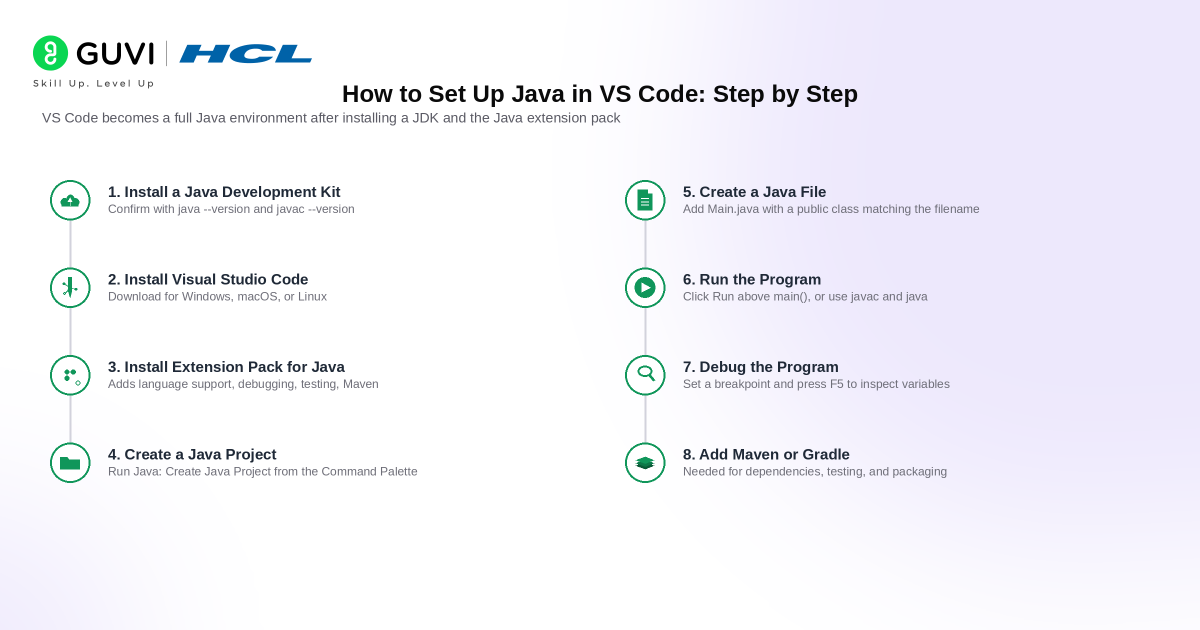
Visual Studio Code is a lightweight editor that becomes a capable Java development environment after installing a JDK and the required Java extensions.
Step 1: Install a Java Development Kit
Install a supported JDK on the computer. A JDK contains the compiler, runtime, and tools required to build Java programs.
Open a terminal and confirm that Java is available:
java --version
javac --version
Both commands should display installed version information.
VS Code can also guide users through installing a JDK. Open the Command Palette and run:
Java: Install New JDK
The Java project tools then display available JDK installation options.
Step 2: Install Visual Studio Code
Download and install Visual Studio Code for Windows, macOS, or Linux. Open the editor after installation.
Step 3: Install the Extension Pack for Java
Open the Extensions panel using Ctrl+Shift+X on Windows and Linux or Command+Shift+X on macOS.
Search for:
Extension Pack for Java
Install the pack published by Microsoft. It currently brings together Java language support, debugging, testing, Maven support, project management, and IntelliCode assistance.
Step 4: Create a Java Project
Open the Command Palette using Ctrl+Shift+P or Command+Shift+P.
Run:
Java: Create Java Project
Choose a project type. A simple project works well for beginners. Maven or Gradle can be selected for structured applications.
Choose a folder and enter the project name.
Step 5: Create a Java File
Create a file named Main.java and add the following code:
public class Main {
    public static void main(String[] args) {
        System.out.println("Java is running in VS Code");
    }
}
The file name must match the public class name.
Step 6: Run the Program
Select the Run link displayed above the main() method.
The same program can also be compiled and executed through the terminal:
javac Main.java
java Main
The terminal should display:
Java is running in VS Code
Step 7: Debug the Program
Add a breakpoint by clicking beside a line number. Press F5 or select Run and Debug.
VS Code will pause execution at the breakpoint and allow developers to inspect variables, move through the program line by line, and identify errors. Java debugging is provided through the Java extension tools.
Step 8: Add Maven or Gradle When Required
Simple files are sufficient for learning basic Java. Larger applications should use Maven or Gradle for dependencies, testing, packaging, and repeatable builds.
VS Code provides Java project management and Maven integrations through the Extension Pack for Java. Spring Boot development also requires a JDK, the Java extension pack, and relevant Spring extensions.
Common VS Code Java Setup Problems
Java is not recognized: Confirm that the JDK is installed and available through the system path.
No Run button appears: Check whether the Extension Pack for Java is installed and enabled.
Wrong Java version is selected: Open the Command Palette and run:
Java: Configure Java Runtime
The class does not run: Confirm that the public class name matches the file name.
VS Code is suitable for learners and developers who want a lightweight, customizable setup. IntelliJ IDEA, Eclipse, or NetBeans may be more convenient for large enterprise applications requiring extensive built-in tooling.
Wrapping Up
The best Java IDE is not necessarily the one with the most features. It is the tool that matches the developer’s skills, workflow, project size, and system requirements.
Beginners may find BlueJ, NetBeans, or Eclipse easier for learning and practising Java fundamentals. Professional developers often prefer IntelliJ IDEA, Eclipse, or NetBeans for advanced debugging, refactoring, framework support, and project management.
Lightweight editors can also strengthen programming skills because they encourage developers to understand syntax and compilation more clearly. However, larger projects usually benefit from a complete IDE that saves time and simplifies development.
Developers should test a few options before making a final choice. The right Java IDE should improve productivity without making the coding process unnecessarily complicated.
FAQs
Q1. Which is the best Java IDE?
Ans. Some of the best Java IDE used in 2026 are:
IntelliJ Idea
Eclipse
NetBeans
BlueJ
JDeveloper
JCreator
Q2. What is IDE in Java programming?
Ans. An integrated development environment (IDE) is a software application that helps programmers develop software code efficiently. It increases developer productivity by combining capabilities such as software editing, building, testing, and packaging in an easy-to-use application.
Q3. What are the three most popular IDE used in Java?
Ans. The three IDEs most often chosen for server-side Java development are IntelliJ IDEA, Eclipse, and NetBeans
Success Stories

About the Author
Vaishali
I'm a seasoned writer with four years of experience across technical, non-technical, and just about every genre or niche you can imagine. Adaptable and curious, I enjoy exploring new topics and making information engaging and easy to understand. Fueled by a steady stream of tea, I approach each project with creativity, reliability, and genuine enthusiasm for storytelling.
View all posts by Vaishali
Connect with me @










Did you enjoy this article?