


Artificial Intelligence and Machine Learning Articles
Claude's Approach to Academic Integrity
Claude for Real-Time Meeting Summarization


Get In Touch For Details! Request More Information
10 Best Databases for Machine Learning and AI [2026]
Feb 13, 2026 6 Min Read 8981 Views
(Last Updated)
87% of AI projects never make it into production because of fragmented data systems and inefficient database infrastructure. A strong database foundation is what separates experimental models from production-grade intelligence. Databases built for machine learning and AI handle massive volumes of structured, semi-structured, and vector data that power today’s predictive and generative models.
Read this blog to explore the 10 Best Databases for Machine Learning and AI, their core strengths, specialized features, and how they’re reshaping the foundation of modern AI systems.
Table of contents
- What is a Database for Machine Learning and AI?
- Top 10 Best Databases for Machine Learning and AI
- PostgreSQL
- MongoDB
- MySQL
- Apache Cassandra
- Redis
- Elasticsearch
- Snowflake
- BigQuery
- Milvus
- Pinecone
- Types of Databases for Machine Learning and AI
- How to Choose the Right Database for Machine Learning and AI in 2026?
- Step 1: Assess Data Structure Needs
- Step 2: Evaluate Scalability and Throughput
- Step 3: Consider Model Integration Capability
- Step 4: Analyze Cost and Resource Efficiency
- Future of Databases for Machine Learning and AI
- Conclusion
- FAQs
- Which database is best for large-scale AI workloads?
- What is the best database for vector and embedding storage?
- Why does the choice of database matter in machine learning?
What is a Database for Machine Learning and AI?
A database for machine learning and AI is a structured system that stores and organizes data used for model training and evaluation. It manages numerical and textual data, which allows algorithms to read information efficiently. Databases connect with preprocessing pipelines that prepare features and labels, creating a reliable foundation for accurate learning outcomes.
The primary purpose of such databases is to streamline data accessibility, scalability, and consistency across AI workflows. In application, these databases power predictive analytics, recommendation systems, natural language processing, and computer vision. They seamlessly support both real-time and large-scale training environments with precision and speed.
Top 10 Best Databases for Machine Learning and AI
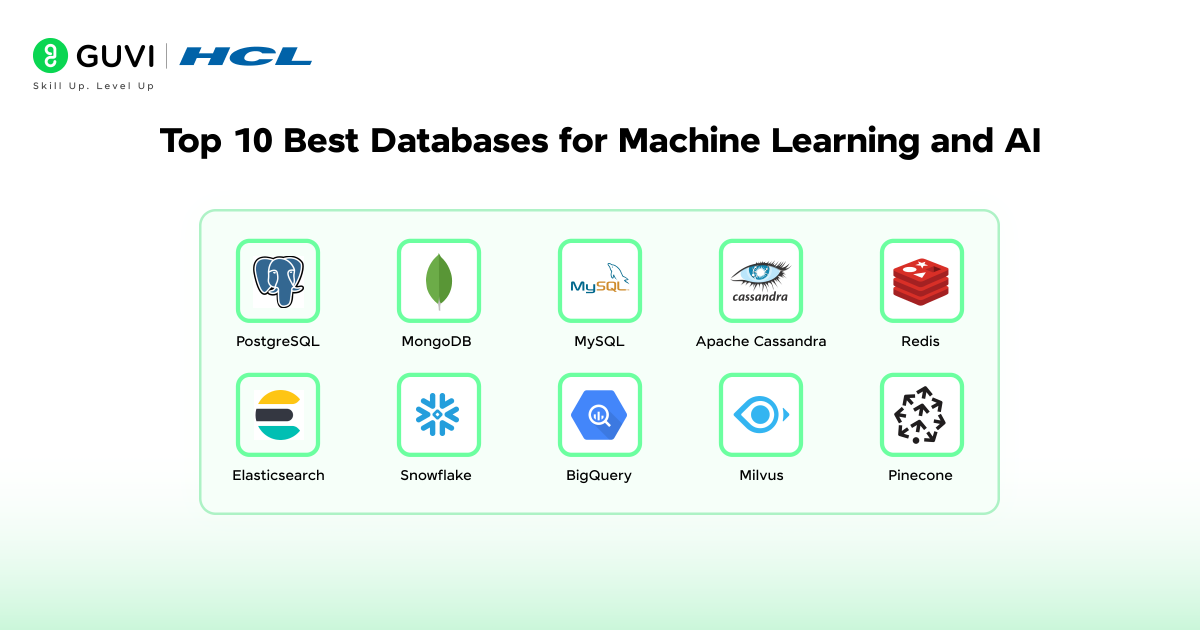
Below are ten leading databases widely used in AI and machine learning workflows:
1. PostgreSQL
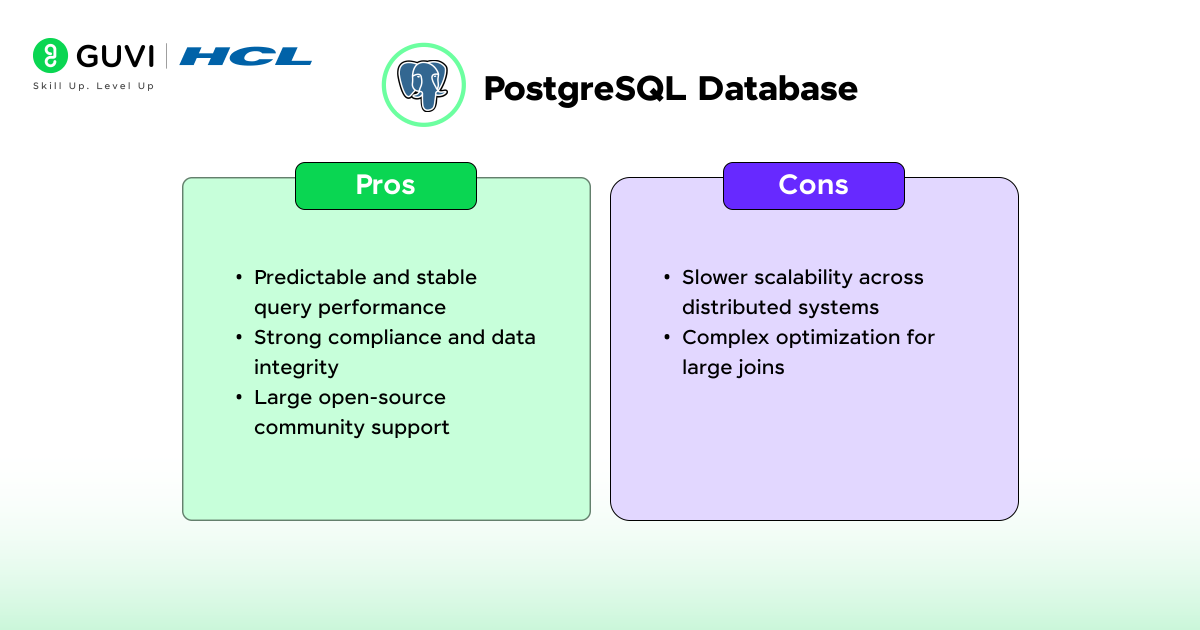
PostgreSQL is a robust open-source relational database built for precision and consistency in analytical and AI workloads. It remains widely used for structured data pipelines and model reproducibility.
Top Features
- Advanced Indexing Methods: Includes B-tree, GiST, and BRIN indexes that improve feature selection performance.
- Foreign Data Wrappers: Allows external data integration from APIs and other databases directly within queries.
- Parallel Query Execution: Distributes computation across CPU cores for faster training data aggregation.
- Data Type Versatility: Supports arrays, JSONB, and geospatial extensions for complex AI datasets.
Benefits
- Predictable Query Performance: Maintains stability during concurrent model training and evaluation.
- Strong Compliance Control: Offers transactional integrity essential for regulatory AI systems.
- Extensive Community Support: Provides rich libraries for data preparation and statistical modeling.
Applications
- Experiment Tracking Systems: Stores model metadata and metrics for iterative learning cycles.
- Financial Forecasting Models: Manages structured historical data for supervised learning.
- Healthcare Record Analysis: Maintains sensitive data under strict access and encryption protocols.
Cons
- Slower scalability across distributed nodes.
- Complex optimization for extremely large joins.
2. MongoDB
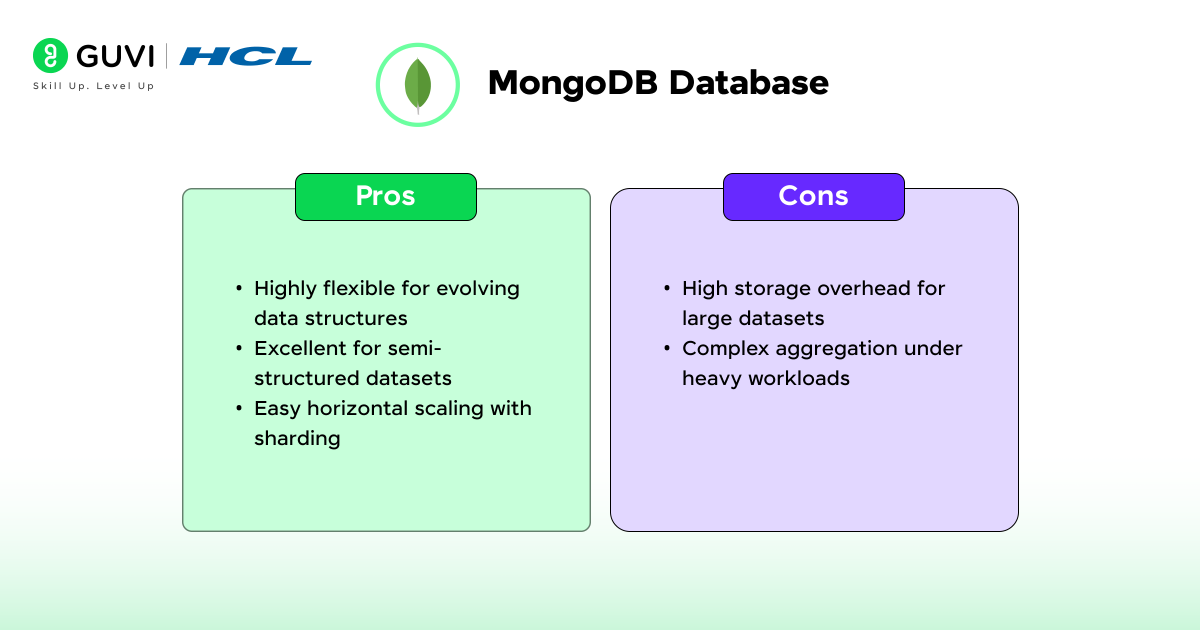
MongoDB is ideal for AI systems that depend on flexible, evolving, and semi-structured data formats such as text or JSON documents.
Top Features
- Dynamic Schema Design: Adapts instantly to data structure changes during model iteration.
- Aggregation Pipelines: Processes training data transformations directly inside the database.
- Atlas Vector Search: Supports embedding-based queries for semantic search applications.
- Change Streams: Enables real-time data synchronization for adaptive AI models.
Benefits
- High Data Adaptability: Fits projects where input formats change across versions.
- Efficient Query Handling: Indexes nested fields for faster retrieval in deep models.
- Simple Horizontal Scaling: Expands capacity through automated shard balancing.
Applications
- Chatbot Context Storage: Maintains evolving conversational states and responses.
- Product Recommendation Engines: Stores user interaction histories with fast query response.
- Sensor-Driven AI Systems: Handles irregular IoT data without schema redesign.
Cons
- MongoDB comes with high storage usage for large datasets.
- Complex aggregation operations under heavy workloads.

3. MySQL
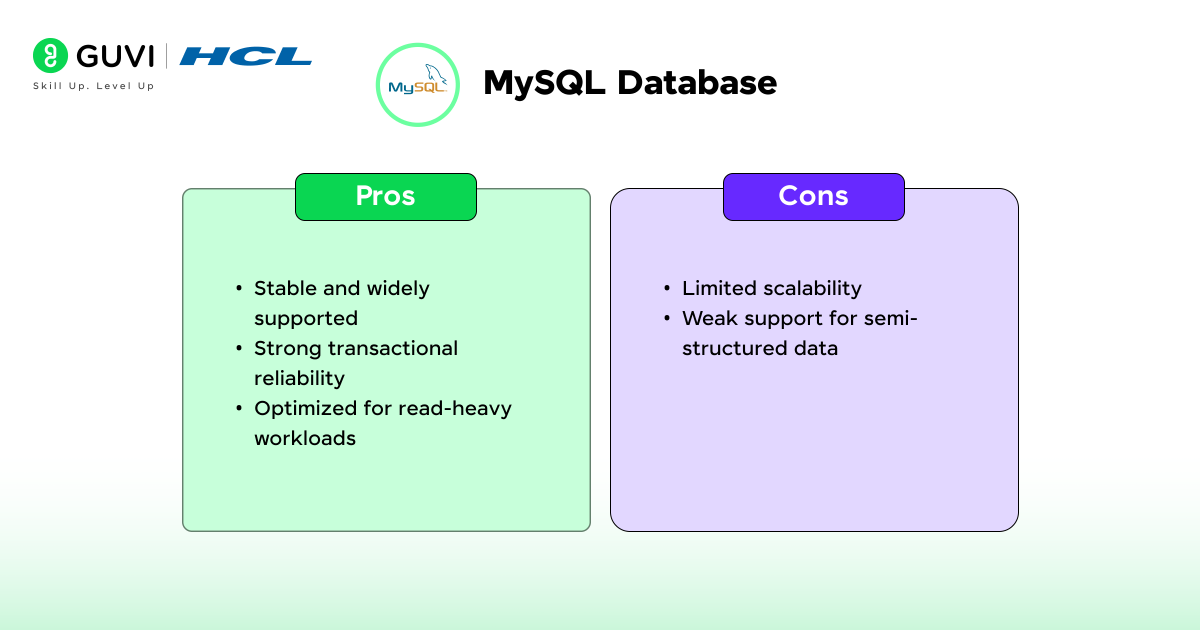
MySQL is suited for AI environments that emphasize predictable performance, structured inputs, and transactional reliability.
Top Features
- Query Cache Layer: Improves access time for repeated analytical queries.
- Foreign Key Support: Maintains relational integrity in model training datasets.
- Partition Pruning: Reduces scan size during data-intensive batch processing.
- Stored Procedures: Automates recurring feature extraction and cleaning tasks.
Benefits
- Stable Enterprise Deployment: Runs efficiently in established business pipelines.
- High Read Optimization: Performs well for model validation and data retrieval workloads.
- Strong Security Features: Incorporates SSL connections and user-level privileges.
Applications
- Credit Scoring Systems: Manages numerical records for logistic regression models.
- Customer Segmentation Analysis: Handles structured marketing data efficiently.
- Quality Assurance Pipelines: Stores validation metrics for automated AI testing.
Cons
- Limited scalability for high-volume distributed setups.
- Minimal support for semi-structured or graph data.
4. Apache Cassandra
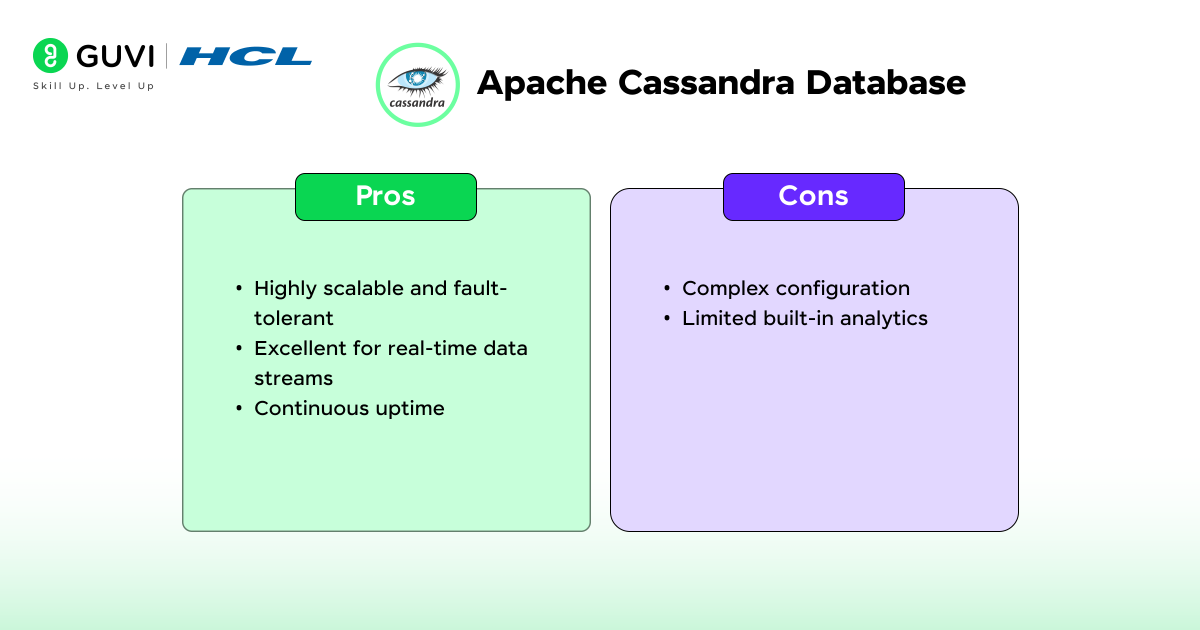
Apache Cassandra is engineered for massive distributed systems that process real-time, high-throughput AI data streams.
Top Features
- Peer-Based Topology: Enables equal-node participation without a master node.
- Tunable Consistency Levels: Adjusts trade-offs between accuracy and response speed.
- Compaction Strategies: Reduce latency in continuous data ingestion.
- Query Language (CQL): Provides SQL-like syntax tailored for AI-driven time-series data.
Benefits
- Continuous Uptime: Apache handles real-time ML predictions without interruption.
- Linear Scalability: Expands capacity seamlessly across multiple data centers.
- Efficient Write Optimization: Handles millions of insertions from streaming pipelines.
Applications
- Predictive Maintenance Models: Analyze temporal equipment data.
- Fraud Detection Pipelines: Monitors transaction streams for anomalies.
- Edge AI Data Capture: Manages high-frequency telemetry inputs.
Cons
- Complex node configuration and tuning.
- Limited built-in analytics functionality.
5. Redis
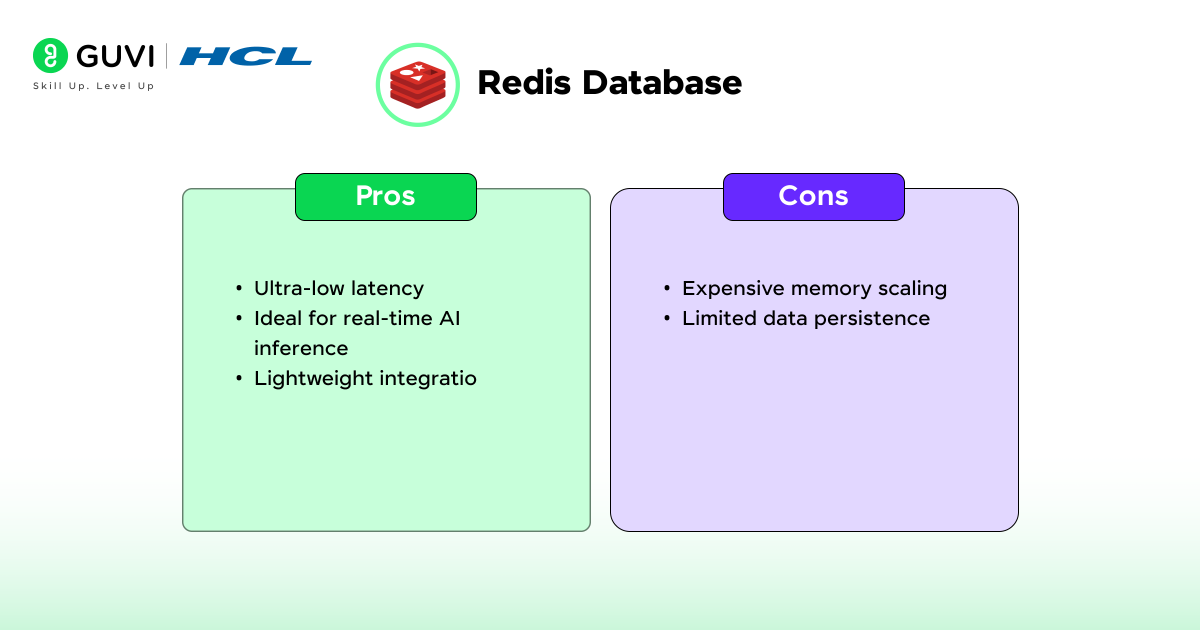
Redis excels in AI and ML workflows that demand millisecond-level latency for inference or caching.
Top Features
- In-Memory Key-Value Architecture: Guarantees fast access to transient training data.
- RedisAI Module: Executes tensor operations and stores model parameters directly in memory.
- Streams and Pub/Sub: Supports event-driven communication between AI services.
- Data Expiration Controls: Automates cache refresh for dynamic feature updates.
Benefits
- Extremely Low Latency: Ideal for models that require rapid response times.
- Compact Memory Management: Handles short-lived data efficiently.
- Lightweight Integration: Connects easily with Python, Go, and Node.js ML APIs.
Applications
- Real-Time Feature Stores: Supplies immediate features for deployed AI models.
- Game AI Engines: Manages state updates during reinforcement learning cycles.
- Edge Deployment Buffers: Caches intermediate inference results.
Cons
- Limited storage persistence options.
- Expensive scaling for RAM-heavy operations.
6. Elasticsearch
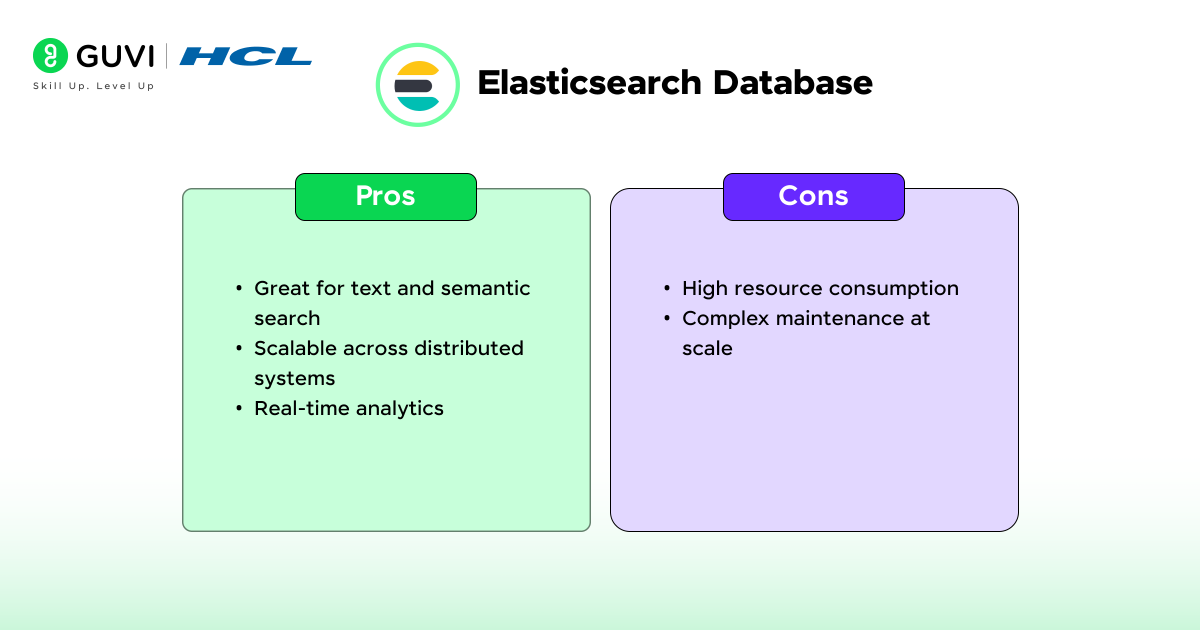
Elasticsearch provides scalable indexing and search capabilities essential for semantic AI, NLP, and monitoring solutions.
Top Features
- Vector Similarity Search: Supports dense embeddings and semantic ranking.
- Distributed Inverted Indexes: Accelerates retrieval for massive unstructured datasets.
- Anomaly Detection Plugin: Detects data drifts or outliers in real-time.
- Cross-Cluster Replication: Synchronizes models and indexes across regions.
Benefits
- Efficient Text Analytics: Processes billions of language tokens quickly.
- Scalable Observability: Integrates monitoring with AI operations pipelines.
- Flexible Query Combinations: Mixes keyword, vector, and metadata filters.
Applications
- Document Retrieval Models: Power contextual search in large knowledge bases.
- Log Intelligence Systems: Analyzes operational patterns for model optimization.
- Semantic Web Search: Connects AI embeddings with search relevance scoring.
Cons
- Memory-intensive indexing.
- High operational overhead during scaling.
7. Snowflake
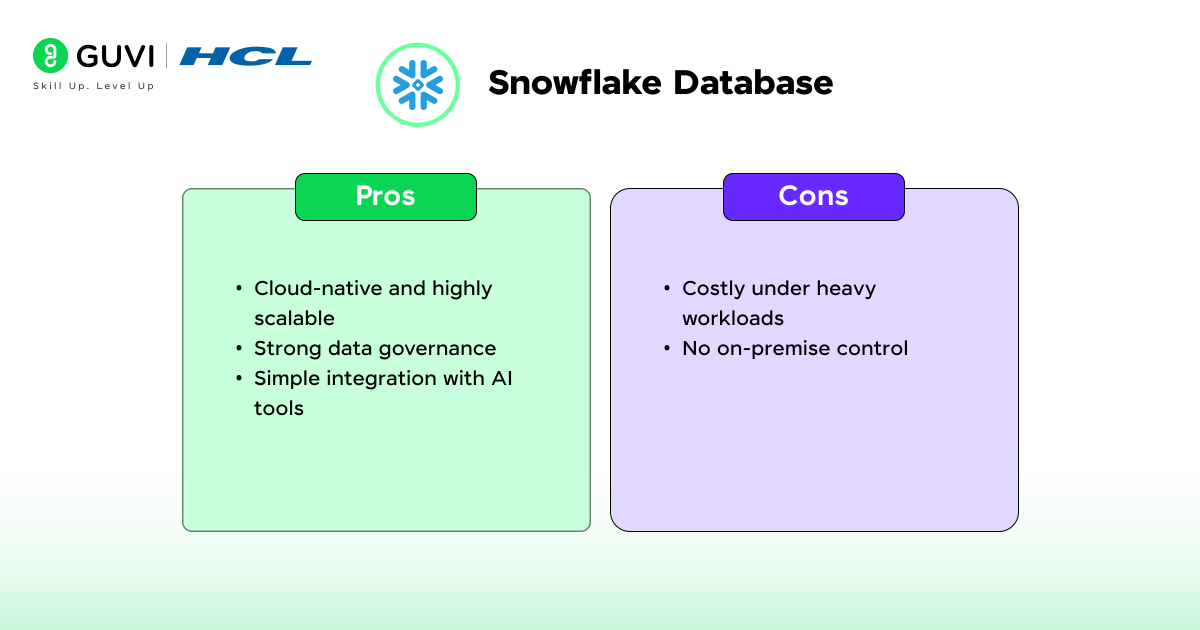
Snowflake offers a cloud-first solution that supports analytical AI workloads requiring elastic resource control.
Top Features
- Virtual Warehouses: Provides isolated compute clusters for parallel model operations.
- Zero-Copy Cloning: Allows duplication of datasets without replication overhead.
- Data Sharing Framework: Enables controlled access across departments and partners.
- Native Python Integration (Snowpark): Runs model preparation directly within Snowflake.
Benefits
- Seamless Resource Allocation: Optimizes compute usage for heavy AI pipelines.
- Unified Data Governance: Maintains compliance while sharing large datasets.
- Multi-Language Compatibility: Works across R, SQL, and Python for flexibility.
Applications
- Enterprise ML Workflows: Supports centralized training and analytics operations.
- Feature Aggregation Pipelines: Combines data across silos for model readiness.
- Predictive Sales Analytics: Performs real-time forecasting within dashboards.
Cons
- Cost scales rapidly with frequent large queries.
- Minimal control for on-premise deployment.
8. BigQuery
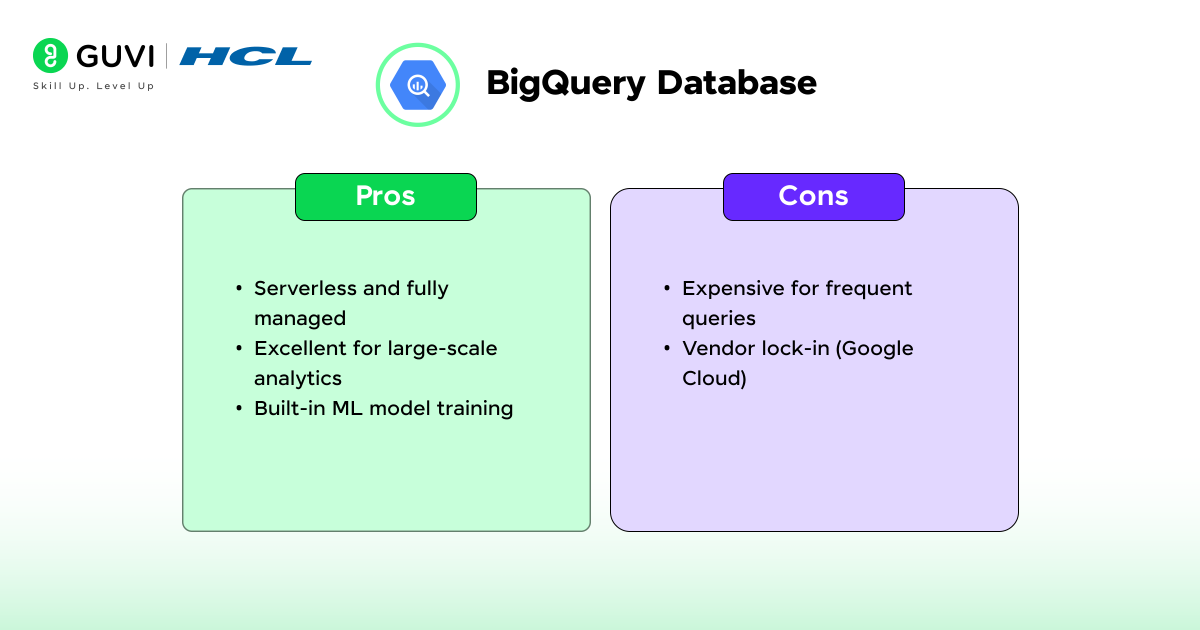
BigQuery functions as Google’s fully managed data warehouse designed for analytical and ML model integration.
Top Features
- Massive Parallel Query Engine: Processes petabytes of data in seconds.
- Integrated BigQuery ML: Trains regression and classification models directly with SQL.
- Materialized Views: Caches repetitive query outputs for faster access.
- Automatic Data Encryption: Protects model data without manual configuration.
Benefits
- High Computational Efficiency: Handles complex ML preprocessing at scale.
- Serverless Operation: Removes infrastructure management and scaling concerns.
- Seamless Cloud Linking: Connects to Google Cloud Storage and Vertex AI easily.
Applications
- Large-Scale Feature Engineering: Combines multi-source enterprise data.
- Demand Forecasting Models: Processes temporal datasets efficiently.
- Operational Analytics: Provides instant insights for live ML dashboards.
Cons
- Pricing complexity due to on-demand queries.
- Vendor dependency for cloud operations.
9. Milvus
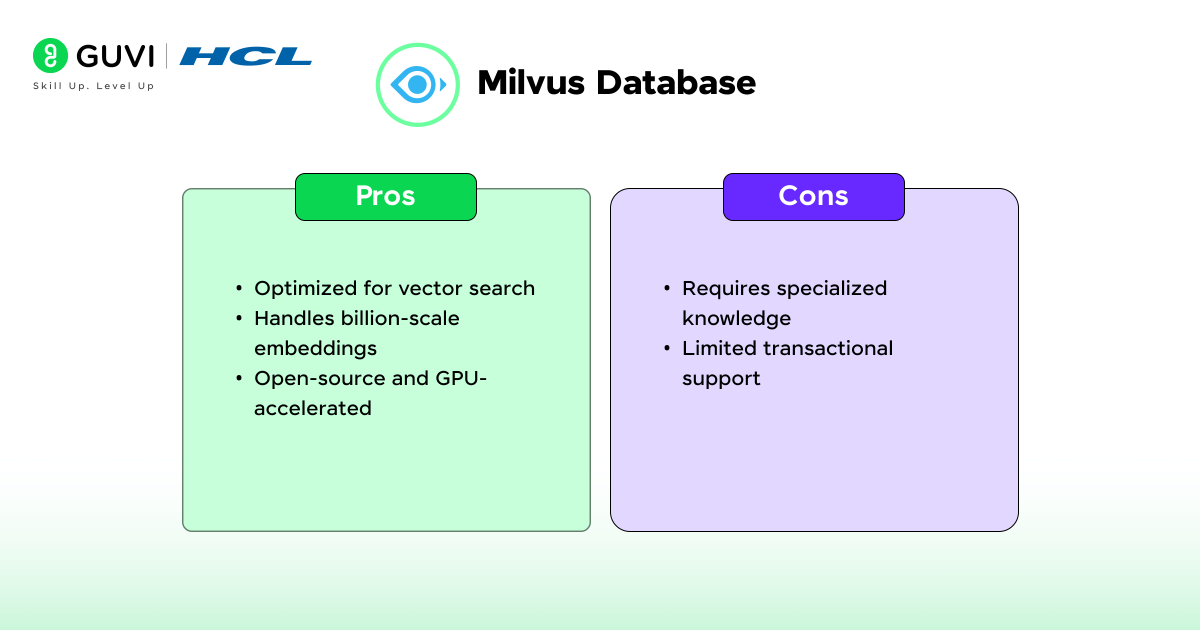
Milvus is an open-source vector database optimized for similarity search and retrieval across large embedding datasets.
Top Features
- Approximate Nearest Neighbor (ANN) Indexing: Balances precision and search speed for high-dimensional data.
- Partition Management: Divides datasets dynamically for balanced performance.
- Scalar Filtering: Combines vector search with metadata-based conditions.
- GPU Acceleration: Enhances vector operations in AI inference workloads.
Benefits
- High-Throughput Vector Processing: Handles billions of records efficiently.
- Customizable Index Algorithms: Supports IVF, HNSW, and other ANN techniques.
- Active Open-Source Ecosystem: Continuous improvements from the AI community.
Applications
- Visual Similarity Detection: Finds related images or videos rapidly.
- Text Embedding Retrieval: Supports large-scale semantic question answering.
- Voice Recognition Systems: Stores and matches speech embeddings.
Cons
- Requires specialized vector search expertise.
- Limited support for transactional operations.
10. Pinecone
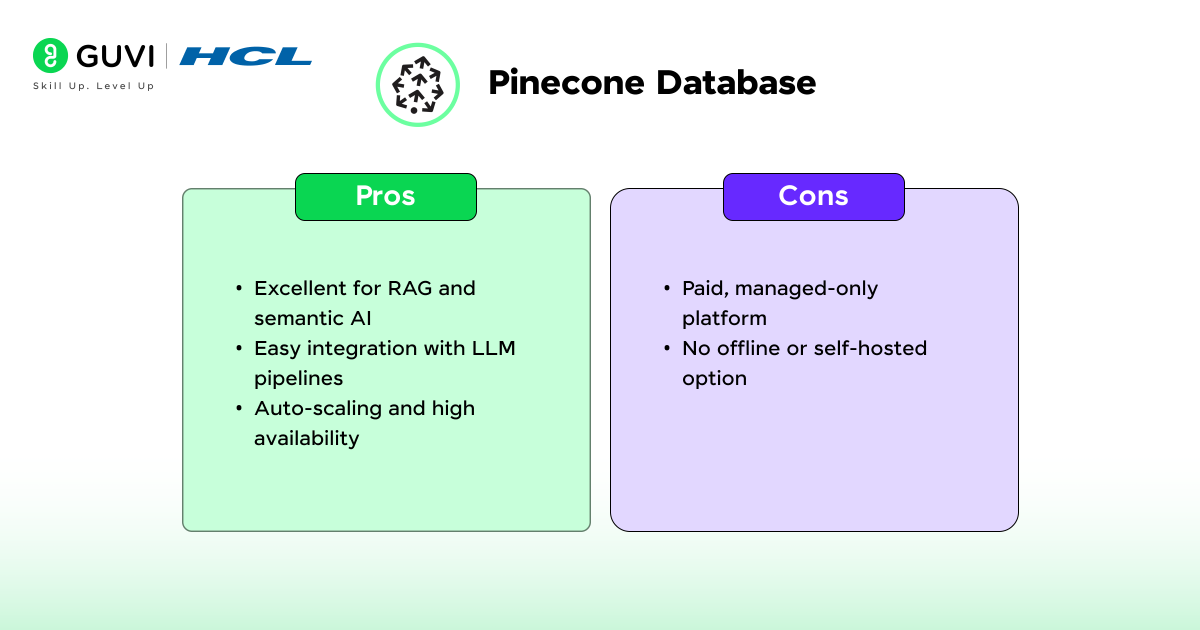
Pinecone delivers managed vector storage designed for production-grade semantic search and generative AI systems.
Top Features
- Automatic Index Sharding: Balances data across multiple regions with zero downtime.
- Hybrid Filtering Capabilities: Combines vector and metadata filters for complex queries.
- Real-Time Update Pipeline: Handles live vector upserts for adaptive models.
- Usage Monitoring Tools: Tracks latency, recall, and capacity metrics in dashboards.
Benefits
- Production-Ready Scalability: Expands automatically based on request volume.
- Developer-Friendly APIs: Simplifies integration with Python and LangChain environments.
- High Query Precision: Maintains consistent performance under concurrent workloads.
Applications
- Retrieval-Augmented Generation (RAG): Supplies contextual embeddings for LLMs.
- Personalization Models: Matches user behavior with semantically similar items.
- Enterprise Knowledge Search: Powers vector-based document discovery systems.
Cons
- Subscription-only access.
- Limited offline or self-hosted flexibility.
Selecting the right database is only half the battle, mastering how to use it for building intelligent AI systems is where your career takes off. Our AI & ML Course with Intel Certification helps you learn Python, data pipelines, model deployment, and AI tools that power real-world machine learning infrastructure. Gain hands-on experience with BigQuery, Snowflake, Milvus, and Pinecone, and earn a globally recognized Intel-backed certification. Enroll now and become an AI engineer who knows how to turn data into intelligence.
Types of Databases for Machine Learning and AI
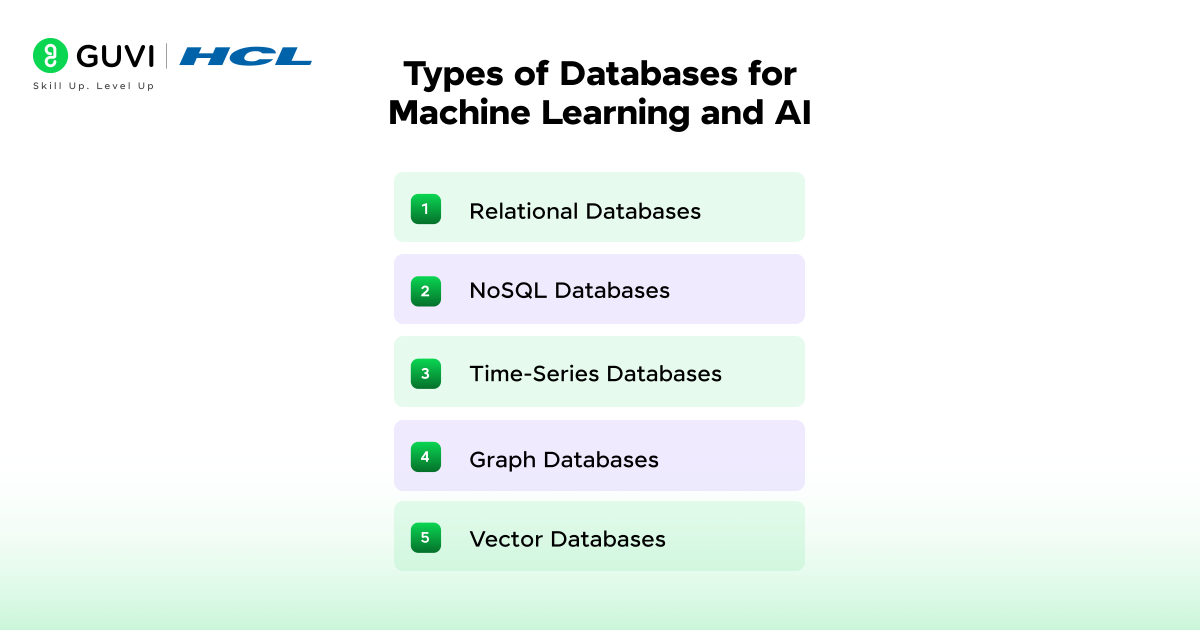
Different databases support distinct workloads and data structures required for Artificial Intelligence-driven applications. The main types include:
- Relational Databases: These systems store data in tables with defined schemas and use SQL for queries. They are suited for structured data where relationships between entities must be preserved.
- NoSQL Databases: These handle unstructured or semi-structured data such as text, images, and logs. They offer flexible schemas and high scalability, which makes them useful for deep learning pipelines.
- Time-Series Databases: These record data indexed by time, which helps models that analyze trends, sensor readings, or system performance metrics.
- Graph Databases: These store data as nodes and edges to represent relationships. They support AI models that infer connections, such as recommendations or social network patterns.
- Vector Databases: These manage high-dimensional embeddings produced by AI models. They enable similarity searches, semantic retrieval, and retrieval-augmented generation systems.
How to Choose the Right Database for Machine Learning and AI in 2026?
Step 1: Assess Data Structure Needs
The first step is understanding the type of data your models rely on. Structured data fits best in relational databases such as PostgreSQL and MySQL, which maintain schema integrity and enforce strict relationships between entities.
Projects handling text, logs, or multimedia data require NoSQL systems like MongoDB or Elasticsearch, which accommodate irregular and semi-structured formats without schema constraints. Choosing the correct structure ensures predictable performance during both training and inference.
Step 2: Evaluate Scalability and Throughput
As data volume and velocity grow, scalability becomes essential. Cassandra and Redis deliver exceptional write throughput and low latency for continuous streams such as IoT feeds or telemetry data.
For analytical pipelines that expand dynamically, Snowflake and BigQuery offer elastic scaling through automated resource allocation. These systems eliminate manual tuning while maintaining performance consistency under heavy loads.
Step 3: Consider Model Integration Capability
Smooth integration between databases and AI frameworks enhances workflow efficiency. PostgreSQL, BigQuery, and Snowflake connect seamlessly with TensorFlow, PyTorch, and similar frameworks for direct model training and inference.
Vector-based systems such as Milvus and Pinecone are purpose-built for embedding retrieval, which makes them ideal for applications involving large language models and semantic search.
Step 4: Analyze Cost and Resource Efficiency
Balancing performance and cost is crucial in continuous AI operations. Managed platforms like Pinecone and Snowflake reduce maintenance tasks but can increase expenses during constant workloads. Open-source databases such as Milvus or PostgreSQL provide customization and long-term cost control.
Step 5: Focus on Real-Time Processing
AI systems performing live predictions depend on databases that support fast retrieval. Redis excels in sub-millisecond feature access for inference pipelines, while Elasticsearch powers real-time vector similarity searches for recommendation and NLP systems. Choosing a database optimized for response speed improves model responsiveness and user interaction quality.
Future of Databases for Machine Learning and AI
- Autonomous and Self-Tuning Databases
Databases will more precisely embed learning algorithms that monitor their own performance and adjust configurations automatically. They will analyze usage patterns and optimize queries, cache management, and indexing without human oversight. Systems will also predict workload spikes and scale resources preemptively, which maintains stable latency even during intensive processing.
- AI-Native Query Understanding
Future databases will support natural and semantic querying across mixed data types. Instead of separating text, image, and tabular information, they will merge them under a unified query layer. This structure will allow developers to search embeddings, metadata, and structured records in one statement.
- Federated and Edge-Aware Databases
As computation moves closer to users and devices, databases will adapt to distributed learning environments. They will synchronize local data stores with central systems while preserving privacy and latency efficiency. Edge databases will process contextual AI tasks locally and share only aggregated insights with the cloud.
Conclusion
Databases have become the intelligence core of every AI system. Their performance defines how fast models train, how accurately they predict, and how reliably they scale in production. From PostgreSQL’s structured stability to Pinecone’s semantic precision, every database on this list brings unique value to AI-driven architectures.
The future of data management lies in systems that learn from workloads, adapt to model behavior, and operate seamlessly across cloud, edge, and hybrid environments. Selecting the right database is no longer optional; it’s the difference between experimental AI and production-grade intelligence.
FAQs
1. Which database is best for large-scale AI workloads?
Snowflake and BigQuery are leading choices for large-scale AI workloads. They provide automatic scaling, serverless processing, and native integration with ML platforms, which make them ideal for enterprise-grade data science.
2. What is the best database for vector and embedding storage?
Milvus and Pinecone are purpose-built for vector and embedding storage. They support fast similarity searches and retrieval-augmented generation, which are essential for large language models and semantic AI systems.
3. Why does the choice of database matter in machine learning?
The database management and selection defines how efficiently data is stored, accessed, and updated. A suitable system reduces latency, improves accuracy, and maintains synchronization between training and inference, authorizing AI models to perform reliably at scale.
Success Stories

About the Author
Vaishali
I'm a seasoned writer with four years of experience across technical, non-technical, and just about every genre or niche you can imagine. Adaptable and curious, I enjoy exploring new topics and making information engaging and easy to understand. Fueled by a steady stream of tea, I approach each project with creativity, reliability, and genuine enthusiasm for storytelling.
View all posts by Vaishali
Connect with me @










Did you enjoy this article?