


Artificial Intelligence and Machine Learning Articles
AI/ML Skills Gap 2026: Why Companies Can't Find Job-Ready Talent
20 AI/ML Interview Questions Recruiters Can Use Without a Tech Background - Best Guide
How Industry-Backed AI/ML Bootcamps Are Changing the AI/ML Hiring Pipeline - Best Guide 2026
From IT Support to AI Engineer: A Realistic Career Switch Guide 2026


Get In Touch For Details! Request More Information

Backtracking Search in CSPs: Finding Smart Solutions
Jul 15, 2026 7 Min Read 739 Views
(Last Updated)
Imagine you are solving a Sudoku puzzle. You fill in a number, then another, and suddenly realize your choice makes the puzzle impossible to complete. What do you do? You erase the last number and try a different one. This is exactly how backtracking search works.
Backtracking search is a systematic method for solving constraint satisfaction problems (CSPs). It tries different combinations of values, and when it hits a dead end, it goes back and tries something different.
If you are building AI systems or dealing with situations where you need to assign values while satisfying rules, understanding backtracking search is essential.
This guide explains what backtracking search is, how it solves constraint satisfaction problems, and when you should use it.
Table of contents
- Quick TL;DR Summary
- Understanding Constraint Satisfaction Problems
- How Backtracking Search Works: The Technical Process
- Step 1: Check if the assignment is complete
- Step 2: Select an unassigned variable
- Step 3: Try each value from the variable's domain
- Step 4: Check if the assignment is consistent
- Step 5: Recursively search with the new assignment
- Step 6: Backtrack if the recursive call fails
- Why Backtracking Works for CSPs
- Common Types of Constraint Satisfaction Problems
- Optimization Techniques That Make Backtracking Faster
- How to Implement Backtracking Search: Practical Steps
- Step 1: Define your CSP components clearly
- Step 2: Implement the constraint checking function
- Step 3: Write the recursive backtracking function
- Step 4: Add variable and value ordering heuristics
- Step 5: Implement forward checking
- Step 6: Test with simple problems first
- Real-World Applications of Backtracking Search
- Conclusion
- FAQs
- What is the difference between backtracking and brute force search?
- How do I know if my problem is a constraint satisfaction problem?
- What is the time complexity of backtracking search?
- Can backtracking find all solutions to a CSP?
- When should I use arc consistency with backtracking?
Quick TL;DR Summary
- This guide explains backtracking search, a recursive algorithm that systematically explores possible solutions to constraint satisfaction problems by trying values and undoing choices that lead to dead ends.
- You will learn what constraint satisfaction problems are, including their three components: variables that need values, domains of possible values, and constraints that restrict valid combinations.
- The guide covers the technical mechanics of backtracking, including how it assigns values one variable at a time, checks constraints, and backtracks when it discovers conflicts.
- Step-by-step examples show you how backtracking search works in practice, from simple graph coloring to real-world applications like scheduling and Sudoku solving.
- You will understand optimization techniques that make backtracking faster, including variable ordering heuristics, value ordering strategies, and constraint propagation methods like forward checking and arc consistency.
What Is Backtracking Search?
Backtracking search is a recursive problem-solving algorithm that constructs solutions incrementally and abandons a path as soon as it is determined that it cannot lead to a valid complete solution. It explores the search space in a depth-first manner, making choices step by step and “backtracking” whenever a constraint is violated or a dead end is reached. This technique is widely used in constraint satisfaction problems such as puzzle solving, permutation generation, and combinatorial optimization.
It is specifically designed for constraint satisfaction problems. These are problems where you need to assign values to variables while satisfying a set of constraints or rules. The algorithm tries one possibility, checks if it violates any constraints, and if it does, backs up and tries a different option.
Understanding Constraint Satisfaction Problems

- The three components of every CSP
A CSP consists of variables that need values assigned, domains defining the possible values for each variable, and constraints restricting which combinations are valid. In Sudoku, the variables are empty cells, domains are numbers 1 through 9, and constraints ensure no duplicates in rows, columns, or boxes.
- Variables and their domains
Each variable has a domain, which is the set of possible values it can take. In map coloring with three colors, the domain is red, blue, and green. Domains can be different for different variables or the same for all variables depending on the problem. Solving the problem means finding a value for every variable from its domain.
- Constraints define valid solutions
Constraints are rules that specify which combinations of values are allowed. In map coloring, adjacent regions cannot have the same color. Constraints can involve two variables (binary constraints) or multiple variables (like all-different constraints in Sudoku rows). A solution must satisfy all constraints simultaneously.
- Why CSPs matter in AI
Many real problems fit the CSP framework. Scheduling classes to classrooms and time slots is a CSP. Assigning frequencies to radio stations without interference is a CSP. Configuration problems where you select compatible components are CSPs. Recognizing when a problem is a CSP tells you that backtracking search is a viable solution approach.
Read More: CSP in AI: How Constraint Satisfaction Problems Power Intelligent Problem Solving
How Backtracking Search Works: The Technical Process
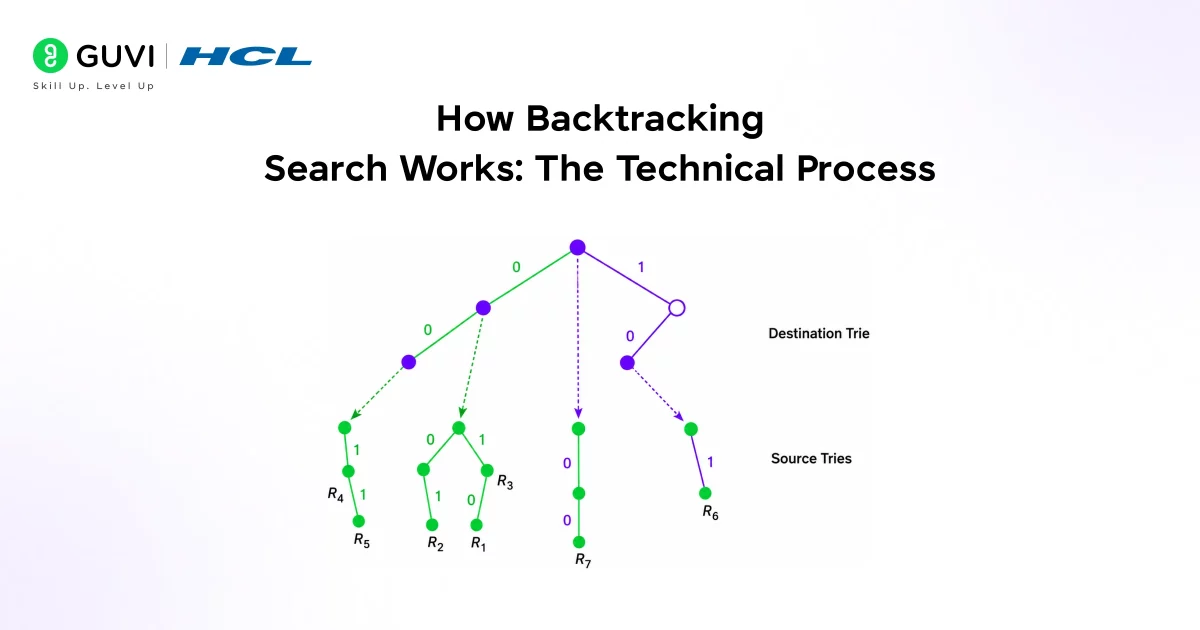
Step 1: Check if the assignment is complete
The algorithm first checks whether every variable has been assigned a value. If all variables are assigned and all constraints are satisfied, the problem is solved. Return this assignment as the solution. If any variable is still unassigned, continue to the next step.
Step 2: Select an unassigned variable
Choose one variable that does not have a value yet. The simplest approach is to pick variables in the order they were defined. Smarter approaches use heuristics. The most common heuristic is choosing the variable with the fewest remaining legal values. This helps detect failures faster.
Step 3: Try each value from the variable’s domain
For the selected variable, try assigning each value from its domain one at a time. Start with the first value. More sophisticated versions order values by how likely they are to lead to solutions. This is called value ordering and can significantly reduce search time.
Step 4: Check if the assignment is consistent
After assigning a value to the variable, check all constraints that involve this variable. If any constraint is violated by the new assignment combined with existing assignments, this value is not valid. If all constraints are satisfied, the assignment is consistent and you can proceed.
Step 5: Recursively search with the new assignment
If the assignment is consistent, make a recursive call to solve the rest of the problem with this variable now assigned. The recursive call will select another unassigned variable and repeat this process. This goes deeper into the search tree, building a more complete assignment.
Step 6: Backtrack if the recursive call fails
If the recursive call returns failure, it means no solution exists with the current assignment. Remove the value you just assigned to the current variable. This is the backtracking step. Try the next value from the domain. If all values fail, return failure to the previous level, which will then backtrack further.
IBM Deep Blue famously defeated world chess champion Garry Kasparov in 1997 by combining brute-force search with carefully designed evaluation heuristics and rule-based reasoning. The system could evaluate an enormous number of positions per second using specialized hardware and handcrafted logic, rather than learning from data. Even today, modern chess engines like Stockfish continue to rely heavily on symbolic search techniques and evaluation functions, demonstrating that rule-based AI combined with efficient search remains extremely powerful in well-defined, constrained domains such as chess.
Why Backtracking Works for CSPs
- Early detection of failures
At any point, you can check whether your current partial assignment violates any constraints. If it does, you know immediately that continuing on this path is pointless. This early detection is what makes backtracking efficient. You do not waste time exploring paths that cannot possibly lead to solutions.
- Systematic exploration guarantees completeness
Backtracking guarantees it will find a solution if one exists. It systematically tries every combination in a depth-first manner. Unlike heuristic methods that might miss solutions, backtracking will eventually check every possibility. If the problem has no solution, backtracking proves it by exhausting all options.
- Manageable memory requirements
Backtracking only needs to store the current path from root to the current node in the search tree. It does not need to store the entire search tree in memory. This makes it practical for problems with large search spaces where storing all possibilities would be impossible.
Common Types of Constraint Satisfaction Problems
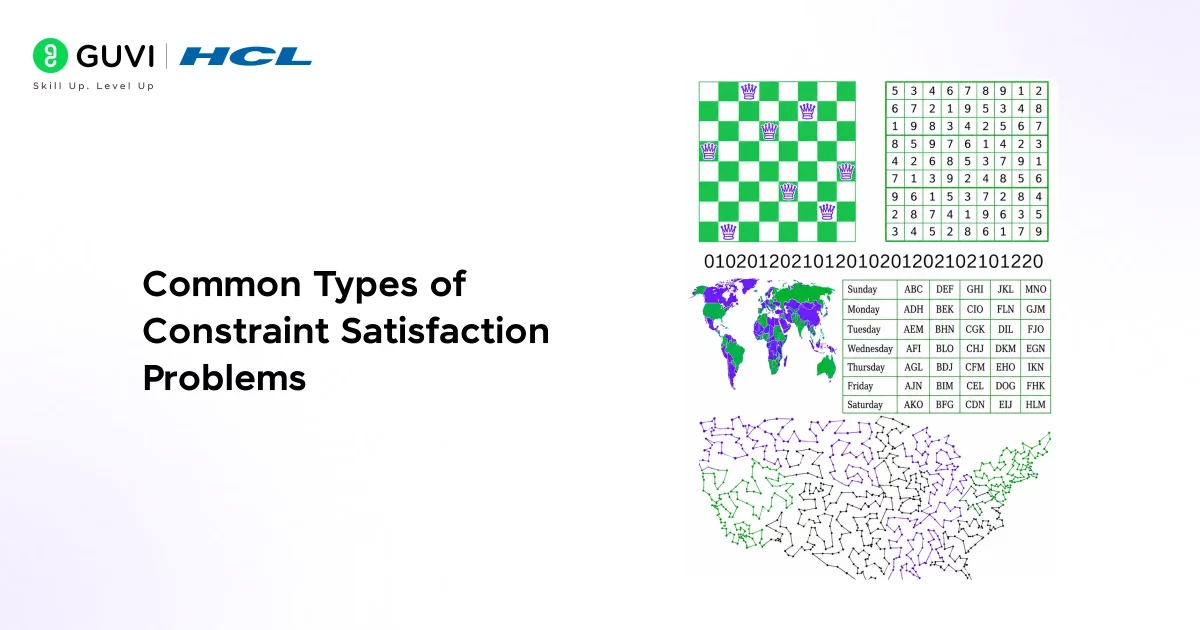
- Graph coloring: Assigning colors to nodes
You have a graph with nodes connected by edges. Each node needs a color. The constraint is that connected nodes cannot have the same color. This models problems like scheduling where conflicts exist between certain pairs.
- N-Queens: Placing queens on a chessboard
Place N queens on an N by N chessboard such that no queen can attack any other. Queens attack along rows, columns, and diagonals. This classic problem has been solved for boards up to thousands of queens using backtracking with optimizations.
- Sudoku: Filling grids with numbers
A 9 by 9 grid must be filled with numbers 1 through 9. Each row, column, and 3 by 3 box must contain all nine numbers exactly once. Backtracking with constraint propagation solves even difficult Sudoku puzzles instantly.
- Scheduling: Assigning tasks to time slots
You have tasks that need time slots and resources like rooms or people. Constraints specify which tasks cannot overlap, which require specific resources, and precedence requirements. Variables are tasks, domains are time slots, and constraints encode the scheduling rules.
- Map coloring: Coloring regions on maps
Given a map divided into regions, assign colors such that no adjacent regions share the same color. The famous four-color theorem proves that any map can be colored with at most four colors, but finding that coloring is a CSP.

Optimization Techniques That Make Backtracking Faster

- Variable ordering: Most constrained variable first
Instead of selecting variables in arbitrary order, choose the variable with the fewest legal values remaining. This is called the minimum remaining values (MRV) heuristic. It detects failures faster because variables likely to cause problems are addressed early. If a variable has no legal values, you know immediately to backtrack.
- Value ordering: Least constraining value first
When trying values for a variable, try the value that rules out the fewest choices for neighboring variables first. This is called the least constraining value heuristic. It keeps options open for future assignments. If this value leads to a solution, you find it quickly.
- Forward checking: Eliminate values early
After assigning a value to a variable, immediately check all unassigned variables connected by constraints. Remove any values from their domains that would violate constraints with the new assignment. If any variable ends up with an empty domain, backtrack immediately without exploring further.
- Arc consistency: Propagate constraints throughout
Arc consistency ensures that for every value in a variable’s domain, there exists a compatible value in every related variable’s domain. When a value is removed from a domain, arc consistency propagates this change to check whether other values become inconsistent. This catches failures much earlier than simple backtracking.
The worst-case time complexity of backtracking algorithms for Constraint Satisfaction Problems (CSPs) is exponential, typically expressed as O(Dⁿ), where D is the domain size and n is the number of variables. In theory, this makes such problems intractable at scale. However, in practice, the combination of constraint propagation, forward checking, and intelligent heuristics such as minimum remaining values (MRV) can dramatically reduce the effective search space. As a result, problems that appear computationally impossible in their naive form can often be solved efficiently in real-world applications—turning what could take exponential time into solutions that run in milliseconds for well-structured instances.
How to Implement Backtracking Search: Practical Steps
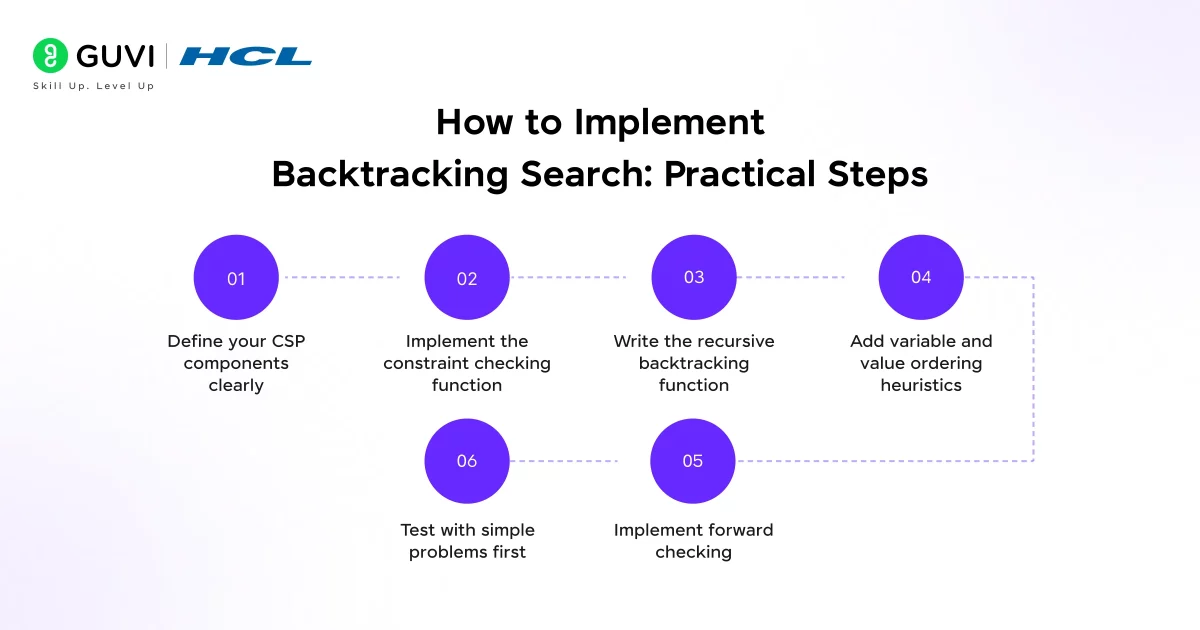
Here is exactly how to implement backtracking search for your constraint satisfaction problem.
Step 1: Define your CSP components clearly
List all variables that need values assigned. For each variable, specify its domain of possible values. Write down all constraints explicitly. Constraints should be functions that take an assignment and return true if it satisfies the constraint or false if it violates it.
Step 2: Implement the constraint checking function
Write a function that takes the current assignment and checks whether it violates any constraints. For efficiency, check only constraints involving variables that have been assigned. This function returns true if all checked constraints are satisfied and false if any constraint is violated.
Step 3: Write the recursive backtracking function
This function takes the current assignment as input. Check if assignment is complete. If yes, return success. Otherwise, select an unassigned variable. For each value in that variable’s domain, assign the value, check constraints, and if consistent, recursively call with the extended assignment. If recursion succeeds, return success. If all values fail, return failure.
Step 4: Add variable and value ordering heuristics
Implement the MRV heuristic to choose variables with fewest remaining legal values. For value ordering, implement least constraining value to try values that eliminate fewest options first. These heuristics dramatically improve performance.
Step 5: Implement forward checking
After assigning a value, update the domains of unassigned variables by removing inconsistent values. Store these reductions so you can restore them during backtracking. If any variable’s domain becomes empty, immediately return failure.
Step 6: Test with simple problems first
Start with small instances where you can manually verify the solution. A 4 by 4 Sudoku or a 4-queens problem are good tests. Make sure your algorithm finds correct solutions and correctly reports when no solution exists.
Real-World Applications of Backtracking Search
- Sudoku solvers and puzzle solving
Every Sudoku solver application uses backtracking with constraint propagation. The algorithm assigns values to cells, uses arc consistency to eliminate impossible values, and backtracks when a cell has no legal values. Difficult puzzles that would take humans hours are solved in milliseconds.
- University class scheduling
Universities use CSP solvers to create class schedules. Variables are courses, domains are combinations of time slots and rooms, and constraints include professor availability, room capacity, and student conflicts. Backtracking with intelligent heuristics finds schedules that satisfy hundreds of constraints.
- Circuit board layout design
Designing printed circuit boards requires placing components and routing connections without overlaps or interference. This is a geometric CSP where backtracking combined with constraint propagation optimizes layouts while satisfying physical constraints.
- Resource allocation systems
Assigning limited resources like meeting rooms, equipment, or personnel to requests is a CSP. Constraints include resource capacities, time conflicts, and requirement specifications. Backtracking finds feasible allocations in scheduling and planning systems.
To learn more about Backtracking Search in CSPs, do not miss the chance to enroll in this HCL GUVI’s AI and Machine Learning course covering machine learning fundamentals, feature engineering, deep learning, and practical implementation through hands-on projects and expert guidance with certification.
Conclusion
Backtracking search is the fundamental algorithm for solving constraint satisfaction problems. It systematically explores possibilities by making choices, checking constraints, and undoing choices that lead to failures.
Effective implementations require optimizations like variable ordering, forward checking, and arc consistency. These make the difference between solving a problem instantly or not at all.
Backtracking works best when your problem has discrete variables with clear constraints. Start with forward checking and good variable ordering, then add arc consistency for harder problems.
FAQs
1. What is the difference between backtracking and brute force search?
Brute force generates all possible complete assignments and checks each one. Backtracking builds assignments incrementally and backtracks as soon as it detects a constraint violation, never completing invalid assignments. This makes backtracking exponentially faster because it prunes huge portions of the search space.
2. How do I know if my problem is a constraint satisfaction problem?
If you need to assign values to variables while satisfying rules or constraints, it is a CSP. Key indicators are discrete variables, finite domains, and explicit constraints that restrict which value combinations are valid. Scheduling, coloring, and configuration problems are typically CSPs.
3. What is the time complexity of backtracking search?
Worst-case time complexity is O(D^N) where N is the number of variables and D is the maximum domain size. In practice, with good heuristics and constraint propagation, many problems are solved much faster because large portions of the search space are pruned.
4. Can backtracking find all solutions to a CSP?
Yes. Instead of stopping when the first solution is found, continue the search and collect all solutions. When the recursive call finds a solution, store it and continue trying remaining values. This finds every possible valid assignment.
5. When should I use arc consistency with backtracking?
Use arc consistency for hard problems where variables are highly interconnected and constraint propagation can significantly reduce domains. The overhead of maintaining arc consistency is worthwhile when it prevents exploring large portions of the search space. For simple problems, forward checking alone might be sufficient.
Success Stories

About the Author
Vishalini Devarajan
An Aerospace Engineer turned content writer, I focus on making complex concepts easy to understand through well-structured, reader-friendly blogs. Whether it’s a technical topic or a non-technical one, I love creating content that is clear, engaging, and impactful.
View all posts by Vishalini Devarajan
Connect with me @













Did you enjoy this article?