


Full Stack Development Articles
Full Stack Development for Career Changers: A Practical 6-Month Learning Plan
Full Stack Development Course Fees in India: What Does the Cost Include?
How to Move from Frontend Development to Full Stack Development Without Quitting Your Job
How to Become a Full Stack Developer After 5 Years in a Non-Development IT Role


Get In Touch For Details! Request More Information
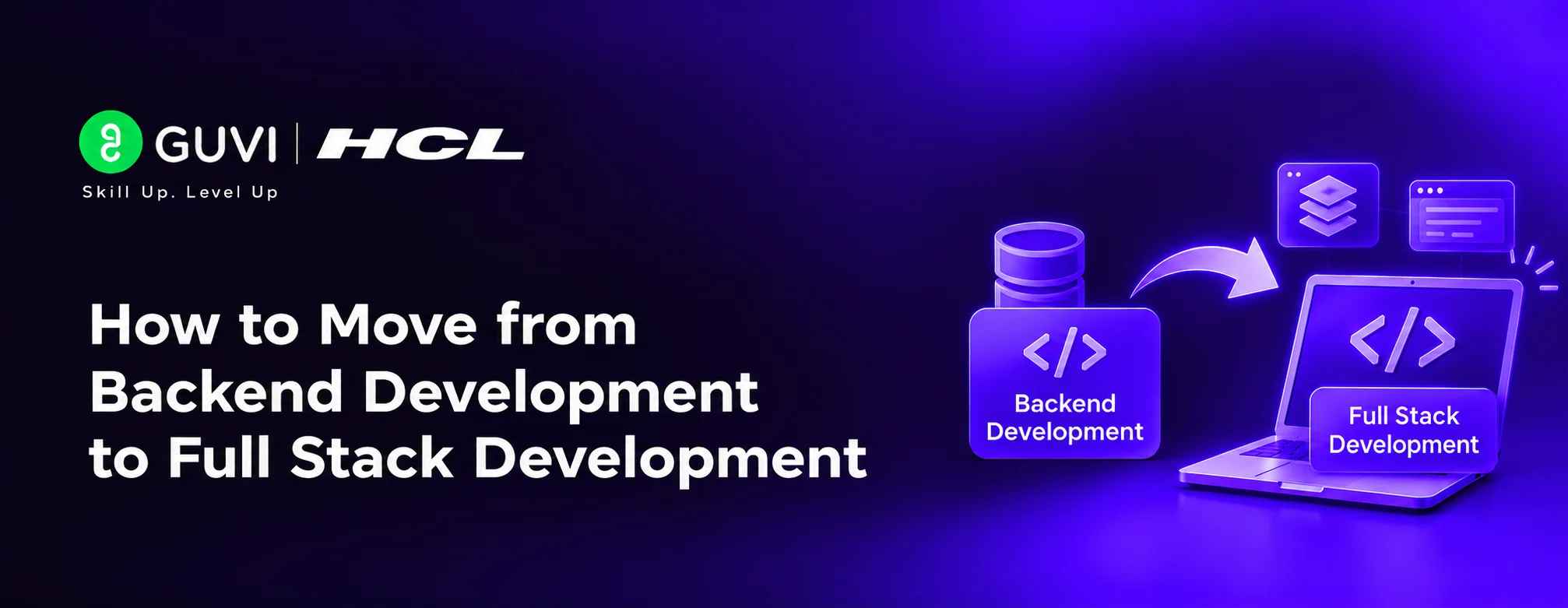
How to Move from Backend Development to Full Stack Development
Nov 11, 2026 4 Min Read 36 Views
(Last Updated)
Your API returns clean, correct JSON. Then a teammate shares a screenshot of a blank white page that sits waiting for your response, and asks what is going on. The server did its job, but you have no idea what the browser is doing.
So can a backend developer to full stack developer switch work? Yes, and it is one of the shortest switches in tech. You already own APIs, databases, and deployment. What is missing is the browser side. Plan for four to five months at about ten hours a week.
In this guide, you will find what you already know, the frontend skills for backend developers to learn, how your language changes the plan, a 20 week full stack developer roadmap, a project that gives your old API a face, and an honest look at pay.
Table of contents
- TL;DR Summary
- What is Backend Developer to Full Stack Developer?
- What You Already Know, Seen From the Browser
- Frontend Skills for Backend Developers
- HTML and CSS Layout
- JavaScript in the Browser
- React Components and State
- Talking to Your API From the Screen
- Styling Without a Designer
- Browser Tools and Accessibility
- How Your Backend Language Changes the Plan
- A 20 Week Full Stack Developer Roadmap for Backend Developers
- Weeks 1 to 4: Layout
- Weeks 5 to 8: Browser JavaScript
- Weeks 9 to 14: React
- Weeks 15 to 20: Full App and Interviews
- Give Your Old API a Face
- Will Pay Rise? An Honest Look
- 💡 Did You Know?
- How to Show Both Sides in Interviews
- What HCL GUVI's Full Stack Development Course Adds for a Backend Developer
- Common Mistakes in Backend Developer to Full Stack Developer Moves
- Conclusion
- FAQs
- How long does backend developer to full stack developer take?
- Which frontend skills for backend developers matter most?
- Do I need to learn design?
- Should a backend developer to full stack developer learn React, Angular, or Vue?
- Will backend to full stack development raise my salary?
TL;DR Summary
- What it is: Backend developer to full stack developer means adding the browser side to the server side you already know.
- Your edge: A backend developer to full stack developer already handles APIs, databases, auth, and deployment.
- Learn next: For backend developer to full stack developer moves, HTML and CSS layout, browser JavaScript, and one framework, usually React.
- Plan: A backend developer to full stack developer plan takes 20 weeks at about ten hours a week.
- Proof: Backend developer to full stack developer hiring rewards one app where you wrote both the API and the screens.
- Next step: Start backend to full stack development by building a single page that lists data from your own API.
What is Backend Developer to Full Stack Developer?
Backend developer to full stack developer is the step from building the server, data, and logic behind an app to building the screens people use as well. A full stack developer works on both sides and understands how they talk.
You already know half of it. For the other half, read how frontend and backend communicate and the differences between frontend and backend development.
Learning screens beside a busy sprint is the tough part. HCL GUVI’s Full Stack Development course runs live weekday and weekend batches with mentors, so you can add the frontend after work and get help when a layout will not behave.
What You Already Know, Seen From the Browser
A backend developer to full stack developer starts further ahead than expected, because each backend skill has a twin on the other side.
| Your Backend Skill | Its Frontend Twin |
|---|---|
| Designing REST endpoints | Calling them from the browser and handling the response |
| Authentication and sessions | Login screens and protected pages |
| Input validation | Form validation that guides the user |
| Error handling | Loading, empty, and error states on screen |
| Caching | Browser caching and avoiding repeat requests |
| Logging | Browser console and the network tab |
| Unit tests | Component tests |
Frontend Skills for Backend Developers
Backend developer to full stack developer learners should take these in order. Each one builds on the last, and none needs a design degree.
1. HTML and CSS Layout
Start with semantic HTML, then flexbox and grid. These tips for responsive design show how a page adapts to phones and laptops.
2. JavaScript in the Browser
Learn the DOM, events, promises, and async and await, and call an API with fetch. This JavaScript roadmap for frontend lists what to cover.
3. React Components and State
Think in components, props, and state. Check the ReactJS prerequisites first, then read what ReactJS is and try the useState hook.
4. Talking to Your API From the Screen
Show a loading state, an error message, and an empty list, not only the happy path. This is where backend developer to full stack developer instincts help most.
5. Styling Without a Designer
Use a CSS framework so you do not design from scratch. This list of CSS frameworks for front end developers helps you choose.
6. Browser Tools and Accessibility
Use the network tab to watch requests and the console to find errors. Add labels and keyboard support so everyone can use your screens.
How Your Backend Language Changes the Plan
Your language shapes how a backend developer to full stack developer plan feels.
| Your Language | What Feels Familiar | What Feels New |
|---|---|---|
| Java | Types and structure, so TypeScript may feel natural | Dynamic typing and the browser event loop |
| Python | Clean, readable code | Browser APIs and asynchronous events |
| PHP | Sending HTML to the browser | Components and state in the browser, not the server |
| Node.js | JavaScript and npm | The DOM and React |
A 20 Week Full Stack Developer Roadmap for Backend Developers
This full stack developer roadmap assumes about ten hours a week. Backend developer to full stack developer learners often move faster through the early weeks.
Weeks 1 to 4: Layout
Build static pages with HTML, CSS, flexbox, and grid. Make each one responsive.
Weeks 5 to 8: Browser JavaScript
Handle events, change the page with the DOM, and fetch data from an API you already wrote.
Weeks 9 to 14: React
Build components, manage state, and connect a React app to your API. Avoid these mistakes in a first React project.
Weeks 15 to 20: Full App and Interviews
Finish one complete app, deploy it, add TypeScript if you like, and do mock interviews that cover both sides.
Give Your Old API a Face
The fastest way to prove backend developer to full stack developer skill is to put screens on an API you already built.

- List page: Show records with search and filters.
- Detail page: Open one record and edit it.
- Login: Use your existing auth.
- States: Add loading, error, and empty views.
- Deploy: Put both sides online.
Need ideas? Browse these React project ideas and pick one that suits your API.
Will Pay Rise? An Honest Look
Many people assume a backend developer to full stack developer move raises pay, but the data is more nuanced. Reported ranges for backend developers are as high as, or higher than, full stack ranges at the same experience.
| Experience | Backend Developer | Full Stack Developer |
|---|---|---|
| 1 to 3 years | about ₹6.8 to ₹7.5 lakh a year | about ₹5.3 to ₹5.9 lakh a year |
| 3 to 6 years | about ₹10.7 to ₹11.8 lakh a year | about ₹9.3 to ₹10.3 lakh a year |
Note: Salary figures may change over time as users update their reported data. Please refer to the linked source for the latest salary ranges.
Read these as averages, not offers, since city, company, and skills shift the number. The benefit of backend to full stack development is wider choice: you can own whole features, join small teams, and lead products, not only services.
💡 Did You Know?
- Brendan Eich wrote the first version of JavaScript at Netscape in about ten days in 1995, so the language you may have skipped began as a quick job.
How to Show Both Sides in Interviews
Backend developer to full stack developer hiring tests the new half closely.
- Demo one app: Show the API and the screens together.
- Explain trade-offs: Say why you picked a state approach or a database.
- Expect frontend questions: Prepare for the event loop, state, and rendering.
- Revise backend basics: Interviewers still ask about APIs, security, and databases.
What HCL GUVI’s Full Stack Development Course Adds for a Backend Developer
| Part of the Program | What It Means for You |
|---|---|
| Node.js, Express.js, MongoDB, Mongoose, REST APIs | Likely revision, with a JavaScript flavour |
| HTML, CSS, JavaScript, React, Tailwind CSS | Your main focus |
| DSA, system design, DevOps, GenAI | Interview prep and growth |
| E-commerce app, order management system, cloud deployment pipeline, AI powered document Q and A chatbot | Projects to show both sides |
| Mentors, one to one doubt solving, mock interviews, resume review | Help when you are stuck |
The program suits a backend developer to full stack developer who wants the browser side covered. It has 130+ hours of live classes in weekday or weekend batches, recordings, an IITM Pravartak certification, and a complimentary MongoDB certification.
Classes run in English, Tamil, Hindi, and Telugu. Check the syllabus and choose a batch on the Full Stack Development course page.
Common Mistakes in Backend Developer to Full Stack Developer Moves
- Looking down on the frontend: Backend developer to full stack developer success needs respect for the user’s screen.
- Learning three frameworks: In backend developer to full stack developer plans, pick one, such as React, and finish a project.
- Skipping CSS: Layout problems cost more time than logic bugs.
- Only building tutorials: Put screens on your own API instead.
- Ignoring loading and error states: Real users meet them every day.
Conclusion
Backend developer to full stack developer is a short switch because the hard server side is already yours. Learn layout, browser JavaScript, and React, then connect them to an API you built. That covers most of the gap in backend developer to full stack developer plans.
Follow the 20 weeks, ship one complete app, and show both sides in interviews. Backend to full stack development rewards patience with the browser.
HCL GUVI’s Full Stack Development course lets you learn live from mentors, build projects, and finish with interview practice and two certifications. Pick a batch and start your backend developer to full stack developer plan this week.
FAQs
1. How long does backend developer to full stack developer take?
Around four to five months at about ten hours a week. The browser side is new, but your backend knowledge shortens the path.
2. Which frontend skills for backend developers matter most?
HTML and CSS layout, browser JavaScript, and React. Add accessibility and browser tools as you build.
3. Do I need to learn design?
No. A backend developer to full stack developer can use a CSS framework and a clean layout, and focus on clear, usable screens.
4. Should a backend developer to full stack developer learn React, Angular, or Vue?
Pick one and learn it well. React is a common starting point, but follow the stack in your target job listings.
5. Will backend to full stack development raise my salary?
Not automatically. Reported backend and full stack ranges are close, so the gain is broader roles and ownership.
Success Stories

About the Author
Jebasta
I translate the language of data into stories that anyone can understand. As a writer with a data science background, I simplify analytics, AI, and decision-making so beginners and enthusiasts can confidently explore the world of data.
View all posts by Jebasta
Connect with me @























Did you enjoy this article?