


Full Stack Development Articles
Qwik 2.0 Explained: Building Lighter, Faster, Better Web Apps
Qwik City Routing Explained: File-Based Routing Made Simple
Best VS Code Extensions That Will Transform Your Workflow
Modern Parallax Scrolling: Techniques, Tools, Practical Guide

Get In Touch For Details! Request More Information
Back-End Developer Resume: Key Technologies & Best Format
Mar 11, 2026 4 Min Read 881 Views
(Last Updated)
In today’s competitive job market, designing a back-end developer resume by investing minimal effort will not work. If you want your resume to reflect your true value, it must include key aspects of your back-end development journey. Employers across all business verticals are now relying on developers who are highly competent at building secure, scalable, and performance-optimized back-end systems that keep software applications running smoothly, without errors or delays.
Tasks such as writing complex business logic, handling APIs, and designing automation models are performed by back-end developers, and including them in your resume not only highlights your strengths but also demonstrates your problem-solving and analytical abilities.
In this blog, we will discuss the key elements to include in your back-end developer resume.
Table of contents
- Key Sections of a Back-End Developer Resume
- Header
- Professional Summary
- Skills Section
- Work Experience
- Projects
- Education
- Additional Sections (Optional)
- Key Skills & Technologies for Back-End Developer Resume
- Best Resume Format for Back-End Developers
- Conclusion
- FAQs
- What is the best resume format for a back-end developer?
- How long should a back-end developer's resume be?
- What skills should I highlight in a back-end developer resume?
Key Sections of a Back-End Developer Resume
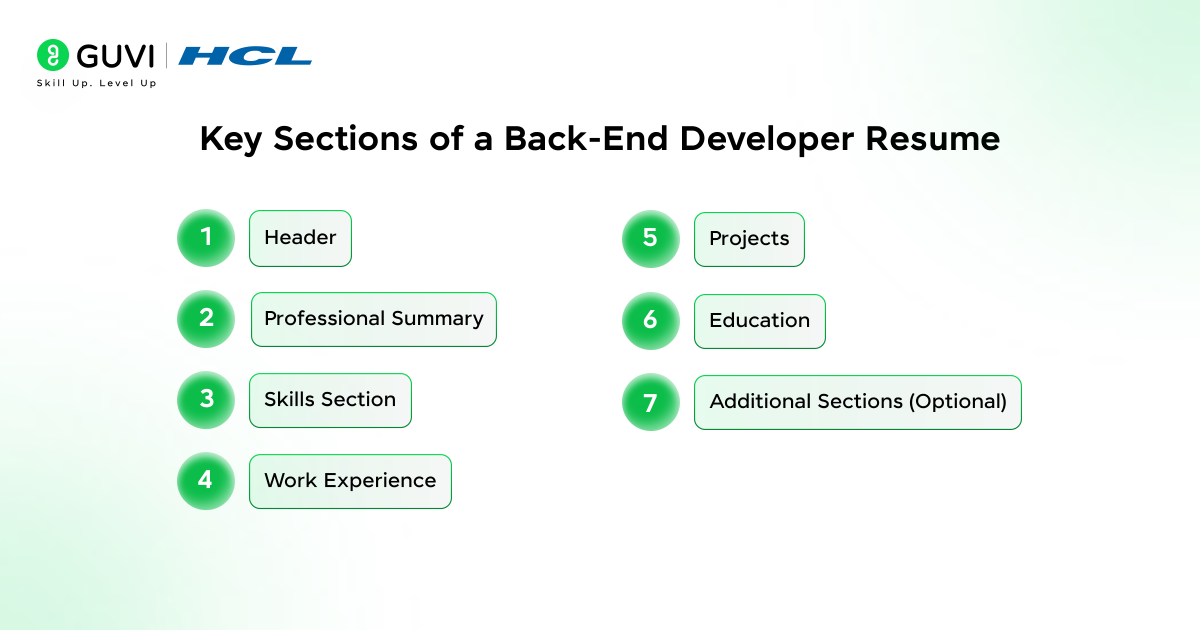
Now let’s walk through all the sections that you must include in your back-end developer resume to stand apart from the crowd, and here, not only the inclusion of these following sections matters, but also how you craft each section is also a deciding factor. The sections are as follows:
1. Header
- The header is the starting section in your back-end developer resume. It is where you are required to include your name, contact details (such as a phone number and a professional email address), and links to your LinkedIn profile, GitHub repositories, or portfolio.
- Avoid including broken links or invalid email addresses, as employers may form the wrong impression of your professional approach. Attach that information so others can go through your contributions and other programming or development work.
- In simple terms, this section is meant to make it easy for recruiters to reach you and get a quick sense of your professional identity.
2. Professional Summary
- While writing this section, keep it simple, short, and effective. Creating a lengthy, wordy professional description could deter employers from exploring your back-end developer resume. Always remember that the writing tone you set here will decide the flow of the writing style for the rest of the section.
- Coming to how to write this section: In three (3) to four (4) lines, try to summarize your professional experience, technical skills, along with your career objectives and requirements. The purpose of this section is to capture the recruiters’ attention and showcase your curiosity and passion for back-end development.
3. Skills Section
- The skills section is one of the most vital elements in your back-end developer resume, since it includes all the core information related to the technology stack you have worked with.
- Here in this section, it is ideal to divide the tools and technologies into categories, for example, Programming Languages (Python, Java, Node.js), Frameworks (Express.js, Spring Boot, Django), Databases (MySQL, MongoDB, PostgreSQL), and Tools/Technologies (Docker, AWS, Git).
- A well-structured skills section with the in-demand frameworks and libraries reflects technical proficiencies and contributes to passing the ATS (Applicant Tracking System) screening.
4. Work Experience
- Work experience is one of the most crucial sections in your resume, which employers place their primary focus on. Include all the must-have information, such as previous/current employer name, designation, duration, along with a brief description of your role and responsibilities.
- Always mention your most recent job or internship, then move backward, maintaining this sequential flow as you write this section. Using keywords such as implemented, optimized, developed, integrated, or other effective terms can make your experience sound more impactful.
- Try to quantify your development contributions, for example, “minimized the API response time by 35%” or “enhanced system uptime by 2X”. This section is proof of your ability to solve real-world scenarios.

5. Projects
- The projects section highlights your hands-on experience and creativity as a back-end developer. Include the best 2-3 projects that truly represent the quality of your work and the level of complexity you dealt with. You are free to include any project — personal, academic, or professional — but it should follow best coding practices and optimization techniques.
- For example, you could write about developing a REST API for an e-commerce site, integrating payment systems, or creating a real-time chat app using Node.js and MongoDB. To make this section more effective, add links to the GitHub repository or live demo.
Note: For freshers or interns who often don’t have full-time work experience, this section can be a performance booster on their resume, showcasing their initiative, technical understanding, and learning attitude.
6. Education
Staying relevant in back-end development has become increasingly vital. As a back-end developer, if you have enrolled in any technical courses, cohorts, or certifications such as AWS Developer Certificates (varies according to experience), Google Cloud Certification, or Backend Development with Node.js, you need to mention all of these in the Education section in addition to your academic background, such as degree name, college/university, and year of completion.
Keep the layout neat and concise, so recruiters can easily understand your educational journey.
7. Additional Sections (Optional)
Add max 2-3 bullet points highlighting your achievements, such as hackathon participation, open-source contributions, or challenges won. Try to avoid adding accomplishments that don’t align with your technical background, such as serving on an organizing committee for Tech Fest or any success in extracurricular activities.
_____________________
Explore the key concepts and architecture of MongoDB with our free resource: MongoDB eBook
Key Skills & Technologies for Back-End Developer Resume
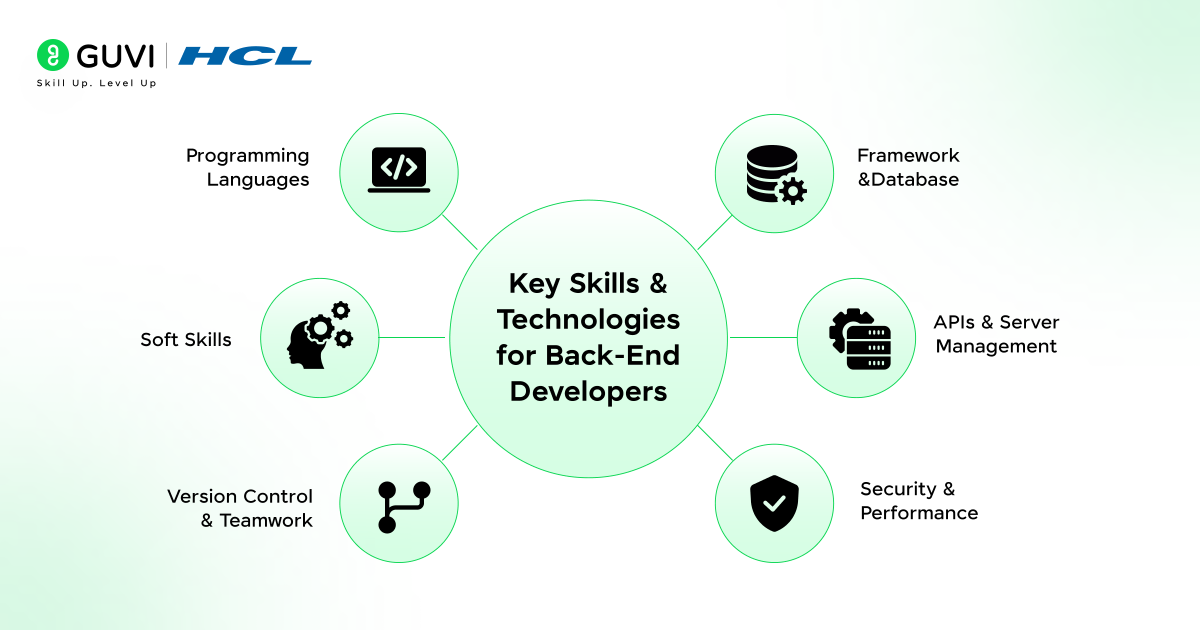
The following are the key skills and technologies that a back-end developer should master or learn to become proficient:
- Programming Languages: Learn core languages like Python, Java, Node.js, PHP, or Ruby to build server-side logic and manage data flow.
- Frameworks & Databases: Use frameworks such as Django, Spring Boot, Express.js, or Laravel, and databases such as MySQL, MongoDB, or PostgreSQL to build data-driven apps.
- APIs & Server Management: Build and manage RESTful or GraphQL APIs, and use tools like AWS, Docker, and Nginx for smooth deployment and hosting.
- Security & Performance: Apply JWT, OAuth, HTTPS, and encryption for data protection, and use caching or optimization to boost speed and reliability.
- Version Control & Teamwork: Use Git with GitHub or GitLab for version control, and focus on teamwork, problem-solving, and clear communication.
- Soft Skills: Focus on communication, teamwork, time management, and problem-solving to work efficiently and handle challenges professionally.
Best Resume Format for Back-End Developers
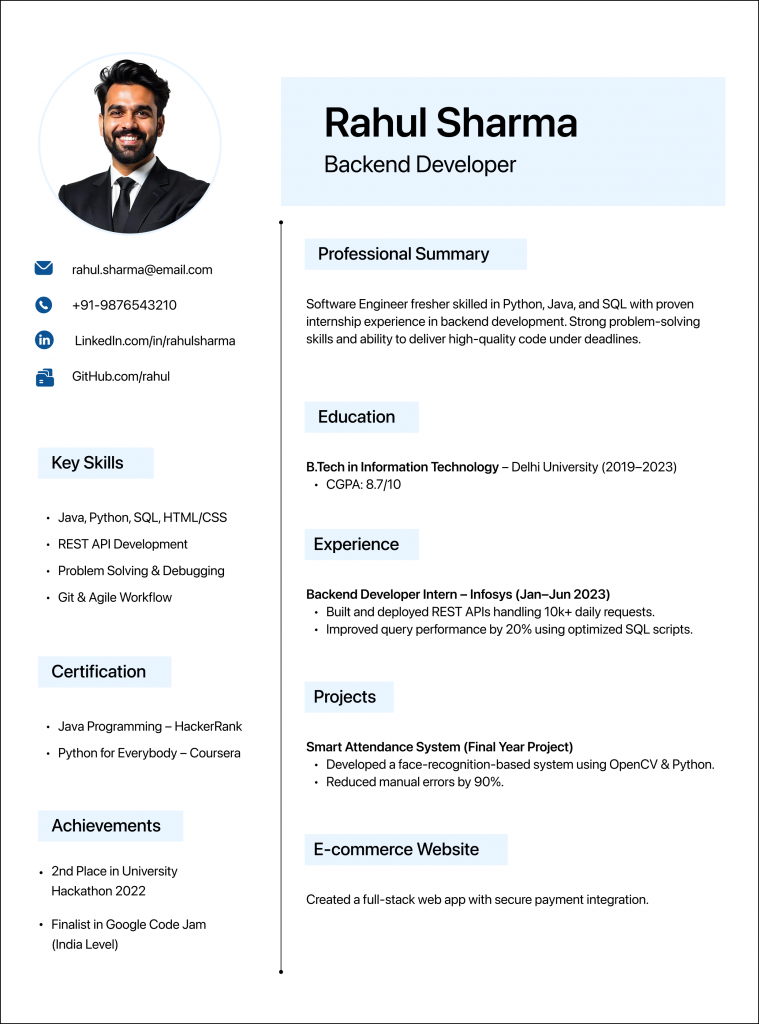
The best resume format for back-end developers is the reverse-chronological format, as it clearly highlights your most recent experience, skills, and projects first — helping recruiters quickly assess your technical growth. This format is ideal for both freshers and professionals because it presents your journey in an organized and easy-to-read structure.
Start with a clear header, followed by a short professional summary, key skills, work experience, projects, and education. Keep the layout clean, avoid fancy designs, and use consistent formatting to ensure your resume passes ATS scans while looking professional and polished.
Refer to the resume below to get a clear overview of how to design it:
Interested in software development but don’t know how to start your journey. Don’t worry, HCL GUVI is here. We are an advanced upskilling platform dedicated purely to transforming your tech career to the next level. Enroll in our IITM Pravartak Certified MERN Full Stack Developer Course with AI Integration and master the in-demand tools like Git, MongoDB, Express, React, Node.js, and more!
If you want to build your Backend Developer resume in minutes and also check the ATS score for it, then use HCL GUVI’s Free Resume Builder Tool – Create and Check ATS Score For Free
Conclusion
A well-crafted back-end developer resume helps you stand out in today’s competitive tech world. By choosing the right format, highlighting key skills and technologies, and clearly presenting your experience, you can make a strong impression on recruiters. Focus on showcasing both your technical expertise and problem-solving abilities to increase your chances of landing your next big opportunity.
FAQs
What is the best resume format for a back-end developer?
The reverse-chronological format works best because it shows your most recent experience and skills first.
How long should a back-end developer’s resume be?
Keep it one page if you’re a fresher, and two pages if you have more experience or projects.
What skills should I highlight in a back-end developer resume?
Focus on Python, Java, Node.js, databases, APIs, and soft skills like teamwork and problem-solving.
Success Stories























Did you enjoy this article?