


Data Science Articles
Finance Manager to Data Analytics: Career Growth, Salary and Seniority
SQL Python Power BI for Accountants What Should You Learn First? - Best Guide
Can a Deputy Manager in Finance Switch to Data Analytics Mid-Career?
What Skills Do Finance Team Leads Need for Finance Analytics Leadership?


Get In Touch For Details! Request More Information
Auditor to Data Analyst: How Financial Audit Experience Transfers
Oct 15, 2026 5 Min Read 35 Views
(Last Updated)
You have spent years testing controls, tracing transactions, and defending conclusions in front of audit committees. Somewhere along the way you probably noticed that the most valuable part of your work was not the ticking and bracketing. It was the moment the data told you something was off.
That instinct is exactly what analytics teams hire for. This guide breaks down the auditor to data analyst move for working professionals: which audit skills transfer as they are, which gaps you genuinely need to close, and how to position years of assurance experience so recruiters read it as analytics experience.
Table of contents
- TL;DR Summary
- What is the Auditor to Data Analyst Transition?
- Finance to Data Analytics: Why Audit Is a Head Start
- Audit Skills That Transfer Directly
- Professional Skepticism Becomes Data Validation
- Materiality Becomes Prioritisation
- Control Logic Becomes Business Rules
- Audit Documentation Becomes Reproducible Work
- Auditor to Data Analyst Skill Gaps You Need to Close
- Hands-On: Audit Tests Rewritten as Analytics Code
- Accountant to Data Analyst: How the Path Differs for Auditors
- Career Transition Roadmap for Working Auditors
- Months 1 to 2: SQL and Data Foundations
- Months 3 to 4: BI and Storytelling
- Months 5 to 6: Python and Portfolio
- Months 6 to 8: Internal Moves and Interviews
- Finance Data Career Options After the Switch
- The Auditor to Data Analyst Market in India
- 💡 Did You Know?
- Common Auditor to Data Analyst Mistakes
- Conclusion
- FAQs
- Can an auditor become a data analyst without a technical degree?
- How long does the auditor to data analyst transition take?
- Which tool should you learn first for an auditor to data analyst move?
- Does an auditor to data analyst move mean a salary cut?
- Is CISA useful for an auditor to data analyst switch?
- What is the best first role after an auditor to data analyst switch?
TL;DR Summary
- What it is: The auditor to data analyst transition is a lateral move where audit professionals apply their testing, sampling, and evidence skills to business data using SQL, Python, and BI tools.
- What transfers: Professional skepticism, materiality judgement, data reconciliation, control logic, and stakeholder reporting.
- What to learn: SQL first, then a BI tool (Power BI or Tableau), then Python with pandas for automation and statistical checks.
- Time commitment: Most working auditors need 4 to 8 months of consistent part-time practice to become interview ready.
- Portfolio tip: Rebuild real audit tests (duplicate payments, Benford’s Law, journal entry testing) as SQL and Python projects.
- Next step: Target finance-adjacent analyst roles first, where your domain knowledge is an immediate edge.
What is the Auditor to Data Analyst Transition?
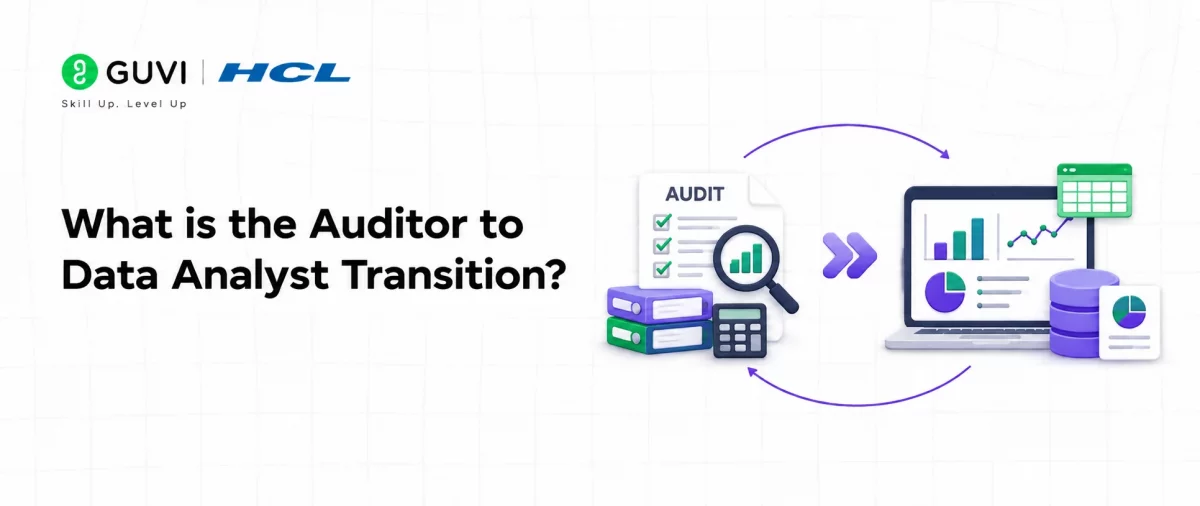
The auditor to data analyst transition is a career move in which a statutory, internal, or IT auditor shifts from validating financial information to analysing business data at scale. Instead of sampling 60 invoices, you query all 6 lakh. Instead of a working paper, you deliver a dashboard or a model.
It is not a restart. Audit already trains you in the core analytical loop: form a hypothesis, gather evidence, test it, and communicate a conclusion with a defined level of confidence. The auditor to data analyst shift mostly changes the tools and the scale, not the thinking.
If you want a structured path with mentors, real datasets, and placement support, HCL GUVI’s Data Science Program, offered with IITM Pravartak, covers SQL, Python, statistics, and BI tools in a format built for working professionals.
Finance to Data Analytics: Why Audit Is a Head Start
The broader finance to data analytics shift is well underway. Audit firms now run full population testing, FP&A teams live in Power BI, and risk teams build anomaly detection on transaction logs. Finance teams want analysts who understand both the ledger and the query.
This is where the auditor to data analyst candidate stands out. A generic analyst can write a join, but may not know why a cut-off error matters or why a suspense account balance is a red flag. You already do.
The table below shows how everyday audit work maps across in an auditor to data analyst switch.
| Audit Activity | Data Analyst Equivalent | Tool You Will Use |
|---|---|---|
| Vouching and tracing | Joining tables and validating keys | SQL |
| Audit sampling (SA 530) | Full population analysis and stratification | SQL, Python |
| Analytical procedures (SA 520) | Trend, ratio, and variance analysis | Excel, Power BI |
| Bank and ledger reconciliation | Data reconciliation and ETL validation | SQL, Power Query |
| Journal entry testing | Rule-based anomaly flagging | SQL, Python |
| Audit report and management letter | Dashboard and insight narrative | Power BI, Tableau |
| Materiality assessment | Defining thresholds and KPIs | Business logic |
Audit Skills That Transfer Directly
These four skills are why the auditor to data analyst path is shorter than most career switches.
1. Professional Skepticism Becomes Data Validation
Auditors never accept a number at face value. In analytics, this habit prevents the most expensive mistake: building insights on dirty data. Checking row counts, nulls, duplicates, and source totals before analysis is second nature to you.
2. Materiality Becomes Prioritisation
Analysts drown in possible questions. Your materiality judgement helps you decide which variance is worth a deep dive and which is noise. Hiring managers value this far more than an extra library on a resume.
3. Control Logic Becomes Business Rules
Every control you have tested is a rule: approvals above a limit, segregation of duties, three-way match. Translating those rules into SQL conditions is often the fastest win in the auditor to data analyst journey.
4. Audit Documentation Becomes Reproducible Work
Working papers demand that another reviewer can re-perform your work. That is the same principle behind clean, commented, version-controlled analysis, and it makes an auditor to data analyst hire easy to onboard.
Auditor to Data Analyst Skill Gaps You Need to Close
Be honest about the gaps in your auditor to data analyst plan. Most auditors are strong in Excel but have limited exposure to databases, scripting, and visual design. Here is a realistic priority order.
| Priority | Skill | Why It Matters for Auditors | Suggested Depth |
|---|---|---|---|
| 1 | SQL | Every finance dataset lives in a database or ERP | Joins, CTEs, window functions |
| 2 | Power BI or Tableau | Replaces static reports with interactive views | Data modelling, DAX basics |
| 3 | Python (pandas) | Automates repeat tests across files and periods | Cleaning, grouping, merging |
| 4 | Statistics | Supports sampling, outliers, and forecasting | Distributions, regression basics |
| 5 | Data storytelling | Turns findings into decisions | Dashboard layout, executive summaries |
For SQL, practise with the question patterns in these SQL interview questions. For BI, this guide on the best Power BI courses with certificate helps you pick a learning route, and Microsoft’s PL-300 certification is a useful signal to recruiters.
Hands-On: Audit Tests Rewritten as Analytics Code
The best proof of an auditor to data analyst transition is code that automates an audit test you already understand. Here is a duplicate payment check on an accounts payable table.
SELECT vendor_id,
       invoice_no,
       invoice_amount,
       COUNT(*) AS times_paid,
       SUM(invoice_amount) AS total_paid
FROM ap_payments
GROUP BY vendor_id, invoice_no, invoice_amount
HAVING COUNT(*) > 1
ORDER BY total_paid DESC;
The next example runs a Benford’s Law first-digit test on journal entries in Python. Large gaps between observed and expected frequencies point you to entries worth investigating.
import numpy as np
import pandas as pd

df = pd.read_csv("journal_entries.csv")
amounts = df["amount"].abs()
amounts = amounts[amounts >= 1]

first_digit = amounts.astype(int).astype(str).str[0].astype(int)
observed = first_digit.value_counts(normalize=True).sort_index()

digits = np.arange(1, 10)
expected = pd.Series(np.log10(1 + 1 / digits), index=digits)

result = pd.DataFrame({"observed": observed, "expected": expected})
result = result.fillna(0)
result["gap"] = (result["observed"] - result["expected"]).round(3)
print(result)
Put both on GitHub with a short README explaining the audit risk each test addresses. That framing is what separates an auditor to data analyst portfolio from a generic one.
Accountant to Data Analyst: How the Path Differs for Auditors
The accountant to data analyst route and the auditor to data analyst route look similar, but the starting strengths differ.

| Factor | Accountant | Auditor |
|---|---|---|
| Core strength | Building and maintaining records | Testing and challenging records |
| Data exposure | One organisation, deep | Many clients, broad |
| Natural analytics fit | FP&A, reporting analyst | Risk, fraud, controls analytics |
| Biggest gap | Analytical scepticism at scale | Tooling and automation |
Accountants usually know one ERP and chart of accounts in depth. Auditors have seen dozens of systems and data quality failures across clients, which gives the auditor to data analyst candidate an edge in data profiling.
If you are weighing certifications, this guide on data analytics certifications for accountants and finance professionals compares the options by goal.
Career Transition Roadmap for Working Auditors
A successful career transition from auditor to data analyst does not require quitting your job. Use this phased plan while you are still employed.
1. Months 1 to 2: SQL and Data Foundations
Learn SELECT, joins, GROUP BY, CTEs, and window functions. Practise on public financial datasets or anonymised sample ledgers. Rebuild three audit tests in SQL as your first auditor to data analyst portfolio pieces.
2. Months 3 to 4: BI and Storytelling
Build one Power BI or Tableau dashboard, such as an AP risk dashboard showing duplicate payments, vendor concentration, and payment timing. This guide on how to design a data dashboard covers layout choices that make stakeholders actually use it.
3. Months 5 to 6: Python and Portfolio
Use pandas to automate a monthly reconciliation and the Benford’s test above. Publish three to four auditor to data analyst projects with clear business context. For more ideas, see these data analyst portfolio project ideas.
4. Months 6 to 8: Internal Moves and Interviews
Volunteer for your firm’s data analytics or forensic team first. An internal move is the lowest risk auditor to data analyst step, since your employer already trusts your judgement.
Finance Data Career Options After the Switch
A finance data career gives you a soft landing because your domain knowledge counts from day one. These roles suit the auditor to data analyst profile best.
| Role | What You Do | Audit Skill Leveraged |
|---|---|---|
| Audit Data Analyst | Full population testing for audit teams | Audit methodology |
| Forensic Data Analyst | Fraud detection and investigation support | Skepticism, evidence handling |
| Risk and Controls Analyst | Monitor control effectiveness with data | Control testing |
| FP&A Analyst | Budgeting, forecasting, variance analysis | Analytical procedures |
| BI Analyst (Finance) | Build reporting layers for finance teams | Financial statement knowledge |
| Compliance Analytics Analyst | Transaction monitoring and regulatory reporting | Regulatory awareness |
Once settled, many professionals move towards data science. If that is your long-term goal, read whether financial analysts need machine learning to become data scientists.
The Auditor to Data Analyst Market in India
India offers a strong runway for this move. Global Capability Centres in Bengaluru, Hyderabad, Chennai, and Pune run large finance operations and controls teams that need analysts who understand accounting.
The Big Four and mid-tier firms also run dedicated audit analytics, forensic, and risk advisory practices. For a CA, CMA, or ACCA holder, an internal auditor to data analyst move within these firms is often faster than an external switch.
💡 Did You Know?
- Benford’s Law predicts that the digit 1 appears as the leading digit in about 30.1% of naturally occurring numbers, which is why forensic teams use it to flag potentially manipulated figures.
- ICAI’s SA 520 on analytical procedures expects auditors to evaluate financial information by comparing it with expectations, a principle also used in variance dashboards.
- ISACA’s CISA certification connects auditing, information systems, and technology, making it a useful credential for IT auditors.
Common Auditor to Data Analyst Mistakes
- Hiding the audit background: This is the most common auditor to data analyst error. Your domain expertise is your edge. Lead with it instead of presenting yourself as a fresher analyst.
- Learning Python before SQL: Most finance data sits in relational databases. SQL gives the fastest return.
- Building generic projects: Another Titanic or Netflix dataset project will not stand out. Audit-flavoured projects will.
- Over-documenting dashboards: Working paper habits can lead to cluttered visuals. Analytics audiences want three clear insights, not thirty.
- Ignoring interview prep: Practise technical rounds, including Python interview questions if the role lists pandas.
If you are ready to make the move with structured mentorship, explore HCL GUVI’s Data Science Program and build a portfolio employers in finance analytics actually notice.
Conclusion
The auditor to data analyst move rewards what you already do well: questioning data, testing assumptions, and explaining conclusions to decision makers. What you add is tooling and scale. With SQL, a BI tool, and a few audit-driven portfolio projects, your years in assurance become a clear competitive advantage.
FAQs
1. Can an auditor become a data analyst without a technical degree?
Yes. Most auditor to data analyst professionals come from commerce, CA, or ACCA backgrounds. Employers care about demonstrated SQL, BI, and Python skills plus a portfolio, not a computer science degree.
2. How long does the auditor to data analyst transition take?
For a working professional practising 8 to 10 hours a week, 4 to 8 months is realistic to become interview ready. Prior Excel strength often shortens this.
3. Which tool should you learn first for an auditor to data analyst move?
Start with SQL. It mirrors vouching and tracing logic and is required in almost every analyst job description.
4. Does an auditor to data analyst move mean a salary cut?
It depends on your seniority and target role. Finance-focused analyst roles usually value audit experience, which reduces the risk of a cut compared to entering a generic analyst role.
5. Is CISA useful for an auditor to data analyst switch?
CISA helps for IT audit, controls analytics, and risk roles. For core data analyst roles, practical SQL and BI skills carry more weight.
6. What is the best first role after an auditor to data analyst switch?
Audit analytics, forensic data analytics, or risk and controls analytics are the smoothest first steps because they combine your audit expertise with new technical skills.
Success Stories

About the Author
Jebasta
I translate the language of data into stories that anyone can understand. As a writer with a data science background, I simplify analytics, AI, and decision-making so beginners and enthusiasts can confidently explore the world of data.
View all posts by Jebasta
Connect with me @







Did you enjoy this article?