


Artificial Intelligence and Machine Learning Articles
AI Impact on Entry-Level Jobs: How Expectations Are Changing in 2026 - Best Guide
Multi-Turn Conversation Management with Claude API


Get In Touch For Details! Request More Information
How AI is Transforming the Software Development Lifecycle in 2025
Oct 24, 2025 5 Min Read 2246 Views
(Last Updated)
The software development lifecycle is experiencing a remarkable transformation with AI growing at an astonishing 37.3% annually in the industry. You’re witnessing a fundamental shift that’s already reshaping how code is written, tested, deployed, and maintained—not in some distant future, but right now.
Currently, developers using AI-generated code report 55% faster development cycles and an impressive 88% increase in productivity. Additionally, GitLab’s research found that 78% of organizations are either actively using AI in their development processes or plan to implement it within the next two years.
As a result, the entire software development lifecycle (SDLC) is evolving, with AI in the software development lifecycle creating more efficient, accurate, and innovative processes. In this comprehensive guide, we will be discussing where AI is used, how it is used, and all aspects of the SDLC. Let’s begin!
Table of contents
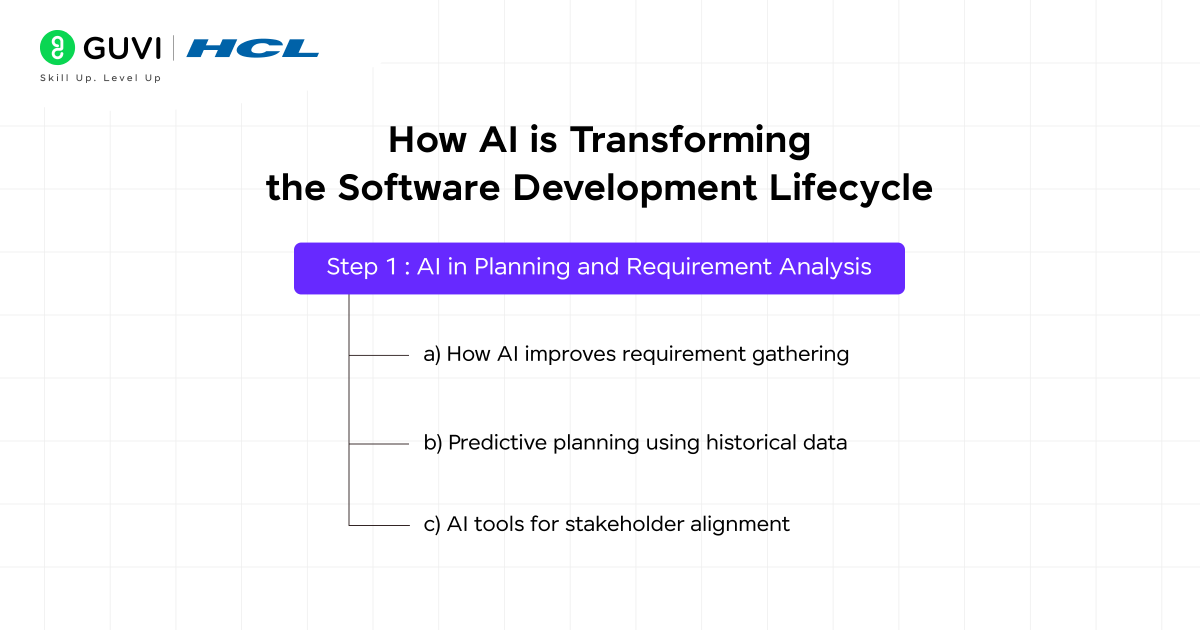
- 1) AI in Planning and Requirement Analysis
- A) How AI improves requirement gathering
- B) Predictive planning using historical data
- C) AI tools for stakeholder alignment
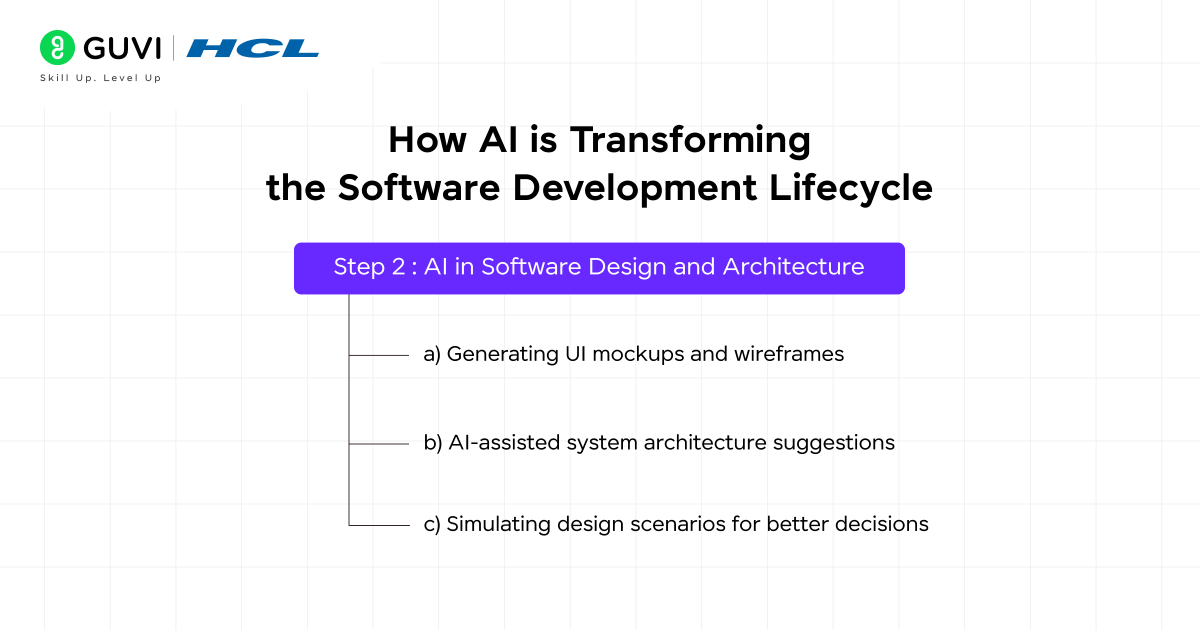
- 2) AI in Software Design and Architecture
- A) Generating UI mockups and wireframes
- B) AI-assisted system architecture suggestions
- C) Simulating design scenarios for better decisions
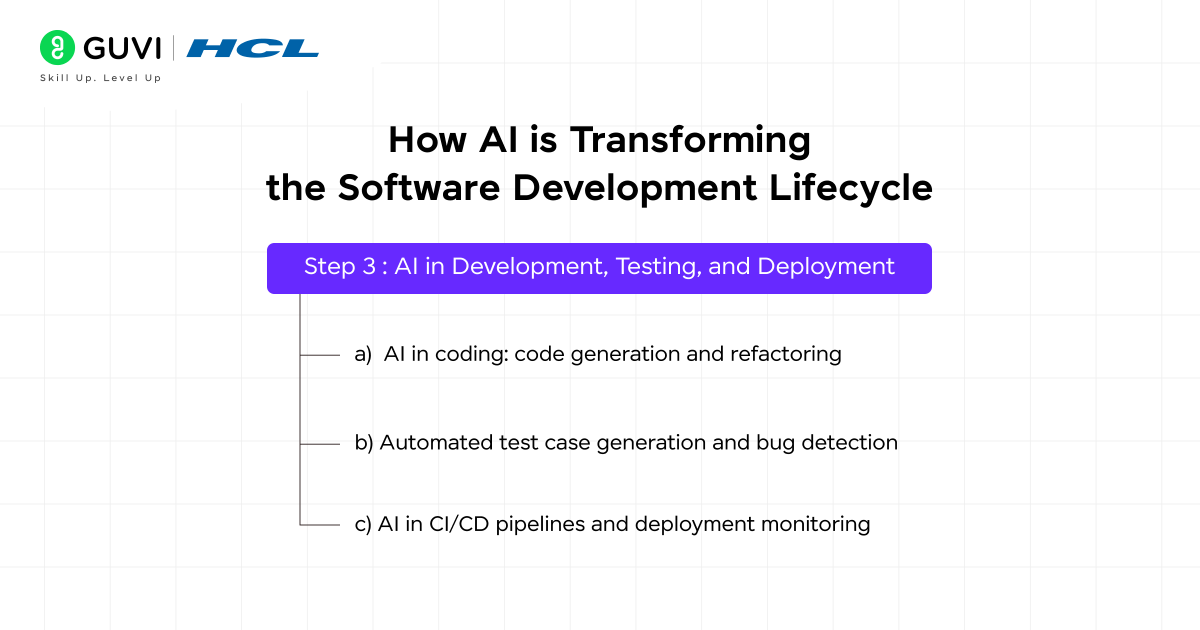
- 3) AI in Development, Testing, and Deployment
- A) AI in coding: code generation and refactoring
- B) Automated test case generation and bug detection
- C) AI in CI/CD pipelines and deployment monitoring
- 4) AI in Maintenance, Monitoring, and Compliance
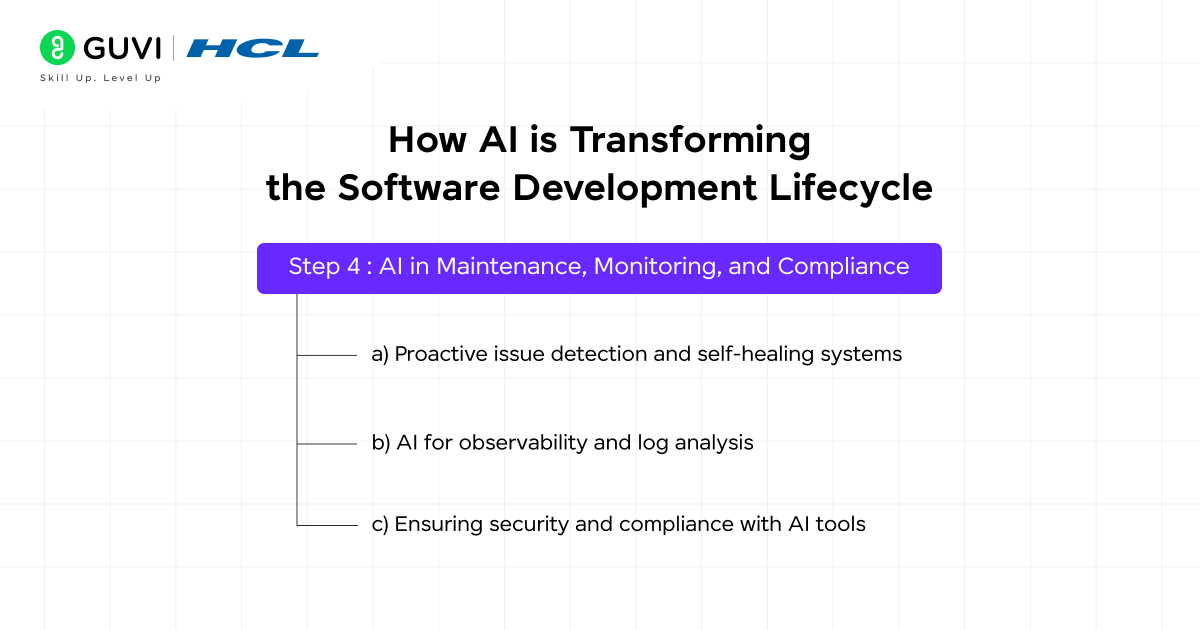
- A) Proactive issue detection and self-healing systems
- B) AI for observability and log analysis
- C) Ensuring security and compliance with AI tools
- Concluding Thoughts…
- FAQs
- Q1. How is AI improving software development efficiency?
- Q2. What role does AI play in the planning phase of software development?
- Q3. How does AI assist in software design and architecture?
- Q4. What impact does AI have on software testing?
- Q5. How does AI contribute to software maintenance and security?
1) AI in Planning and Requirement Analysis
Planning and requirement analysis, traditionally one of the most time-consuming phases of the software development lifecycle, is now experiencing significant efficiency gains through AI implementation. Let’s explore how these changes are reshaping the foundation of successful software projects.
A) How AI improves requirement gathering
AI-driven requirements management enhances the efficiency and quality of elicitation, analysis, documentation, and writing processes. Instead of manually sifting through scattered information, AI tools can now automatically gather requirements from various sources such as emails, documents, and meeting notes using Natural Language Processing (NLP).
Furthermore, AI excels at:
- Detecting the quality of written requirements and analyzing them against various writing standards
- Identifying inconsistencies and suggesting improvements in existing requirements
- Standardizing terminology across documents to ensure everyone understands requirements clearly
This automation reduces the time spent on manual documentation by up to 50%, allowing teams to focus on more strategic activities. Moreover, AI can translate requirements into multiple languages while maintaining context, effectively breaking down communication barriers in global development teams.
B) Predictive planning using historical data
Predictive AI uses statistical analysis and machine learning to identify patterns and forecast upcoming events in the software development lifecycle. By examining vast amounts of historical project data, AI algorithms can:
- Reveal patterns and correlations that human analysts might overlook
- Provide realistic timelines, enabling stakeholders to set appropriate expectations
- Identify potential risks early by analyzing factors that have historically resulted in delays
The accuracy of these predictions largely depends on the quality and quantity of training data available. As projects progress, AI algorithms continuously learn from real-time data, adapting and refining their predictions for greater accuracy.
C) AI tools for stakeholder alignment
Stakeholder misalignment kills more projects than budget overruns or technical failures. AI-powered stakeholder analysis transforms how teams approach this challenge by:
- Providing real-time insights into stakeholder sentiments through continuous monitoring of communications
- Forecasting stakeholder reactions to project decisions or changes
- Identifying key influencers within stakeholder groups who can impact project success
Organizations implementing AI-driven stakeholder management have reported increased stakeholder satisfaction by 40% and improved adoption rates of new software. By detecting growing stakeholder concerns before they escalate, teams can avoid costly project delays and maintain positive relationships throughout the software development lifecycle.
2) AI in Software Design and Architecture
The design phase of the software development lifecycle is now significantly enhanced through AI, with tools that translate concepts into visuals in seconds rather than days.

A) Generating UI mockups and wireframes
AI-powered design tools have reshaped how teams create user interfaces. Tools like Uizard can generate entire multi-screen, editable prototypes from simple text descriptions. Consequently, tasks that once took days now happen within minutes. For instance:
- Designers can create mockups in seconds and iterate rapidly
- Non-designers can visualize concepts without technical skills
- Teams can explore multiple design directions simultaneously
According to user feedback, these AI tools enable product managers to accomplish approximately 80% of a UX designer’s job, dramatically compressing the design timeline.
B) AI-assisted system architecture suggestions
In system architecture, AI serves as a valuable collaborator rather than a replacement. Currently, AI tools can support five out of six core architecture activities, specifically:
- Clarifying requirements and identifying constraints
- Supporting proof-of-concept creation and documentation
- Designing cross-sectional concepts and generating diagrams
- Creating checklists for architecture evaluation
- Translating technical concepts into ubiquitous language
Notably, AI helps software architects break large problems into smaller, manageable components while suggesting potential architecture options based on established patterns and best practices.
C) Simulating design scenarios for better decisions
Perhaps most impressively, AI enables architects to simulate multiple design scenarios before implementation. AI-powered generative design tools allow teams to:
- Rapidly generate numerous design alternatives by setting specific parameters
- Optimize layouts and material selections for both innovation and practicality
- Test performance characteristics through predictive analytics
Digital twins powered by AI can simulate scenarios, predict outcomes, and optimize building performance for more efficient operations. Equally important, these simulations help teams identify potential issues early, substantially reducing the cost of changes compared to discoveries made during development or post-launch.
3) AI in Development, Testing, and Deployment
The core development and testing phases of the software development lifecycle are witnessing remarkable efficiency gains through AI adoption. Currently, teams implementing AI-powered tools report time savings of up to 10 weeks of development time.
A) AI in coding: code generation and refactoring
AI code generation tools now automatically produce source code from specifications, substantially boosting developer productivity and reducing coding errors. These tools excel at:
- Generating boilerplate code and handling repetitive coding tasks
- Detecting bugs and suggesting fixes based on analyzing large codebases
- Creating reusable code components for faster iteration
This allows developers to focus on more complex programming requirements and creative tasks rather than routine coding work. Studies show AI-assisted coding can increase programming efficiency by 45-55%.
B) Automated test case generation and bug detection
AI has fundamentally transformed testing by generating comprehensive test cases automatically. Using machine learning algorithms, AI can:
- Analyze the software’s behavior to create diverse test scenarios
- Identify high-risk code sections through predictive analytics
- Detect subtle issues missed by traditional testing methods
In fact, AI-powered testing frameworks can identify 87% of critical defects within the first 30% of test execution time. Organizations report reduced manual testing time by up to 80% when using AI-generated test cases.
C) AI in CI/CD pipelines and deployment monitoring
AI integration within CI/CD pipelines has become essential for maximizing deployment efficiency. Machine learning models now streamline deployment processes by:
- Predicting potential failures and recommending adjustments for smoother releases
- Automating monitoring and scaling to improve build efficiency
- Optimizing resource allocation to manage bottlenecks
Overall, AI-powered CI/CD tools continuously analyze execution times, resource usage, and error rates to create self-healing pipelines with automated issue resolution. This proactive approach enables faster, more reliable software delivery while minimizing production risks.
AI is quietly reshaping coding culture in ways you might not expect:
AI Writes Millions of Lines of Code Daily: GitHub Copilot alone now assists in generating code for over 30% of all new projects worldwide, drastically cutting down repetitive coding.
Bug Detection Before Launch: Studies show AI-powered testing frameworks can catch 87% of critical defects before software even reaches production.
From Weeks to Minutes: Tools like Uizard can turn plain text descriptions into working UI prototypes in under 60 seconds—a process that once took entire design sprints.
These fun facts highlight how AI is not just supporting, but actively accelerating every step of the software development lifecycle!
4) AI in Maintenance, Monitoring, and Compliance
The final phase of the software development lifecycle now harnesses AI’s analytical power to maintain and secure applications with minimal human intervention.
A) Proactive issue detection and self-healing systems
AI predictive maintenance systems continuously analyze operational conditions, detecting subtle performance dips in real-time before they become major failures. These systems can:
- Reduce machine outages by predicting failures faster and more accurately than traditional methods
- Analyze historical and real-time data to create predictive models of equipment deterioration
- Enable self-healing capabilities that automatically patch vulnerabilities and restore breached networks
Studies show AI-powered predictive maintenance has achieved a 30% reduction in downtime for data centers.
B) AI for observability and log analysis
AI observability solutions transform how teams monitor software by:
- Automating log analysis across millions of messages to quickly identify root causes
- Processing logs in real-time to detect patterns and anomalies
- Providing plain language root cause summaries, eliminating manual troubleshooting
One study found AI-powered log analysis created accurate root-cause reports 95% of the time.
C) Ensuring security and compliance with AI tools
As AI adoption accelerates in the software development lifecycle, AI Security Posture Management (AI-SPM) provides:
- Visibility across AI systems with real-time monitoring
- Identification of potential routes where attacks might occur
- Continuous adherence to security standards and regulatory requirements
These capabilities ensure software remains secure throughout its lifecycle while maintaining compliance with evolving regulations.
To keep up with AI’s accelerating role in software development — from generative models to MLOps — HCL GUVI’s Intel & IITM-Pravartak Certified Artificial Intelligence and Machine Learning Course offers hands-on training across Deep Learning, NLP, Agentic AI and more, even for those without a coding background. It’s the bridge between curiosity and career-ready AI expertise.
Concluding Thoughts…
AI has undoubtedly reshaped every aspect of the software development lifecycle as we approach 2025. Throughout this article, we’ve seen how AI tools now handle tasks that previously required extensive human effort. From automatically gathering requirements to generating code and predicting potential failures, AI serves as a powerful ally rather than a replacement for human creativity.
You don’t need to be a technical expert to benefit from these advancements. Though challenges certainly exist, the trajectory is clear. AI will continue to evolve and integrate deeper into the software development process. Good Luck!
FAQs
Q1. How is AI improving software development efficiency?
AI is significantly boosting efficiency in software development by automating tasks like code generation, test case creation, and bug detection. Developers using AI-generated code report 55% faster development cycles and an 88% increase in productivity.
Q2. What role does AI play in the planning phase of software development?
In the planning phase, AI enhances requirement gathering by automatically collecting information from various sources, detecting inconsistencies, and standardizing terminology. It also uses historical data for predictive planning and helps in stakeholder alignment through sentiment analysis.
Q3. How does AI assist in software design and architecture?
AI tools can generate UI mockups and wireframes rapidly, provide system architecture suggestions, and simulate design scenarios. This allows teams to explore multiple design directions quickly and make better decisions before implementation.
Q4. What impact does AI have on software testing?
AI has transformed testing by automatically generating comprehensive test cases, identifying high-risk code sections, and detecting subtle issues. Organizations report reduced manual testing time by up to 80% when using AI-generated test cases.
Q5. How does AI contribute to software maintenance and security?
AI enhances software maintenance through proactive issue detection and self-healing systems, reducing downtime significantly. In security, AI-powered tools provide real-time monitoring, identify potential attack routes, and ensure continuous adherence to security standards and regulatory requirements.
Success Stories

About the Author
Jaishree Tomar
A recent CS Graduate with a quirk for writing and coding, a Data Science and Machine Learning enthusiast trying to pave my own way with tech. I have worked as a freelancer with a UK-based Digital Marketing firm writing various tech blogs, articles, and code snippets. Now, working as a Technical Writer at GUVI writing to my heart’s content!
View all posts by Jaishree Tomar
Connect with me @







Did you enjoy this article?