


Artificial Intelligence and Machine Learning Articles
Finance Manager to Data Analytics: Career Growth, Salary and Seniority
How to Evaluate LLM Outputs in Production Deployments
AI/ML Skills Gap 2026: Why Companies Can't Find Job-Ready Talent
20 AI/ML Interview Questions Recruiters Can Use Without a Tech Background - Best Guide


Get In Touch For Details! Request More Information

Future of AI in 2026: 10 AI Predictions You Shouldn’t Miss
Feb 25, 2026 5 Min Read 6730 Views
(Last Updated)
What if 2026 isn’t about bigger AI models but about smarter, safer, and more useful ones? Artificial Intelligence has officially moved past the “wow” phase. We’ve all seen the flashy demos and viral tools.
The real question now is: how will AI actually shape the way we work, learn, and make decisions this year? From autonomous agents that manage your tasks to stricter AI governance shaping how products are built, 2026 is setting a new tone. It’s less about hype and more about practical, measurable impact.
This article lets you walk through ten predictions that reveal where the future of AI is really headed and what that means for you. So, without further ado, let us get started!
Table of contents
- What the Data Says Right Now About the Future of AI
- Top 10 AI Predictions That You Should Care About
- Agentic AI becomes useful, not just flashy
- The Gen-AI Paradox Forces Industrialization
- Governance, Audits, and AI Compliance go Mainstream
- Vertical, Domain-specific Models win where Accuracy and Compliance matter
- Multimodal helps solve real problems, but grounding is required
- Hybrid edge-cloud Architectures and AI Hardware Shape Product Strategy
- A Public Safety/Regulatory Incident will Accelerate Rules and Procurement Changes
- SMBs Start using Real, Productized AI features — Not just APIs
- Data-centric AI becomes the Real Moat
- Explainability, Monitoring, and Continuous Validation are now Product Features
- What this Means for Product Managers, Engineers, and Leaders
- Quick decision guide (if you only have 5 minutes)
- Conclusion
- FAQs
- What will be the biggest AI trend in 2026?
- Will 2026 be the year regulation catches up to AI?
- Do bigger models always mean better results in 2026?
- How important is it to monitor AI once it’s in production?
- Can small and medium businesses afford to use AI in 2026?
What the Data Says Right Now About the Future of AI
Here’s the thing: 2025 and early 2026 changed the conversation about Artificial Intelligence from “what if” to “what now.” Organizations are moving beyond experiments toward scaling and governance, but many still struggle to convert AI pilots into measurable business impact.
Reports show a surge in hiring for AI engineers, compliance roles, and MLOps specialists: all signs that AI is becoming business infrastructure, not just an experiment. The takeaway? Everyone’s still excited about AI, but the focus has shifted from what’s possible to what actually works.
What this really means is: the conversation in 2026 is less about “new model X” and more about “how do we safely, reliably, and cheaply run AI that actually changes outcomes?”
Top 10 AI Predictions That You Should Care About
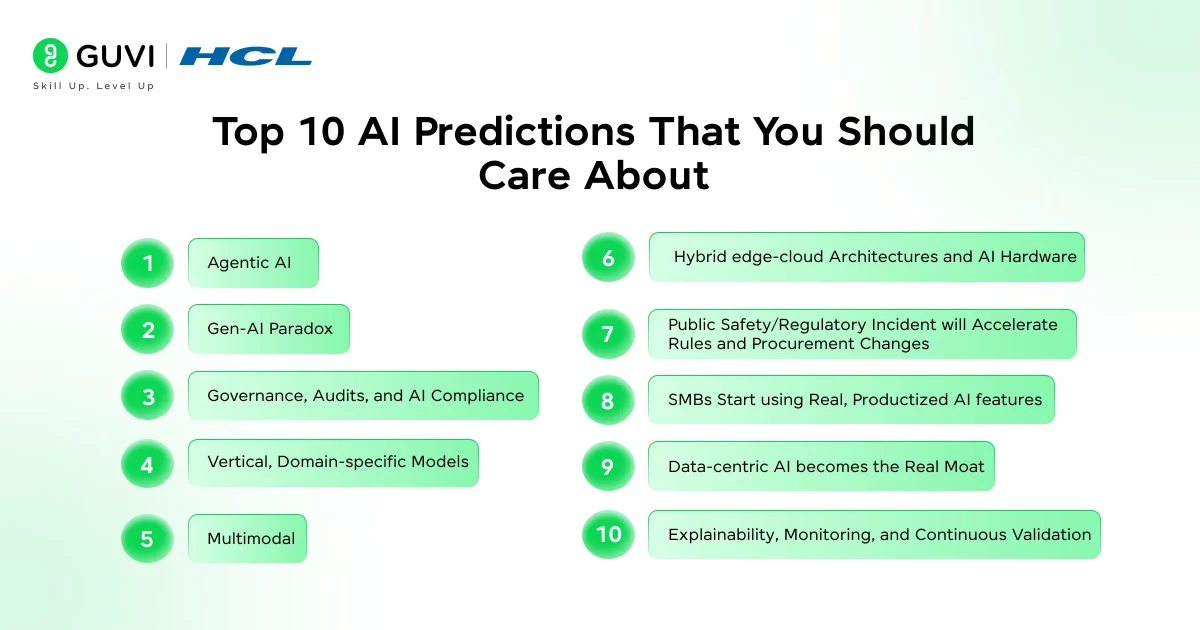
These aren’t wild guesses. They’re practical trends that analysts, researchers, and market data are already pointing toward. I’ll say what will change, why it matters to you, and one or two concrete moves you or your team can take next.
1. Agentic AI becomes useful, not just flashy
Imagine an assistant that doesn’t just answer questions but takes a chain of steps for you: checks a calendar, drafts a follow-up email, files the result in your CRM, and nudges a teammate, all under rules you set. That’s agentic AI: models orchestrating tools and APIs to complete multi-step tasks.
Why should you care?
If you build productivity or workflow tools, you’ll see these agents embedded in features, not as an optional demo, but as part of everyday workflows. They’ll save time, but they’ll also require clear limits (what the agent can do automatically vs. what needs human approval).
Quick things to do
- Treat agents like employees: give them scoped permissions and audit logs.
- Start small: automate a single reliable process end-to-end before letting agents touch higher-stakes work.
2. The Gen-AI Paradox Forces Industrialization
Lots of teams built impressive generative AI pilots. Few got consistent business outcomes. In 2026, the pressure is on to convert experiments into reliable products that move metrics, not just demo slides.
Why does it matter for your org?
Expect more investment in the nuts-and-bolts: MLOps, integration, testing, and measurable business KPIs (revenue influenced, time saved, error reduction). Leadership will ask for ROI, not just novelty.
Quick things to do
- Define the downstream metric before you model anything.
- Add monitoring and human review points from day one.
- Focus on repeatability: Can this be deployed, observed, and iterated without heroics?
3. Governance, Audits, and AI Compliance go Mainstream
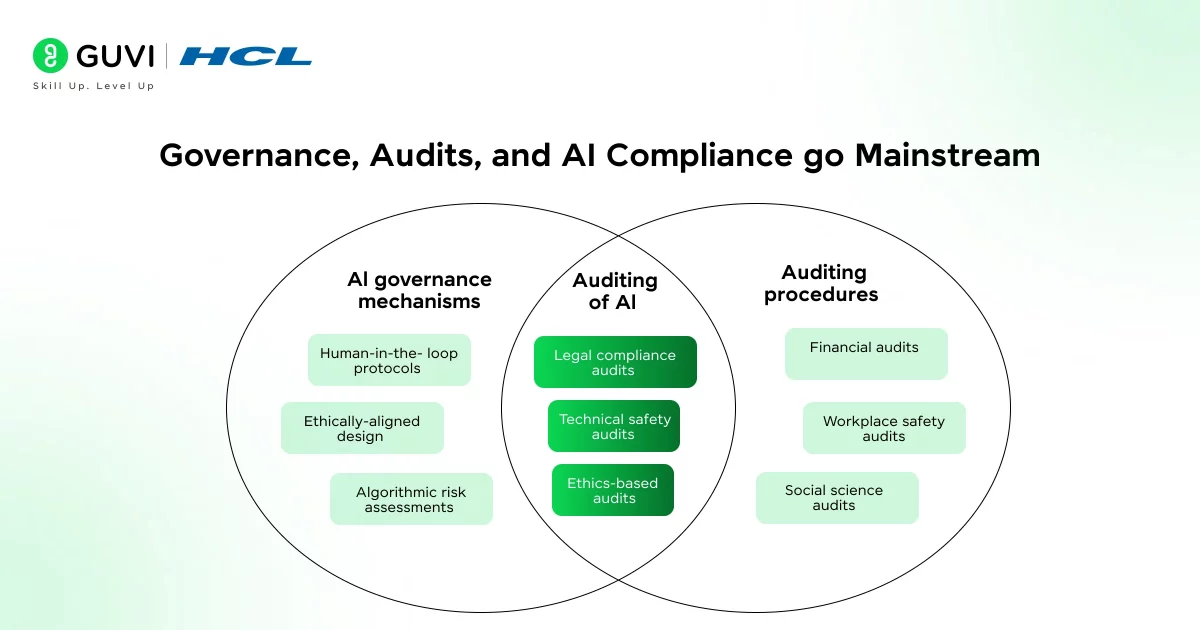
AI accountability stops being a checkbox and becomes a job. Organizations will formalize model risk assessments, data lineage, explainability requirements, and incident response for AI-specific failures.
Why this matters to you
Procurement, legal, and customers will expect explainability and audit trails. Even product features may need provenance (showing where the model pulled a piece of information from).
Quick things to do
- Create an AI playbook: risk levels, review steps, and rollback procedures.
- Keep immutable logs for model inputs/outputs and versions.
4. Vertical, Domain-specific Models win where Accuracy and Compliance matter
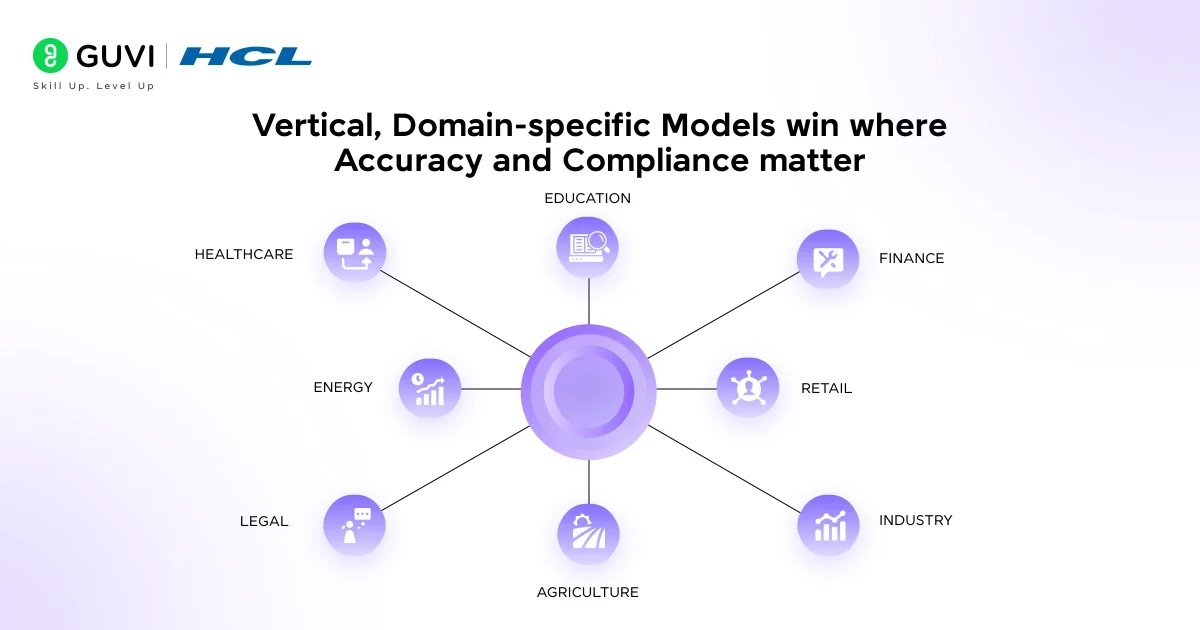
General LLMs are great for prototyping. But when you need precise, auditable answers: clinical recommendations, contract clauses, financial risk signals, models trained or tuned on domain data outperform general models.
Why you should care
If you’re in healthcare, finance, legal, or telecom, domain specialization reduces hallucinations and speeds approval from compliance teams.
Quick things to do
- Start with retrieval-augmented setups (RAG): a smaller model + curated knowledge base.
- Measure on domain-specific metrics (e.g., clinical false positive rate), not just generic language scores.
5. Multimodal helps solve real problems, but grounding is required
Models that mix images, video, audio, and text become more capable. But useful deployments pair multimodal understanding with grounding, linking outputs to validated data or sources.
Why it matters for you
Use-cases that benefit: visual troubleshooting (customer sends a screenshot + logs), automated grading with spoken and written components, and product inspections combining video and sensor telemetry.
Quick things to do
- Design pipelines that attach citations or evidentiary data to model answers.
- Validate multimodal outputs against structured checks before automating actions.
6. Hybrid edge-cloud Architectures and AI Hardware Shape Product Strategy
Training will remain cloud-heavy, but inference will split: simple, latency-critical tasks run at the edge; heavy reasoning runs in the cloud. Specialized AI chips and inference-optimized hardware will cut costs and latency.
Why you should care
If your product needs real-time responses or offline capabilities, you’ll need to plan for on-device inference (or tiny distilled models) and cloud fallbacks.
Quick things to do
- Build modular inference paths: local model → cloud escalation.
- Budget for throughput and chip availability, not just model licensing.
7. A Public Safety/Regulatory Incident will Accelerate Rules and Procurement Changes
Not a sci-fi scenario, more likely a real-world deployment that produces biased or harmful outcomes at scale, or a widely shared privacy failure. That incident will trigger sharper regulations, stricter procurement checks, and insurance requirements for AI deployments.
Why this matters to you
Buyers will require evidence of testing and rollback capability. Vendors who can show audits, red-teaming results, and clear safety controls will be preferred.
Quick things to do
- Prepare incident playbooks for AI-specific failures.
- Keep versioned models and quick rollback paths.
8. SMBs Start using Real, Productized AI features — Not just APIs
Expect practical, subscription-based AI that looks like a feature: automated bookkeeping assistants, brand-aware copy generators, and simple AI-driven customer helpers that plug into existing SaaS tools.
Why you should care
If you target SMBs, selling predictable, constrained AI features is easier than selling “build your own LLM” or token-heavy pricing.

Quick things to do
- Package AI as workflow templates with clear value metrics.
- Offer predictable pricing tiers with usage caps to avoid bill shock.
9. Data-centric AI becomes the Real Moat
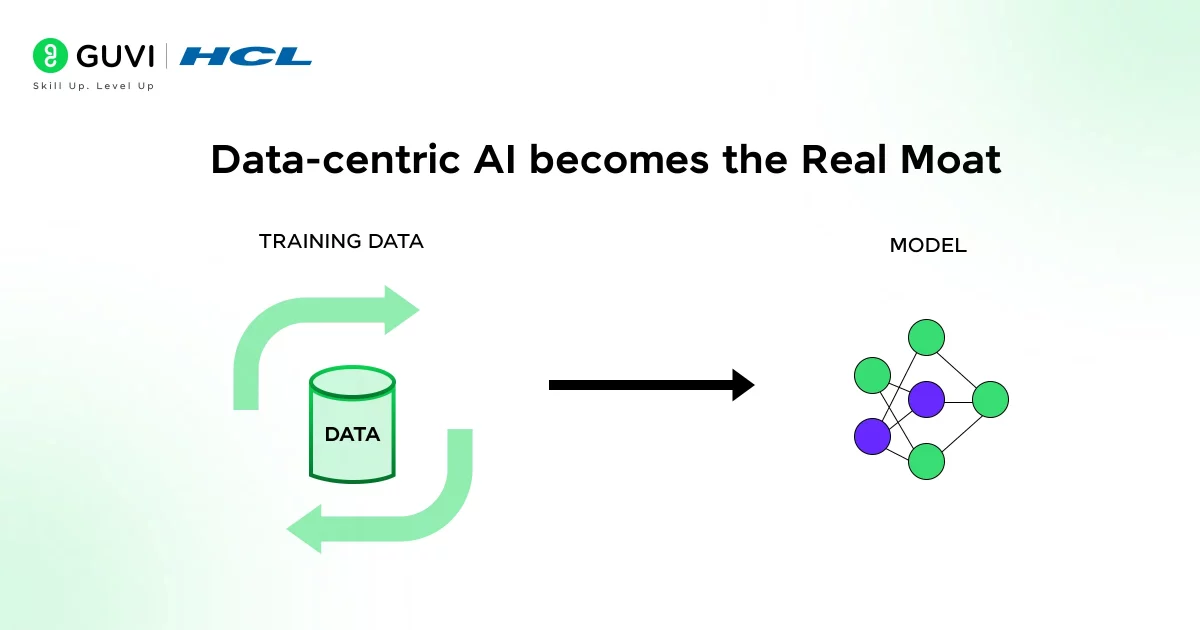
Beyond choosing models, teams that win will be the ones who craft great datasets: clean labels, smart augmentation, and retrieval sources that make models useful where they matter.
Why it matters to you
You’ll get more impact from improving data quality than from swapping to a slightly larger foundation model.
Quick things to do
- Track label quality metrics and dataset coverage gaps.
- Invest in synthetic-data pipelines only when you have strong validation steps.
10. Explainability, Monitoring, and Continuous Validation are now Product Features
Model monitoring, drift detection, human-in-the-loop escapes, and output provenance become part of the UX, not optional extras. Users and regulators will want clear signals about confidence and why the model answered a certain way.
Why you should care
If your product makes decisions that affect people or money, explainability and monitoring are key to trust, support, and legal compliance.
Quick things to do
- Instrument endpoints for latency, accuracy on slice tests, and unusual input alerts.
- Surface confidence and provenance to users when outputs matter.
(AI governance resources and regulatory tracking emphasize monitoring and explainability.)
If you are interested to learn the Essentials of AI & ML Through Actionable Lessons and Real-World Applications in an everyday email format, consider subscribing to HCL GUVI’s AI and Machine Learning 5-Day Email Course, where you get core knowledge, real-world use cases, and a learning blueprint all in just 5 days!
What this Means for Product Managers, Engineers, and Leaders
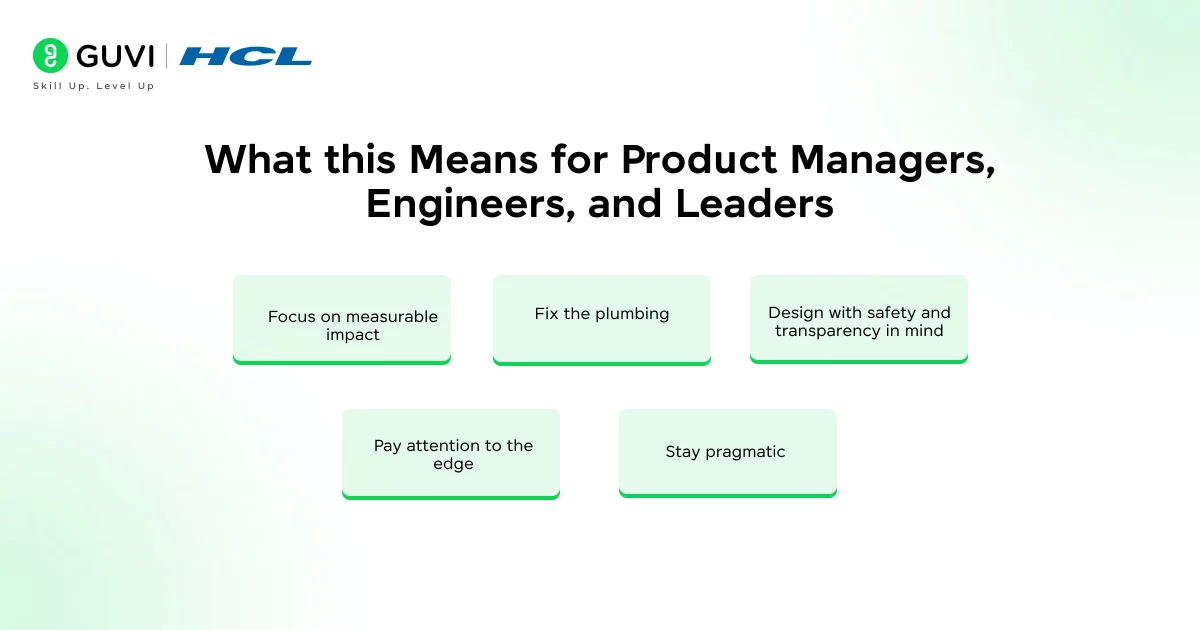
If you’re steering a product or team right now, here’s the takeaway: 2026 is about execution, not experimentation. The shine of “AI-powered” isn’t enough anymore: people want to see results.
- Focus on measurable impact. Tie every AI feature to something that moves a real metric, revenue, retention, time saved, or errors reduced.
- Fix the plumbing. Strong data pipelines, versioning, monitoring, and model ops aren’t side projects. They’re the backbone that turns prototypes into products.
- Design with safety and transparency in mind. Build audit logs, rollback buttons, and explainability right into your workflows. It’s easier to do it now than retrofit later.
- Pay attention to the edge. Latency and compute costs can make or break your user experience: hybrid setups will matter more than fancy model names.
- Stay pragmatic. The winners won’t always have the biggest models; they’ll have the ones that deliver consistent value to a specific problem or audience.
Quick decision guide (if you only have 5 minutes)
Need the cheat sheet version? Here’s your gut check before your next AI meeting:
- If you’re evaluating vendors: Ask how their AI actually improves outcomes, and make them show monitoring dashboards, not just marketing slides.
- If you’re building: Start with a clear use case and pair your model with retrieval or domain data. Don’t over-engineer before you validate the value.
- If you’re hiring: Prioritize people who can ship and maintain, MLOps engineers and data specialists before adding more “AI researchers.”
- If you’re buying tools: Choose products with predictable pricing and strong governance baked in. AI surprises should be delightful, not on your invoice.
In short: measure real value, build trust, and stay grounded. That’s how you’ll actually win with AI in 2026.
Use of generative AI in enterprises jumped dramatically from 2023 to 2024, which is why the focus in 2026 is “how do we make it reliable?”
If you’re serious about mastering artificial intelligence and want to apply it in real-world scenarios, don’t miss the chance to enroll in HCL GUVI’s Intel & IITM Pravartak Certified Artificial Intelligence & Machine Learning course. Endorsed with Intel certification, this course adds a globally recognized credential to your resume, a powerful edge that sets you apart in the competitive AI job market.
Conclusion
If 2023 and 2024 were about exploration, 2026 is about accountability. The biggest wins this year won’t come from who adopts AI first, but from who implements it wisely. You don’t need the largest model or the flashiest features; you need reliable systems, good data, and clear guardrails.
Whether you’re a product manager trying to ship responsibly, an engineer fine-tuning performance, or a leader mapping strategy, the goal is the same: make AI an everyday advantage, not an uncontrolled experiment. The future isn’t just automated: it’s thoughtful, transparent, and built to last.
FAQs
1. What will be the biggest AI trend in 2026?
Agentic AI (i.e. AI agents that autonomously chain tasks) is expected to shift from demos to real product features.
2. Will 2026 be the year regulation catches up to AI?
Very likely. Companies and governments are already pushing for compliance, audits, and safe deployment practices.
3. Do bigger models always mean better results in 2026?
Not necessarily. Domain-specialized or hybrid models tailored to specific industries often outperform generic large models in accuracy and control.
4. How important is it to monitor AI once it’s in production?
Critical. Without monitoring, drift, bias, or failure modes go unnoticed, and that’s where reputational or regulatory damage happens.
5. Can small and medium businesses afford to use AI in 2026?
Yes. Expect more affordable, packaged AI features in SaaS tools, with predictable pricing and easy integration so SMBs can adopt without huge infrastructure.
Success Stories

About the Author
Lukesh S
A professional content writer who has experience in freelancing and now working as a Technical Content Writer at HCL GUVI having sound knowledge in Blog Writing and Creative Writing!
View all posts by Lukesh S
Connect with me @









Did you enjoy this article?