


Career Articles
Android Development Roadmap :10-Step Guide to Become an Android Developer
Network Engineer Roadmap: From Beginner to Expert
VLSI Roadmap: 11 Steps to Become a Successful VLSI Engineer
Azure Certification Roadmap 2026: 7 Best Certifications Beginners Must Know

Get In Touch For Details! Request More Information
How AI Is Changing Coding Interviews: What Candidates Should Expect in 2026
Feb 06, 2026 6 Min Read 860 Views
(Last Updated)
Have you thought about how coding interviews will happen over the next few years?
With Artificial Intelligence now being an integral part of technology hiring, coding interviews are about to experience one of the biggest changes ever. Traditional methods like whiteboard rounds, phone screenings, and long on-site interviews are slowly being replaced with smarter, faster, and more accurate AI-driven systems.
At the end of 2026, we will have an idea of how much of this Artificial Intelligence will affect developer job applications.
As technology advances, it is evident that the hiring process will change dramatically, and consequently, how job applicants prepare for their corresponding job offers will also change significantly because of the involvement of AI coding interviews. Therefore, we must prepare for an AI-first world where coding interviews will take place.
Quick answer:
AI is transforming coding interviews by automating resume screening, generating personalized coding challenges, analyzing communication through video, and evaluating code quality with high accuracy. By 2026, candidates can expect adaptive assessments, instant scoring, strict plagiarism detection, and AI-driven behavior analysis.
Table of contents
- The Traditional Coding Interview: How It Used to Work
- AI Steps In: The Turning Point in Coding Interviews
- AI-Powered Resume Screening – Faster, Smarter, Fairer
- AI-Assisted Coding Problems - Smarter Tests
- AI-Driven Behavioral & Communication Assessments
- Automated Interview Scheduling & Coordination
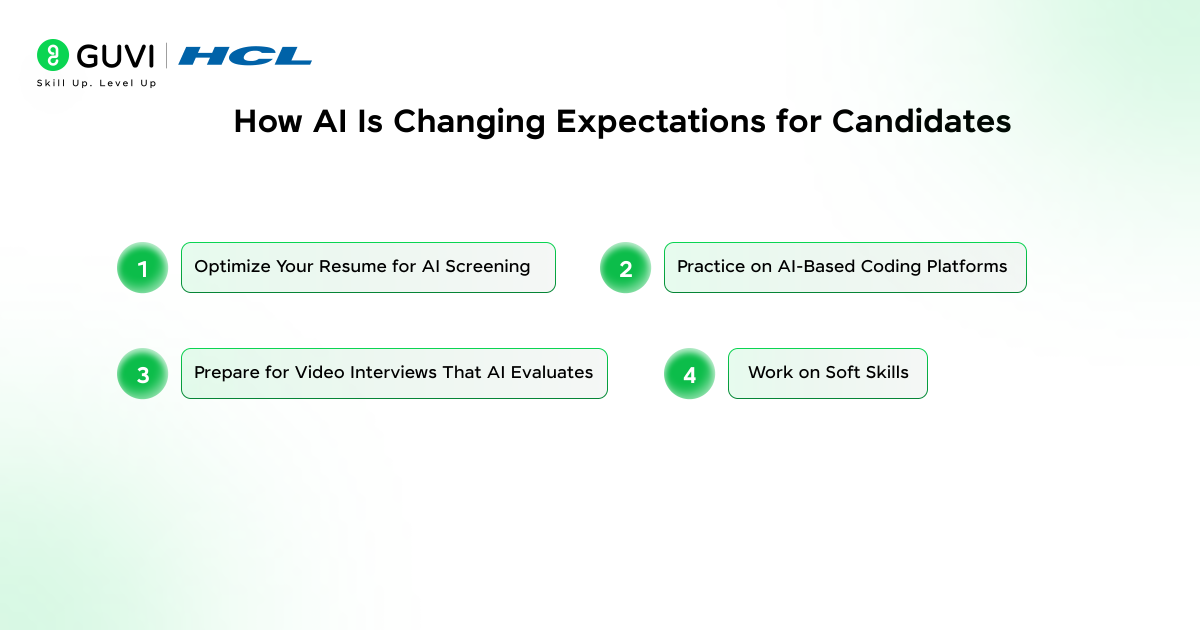
- How AI Is Changing Expectations for Candidates
- Optimize Your Resume for AI Screening
- Practice on AI-Based Coding Platforms
- Prepare for Video Interviews That AI Evaluates
- Work on Soft Skills
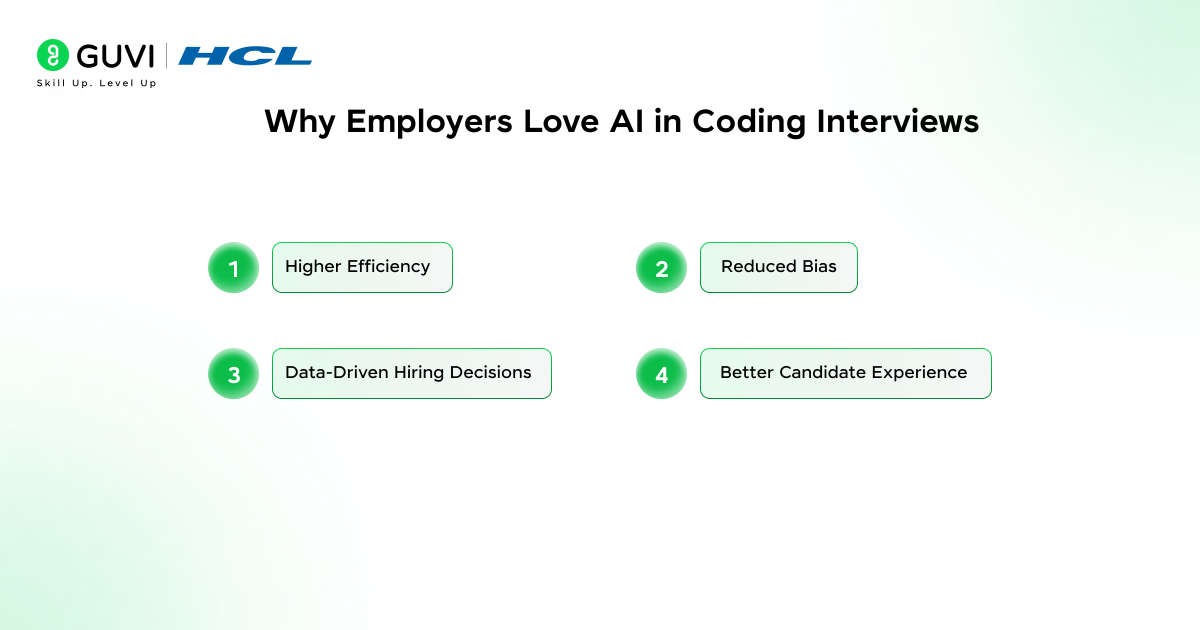
- Why Employers Love AI in Coding Interviews
- Higher Efficiency
- Reduced Bias
- Data-Driven Hiring Decisions
- Better Candidate Experience
- Challenges & Ethical Questions Around AI Interviews
- Privacy Concerns
- Over-Reliance on AI
- Candidates Trying to Outsmart AI
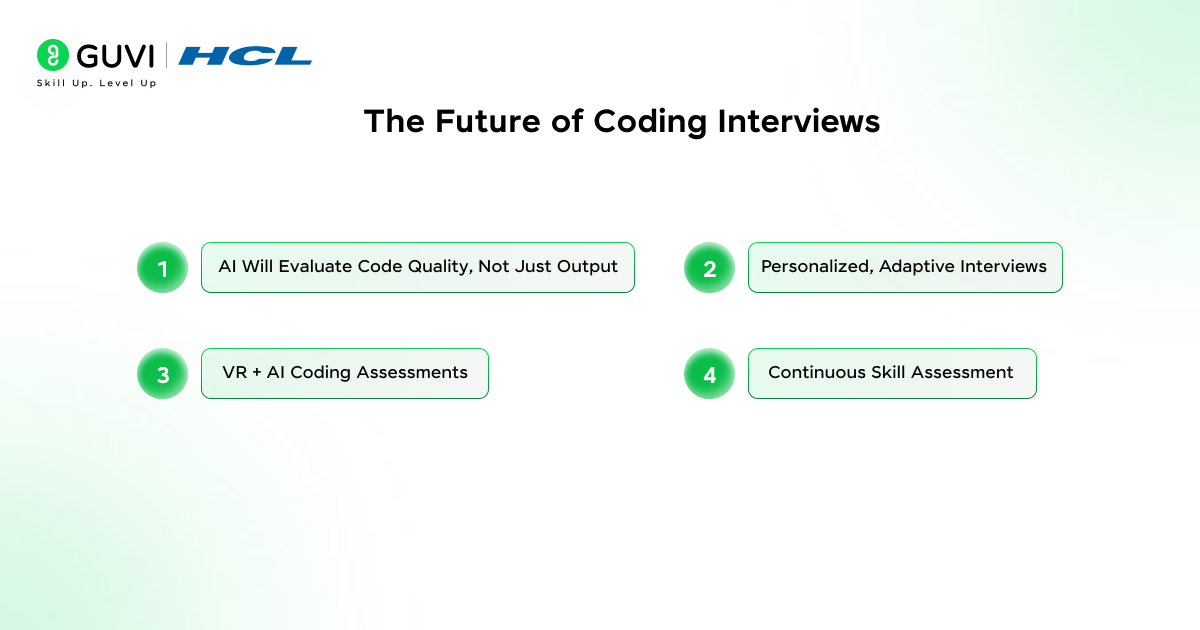
- The Future of Coding Interviews: What 2026 and Beyond Will Look Like
- AI Will Evaluate Code Quality, Not Just Output
- Personalized, Adaptive Interviews
- VR + AI Coding Assessments
- Continuous Skill Assessment
- Getting Ready for AI-Driven Coding Interviews
- For Candidates
- For Employers
- Wrapping it up:
- FAQs
- How is AI used in coding interviews?
- What should candidates expect in an AI-based coding interview?
- Can AI detect copied or AI-generated code?
- How can I prepare for AI-driven coding interviews?
The Traditional Coding Interview: How It Used to Work
Before we learn how AI is changing it all, we can see how the coding interviews used to be or still are:
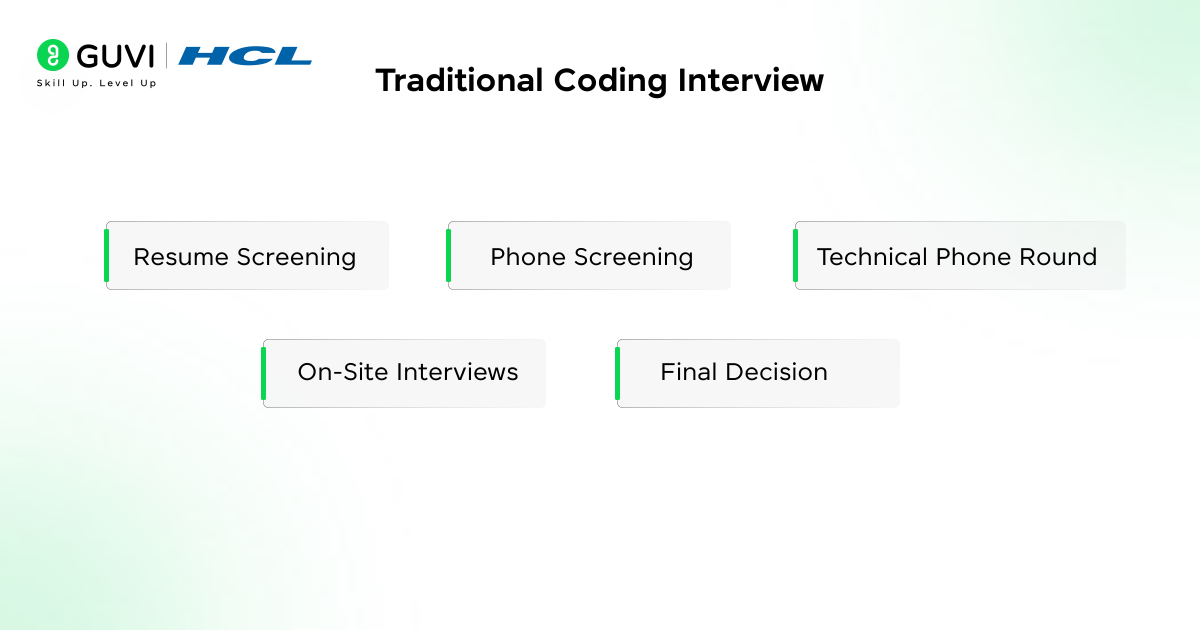
- Resume Screening: Human recruiters were checking the resumes manually and shortlisting the profiles.
- Phone Screening: A short chat to confirm the basic skills and communication.
- Technical Phone Round: Discussion of a coding issue or problem on the call.
- On-Site Interviews: Several sessions – whiteboard coding, system design, problem-solving discussions, and behavioral questions.
- Final Decision: The offer was made, and all the rounds were reviewed by the hiring panel.
This process has been decades old, and it was not flawless. It was tedious, and in many cases subjective and much relied on the experience of the interviewer. Most qualified candidates have been rejected through bias or nervousness, and occasionally good resumes have been overlooked.
Also read: AI Tools for Resume Building: Unlock ATS-Friendly Resumes
AI Steps In: The Turning Point in Coding Interviews
AI is transforming the entire process of hiring, and coding interviews are the biggest focus of the transformation. By 2027, nearly all technology firms will have a coding interview with AI as their first or second screening process.
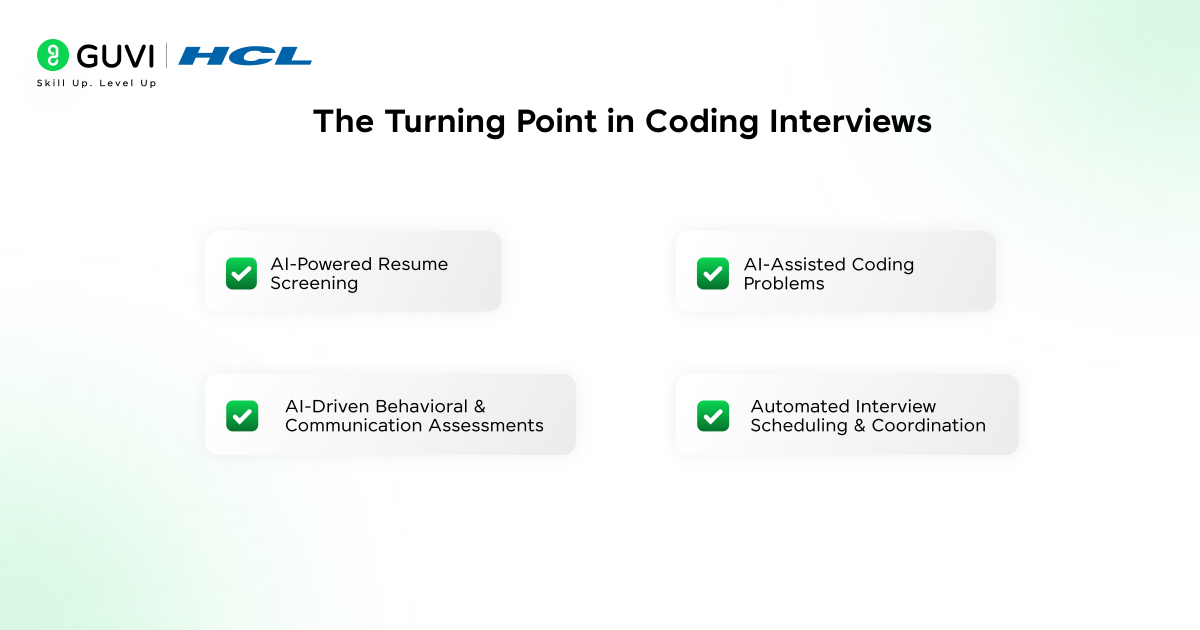
This is the way AI is transforming things- permanently and forever.
1. AI-Powered Resume Screening – Faster, Smarter, Fairer
Rather than have human beings go through hundreds of resumes manually, AI is now able to scan and shortlist candidates within a few seconds.
- These systems can:
- Know job-related keywords.
- Match skills to job requirements.
- Reduce human bias
- Automatic process of identifying strong candidates.
- Filter through huge pools of applicants.
Already it is being done by such a tool as Hiretual, Ideal, and LinkedIn Talent Insights.
This change implies that your resume needs to be reader-friendly with keywords, understandable, and readable by AI, particularly due to raising AI in code interviews.
Also read: Java Developer Resume Tips for 2026

2. AI-Assisted Coding Problems – Smarter Tests
AI is now being used to design, monitor, and examine coding tests on the platforms. It is among the largest shifts in the trend of AI coding interviews.
AI can now:
- Develop various coding questions to each applicant.
- Test the logic, efficiency, and style of coding.
- Copied or AI-generated answers.
- Provide instant scoring
- Monitor the behavior of problem-solving.
This provides a more balanced and profound assessment since AI does not simply ensure the code is working- it tries to evaluate how you got to the solution.
- AI in coding interviews can analyze over 70+ data points from your problem-solving process — all within just a few seconds.
- By 2026, nearly 80% of tech companies are expected to use AI-driven screening as a core part of their hiring process.
- AI tools can now detect AI-generated or copied code with more than 95% accuracy, ensuring fair evaluations.
- Some advanced AI interview platforms track typing patterns, hesitation time, debugging behavior, and even your problem-solving flow to understand how you think.
3. AI-Driven Behavioral & Communication Assessments
AI is not just analyzing technical competency. In most businesses, machine learning algorithms are used to study your video interview.
These systems can study:
- Communication clarity
- Confidence level
- Tone of voice
- Micro-expressions
- Overall engagement
- Syntactic consistency of responses.
Such methods are already employed by such tools as HireVue, and by 2026, it will become widespread among big firms.
4. Automated Interview Scheduling & Coordination
AI-based scheduling agents will handle:
- Interview time slots
- Rescheduling
- Sending reminders
- Basic questions to the candidates.
- Status updating the applications.
This will facilitate the process of the interview and will also save time, which is a huge win-win to both the employees and the HR departments.
Also read: Best Full-Stack Developer Resume Example 2026
How AI Is Changing Expectations for Candidates
With AI taking the centre stage in recruitment, this requires potential employees to change their preparatory style.
Here’s how to stay ahead:
1. Optimize Your Resume for AI Screening
To pass AI filters easily:
- Standard templates that are ATS-friendly.
- Write keywords that are relevant to the job.
- Focus on technical means, structures, and successes.
- Heavy graphics or tables should be avoided.
- Always make the format clean and simple.
- AI seeks clarity and relevance, not glitzy designs.
2. Practice on AI-Based Coding Platforms
The majority of AI coding interview tools consider:
- Code readability
- Complexity
- Efficiency
- Error handling
- Real-time typing behavior
Practice on such platforms as:
3. Prepare for Video Interviews That AI Evaluates
In one of the video rounds, AI will watch your communication style.
Important tips:
- Adequate lighting, background is clean.
- Look directly into the camera.
- Speak at a steady pace
- Avoid long pauses
- Keep answers structured
- AI adores clarity, confidence and uniformity
4. Work on Soft Skills
With AI replacing the technical screening, companies are paying more attention to:
- Teamwork
- Problem-solving process
- Communication
- Adaptability
- Cultural fit
Develop these skills because the human rounds that follow AI screening will focus heavily on them.
Also read: Top AI Interview Preparation Tips to Land Your Dream Job (2026 Guide)
Why Employers Love AI in Coding Interviews
AI not only helps the candidates, but it also eliminates a lot of recruiting problems that businesses have.
1. Higher Efficiency
Hiring time is cut drastically with AI.
Companies can:
- Screen applicants faster
- Evaluate more candidates
- Profiling talent correctly.
- Eliminate intersectionality during interviews.
2. Reduced Bias
AI systems rate all people to the same standards.
This brings:
- More fairness
- Reduced the impact of personal opinion.
- Unbiased opportunities for various candidates.
3. Data-Driven Hiring Decisions
AI gathers a lot of information, such as:
- Coding patterns
- Problem-solving behavior
- Performance trends
- Soft-skill indicators
This aids employers in making better decisions that are long-term.
4. Better Candidate Experience
AI generates more seamless recruitment by:
- Providing fast updates
- Reducing long wait times
- Giving structured feedback
- Maintaining the transparency of the process.
- Issues and Moral Concerns of AI Interviews.
We at HCL GUVI have built a free Resume Builder Tool featuring top recommended templates aligned with industry standards, all curated by leading recruiters. This tool can help you easily clear the initial screening stage.
Challenges & Ethical Questions Around AI Interviews
On the one hand, AI is impressive; on the other hand, it is not flawless. Companies have to be mindful of a number of issues.
1. Algorithmic Bias
- When artificial intelligence is trained on biased or imbalanced data, it can become biased toward a specific background, level of education or demographic.
- Even when the past patterns of hiring were discriminatory, AI might do the same.
- It is necessary to check AI algorithms by companies regularly so that no decisions could be unjust and biased.
- Application of diverse and representative training data is useful in cutting unfair scoring.
- Final hiring decisions have to involve human interaction to ensure there is fairness and context.
2. Privacy Concerns
- AI interview technologies tend to gather behavioral information such as typing speed, eye movement and hesitation interval.
- Artificial intelligence based on videos can examine facial expressions, bodily gestures, and emotional responses.
- The voice analysis software can assess tone, pace, accent, and clearness of the speech, and this brings up privacy concerns.
- Corporations need to remain open in terms of the information gathered and its purpose.
- When processing or storing candidate data, organizations should adhere to privacy regulations, including GDPR.
- Handling of data should be secured to stop the misuse or breach of sensitive data.
3. Over-Reliance on AI
- AI is not able to fully comprehend human aspects such as creativity, the ability to work as a team or motivation.
- Excessive reliance on AI can make firms ignore outstanding candidates who do not match the algorithmic models.
- The initial screening and skill assessment of prospective employees should be done through AI.
- Human interviews are yet needed to comprehend personality, communication style and cultural fit.
- A combination of AI knowledge and human judgments will result in a more precise and balanced hiring process.
4. Candidates Trying to Outsmart AI
- Other candidates can provide scripted or rehearsed responses that are meant to fit AI scoring patterns.
- AI code in tools such as ChatGPT or Copilot can be abused in a coding test.
- Candidates may also exhibit unnatural facial expressions and speaking style in a bid to manipulate AI behavior scores.
- Businesses apply new detection applications to detect AI-written codes and suspicious typing activity.
- Having a variety of question formats, such as coding and explanations, and debugging tests will decrease the attempts of cheating.
- The multi-layered evaluation will be used so that the final decision will not be made on manipulating the system, but on actual talent.
The Future of Coding Interviews: What 2026 and Beyond Will Look Like
The transition to AI-driven systems of coding interviews is not the end, and the coming several years will usher in further updated practices on developer evaluation.
1. AI Will Evaluate Code Quality, Not Just Output
- The coming AI tools will analyze whether your code is maintainable, i.e. it is easy to read, comprehend, and edit.
- Scalability will be tested to determine whether your code is capable of processing increased inputs and growth.
- AI will review architecture choices to understand how well you structure your solution and apply design principles.
- The pattern of coding (consistency, naming conventions, and logic flow) will be assessed to determine the professionalism in coding.
- The behavior of real-time debugging will be tracked to observe the effectiveness with which you detect and correct the errors during the process of coding.
2. Personalized, Adaptive Interviews
- AI will also design a personalized interview process where each candidate is asked different questions, rather than having the same questions applied to all candidates.
- The challenge of the interview will be heightened or lowered depending on the performance in previous tasks.
- Based on your strengths and weaknesses, the system can change the type of questions, such as of algorithms to debugging.
- This subjective method provides the companies with a better idea of the actual level of skills of a candidate.
3. VR + AI Coding Assessments
- Virtual Reality worlds can play the programming scenarios of the real world, and therefore, interviewing becomes more viable and interactive.
- The candidates can cooperate with the virtual team members to check their skills of teamwork and communication.
- The system design work could be accomplished in a 3D space, and the candidates would be able to map out architecture and workflow visually.
- These VR tests provide businesses with a better image of how developers would operate under real-life conditions.
4. Continuous Skill Assessment
- AI can be used to monitor the activity on GitHub, where changes in consistency of building projects, open-source participation, and improvement can be identified and followed by candidates.
- The development of online courses and code learning would be assessable to know the growth attitude of a candidate.
- The effort in making open-source projects will facilitate the creation of AI to assess the reality in the field of coding experience (not just interview tests).
- A skill profile in the long term could be generated through practical code analytics, such as style of coding, commit history and problem-solving habits.
Getting Ready for AI-Driven Coding Interviews
For Candidates
- Keep improving AI values consistency, so regular practice helps build a strong skill pattern.
- Build a visible online presence through GitHub, LinkedIn, or project portfolios.
- Practice with AI-based coding tools to get used to automated scoring and feedback.
- Improve communication skills, since AI evaluates clarity and structure in explanations.
- Stay open to new interview formats, as AI-driven assessments evolve quickly.
For Employers
- Use AI ethically and transparently to maintain trust and fairness in hiring.
- Combine AI results with human judgment for well-rounded decisions.
- Review AI processes regularly to remove bias and improve accuracy.
- Focus on practical skills, prioritizing real-world coding ability over theoretical knowledge.
Want to stand out in your next AI-driven coding interview? Boost your preparation with HCL GUVI’s Interview Mastery Course and unlock your career goals with confidence!
Wrapping it up:
AI is transforming coding interviews in ways that make hiring smarter, faster, and more focused on real talent.The introduction of AI technology brings with it new hurdles to clear, such as privacy concerns and being overly reliant on algorithms. However, it also provides the opportunity for more transparent and equitable evaluations of applicants.
As you prepare for your future, you will want to be open-minded, keep practicing regularly, and develop both your technical and communication skills to stand out during interviews using AI. Hiring is altering rapidly, but with an open mind and a commitment to preparation, you will be well-positioned to succeed by 2026 and well on into the future.
FAQs
1. How is AI used in coding interviews?
AI has many uses in the coding interview process. The primary applications of AI include resume screening, evaluating coding tests, analyzing communication, and scheduling interviews automatically.
2. What should candidates expect in an AI-based coding interview?
When going through an AI-driven coding interview, candidates should prepare for adaptive coding challenges, automated scoring, analysis of their behaviour, and real-time feedback.
3. Can AI detect copied or AI-generated code?
Yes, AI is capable of recognising plagiarised material, as well as identifying unusual typing behaviours or algorithms generated through artificial intelligence.
4. How can I prepare for AI-driven coding interviews?
Practice on AI-powered platforms, improve communication, and maintain clean, readable code.
Success Stories

About the Author
Vishalini Devarajan
An Aerospace Engineer turned content writer, I focus on making complex concepts easy to understand through well-structured, reader-friendly blogs. Whether it’s a technical topic or a non-technical one, I love creating content that is clear, engaging, and impactful.
View all posts by Vishalini Devarajan
Connect with me @











Did you enjoy this article?