


Data Structure Articles
Sliding Window Technique: Explained with Examples
Two Pointer Technique: Problems and Applications


Get In Touch For Details! Request More Information
DSA for System Design in 2026: Beginner’s Guide to Building Scalable Systems
Aug 23, 2026 8 Min Read 3467 Views
(Last Updated)
DSA is the vital backbone of programming that allows computers to analyze and process large amounts of data effectively. As the foundation of scalable system design and efficient coding, your understanding of DSA can significantly influence code performance and scalability.
In fact, selecting the right data structures for your specific needs is crucial for efficient coding and building scalable systems. Data structures offer a way to store and retrieve data effectively—an essential requirement for applications needing immediate data access, such as file systems and databases.
Therefore, this beginner’s guide aims to introduce you to the world of DSA for system design in a straightforward, accessible manner. Throughout this article, you’ll learn the basic concepts, understand their practical applications, and discover how to implement them effectively in your own projects. Let’s begin!
Quick Answer
DSA for system design means using data structures and algorithms to store, retrieve, and process data efficiently in scalable software systems. For beginners learning DSA for system design, the most important concepts are:
- Hash tables for fast lookups and caching
- Queues for request and task processing
- Trees for hierarchical and indexed data
- Graphs for networks and relationships
- Heaps for priority-based processing
- BFS and DFS for graph traversal
- Sorting and searching for efficient data processing
- Time and space complexity for evaluating scalability
Table of contents
- Why DSA for System Design?
- Role of DSA in building scalable systems
- How DSA for system design improves code performance
- Real-world impact of efficient algorithms
- DSA for System Design: Key Comparison Table
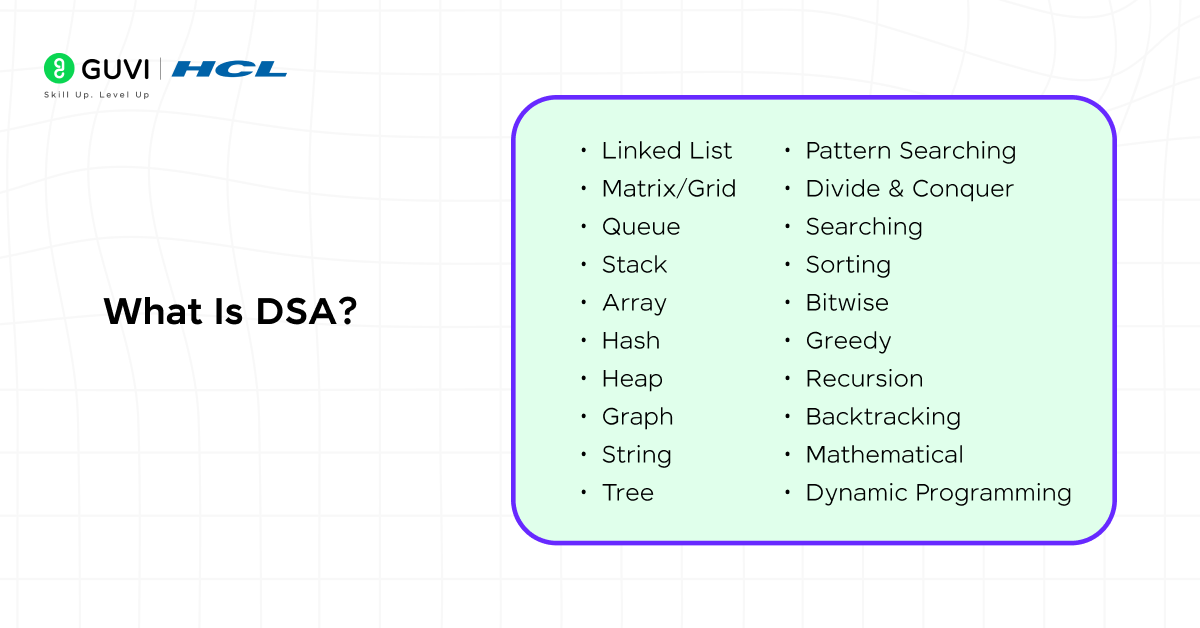
- Common Data Structures Every Beginner Should Know
- Arrays and Linked Lists
- Stacks and Queues
- Trees and Graphs
- Hash Tables and Heaps
- Essential Algorithms for System Design
- Sorting and Searching
- Graph traversal (BFS, DFS)
- Dynamic Programming
- Divide and Conquer techniques
- System Design Principles Using DSA
- Scalability and performance
- Fault tolerance and redundancy
- Caching and load balancing
- Microservices and modularity
- Best DSA Topics for System Design in India in 2026
- Steps to Apply DSA in Real-World System Design
- Define system requirements
- Choose the right data structures
- Select efficient algorithms
- Optimize for time and space
- Test and benchmark your system
- Concluding Thoughts…
- FAQs
- Is DSA required for system design?
- How much DSA is required for system design?
- Can I learn system design without DSA?
- Should I learn DSA or system design first?
- Which DSA topics are most important for system design?
Why DSA for System Design?
In the world of system design, data structures and algorithms (DSA) serve as the crucial foundation that determines how efficiently your software will function at scale. Understanding DSA isn’t just an academic exercise—it’s a practical necessity for anyone building systems that need to handle real-world demands.
1. Role of DSA in building scalable systems
- Scalability refers to a system’s ability to handle growing workloads without compromising performance. As applications expand from serving thousands to millions of users, the importance of efficient algorithms becomes increasingly apparent. Without proper DSA implementation, your system might function perfectly during testing but collapse when faced with production-level demands.
- Scalable systems require a thoughtful selection of data structures based on specific requirements. This selection ensures efficient data retrieval and storage, optimizing memory usage and reducing access times.
- For instance, a social media platform’s recommendation algorithm must scale gracefully as user numbers grow from thousands to millions—something only possible with properly implemented data structures like graphs and efficient algorithms.
- Additionally, DSA for system design helps in designing distributed systems where data is processed across multiple nodes. Algorithms like MapReduce enable efficient distribution and processing of data across these nodes, ensuring your system remains responsive even as demands increase.
2. How DSA for system design improves code performance
Performance optimization stands as one of the primary benefits of properly implemented DSA. Choosing the right algorithm for specific tasks can dramatically improve both efficiency and speed. Consider sorting a large dataset:
- Using Bubble Sort might take O(n²) time complexity—becoming impractical for large datasets
- Using QuickSort or MergeSort reduces time complexity to O(n log n)—making it much faster
Besides speed, DSA helps optimize resource utilization—particularly important in environments with limited resources such as mobile devices or embedded systems. Well-designed data structures and algorithms contribute to:
- Minimized memory overhead
- Faster computation times
- Reduced CPU cycles
- Enhanced overall system responsiveness
Moreover, DSA provides a systematic approach to problem-solving, resulting in more efficient and optimized solutions that improve the performance and reliability of your software applications.
3. Real-world impact of efficient algorithms
The practical applications of DSA in system design are vast and impactful across numerous domains. In search engines, hash tables enable web servers to store frequently requested webpages in cache, allowing for rapid delivery without regenerating entire pages. Similarly, social networks utilize graph data structures and traversal algorithms like breadth-first search to power friend recommendations and relationship mapping.
Furthermore, in time-sensitive applications like financial trading platforms, efficient algorithms provide a significant competitive advantage—platforms that execute trades more quickly using optimized algorithms can deliver superior services to clients.
Other notable real-world applications include:
- Auto-complete functionality in search engines using trie data structures
- Operating system task scheduling with priority queues
- GPS navigation systems implementing Dijkstra’s algorithm for route optimization
- Database systems using binary search for record retrieval
DSA for System Design: Key Comparison Table
Different data structures solve different system design problems. The right choice depends on how frequently data must be searched, inserted, updated, or prioritised.
| DSA Concept | Typical Performance | System Design Use | Example |
|---|---|---|---|
| Arrays | O(1) indexed access | Fast sequential data access | In-memory records |
| Hash Tables | O(1) average lookup | Caching and fast key-value retrieval | User session lookup |
| Queues | O(1) enqueue/dequeue | Asynchronous task processing | Request and job queues |
| Heaps | O(log n) insertion/deletion | Priority-based processing | Task schedulers |
| Trees | O(log n) in balanced trees | Ordered and hierarchical data | Database indexes |
| Graphs | O(V+E) traversal | Relationship and network modelling | Social networks |
| Tries | O(L) lookup | Prefix-based searching | Search autocomplete |
The comparison shows why DSA is important for system design. A data structure that works well for one access pattern may become inefficient when system requirements change.
Common Data Structures Every Beginner Should Know
Understanding fundamental data structures forms the bedrock of effective system design. These organizational tools determine how your application stores, accesses, and manipulates data—ultimately affecting everything from speed to scalability.
1. Arrays and Linked Lists
- Arrays and linked lists represent the most basic yet powerful ways to organize sequential data, albeit with different approaches.
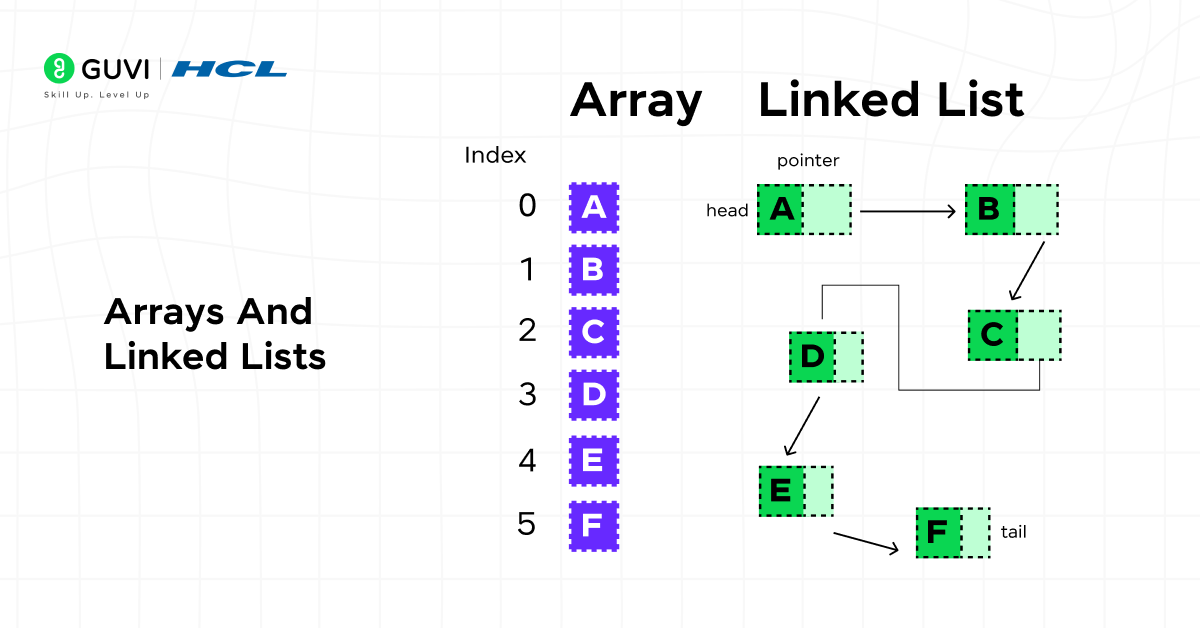
- Arrays store elements in contiguous memory locations, offering immediate O(1) access to any element using its index. This makes arrays perfect for situations requiring frequent random access. However, arrays come with limitations: they typically have fixed sizes, and inserting or removing elements in the middle requires shifting other elements, resulting in O(n) time complexity.
- In contrast, linked lists consist of nodes where each node contains data and a reference to the next node. Unlike arrays, linked lists can grow or shrink dynamically without memory reallocation. Their greatest strength lies in efficient insertion and deletion in the middle—operations that take just O(1) time if you have a pointer to the target position. Despite this advantage, linked lists sacrifice random access speed, requiring O(n) time to find the nth element.
- Choose arrays when you need fast lookups and have a stable data size. Opt for linked lists when you anticipate frequent insertions and deletions at various positions.
2. Stacks and Queues
Stacks and queues offer specialized ways to handle data access patterns common in system design.
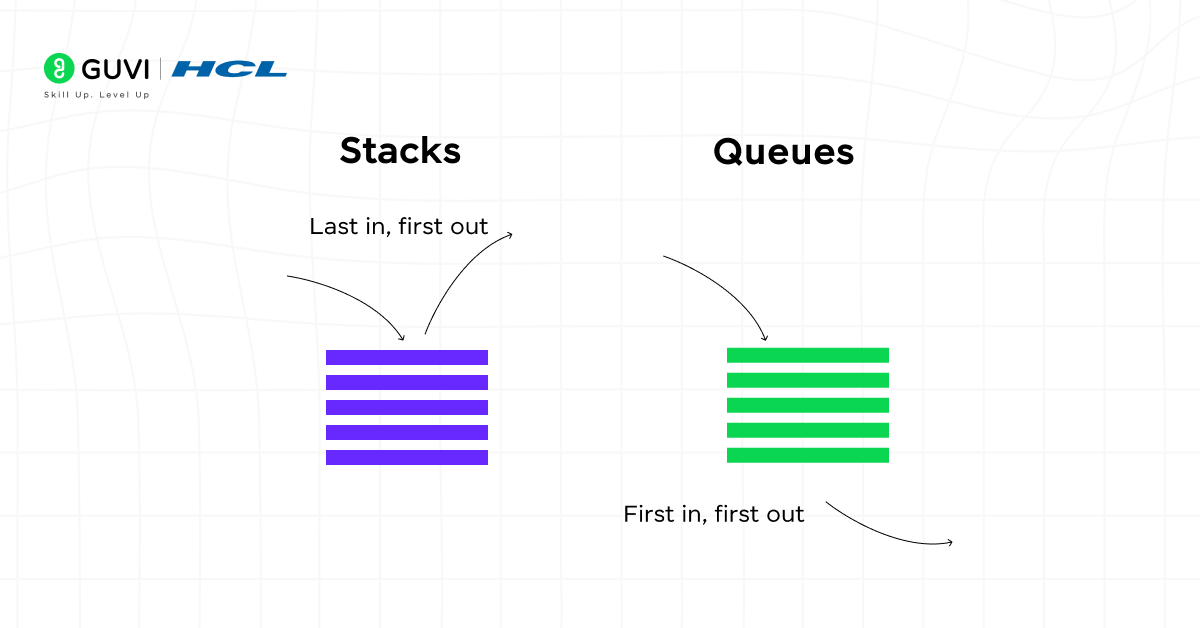
Stacks follow the Last-In-First-Out (LIFO) principle—like a stack of plates where you add and remove from the top. This simple structure proves remarkably useful for:
- Function call management in programming languages
- Implementing undo mechanisms in applications
- Syntax parsing in compilers
- Browser history navigation
Queues, meanwhile, implement the First-In-First-Out (FIFO) principle—similar to people waiting in line. Elements enter at the rear and exit from the front. Queues excel in:
- Task scheduling in operating systems
- Request handling in web servers
- Print job management
- Breadth-first search algorithms in graph traversal
Both structures support their core operations (push/pop for stacks, enqueue/dequeue for queues) in O(1) time, making them highly efficient for their specialized purposes.
3. Trees and Graphs
- Trees and graphs enable the representation of hierarchical and network relationships essential for complex system design.
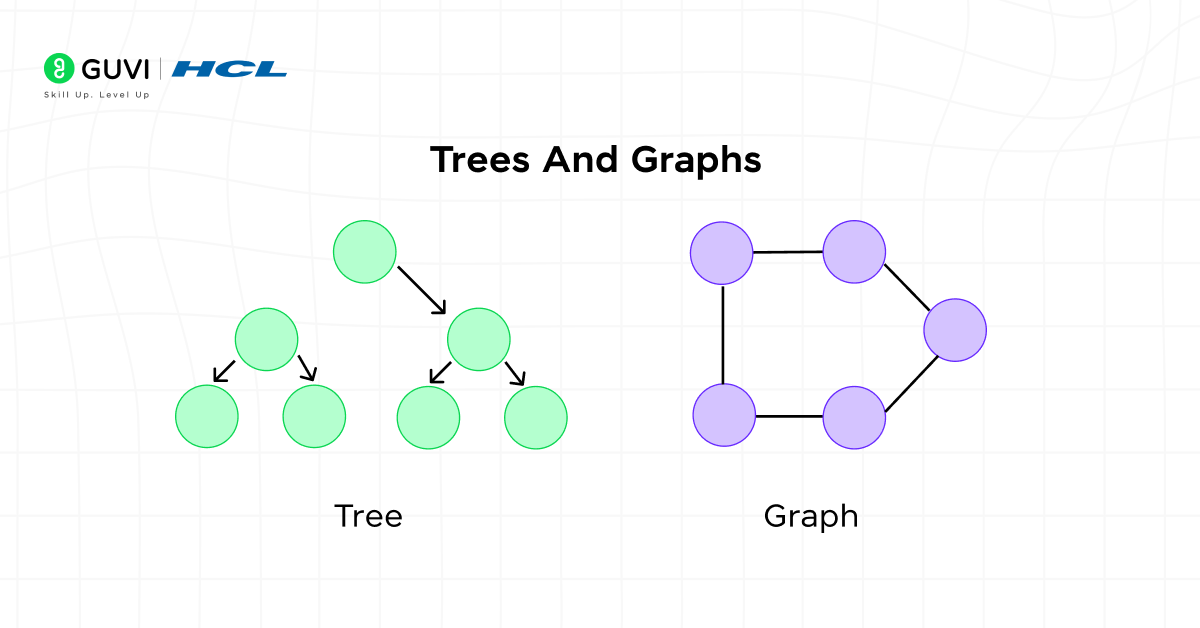
- Trees consist of nodes connected by edges in a hierarchical structure, starting with a root node at the top. Each node (except the root) has exactly one parent, creating a clear parent-child relationship. Trees efficiently organize hierarchical data like file systems, organizational charts, and XML/HTML documents.
- Graphs extend the tree concept by allowing multiple connections between nodes and potentially forming cycles. This flexibility makes graphs ideal for modeling complex relationships such as social networks, web page connections, or transportation systems. Graph algorithms like breadth-first search and depth-first search help navigate these structures efficiently.
- Both structures support various system design needs, from representing hierarchical data to modeling complex relationships between entities.
4. Hash Tables and Heaps
- Hash tables and heaps provide specialized functionality that dramatically improves system performance for specific operations.
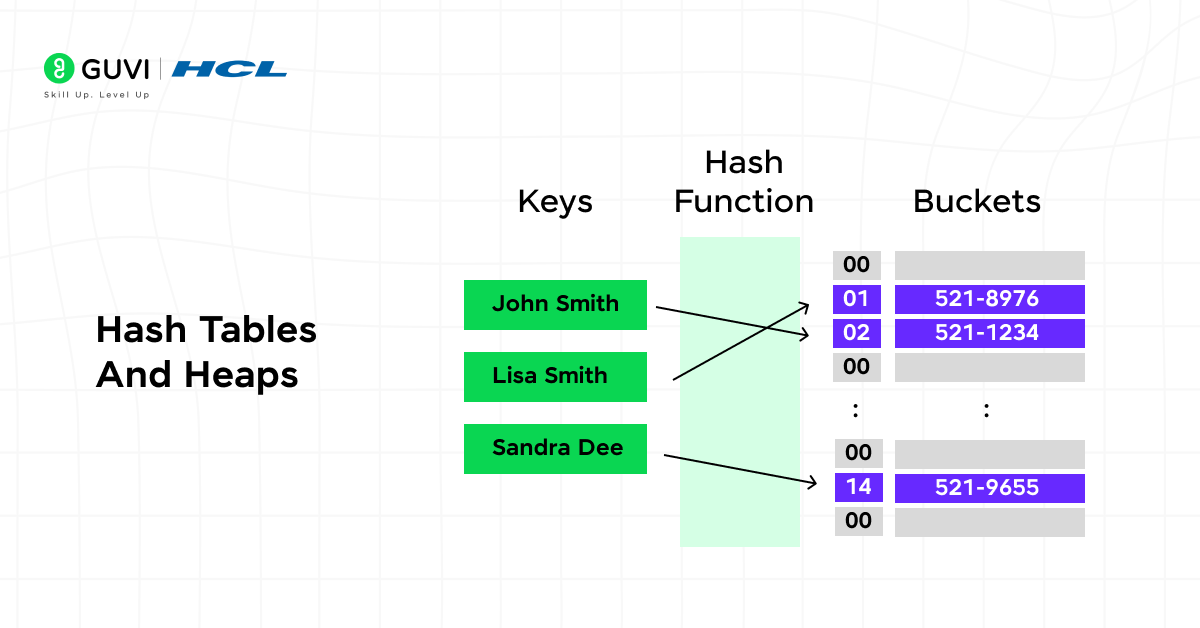
- Hash tables store key-value pairs, using a hash function to compute an index for fast data retrieval. They offer O(1) average-case performance for lookups, insertions, and deletions—regardless of whether your table contains thousands or billions of elements. This constant-time performance makes hash tables indispensable for implementing caches, dictionaries, and database indexes.
- Heaps are specialized tree-based structures that satisfy the heap property—in a max-heap, parent nodes are greater than or equal to their children; in a min-heap, parents are less than or equal to their children.
- This organization makes heaps perfect for priority queues, enabling efficient access to the highest or lowest priority element. Heaps support operations like insertion, deletion, and peeking in logarithmic time, making them ideal for task scheduling and sorting algorithms.
Understanding these fundamental data structures provides you with the essential building blocks needed for effective system design in 2026 and beyond.
Essential Algorithms for System Design
Beyond data structures, algorithms serve as the engines that power modern systems, enabling them to process data efficiently across various scales. Let’s explore the key algorithmic approaches essential for effective system design.
1. Sorting and Searching
Efficient sorting and searching form the cornerstone of data manipulation in system design. Sorting algorithms arrange elements in a specific order (ascending or descending), while searching algorithms help locate specific items within datasets.
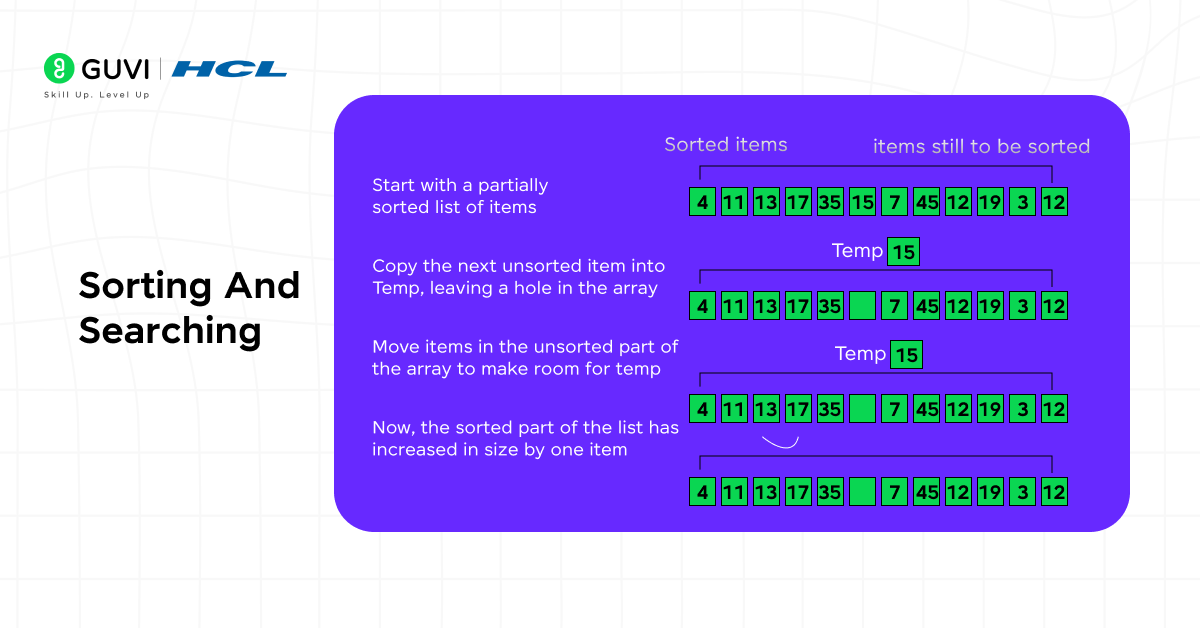
Popular sorting algorithms include:
- Quick Sort: Average time complexity of O(n log n) but potentially O(n²) in worst cases; works well for in-memory sorting
- Merge Sort: Guarantees O(n log n) performance regardless of input order; excellent for large datasets
- Heap Sort: O(n log n) time complexity with O(1) space efficiency, making it suitable for memory-constrained environments
For searching, Binary Search stands out with O(log n) complexity, making it significantly faster than linear search for large datasets. However, it requires the data to be presorted, highlighting how algorithms often work in tandem within systems.
2. Graph traversal (BFS, DFS)
Graph algorithms excel at solving relationship-based problems in system design. The two primary traversal techniques offer distinct advantages:
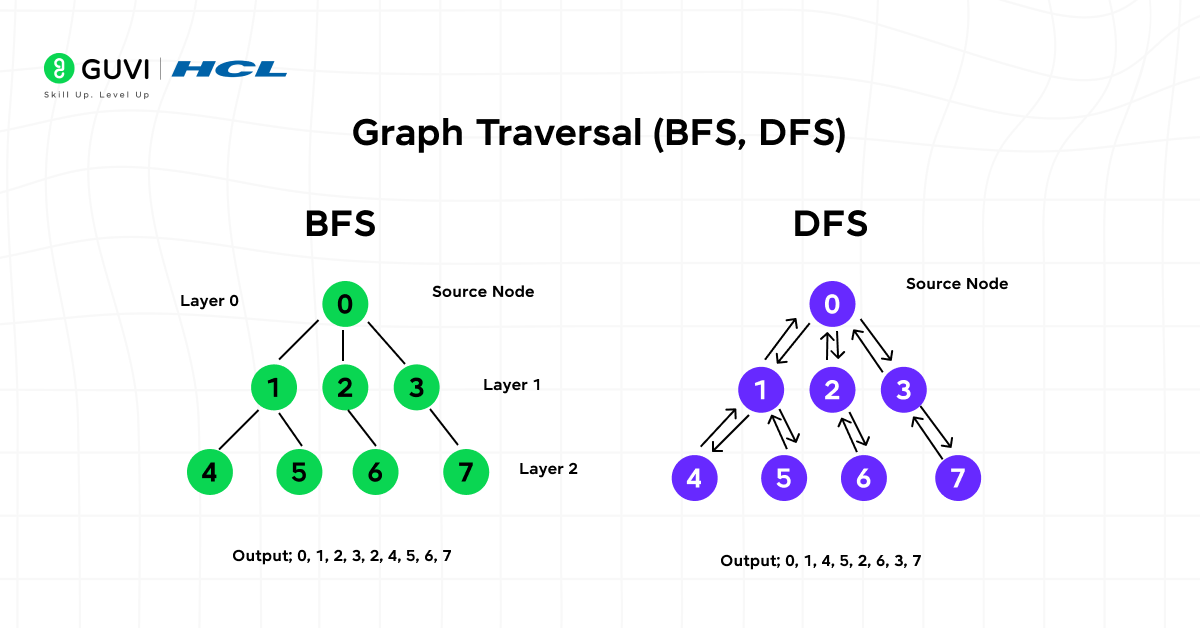
- Breadth-First Search (BFS) explores vertices level by level, visiting all neighbors before moving to the next level. It uses a queue data structure (FIFO) and excels at finding shortest paths in unweighted graphs. BFS proves invaluable for network routing, web crawling, and social network friend recommendations.
- Depth-First Search (DFS) dives deep into branches before backtracking, using a stack data structure (LIFO). This approach works exceptionally well for maze solving, cycle detection, and topological sorting in directed acyclic graphs. Both traversal methods have O(V+E) time complexity, where V represents vertices and E represents edges.
3. Dynamic Programming
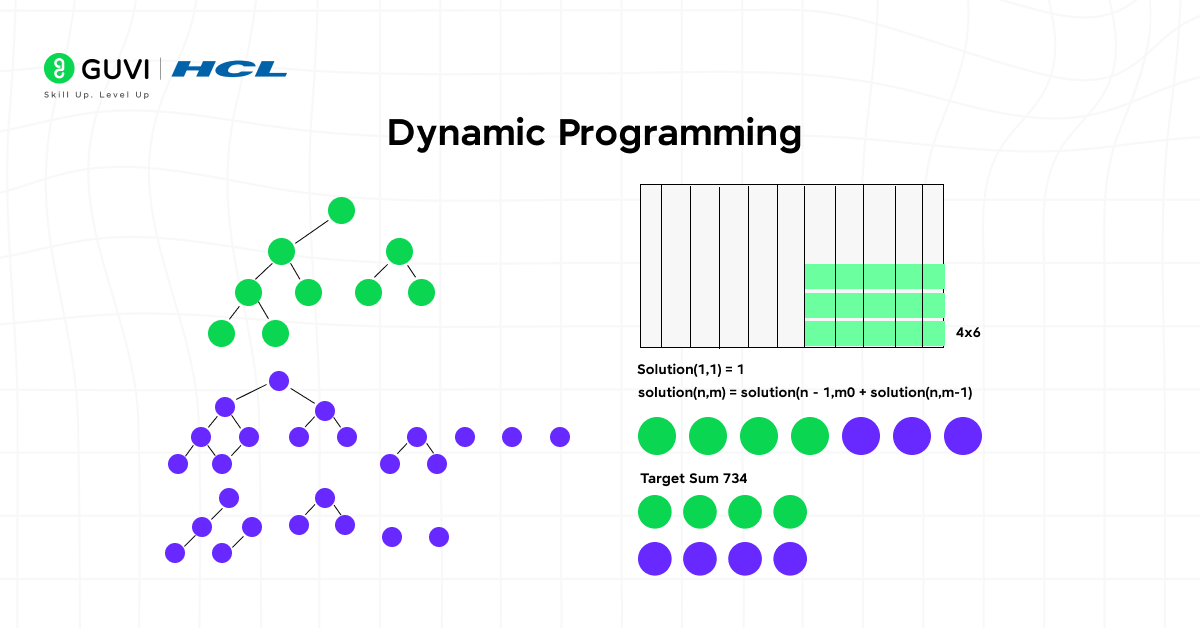
- Dynamic Programming (DP) solves complex problems by breaking them into overlapping subproblems. Initially, it identifies if a problem has optimal substructure (solutions to subproblems combine to solve the larger problem) and overlapping subproblems (same calculations performed repeatedly).
- DP offers two implementation approaches: top-down (memoization) and bottom-up (tabulation). Memoization uses recursion with stored results, while tabulation builds solutions iteratively from the bottom up. This technique proves especially valuable for optimization problems like resource allocation and path finding in system design.

4. Divide and Conquer techniques
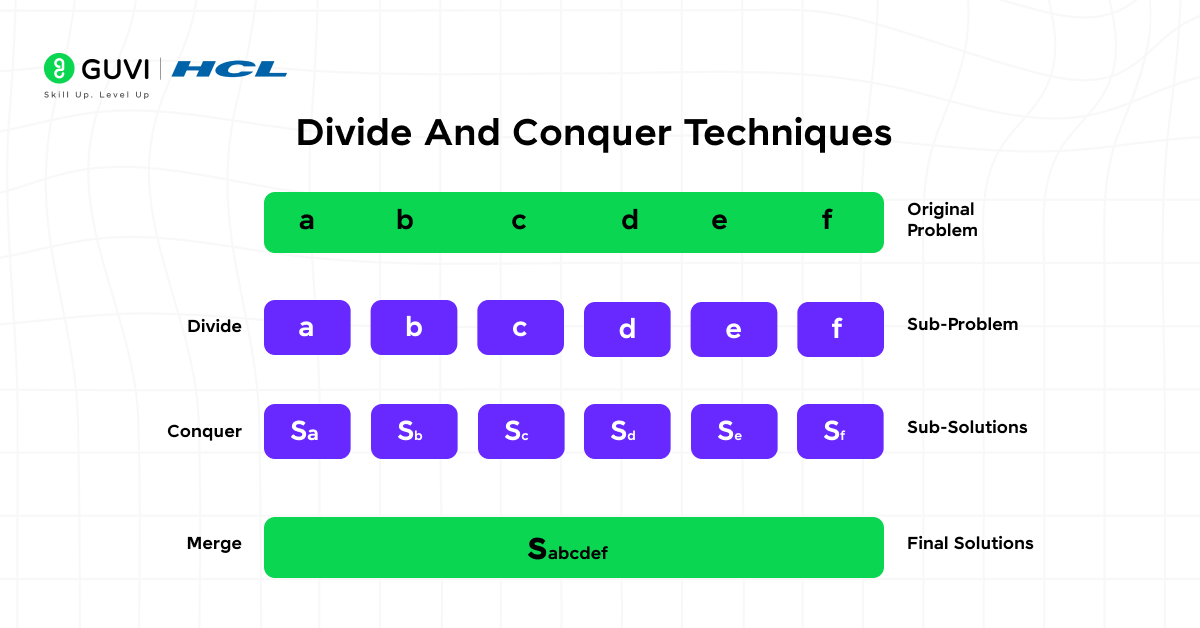
- Divide and Conquer algorithms solve problems by recursively breaking them into smaller, independent subproblems. This approach involves three steps: divide the problem, conquer subproblems independently, and combine their solutions.
- This strategy powers numerous efficient algorithms like merge sort, quicksort, and the fast Fourier transform. Essentially, it enables parallel processing opportunities since subproblems can be solved concurrently, though performance depends on factors like subproblem size equality and the computational complexity ratio between base cases and recursive operations.
System Design Principles Using DSA
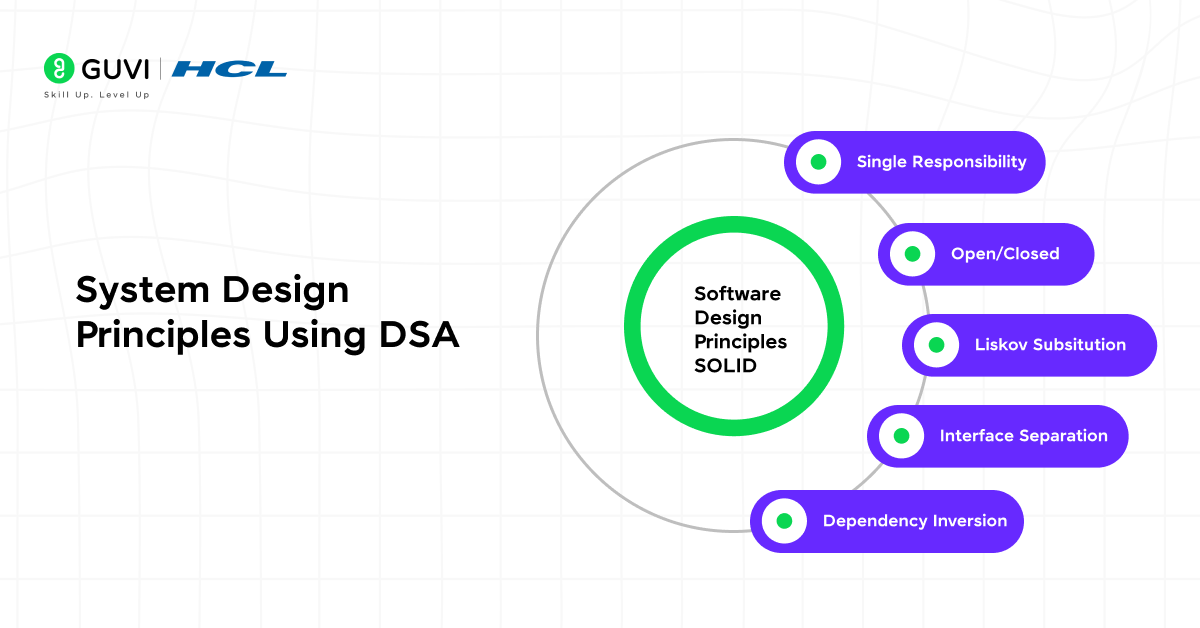
Applying data structures and algorithms effectively requires understanding key system design principles that govern how your solutions perform in real-world environments. These principles serve as practical guidelines for implementing DSA for system design concepts at scale.
1. Scalability and performance
Scalability determines how well your system handles increasing workloads without performance degradation. Two primary approaches exist:
- Vertical Scaling (Scaling Up): Adding more resources (CPU, memory) to a single machine. This approach is straightforward but has physical limitations.
- Horizontal Scaling (Scaling Out): Adding more machines to distribute workload. This is generally more flexible and cost-effective for large systems.
Your choice of data structures directly impacts scalability. For instance, hash tables provide efficient O(1) lookups regardless of data size, making them excellent for systems requiring rapid data retrieval. Alternatively, B-trees optimize database operations by minimizing disk I/O, enhancing performance for large datasets.
2. Fault tolerance and redundancy
Fault tolerance ensures your system continues functioning even when components fail. Given that component failures are inevitable in large-scale systems, robust design anticipates these failures.
Redundancy forms the foundation of fault-tolerant design through:
- Replication: Creating multiple copies of data or services across different nodes
- Failover Mechanisms: Automatically switching to standby systems when primaries fail
- Graceful Degradation: Continuing partial functionality rather than complete failure
Implementing these techniques often involves specialized data structures like distributed hash tables or consensus algorithms (Raft, Paxos) that ensure consistency across replicated systems.
3. Caching and load balancing
Caching stores frequently accessed data in high-speed storage. This reduces retrieval time and lowers the load on databases and backend services.
Effective caching strategies include:
- Client-Side Caching: Stores frequently used data in browsers or applications
- Server-Side Caching: Uses in-memory stores such as Redis or Memcached
- Content Delivery Networks: Stores content at edge locations closer to users
For a current 2026 technology reference, Redis Open Source 8.2.8 was released in July 2026 while Memcached 1.6.45 was released in July 2026.
Load balancing distributes incoming traffic across multiple servers. Common algorithms include Round Robin for distributing requests sequentially and Least Connections for directing traffic to servers with fewer active connections.
4. Microservices and modularity
Microservices architecture breaks applications into smaller, independent services that communicate over networks. Each microservice:
- Focuses on specific business functionality
- Can be developed and deployed independently
- Typically maintains its own database
This approach enhances system resilience as failures remain isolated to specific services rather than bringing down entire systems. Additionally, it allows different services to utilize the most appropriate data structures and algorithms for their specific needs.
The bulkhead pattern further isolates components, preventing cascade failures by creating boundaries between services—much like compartments in ships prevent total flooding when one section is breached.
To add a little intrigue to your DSA journey, here are a few interesting facts you might not know about the world of algorithms and system design:
The First Algorithm Was Written in the 1800s: Long before modern computers existed, Ada Lovelace—often regarded as the first computer programmer—wrote the world’s first algorithm in 1843 for Charles Babbage’s Analytical Engine.
Big O Notation Originated from Mathematics: The term “Big O” was introduced by German mathematician Paul Bachmann in 1894, long before it became a cornerstone concept in computer science for analyzing algorithm efficiency.
Google’s Success Is Built on an Algorithm: The foundation of Google’s search engine—the PageRank algorithm—was created by Larry Page and Sergey Brin as part of their PhD project at Stanford. It revolutionized how search engines ranked web pages.
These facts show how the principles of DSA have deep historical roots and continue to power some of the most advanced technologies we use today.
Best DSA Topics for System Design in India in 2026
Developers preparing for system design roles and technical interviews in India do not need every advanced algorithm at the beginning. Current 2026 interview preparation material continues to emphasise core structures such as arrays, hashing, trees, graphs, queues, and dynamic programming alongside system design fundamentals.
The best topics to prioritise are:
- Arrays and Strings: Build strong foundations for data manipulation.
- Hash Maps and Hashing: Understand caching, indexing, and fast lookups.
- Stacks and Queues: Learn request processing, scheduling, and buffering.
- Trees and Heaps: Understand indexing, hierarchical data, and priority queues.
- Graphs: Learn network modelling and relationship-based systems.
- BFS and DFS: Understand traversal and path-finding problems.
- Sorting and Searching: Improve data retrieval and processing.
- Dynamic Programming: Learn how to optimise problems with repeated subproblems.
- Time and Space Complexity: Evaluate whether a solution can scale.
- Consistent Hashing and Distributed Data Concepts: Connect DSA fundamentals with large-scale system design.
For beginners, the goal should be to understand why a particular data structure fits a system requirement rather than memorising algorithms without understanding their practical use.
Steps to Apply DSA in Real-World System Design
Putting data structures and algorithms into practice requires a systematic approach that bridges theoretical knowledge with real-world application. Following these five steps will help you implement DSA concepts effectively in your system design projects.
1. Define system requirements
Start by identifying all stakeholders involved in or impacted by the system. Categorize requirements into functional (what the system should do) and non-functional (how the system should perform) components. Accordingly, establish clear objectives and scope, outlining both the core functionalities and constraints like budget limitations and time restrictions.
2. Choose the right data structures
Select data structures based on the operations your system will frequently perform:
- Hash tables for constant-time lookups and insertions
- Trees for hierarchical data and ordered operations
- Graphs for relationship mapping
- Heaps for priority-based operations
3. Select efficient algorithms
Match algorithms to your specific problem domains. Consider sorting algorithms like QuickSort for in-memory operations or MergeSort for large datasets. For search functionality, evaluate whether linear, binary, or graph-based algorithms best fit your needs.
4. Optimize for time and space
Balance time and space complexity based on your constraints. Techniques include memoization to avoid redundant computations, in-place algorithms to reduce memory usage, and parallel processing for computationally intensive tasks.
5. Test and benchmark your system
Finally, evaluate performance through systematic testing. Measure execution time and memory consumption under various conditions to identify bottlenecks and subsequently refine your implementation.
Looking to bridge DSA with system-design thinking? The HCL GUVI DSA Using Python Course walks beginners through data structures and algorithms from the ground up, while sharpening problem-solving skills essential for scalable system architecture. It’s a strategic first step toward building robust, high-performance systems in 2026.
Concluding Thoughts…
Understanding data structures and algorithms proves essential for anyone venturing into system design. Throughout this guide, you’ve learned how DSA fundamentally shapes the scalability and performance of your applications. Therefore, mastering these concepts gives you the power to build systems that handle increasing workloads efficiently while maintaining optimal performance.
As you continue developing your DSA for system design skills, you’ll find yourself naturally thinking in terms of efficiency and scalability. Subsequently, this mindset will transform not just how you code, but how you approach problem-solving in general—an invaluable asset for any developer in 2026 and beyond.
FAQs
Is DSA required for system design?
Yes. DSA provides the foundation for making efficient decisions about data storage, retrieval, processing, and optimisation. System design involves broader concepts such as databases, caching, load balancing, APIs, and distributed systems. DSA helps determine how efficiently many of these components process and organise data.
How much DSA is required for system design?
You do not need to master every advanced algorithm before learning system design.
Start with arrays, hash tables, stacks, queues, trees, heaps, graphs, sorting, searching, BFS, DFS, and basic dynamic programming. You should also understand Big O notation and the time and space trade-offs of different approaches.
More advanced concepts can be added as you begin designing larger distributed systems.
Can I learn system design without DSA?
You can start learning basic system design concepts without mastering DSA. However, a working knowledge of DSA makes it much easier to understand performance and scalability trade-offs.
For example, system design may tell you that an application requires caching. DSA knowledge helps you understand how hashing enables efficient key-value retrieval inside that caching layer.
Learning the two subjects together can therefore make system design concepts easier to apply.
Should I learn DSA or system design first?
Beginners should usually learn basic DSA before moving deeply into system design.
Start with data structures, algorithms, Big O notation, and basic problem-solving. Once you understand how data is stored and processed efficiently, move into databases, caching, APIs, load balancing, scalability, and distributed systems.
You do not need to finish every DSA topic before beginning system design. The two skills can be developed together after the fundamentals are clear.
Which DSA topics are most important for system design?
The most important DSA topics for system design include:
Hashing and hash tables
1. Queues
2. Trees
3. Heaps
4. Graphs
5. BFS and DFS
6. Sorting and searching
7. Time and space complexity
Hash tables are particularly useful for caches and key-value lookups while queues are important for asynchronous processing. Graphs help represent complex relationships and trees are widely used for hierarchical and indexed data.
Success Stories

About the Author
Vaishali
I'm a seasoned writer with four years of experience across technical, non-technical, and just about every genre or niche you can imagine. Adaptable and curious, I enjoy exploring new topics and making information engaging and easy to understand. Fueled by a steady stream of tea, I approach each project with creativity, reliability, and genuine enthusiasm for storytelling.
View all posts by Vaishali
Connect with me @















Did you enjoy this article?