Apply Now Apply Now Apply Now
header_logo
Post thumbnail
DATA STRUCTURE

Arrays vs Linked Lists [2025 Guide]

By Jaishree Tomar

When deciding between arrays vs linked lists, you’re choosing between two fundamentally different data structures that each excel at specific operations. Arrays store elements in contiguous memory locations, allowing for O(1) constant-time access by index, while linked lists offer more flexibility with dynamic sizing and efficient insertions.

The difference between an array and a linked list becomes clear when examining their performance characteristics. Specifically, insertion at the beginning takes O(n) time for arrays but only O(1) for linked lists. 

When considering when to use arrays vs linked lists, your decision should depend on whether you need fast random access or frequent insertions and deletions. This guide will help you understand both data structures and arrays vs linked lists as well as choose the right one for your specific programming needs. Let’s get right to it!

Table of contents


  1. What is an Array?
    • 1) How arrays store data
    • 2) Fixed size and memory layout
    • 3) Accessing elements in arrays
  2. What is a Linked List?
    • 1) How linked lists store data
    • 2) Types of linked lists
    • 3) Accessing elements in linked lists
  3. Array vs Linked List: Key Differences
    • 1) Contiguous vs non-contiguous memory
    • 2) Static vs dynamic sizing
    • 3) Access and traversal speed
    • 4) Insertion and deletion complexity
    • 5) Memory overhead and efficiency
  4. Performance Comparison: Time and Space Complexity
    • 1) Array vs linked list time complexity
    • 2) Space complexity and memory usage
    • 3) Cache performance differences
  5. When to Use Arrays vs Linked Lists
    • 1) Use cases for arrays
    • 2) Use cases for linked lists
  6. Concluding Thoughts…
  7. FAQs
    • Q1. When should I choose an array over a linked list? 
    • Q2. What are the main advantages of linked lists over arrays? 
    • Q3. How do arrays and linked lists differ in terms of memory usage? 
    • Q4. Which data structure performs better for random access operations? 
    • Q5. How do insertion and deletion operations compare between arrays and linked lists? 

What is an Array?

An array stands as one of the oldest and most important data structures in computer programming, found in virtually every program. This linear collection of elements forms the foundation of many algorithms and applications. Unlike other data structures, arrays excel at providing predictable memory layouts and fast element access.

1) How arrays store data

  • Arrays store elements in contiguous memory locations, meaning all data is placed next to each other in memory. This fundamental characteristic allows arrays to efficiently exploit the addressing logic of computers. Think of an array as a row of boxes lined up side-by-side, each containing a value of the same type.
  • The memory organization begins with what’s called the “base address” or “foundation address” – the memory location of the first element. Furthermore, all elements in a standard array must be of the same data type, ensuring each element occupies the same amount of memory.
  • For example, an array of ten 32-bit integers might be stored at memory addresses 2000, 2004, 2008, and so on. Additionally, each subsequent element is positioned exactly 4 bytes (the size of an integer) after the previous one, creating a neat, orderly storage pattern.

2) Fixed size and memory layout

Most traditional arrays have a fixed size determined at creation time. Once allocated, this size cannot be changed dynamically without creating an entirely new array and copying the elements. This constraint exists because of how memory is allocated for arrays.

Arrays can be created in different ways depending on memory allocation:

  • Stack allocation: Local arrays created at compile time
  • Data/BSS segment allocation: Global or static arrays
  • Heap allocation: Dynamically created arrays using functions like malloc() or new

The fixed-size nature presents both advantages and challenges. On the positive side, it allows for efficient memory use with minimal overhead. Conversely, it requires programmers to know in advance how much space they’ll need, which isn’t always possible.

3) Accessing elements in arrays

  • The most powerful feature of arrays is their O(1) constant-time access regardless of the array’s size. This means you can retrieve any element directly without traversing through other elements first.
  • Arrays work on an index system starting from 0 to (n-1), where n represents the array’s size. To access the value at a specific position, the computer performs a simple arithmetic calculation:
    • > Address of element at index i = Base address + (i × size of one element)
    • For instance, if an array starts at memory address 108 and each integer takes 4 bytes, then the element at index 4 would be located at address 108 + (4 × 4) = 124. 
    • This calculation happens instantly, making arrays significantly faster for random access operations than linked lists, which require sequential traversal.
  • This efficient access method makes arrays particularly suitable for applications requiring frequent element retrieval by position. Nevertheless, as we’ll see when comparing arrays vs linked lists, this advantage comes with trade-offs in other operations.

What is a Linked List?

Unlike their array counterparts, linked lists offer a completely different approach to storing sequential data in memory. A linked list is a linear data structure consisting of a sequence of elements where each element points to the next one. This fundamental difference from arrays creates unique advantages for specific programming scenarios.

MDN

1) How linked lists store data

Linked lists store data through a collection of separate units called nodes. Each node contains two key components:

  • Data: The actual value or information stored (such as integers, characters, or complex objects)
  • Pointer(s): A reference to the memory address of another node

The first node in a linked list is called the head, which serves as the starting point for accessing the entire structure. The final node typically points to null, indicating the end of the list.

One significant advantage of linked lists over arrays is that nodes don’t require contiguous memory allocation. 

Essentially, the computer can store each node wherever free memory exists, rather than needing a single uninterrupted block of memory. This non-contiguous storage enables more flexible memory utilization, primarily because adding or removing nodes doesn’t require shifting other elements.

2) Types of linked lists

Several types of linked lists exist, each designed for specific use cases:

  1. Singly Linked List: The simplest type, where each node contains data and a single pointer to the next node. The list can only be traversed in one direction (forward).
  2. Doubly Linked List: Contains pointers to both the next and previous nodes, allowing bidirectional traversal. This additional pointer makes operations like backward traversal possible at the cost of extra memory usage.
  3. Circular Linked List: A variation where the last node points back to the first node instead of null, creating a circular structure. This design allows for continuous traversal without reaching an end.
  4. Circular Doubly Linked List: Combines features of both doubly linked and circular lists, with the last node pointing to the first and the first node pointing to the last.
  5. Multilevel Linked List: An advanced structure with hierarchical relationships, where nodes contain a child pointer to a sub-list in addition to the next pointer.

3) Accessing elements in linked lists

  • In contrast to arrays, linked lists don’t support direct access to elements by index. To reach a specific element, you must start at the head and follow the chain of pointers until you arrive at your target node.
  • For example, to access the fifth node, you would:
    1. Begin at the head node
    2. Follow the next pointer to the second node
    3. Continue this process until reaching the fifth node
  • This sequential access pattern results in O(n) time complexity for finding elements. As a result, linked lists are less efficient than arrays for random access operations but excel in scenarios requiring frequent insertions or deletions.
  • The traversal process follows a consistent pattern:

current = head

while current is not null:

    process current.data

    current = current.next

  • This algorithm forms the foundation for many linked list operations, including searching, counting, and modification tasks.

Overall, linked lists represent a trade-off between flexible memory usage and access speed when compared to arrays. Your choice between these data structures should depend on your specific needs regarding memory allocation, insertion frequency, and access patterns.

Array vs Linked List: Key Differences

The fundamental differences between arrays and linked lists explain why each excels in different scenarios. Understanding these contrasts helps you choose the right data structure for your specific programming needs.

1) Contiguous vs non-contiguous memory

  • Arrays utilize contiguous memory allocation, storing all elements in adjacent memory locations. This arrangement enables efficient memory addressing through simple arithmetic calculations. Consequently, the computer can quickly locate any element by knowing the starting memory address.
  • Linked lists employ non-contiguous memory allocation where each node can reside anywhere in memory, connected only through pointers. This scattered approach allows nodes to be placed wherever free memory exists, offering more flexibility but at the cost of organization.

2) Static vs dynamic sizing

  • Arrays generally have a fixed size determined at initialization. Once created, changing an array’s size typically requires creating an entirely new array and copying all elements, making resizing operations expensive. Even with dynamic arrays (like ArrayList in Java), resizing involves deallocating the entire memory block and allocating a larger chunk.
  • Linked lists offer truly dynamic sizing as they allocate memory node-by-node. This flexibility allows linked lists to grow or shrink naturally during execution without requiring contiguous blocks of memory. Moreover, since each node is allocated individually, the structure only uses as much memory as needed at any given time.

3) Access and traversal speed

  • For arrays, accessing elements by index takes constant time O(1). This exceptional speed results from the simple arithmetic calculation: base address + (index × element size).
  • Linked lists require sequential traversal from the head node, following pointers until reaching the desired element. This traversal results in linear time complexity O(n) for access operations. Generally, accessing the last element means traversing the entire list, making random access operations significantly slower than with arrays.

4) Insertion and deletion complexity

  • With arrays, inserting or deleting an element (especially at the beginning or middle) requires shifting subsequent elements to maintain contiguity. This shifting results in O(n) time complexity for these operations.
  • In contrast, linked lists excel at insertions and deletions. Once you have a pointer to the insertion location, the operation only requires adjusting a few pointers, resulting in O(1) time complexity. This efficiency makes linked lists ideal for applications with frequent structural modifications.

5) Memory overhead and efficiency

  • Arrays offer superior memory efficiency with minimal overhead since they only store the actual data. Additionally, their contiguous nature improves cache performance, further enhancing speed.
  • Linked lists incur additional memory overhead for storing pointers alongside data. Each node requires extra memory for references, which can be substantial—a single integer in a linked list might require double or triple the memory compared to an array. Furthermore, this scattered memory arrangement often leads to poorer cache performance compared to arrays.
💡 Did You Know?

Here are a few fascinating facts that reveal the history and quirks behind these foundational data structures:

Arrays Date Back to the 1950s: The concept of arrays was introduced during the early days of programming languages like Fortran (1957), making them one of the oldest and most fundamental data structures in computer science.

Linked Lists Were Invented by Allen Newell and Herbert Simon: The linked list structure was first implemented in 1956 as part of the Logic Theory Machine—one of the earliest AI programs—showcasing how flexible memory structures could support symbolic reasoning.

Arrays Are Cache-Friendly, Linked Lists Are Not: Due to their contiguous memory layout, arrays utilize CPU cache much more efficiently than linked lists, often making them faster in practice—even for operations where theory suggests otherwise.

Modern Languages Still Rely on Them: Despite decades of evolution in data structures, arrays and linked lists remain the backbone of complex structures like hash tables, stacks, queues, and dynamic arrays (like Python’s list and Java’s ArrayList).

These insights show how arrays and linked lists, though simple in design, continue to power the very foundations of modern computing.

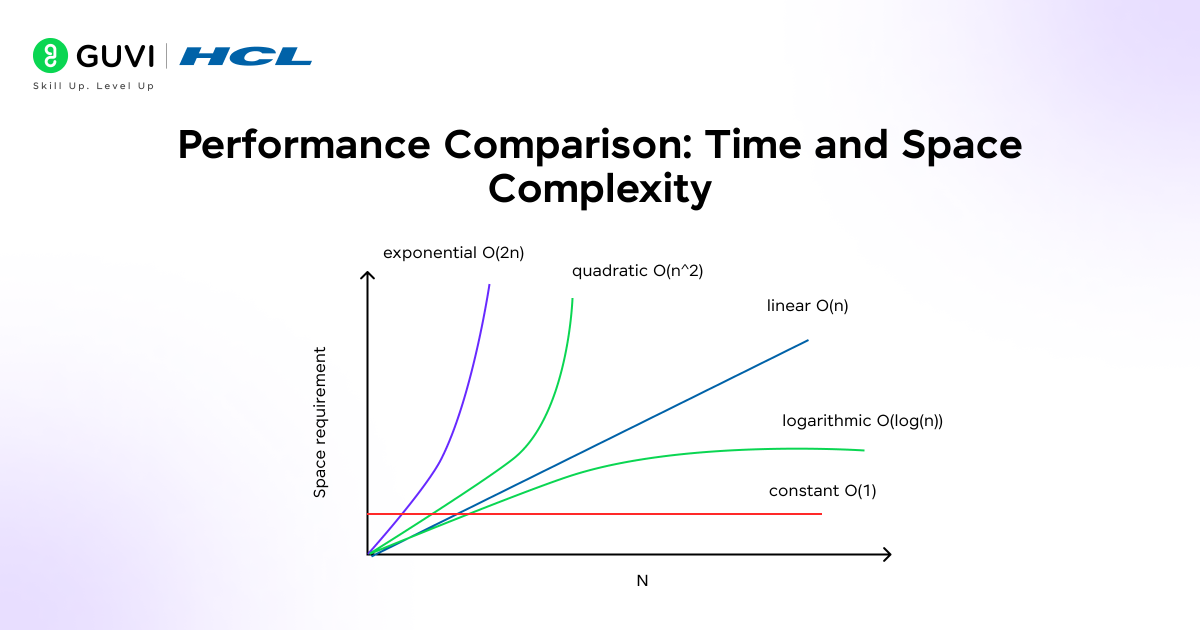
Performance Comparison: Time and Space Complexity

Performance metrics reveal crucial distinctions between arrays vs linked lists, helping you make informed implementation decisions. Let’s examine these differences through their time and space complexity characteristics.

1) Array vs linked list time complexity

Looking at operation speeds, arrays excel at certain tasks while linked lists shine in others:

OperationArrayLinked List
Access by IndexO(1) – Direct access using indexO(n) – Sequential traversal
Search (Unsorted)O(n) – Linear searchO(n) – Linear search
Search (Sorted)O(log n) – Binary search possibleO(n) – Must traverse sequentially
Insertion (Beginning)O(n) – Shifting elements requiredO(1) – Pointer adjustment
Insertion (Middle)O(n) – Elements must shiftO(n) – Traversal + pointer update
Insertion (End)O(1) (if space available) / O(n) if resizing neededO(1) – With tail pointer; otherwise O(n)
Deletion (Beginning)O(n) – Shifting requiredO(1) – Adjust head pointer
Deletion (Middle)O(n) – Shifting requiredO(n) – Traversal + pointer update

The primary speed advantage for arrays comes from direct memory addressing, whereas linked lists require sequential traversal to reach specific positions.

2) Space complexity and memory usage

Regarding memory utilization, several factors come into play:

  • First, arrays need contiguous memory blocks, meaning all elements must be stored together. Linked lists use non-contiguous allocation, allowing each node to exist anywhere in memory.
  • Second, linked lists require extra space for pointers, creating significant overhead. For instance, a singly linked list needs one pointer per node, while a doubly linked list requires two pointers per node. This additional memory can be substantial—potentially doubling or tripling the memory usage compared to an equivalent array.
  • Third, arrays may waste memory through unused capacity. If you create an array with 100 slots but only use 50, that extra space remains allocated. Conversely, linked lists allocate memory precisely as needed, growing and shrinking dynamically without wasted space.

3) Cache performance differences

Modern computers heavily rely on cache memory to improve performance, and memory layout significantly impacts cache efficiency:

  • Arrays benefit tremendously from their contiguous memory arrangement. When accessing an array element, the processor often loads not just that element but neighboring elements into cache memory. This prefetching mechanism means subsequent elements are already cache-ready, resulting in fewer cache misses and faster overall performance.
  • In contrast, linked list nodes exist at scattered memory locations, creating poor cache locality. Each node access potentially causes a cache miss, forcing the processor to fetch new memory blocks. The processor cannot predict where the next node will be located, making prefetching impossible.
  • Notably, for small data elements (under 32 bytes), array operations often outperform linked lists even for insertions and deletions, primarily due to superior cache performance. Only when working with larger elements do linked lists begin to show performance advantages for these operations.

When to Use Arrays vs Linked Lists

Selecting the right data structure fundamentally impacts your application’s performance. Now that you understand how arrays and linked lists work differently, let’s explore when to choose each option.

1) Use cases for arrays

Arrays shine in scenarios requiring:

  • Random access needs: When you need constant-time O(1) access to elements by their position
  • Fixed-size requirements: If you know the data size won’t change during execution
  • Cache-sensitive operations: Applications where memory locality and cache performance are critical
  • Mathematical operations: Particularly useful in linear algebra computations
  • Sorting algorithms: Many efficient sorting implementations work best with arrays

2) Use cases for linked lists

Linked lists excel in these situations:

  • Dynamic size requirements: When your collection needs to grow or shrink without reallocation
  • Frequent insertions/deletions: Applications requiring many additions or removals, especially at the beginning or middle
  • Implementation of other structures: Building stacks, queues, or certain types of trees
  • Memory management: Scenarios where you need to allocate memory precisely as needed
  • Circular patterns: Applications requiring continuous cycling through elements

Ready to master data structures for 2025? Dive into the DSA Using Python Course by HCL GUVI and build your foundation in Python-based algorithms, boost your coding problem-solving with hands-on platform access, and get globally recognized certification that elevates your resume. 

Concluding Thoughts…

Understanding the differences between arrays and linked lists empowers you to make better programming decisions. Arrays offer exceptional random access performance and memory efficiency, though their fixed size presents limitations. Meanwhile, linked lists excel at dynamic sizing and efficient insertions but sacrifice direct access capability.

Ultimately, neither arrays nor linked lists work as a universal solution. The best data structure depends entirely on your application’s unique needs and performance priorities. Armed with this knowledge, you can now confidently select the optimal structure for each programming task, whether building a simple application or designing complex algorithms. Good Luck!

FAQs

Q1. When should I choose an array over a linked list? 

Arrays are preferable when you need fast random access to elements, have a fixed-size data set, or require cache-efficient operations. They’re ideal for scenarios like image processing, spreadsheets, and database indexing, where quick element retrieval by index is crucial.

Q2. What are the main advantages of linked lists over arrays? 

Linked lists excel in situations requiring frequent insertions and deletions, especially at the beginning or middle of the list. They offer dynamic sizing without reallocation and are efficient for implementing other data structures like stacks and queues. Linked lists are also useful in scenarios where memory needs to be allocated precisely as needed.

Q3. How do arrays and linked lists differ in terms of memory usage? 

Arrays use contiguous memory blocks and require less memory per element. However, they may waste space with unused capacity. Linked lists use non-contiguous memory allocation, allowing for more flexible memory usage, but they require additional memory for storing pointers, which can increase overall memory consumption.

Q4. Which data structure performs better for random access operations? 

Arrays significantly outperform linked lists for random access operations. Arrays offer O(1) constant-time access to elements by index, while linked lists require O(n) linear time for accessing elements, as they need to traverse the list sequentially from the beginning.

MDN

Q5. How do insertion and deletion operations compare between arrays and linked lists? 

Linked lists generally perform better for insertions and deletions, especially at the beginning or middle of the structure. These operations typically have O(1) time complexity in linked lists, as they only require adjusting a few pointers. In contrast, arrays often need O(n) time for these operations due to the necessity of shifting elements to maintain contiguity.

Success Stories

Did you enjoy this article?

Schedule 1:1 free counselling

Similar Articles

Loading...
Get in Touch
Chat on Whatsapp
Request Callback
Share logo Copy link
Table of contents Table of contents
Table of contents Articles
Close button

  1. What is an Array?
    • 1) How arrays store data
    • 2) Fixed size and memory layout
    • 3) Accessing elements in arrays
  2. What is a Linked List?
    • 1) How linked lists store data
    • 2) Types of linked lists
    • 3) Accessing elements in linked lists
  3. Array vs Linked List: Key Differences
    • 1) Contiguous vs non-contiguous memory
    • 2) Static vs dynamic sizing
    • 3) Access and traversal speed
    • 4) Insertion and deletion complexity
    • 5) Memory overhead and efficiency
  4. Performance Comparison: Time and Space Complexity
    • 1) Array vs linked list time complexity
    • 2) Space complexity and memory usage
    • 3) Cache performance differences
  5. When to Use Arrays vs Linked Lists
    • 1) Use cases for arrays
    • 2) Use cases for linked lists
  6. Concluding Thoughts…
  7. FAQs
    • Q1. When should I choose an array over a linked list? 
    • Q2. What are the main advantages of linked lists over arrays? 
    • Q3. How do arrays and linked lists differ in terms of memory usage? 
    • Q4. Which data structure performs better for random access operations? 
    • Q5. How do insertion and deletion operations compare between arrays and linked lists?