


Data Structure Articles
Sliding Window Technique: Explained with Examples
Two Pointer Technique: Problems and Applications


Get In Touch For Details! Request More Information
Difference Between Algorithm and Program: With Examples (2026)
Aug 19, 2026 8 Min Read 2986 Views
(Last Updated)
Most of us who are into software development or programming think there is little difference between algorithm and program, or even that they are equivalent. Yes, they are in relation to each other, but that doesn’t mean they are similar. An algorithm is always written or designed to focus on what to do, while a program is executed to perform a specific set of tasks using code and computer instructions.
Think of an algorithm as an abstraction and a program as a tool that implements the algorithm using a specific programming language (Java, Python, C++, or JavaScript).
However, the differences between these two are not limited to just two or three points; they go beyond that, and in this blog, we are going to explore each of them. So, let’s get started.
Quick Answer:
An algorithm is a simple, step-by-step method written in plain language that explains how to solve a problem. At the same time, a program is the actual code written in programming languages like JavaScript, Python, C++, or Java that a computer can run to produce the final result.
The first high-level programming language, Fortran (1957), allowed developers to turn algorithms into real programs more easily, speeding up scientific computing.
Table of contents
- Difference between Algorithm and Program Through an Example
- Example:
- Algorithm =>
- Program =>
- Algorithm vs Program: Key Differences at a Glance
- Key Differences Between Algorithm and Program
- Purpose
- Language
- Execution
- Dependency
- Flexibility
- Output
- Errors
- Use
- Efficiency
- Portability
- Algorithm vs Program vs Code vs Software: What's the Difference?
- Example:
- Difference Between Algorithm and Program: Making Tea as a Real-Life Example
- Algorithm Interview Questions for Freshers
- Conclusion
- FAQs
- Why do we need an algorithm before writing a program?
- Can one algorithm be used to make programs in different languages?
- How are an algorithm and a program connected?
Difference between Algorithm and Program Through an Example
An algorithm is a piece of code that consists of a sequence of steps for solving a problem or challenge as efficiently as possible. And remember that an algorithm doesn’t rely on a programming language; it can be represented in plain text, a flowchart, or pseudocode. Writing algorithms is flexible.
A program, on the other hand, is a collection of instructions that are coded using a programming language such as Java, C++, or Python. A program is created by translating the steps in an algorithm into code that the computer can understand to solve a particular problem. From performing simple mathematical computations like adding two numbers or finding the factorial of an integer to complex apps such as games, websites, or mobile platforms, all are examples of programs.
Take your tech career to the next level by joining HCL GUVI’s IITM Pravartak & MongoDB Certified AI Software Development Course. This program covers all the intricacies of software development & Gen AI, along with hands-on projects & flagship mentorship to help you build real-world solutions. Join us today, and our dedicated team will guide you through everything.
Example:
Problem Statement: Verify the voting eligibility of individuals. If an individual is 18 or older, they are eligible to vote; otherwise, they are not.
Now let’s design the solution by first writing a step-by-step algorithm and then implementing it in our code to get the desired output.
Note: For this particular example, we have used JavaScript (JS) as our primary programming language. You can use any language that you are comfortable with.
Algorithm =>
Steps to be followed:
- Start Program
- Take a number from the user (voter)
- Check if the number is greater than or equal to 18
- If yes, display “You are eligible to vote.”
- If no, display “You are not eligible to vote.”
- End Program
Program =>
function checkVotingEligibility(age) {
if (age >= 18) {
return “You are eligible to vote”;
}
else {
return “You are not eligible to vote”;
}
}
console.log(checkVotingEligibility(20)); // Output: You are eligible to vote
console.log(checkVotingEligibility(15)); // Output: You are not eligible to voteProgram Explanation:
- In this code example, we have created a function called checkVotingEligibility that checks voting eligibility based on age.
- The program starts by taking the voter’s age as an input parameter.
- When the age is entered into the function, then it goes through the conditional (if…else) statement. This condition then checks if the number is greater than or equal (>=) to 18.
- If it satisfies the condition, then the voter is eligible; if not, then they are not eligible to vote.
Uplift your coding skills by joining HCL GUVI’s comprehensive DSA course: DSA for Programmers
Algorithm vs Program: Key Differences at a Glance
Here’s the quick difference between Algorithm and Program, summed up across all 10 factors we just covered:
| Basis of Comparison | Algorithm | Program |
|---|---|---|
| Purpose | Explains the entire thought process for solving a problem | Converts that logic into actual, executable code |
| Language | Written in plain language, pseudocode, or flowcharts | Written strictly in a programming language like C++, Python, or JavaScript |
| Execution | Cannot be executed by a computer; meant for humans to understand | Can be executed by a computer to produce results |
| Dependency | Independent of any programming language | Dependent on the syntax and rules of the chosen language |
| Flexibility | Easy to modify since it’s just simple steps | Harder to modify; small changes can affect other parts of the code |
| Output | Only outlines what the output should be | Actually generates and displays the real output |
| Errors | Can only have logical errors | Can have syntax, runtime, and logical errors |
| Use | Used at the design stage to plan the solution | Used at the implementation stage to build the working solution |
| Efficiency | Efficiency can be judged on paper, before coding | Efficiency is known only after writing and running the code |
| Portability | Fully portable across any machine or platform | Often tied to a specific language, compiler, or OS |
Key Differences Between Algorithm and Program
We have listed below some of the key differences between an algorithm and a program based on eight different factors:
1. Purpose

An algorithm details the entire thought process of finding a solution to a problem. It breaks the problem into smaller, simpler parts. It is like a very detailed guide or roadmap leading you to the correct answer. Algorithms are comprehensible to any human being and do not require technical knowledge or coding skills, as they focus solely on the concept and logic, without providing computer instructions.
A program does precisely the opposite. It takes this logical plan and changes it into an actual, executable code. It converts the steps into a language a computer can understand. A program is what ultimately causes the machine to perform operations, calculations, or actions that result in the output.
2. Language

An algorithm is expressed in simple language, pseudocode, or flowcharts. It is not a formal composition. You merely outline the reasoning in a neat, comprehensible manner, concentrating on what is to be done rather than how the computer will do it. The main objective is to make it understandable to humans, not executable by machines.
Conversely, a program must be written according to the standards of a specific programming language, such as C++, Python, or JavaScript. Each line must strictly adhere to the rules, structure, symbols, and formatting so that the computer can correctly understand and execute it. If you violate the rules, the program won’t work.
3. Execution

An algorithm is not something a computer can execute, as it isn’t written in a form recognizable by a machine. It’s more like a manual that humans have to think through and grasp the solution from.
On the other hand, a program is something that can be executed. When you run the program, the computer breaks it down into instructions and executes them as specified by the code.
4. Dependency
An algorithm does not depend on any specific programming language. It can be written in any language you like, such as English, Hindi, pseudocode, or even a flowchart, and the logic will stay consistent. It is not dependent on syntax or technical rules.
A program is a feature of the language you choose to work with. The manner in which you write your instructions, the symbols you use, and the way you organize your code are the aspects that distinguish one programming language from another. The same thought has to be expressed differently in Java, Python, or C++ because each language has its own set of rules.
5. Flexibility

Because algorithms are written in simple steps, it is very easy to change one of them. If you want to change the logic, add new steps, or correct mistakes, you can do so in no time, without errors or technical problems.
The alteration of a program is not as simple as that of an algorithm. Even a tiny modification can have a ripple effect across different parts of the code, leading to errors. You’re required to update the code carefully and test it to ensure functionality is preserved.
6. Output

An algorithm only makes clear what the output is supposed to be. It does not actually generate the output. It is only a guide that shows the way the solution will be found.
When a program is executed, it yields the actual output. The program delivers what it is supposed to do on the machine and displays the precise result to you, whether a number, text, message, or any other form of output.
7. Errors

Algorithms may contain logical errors. Logical errors occur when the steps or thought process are wrong. Since algorithms are written in plain language, there can’t be any syntax or technical errors; errors can exist only in logical form.
There could be mainly three kinds of technical errors in a program. Syntax errors occur when coding rules are violated. Runtime errors occur while a program is running and are caused by unexpected input or internal issues. Logical errors occur when a program operates correctly but produces incorrect results because of faulty logic.
8. Use

An algorithm is used during the design stage. It helps you organize your thoughts, understand the problem correctly, and plan the correct steps before writing any code.
A program comes into the implementation stage. Once the logic is ready, the program compiles it into executable code that the computer can run. It becomes the real, working solution that users can actually interact with.
9. Efficiency

An algorithm lets you judge how good a solution is before writing any code. Just by looking at the steps, you can guess how fast it’ll run or how much memory it’ll need, even on large inputs. This helps you catch a slow approach early, before wasting time coding it.
A program’s real speed only shows up once it’s written and run. Things like the language, compiler, and hardware all affect performance. So the same algorithm coded by two different people can end up running at very different speeds.
10. Portability

An algorithm goes anywhere. Since it’s just an idea in plain words or simple steps, it doesn’t depend on any computer, OS, or software. You could explain it to someone on a laptop, a phone, or even on paper, and it would still make complete sense.

A program is often tied to a specific setup. It depends on the language and tools used to build it, and sometimes even the OS it was made for. A program built for Windows might not run on a Mac without some changes first.
Algorithm vs Program vs Code vs Software: What’s the Difference?
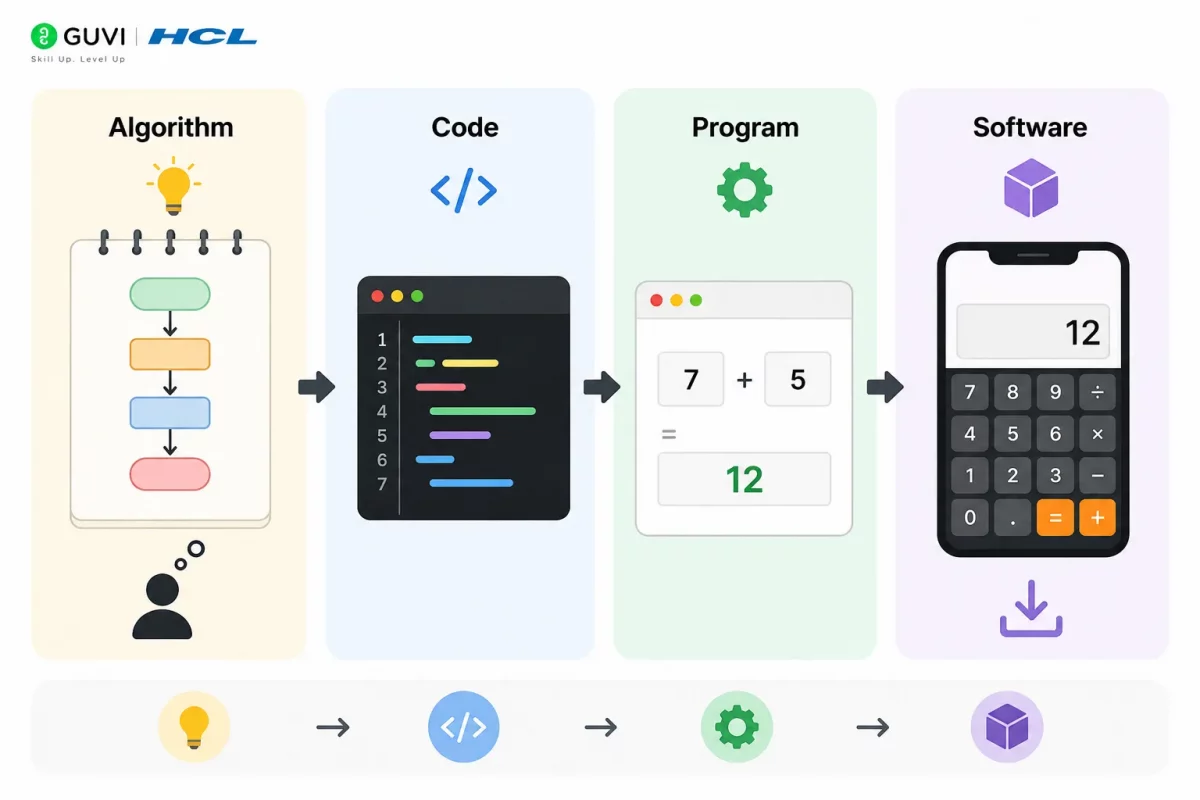
Algorithm — This is just the idea. The plan. The step-by-step thinking you do before touching a keyboard. It’s how you’d explain your solution to a friend on a piece of paper.
Program — This is the algorithm turned into instructions a computer can actually run. You’ve picked a language, written the logic properly, and now it executes.
Code — This is the actual text you type out, line by line, in that programming language. Code is basically the building blocks that make up a program. You could say a program is made of code, the way a house is made of bricks.
Software — This is the finished, usable product. It’s one or more programs bundled together, packaged, and made ready for someone to actually open and use, complete with things like a UI, features, and updates.
Example:
Say you want to build a calculator app.
- The algorithm is you working out on paper: “take two numbers, add them, show the result.”
- The code is the actual lines you write in Python or Java to make that addition happen.
- The program is that code once it runs and gives you the sum when you input two numbers.
- The software is the full calculator app itself, with buttons, a screen, and other features, ready for someone to download and use on their phone.
Still having doubts? Let’s make it super simple with something you do every single day.
Difference Between Algorithm and Program: Making Tea as a Real-Life Example
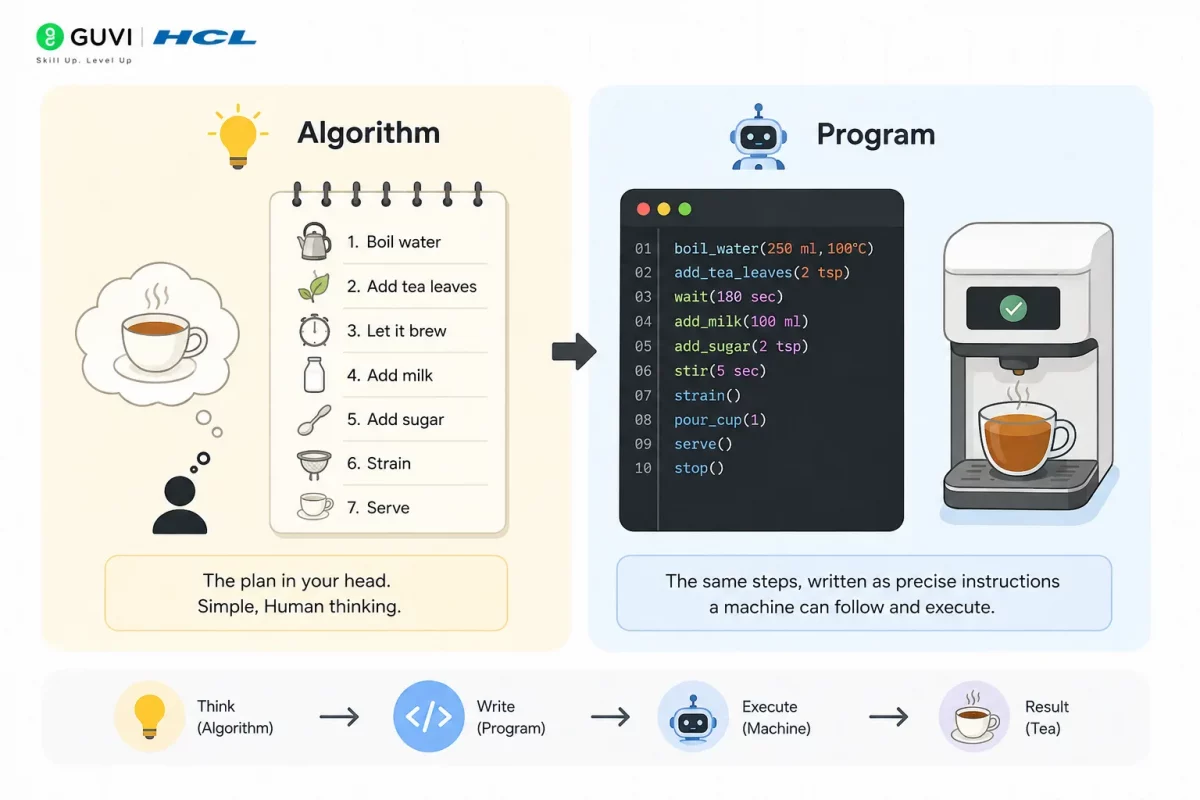
Think about how you make tea every morning. Before you even touch the stove, your brain already knows the steps: boil water, add tea leaves, let it brew, pour in milk, add sugar, strain it, and serve.
That entire thought process, the one running in your head, is the algorithm. Nobody needs to see you type it out or code it. You could say it out loud to your mom, your roommate, or write it on a sticky note, and it would still make complete sense.
________________________________________
Now imagine you had to teach a smart kitchen robot to make tea for you. You can’t just tell it “boil water” in plain English, because a machine doesn’t understand vague instructions like that.
You’d have to translate every single step into precise commands it understands — how many millilitres of water, what temperature, how many seconds to brew, when exactly to add milk. Once you write all of this out in a language the robot can follow, and it actually starts making tea on its own, that’s the program.
So the algorithm was just you thinking through the tea-making process in your head.
The program is that same thinking, converted into exact instructions, running for real and giving you an actual cup of tea. Same idea, two very different forms.
Algorithm Interview Questions for Freshers
Algorithm questions show up in almost every entry-level tech interview. Interviewers aren’t trying to trip you up; they just want to see if you can actually think through a problem instead of reciting something you memorised the night before.
Here are the ones that come up again and again, with answers that’ll actually help you, not just fill space.
1. What is an algorithm, in your own words?
Skip the textbook definition. Just explain it like you’re talking to a friend: it’s a clear set of steps to solve a problem, and those steps have to eventually stop and give you an answer. This is usually the opening question, and interviewers mainly want to hear that you get it, not that you’ve memorized a definition.
2. What makes an algorithm “good”?
A lot of freshers only talk about speed here, which is a mistake. A complete answer touches four things: the steps should be clear and unambiguous, it has to actually finish (terminate), it needs to solve the problem correctly, and it should use time and memory reasonably. Bringing up all four instead of just efficiency is what makes this answer stand out.
3. What’s the difference between an algorithm and a program?
You already know this one from earlier in the blog. Keep it short in an interview: the algorithm is the logic, the program is that logic written in code and made to run. This is a warm-up question, don’t overexplain it.
4. What is time complexity, and why does it matter?
It describes how the runtime of your solution grows as the input gets bigger, usually written using Big O, like O(n) or O(log n). Why it matters is simple: your code can run instantly on 10 items during testing and still crawl on 10 million items once it’s live. Time complexity is what catches that before it becomes a production problem.
5. What is space complexity?
Same idea, but for memory instead of time. Worth mentioning that there’s often a trade-off, sometimes you speed things up by using more memory, or save memory by accepting a slower runtime. Knowing that trade-off exists matters more than reciting a definition.
6. Write an algorithm to check if a number is prime.
This checks if you can actually think in steps, not whether you know a trick. Talk it through out loud: check if the number is less than 2, then try dividing it by every number up to its square root, and if nothing divides evenly, it’s prime. Saying “up to the square root” instead of “up to the number itself” is usually the detail that shows you actually understand it.
7. Write an algorithm to reverse a string or array.
Explain the logic before touching any code: swap the first and last elements, move inward, and keep going until you reach the middle. Jumping straight into code without explaining your thinking first almost always gets you stopped and asked to explain anyway, so just lead with the reasoning.
8. What is recursion? Give an example.
Plenty of freshers can define recursion but blank out when asked for an example on the spot. Keep it simple: it’s a function that calls itself to solve a smaller version of the same problem, until it hits a base case that stops it. Factorial and Fibonacci work fine, just make sure you can explain the base case too, since that’s usually the follow-up.
9. Linear search vs binary search, what’s actually different?
Linear search checks items one by one, so it works on any list, but it’s slow once the list gets big. Binary search is much faster, but it only works on a sorted list, since it keeps cutting the search space in half. People often forget to mention the “sorted” part, and interviewers are usually listening for exactly that.
10. Why not just write code that works and skip analyzing the algorithm?
Because code that works fine on a small test case can completely fall apart on real data if the approach behind it is inefficient. Catching that early saves you from rewriting everything later, after the product is already live and people are actually using it.
One real tip: interviewers care more about hearing you think out loud than about you getting the perfect answer instantly. If you get stuck, talk through what you’re considering instead of going silent, silence looks worse than a wrong guess.
Conclusion
In simple terms, an algorithm is a set of instructions that explains how to solve a problem step by step. At the same time, a program is the actual code written in a programming language like JavaScript, Python, C++, or Java that makes a computer follow those steps. An algorithm cannot run directly on a computer, but a program can be executed to produce real output. Both are connected, but an algorithm focuses on the logic, and a program focuses on converting that logic into a working solution.
FAQs
Why do we need an algorithm before writing a program?
An algorithm helps you plan the logic clearly so you don’t get confused while writing the actual code.
Can one algorithm be used to make programs in different languages?
Yes, the same algorithm can be implemented in JavaScript, Python, C++, or any other language, since the steps remain the same.
How are an algorithm and a program connected?
First, we create an algorithm to plan the solution, and then we convert those steps into a program that the computer can understand and execute.
Success Stories











Did you enjoy this article?