


Artificial Intelligence and Machine Learning Articles
Finance Manager to Data Analytics: Career Growth, Salary and Seniority
How to Evaluate LLM Outputs in Production Deployments
AI/ML Skills Gap 2026: Why Companies Can't Find Job-Ready Talent
20 AI/ML Interview Questions Recruiters Can Use Without a Tech Background - Best Guide


Get In Touch For Details! Request More Information

Dimensionality Reduction in Machine Learning: A Complete Guide (2026)
Sep 23, 2026 8 Min Read 3919 Views
(Last Updated)
Dimensionality reduction in machine learning has become a crucial technique you need to master as datasets grow increasingly complex. In 2024, John Hopfield and Geoffrey Hinton won the Nobel Prize for their groundbreaking work on neural networks, which revolutionized machine learning and contributed to advanced techniques like autoencoders.
When working with high-dimensional data, you’ll face significant challenges, including increased computational complexity, higher risks of overfitting, and difficulties in visualization. This is where dimensionality reduction techniques come into play, helping you preserve essential information while reducing the number of features.
Essentially, dimensionality reduction refers to the process of transforming your data into a lower-dimensional space while maintaining its core information. In this beginner-friendly guide, you’ll learn what dimensionality reduction is, why high-dimensional data poses problems, and how various techniques help transform your data into uncorrelated variables called principal components. Furthermore, we’ll explore practical applications and show you how to implement these concepts using Python. Let’s begin!
Table of contents
- AI Overview:
- What is Dimensionality Reduction in Machine Learning?
- Why high-dimensional data is a problem
- Feature selection vs feature extraction
- Dimensionality Reduction vs Feature Selection
- How dimensionality reduction helps
- Comparison of Dimensionality Reduction Techniques
- Top 5 Dimensionality Reduction Techniques Explained
- Principal Component Analysis (PCA)
- t-Distributed Stochastic Neighbor Embedding (t-SNE)
- Autoencoders
- Linear Discriminant Analysis (LDA)
- Kernel PCA
- How to Choose the Right Dimensionality Reduction Method
- 1) Understand your data type and structure
- 2) Decide between interpretability and performance
- 3) Consider scalability and computation time
- 4) Check if visualization is a goal
- 5) Avoid overfitting with fewer features
- 6) Use domain knowledge and iterate
- Real-World Applications of Dimensionality Reduction
- 1) Image and video processing
- 2) Natural language processing (NLP)
- 3) Genomics and bioinformatics
- 4) Finance and fraud detection
- 5) Healthcare and medical imaging
- 6) Recommender systems
- Python Implementation: A Simple PCA Example
- Step 1: Load and scale your data
- Step 2: Apply PCA using scikit-learn
- Step 3: Visualize the reduced data
- Step 4: Interpret the explained variance
- Concluding Thoughts…
- FAQs
- Q1. What is dimensionality reduction in machine learning and why is it important?
- Q2. How does PCA differ from LDA in dimensionality reduction?
- Q3. Can you implement PCA using Python?
- Q4. What are some real-world applications of dimensionality reduction?
- Q5. How do you choose the right dimensionality reduction method for your data?
- Q6. What are the main techniques of dimensionality reduction?
- Q7. Is PCA a dimensionality reduction technique?
AI Overview:
Dimensionality reduction in machine learning is the process of transforming high-dimensional data (many features) into a lower-dimensional representation while preserving the most important information
Key points:
- What it means: Reducing the number of input variables (features) in a dataset by removing redundant or irrelevant features or by creating new, compressed features.
- Why it’s used: To combat the “curse of dimensionality,” reduce computational cost, improve model generalization, and enable visualization of complex data.
- How it helps: By focusing on the most informative patterns, dimensionality reduction speeds up training, reduces overfitting, and can even improve accuracy.
- Common techniques: Principal Component Analysis (PCA), Linear Discriminant Analysis (LDA), t-SNE, UMAP, and autoencoders.
- When it’s useful: When you have many correlated features, limited samples relative to features, or need to visualize high-dimensional data in 2D/3D.
What is Dimensionality Reduction in Machine Learning?
Dimensionality reduction in machine learning is the process of transforming data from a high-dimensional space into a lower-dimensional one while preserving its most meaningful properties. This transformation effectively removes irrelevant or redundant features to create a model with fewer variables, making analysis both simpler and more powerful.
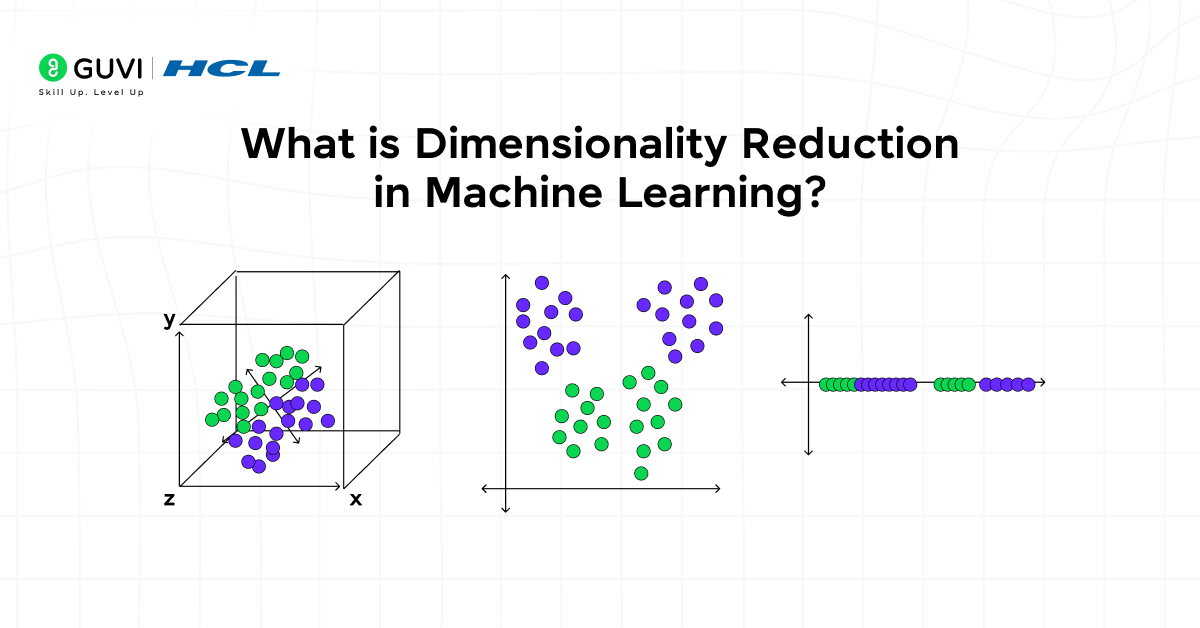
Why high-dimensional data is a problem
High-dimensional data refers to datasets with numerous predictor variables, which pose several significant challenges for machine learning algorithms. This phenomenon is often referred to as the “curse of dimensionality”.
The primary issues with high-dimensional data include:
- Data sparsity: As dimensions increase, data points become more sparse. In fact, to maintain the same level of coverage, the number of data points needed grows exponentially with each added dimension.
- Decreased accuracy: High dimensionality can lead to decreased accuracy in predictive models. A typical rule of thumb suggests you need at least 5 training examples for each dimension to achieve reasonable generalization.
- Computational burden: More dimensions mean increased computation time and storage requirements.
- Overfitting risk: Models may learn noise instead of actual patterns, especially when dimensions outnumber observations.
- Visualization difficulties: Data with more than three dimensions becomes nearly impossible to visualize intuitively.
Feature selection vs feature extraction
Dimensionality reduction techniques generally fall into two major categories – each with distinct approaches to tackling high-dimensional data.
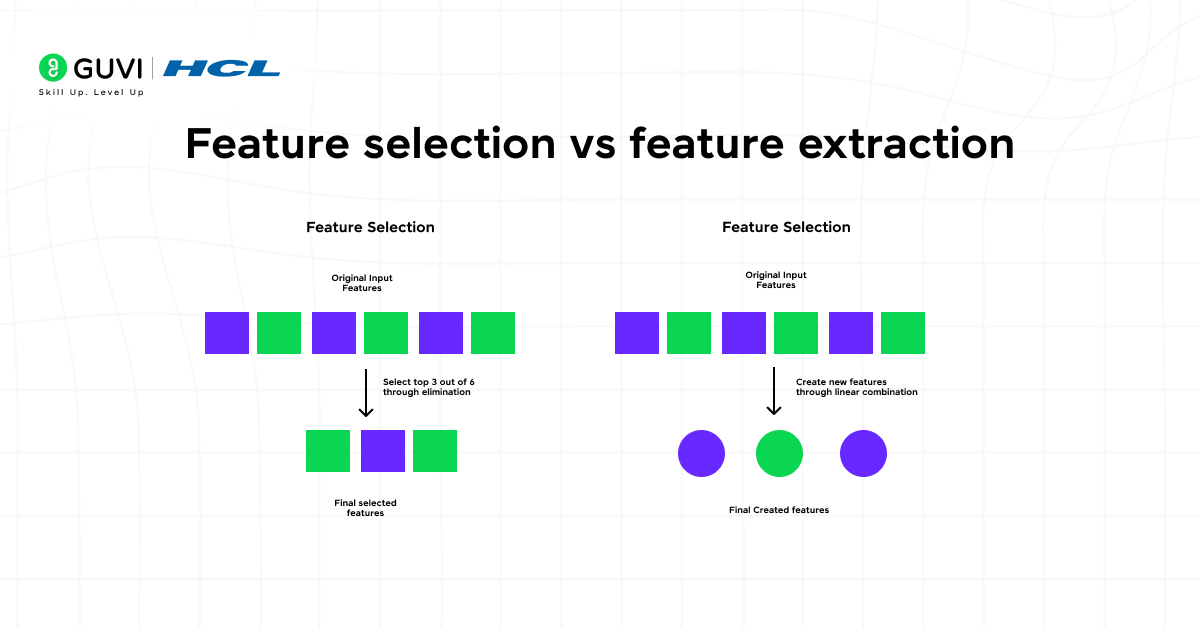
- Feature selection involves identifying and keeping only the most relevant original features from your dataset. This approach is particularly valuable when you need to maintain the interpretability of your variables or reduce data collection costs. Feature selection methods include:
- Filter methods that use statistical measures to rank features
- Wrapper methods that evaluate feature subsets based on model performance
- Embedded methods that integrate selection into the model training process
- Feature extraction, conversely, transforms or combines your original features to create an entirely new set of features. Rather than simply selecting from existing variables, extraction methods create new representations that often capture underlying patterns more effectively. Popular extraction techniques include:
- Principal Component Analysis (PCA)
- Linear Discriminant Analysis (LDA)
- Autoencoders
The key difference is that selection preserves original feature meanings, whereas extraction creates new features that might not have clear interpretations but often better capture complex relationships.
Dimensionality Reduction vs Feature Selection
A common point of confusion is whether dimensionality reduction and feature selection are the same. They’re related but distinct.
| Aspect | Feature Selection | Dimensionality Reduction (Feature Extraction) |
|---|---|---|
| What it does | Selects a subset of original features | Creates new features (components) from original features |
| Interpretability | High – original feature names retained | Lower – new components are combinations of features |
| Information loss | May discard useful correlated features | Can preserve more variance by combining features |
| Examples | Correlation filtering, RFE, LASSO | PCA, LDA, Autoencoders, t-SNE |
| Best for | When you need explainable models | When features are highly correlated or numerous |
How dimensionality reduction helps
Applying dimensionality reduction techniques offers numerous benefits that can significantly improve your machine learning workflow:
- First, it addresses the curse of dimensionality by reducing data sparsity issues. Additionally, it decreases computational complexity, making models faster to train and deploy, particularly important when resources are limited.
- Dimensionality reduction also enhances model generalization by removing noise and redundant features that might lead to overfitting. Moreover, it improves data visualization capabilities, allowing for better exploratory data analysis and insights.
- In practice, dimensionality reduction serves as a critical preprocessing step in many applications – from image processing and natural language processing to genomics and financial analysis. By transforming complex datasets into more manageable forms, you gain both efficiency and effectiveness in your machine learning projects.
Comparison of Dimensionality Reduction Techniques
| Technique | Type | Supervised? | Main Idea | Best Used For | Key Advantage | Limitation |
|---|
| Technique | Type | Supervised? | Main Idea | Best Used For | Key Advantage | Limitation |
|---|---|---|---|---|---|---|
| PCA | Linear | No | Finds orthogonal axes of maximum variance | General preprocessing, compression, visualization | Fast, interpretable, widely supported | Only captures linear relationships; unsupervised |
| LDA | Linear | Yes | Maximizes class separability | Classification tasks with labeled data | Improves class separation | Assumes normal distribution; limited to c-1 components (c = classes) |
| t-SNE | Nonlinear | No | Preserves local neighborhood structure | 2D/3D visualization of clusters | Reveals fine-grained clusters | Slow on large data; doesn’t preserve global structure |
| UMAP | Nonlinear | No | Manifold approximation with neighbor graphs | Visualization, embedding compression | Faster than t-SNE; better global structure | More complex parameters; newer than t-SNE |
| Autoencoders | Nonlinear | No | Neural network encoding/decoding | Complex patterns, deep learning pipelines | Captures nonlinear structure; flexible | Requires more data and tuning; less interpretable |
| Kernel PCA | Nonlinear | No | PCA with kernel trick for nonlinear patterns | Nonlinear data with clear variance structure | Extends PCA to nonlinear cases | Computationally expensive; kernel selection critical |
Top 5 Dimensionality Reduction Techniques Explained
Now that you understand what dimensionality reduction is, let’s explore the five most powerful techniques that data scientists rely on to tackle high-dimensional datasets.
1. Principal Component Analysis (PCA)
PCA stands as the most widely used dimensionality reduction algorithm that identifies dominant patterns and creates linear combinations of original variables with maximum variance. This technique transforms your data into a new coordinate system where the first principal component captures the largest variance, followed by subsequent components that are uncorrelated with previous ones.
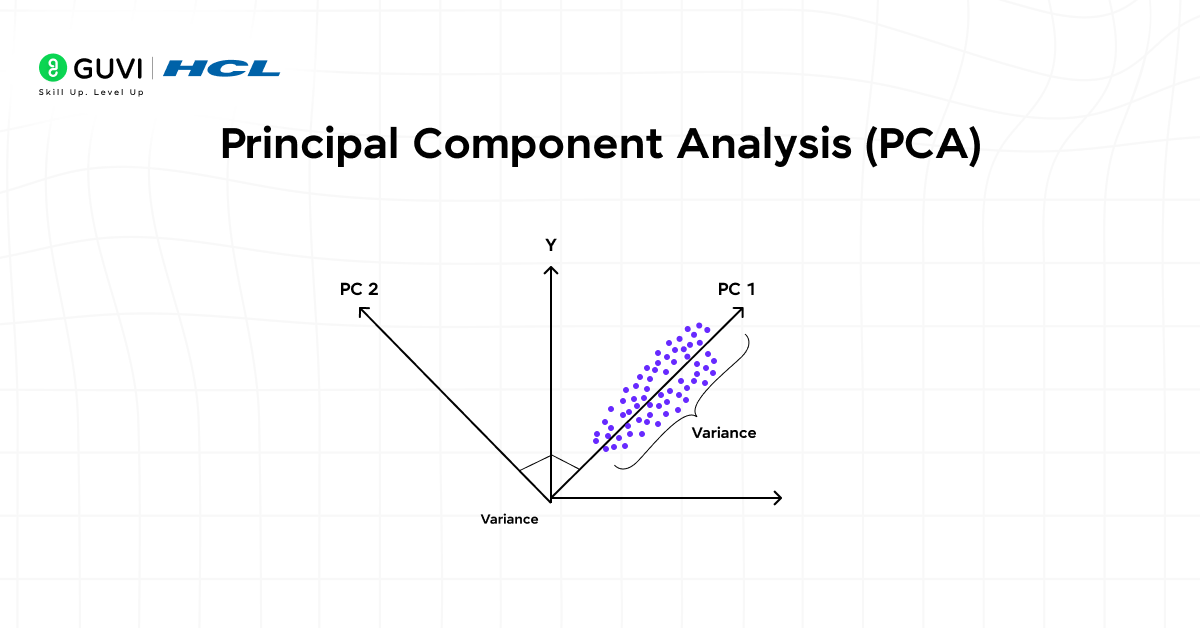
The beauty of PCA lies in its straightforward approach:
- Standardize your data so each variable contributes equally
- Compute the covariance matrix to understand relationships between variables
- Find eigenvectors and eigenvalues that determine new axes maximizing variance
- Sort components by importance based on eigenvalues
- Project your data onto this new lower-dimensional space
PCA excels at exploratory data analysis, visualization, and preprocessing for machine learning algorithms by extracting the most informative features while minimizing information loss.
2. t-Distributed Stochastic Neighbor Embedding (t-SNE)
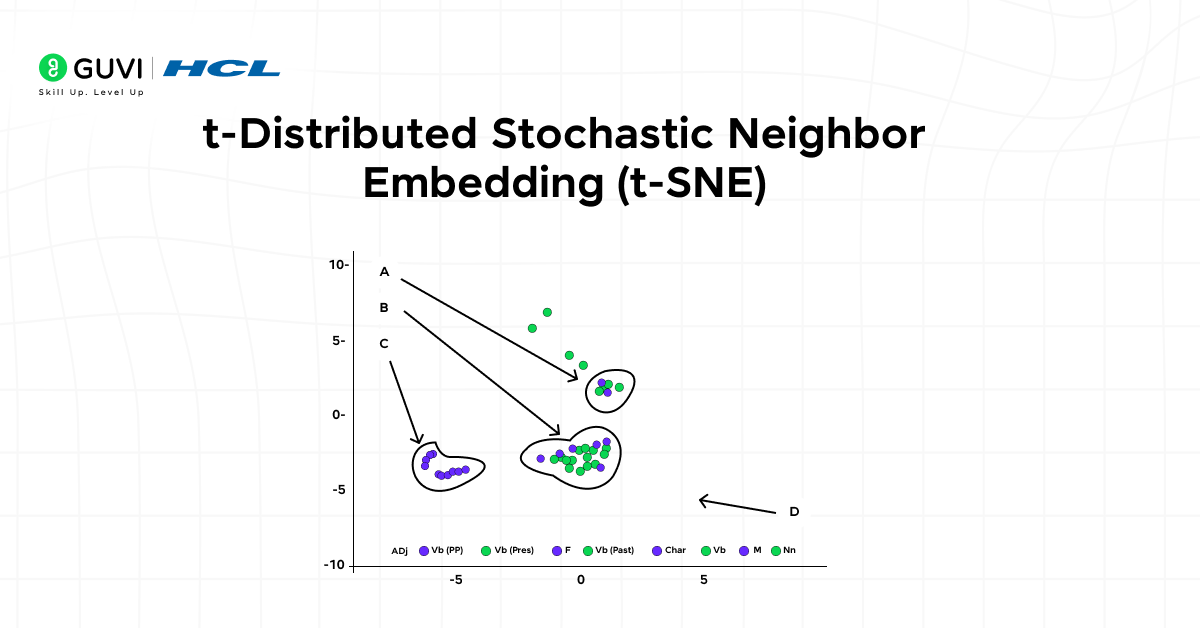
- t-SNE has become the go-to method specifically for visualizing high-dimensional data in two or three dimensions. Unlike PCA, t-SNE excels at preserving local structure, making it ideal for revealing clusters.
- The algorithm operates in two main stages. First, it constructs probability distributions over pairs of high-dimensional points, assigning higher probabilities to similar objects. Next, it defines a similar distribution in the low-dimensional map and minimizes the difference between these distributions.
- t-SNE’s effectiveness depends heavily on its perplexity parameter—typically set between 5 and 50—which can be interpreted as a smooth measure of the effective number of neighbors. However, remember that t-SNE plots can be influenced by parameter choices, so cluster sizes and distances between clusters aren’t always informative.
3. Autoencoders
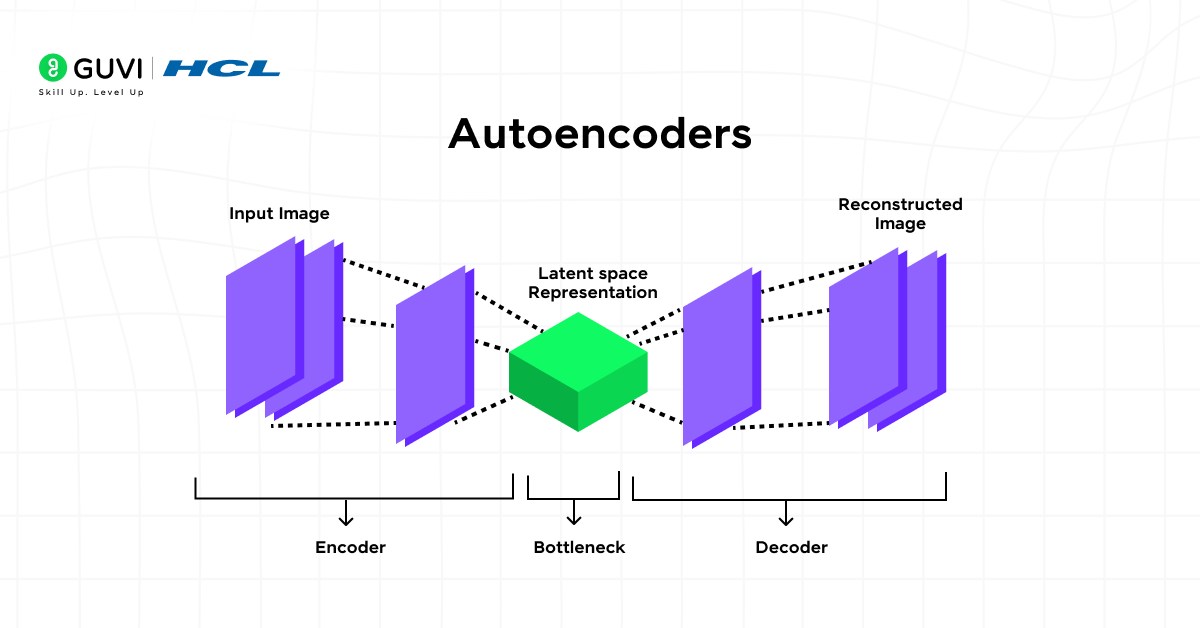
- Autoencoders offer a neural network approach to dimensionality reduction through unsupervised learning. These networks consist of an encoder that compresses data into lower dimensions (bottleneck layer) and a decoder that reconstructs the original input.
- The architecture typically features decreasing neurons in encoder layers and increasing neurons in decoder layers. For instance, you might see a structure with 32, 16, and 7 units in encoder layers and 7, 16, and 32 units in decoder layers.
- When using autoencoders, the compressed representation at the bottleneck layer becomes your reduced-dimensional data. This process effectively performs feature extraction while potentially capturing more complex patterns than linear methods like PCA.
4. Linear Discriminant Analysis (LDA)
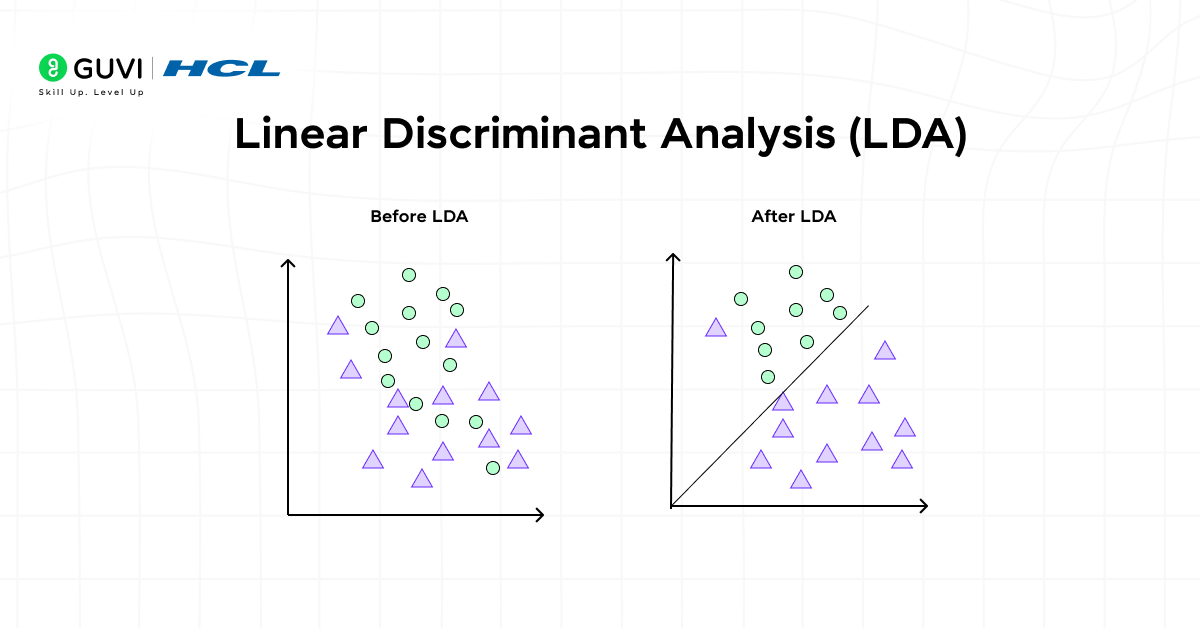
- Unlike previous techniques, LDA is a supervised approach that solves multi-class classification problems. It separates multiple classes by finding linear combinations of features that best characterize or distinguish different classes.
- LDA works by maximizing the distance between projected means of different classes (between-class variance) while minimizing the variance within each class (within-class variance). This makes LDA particularly valuable for classification tasks.
- The technique follows a generative model framework, meaning it models data distribution for each class and uses Bayes’ theorem to classify new data points. LDA works best when your data follows a normal distribution and classes have equal covariance matrices.
5. Kernel PCA
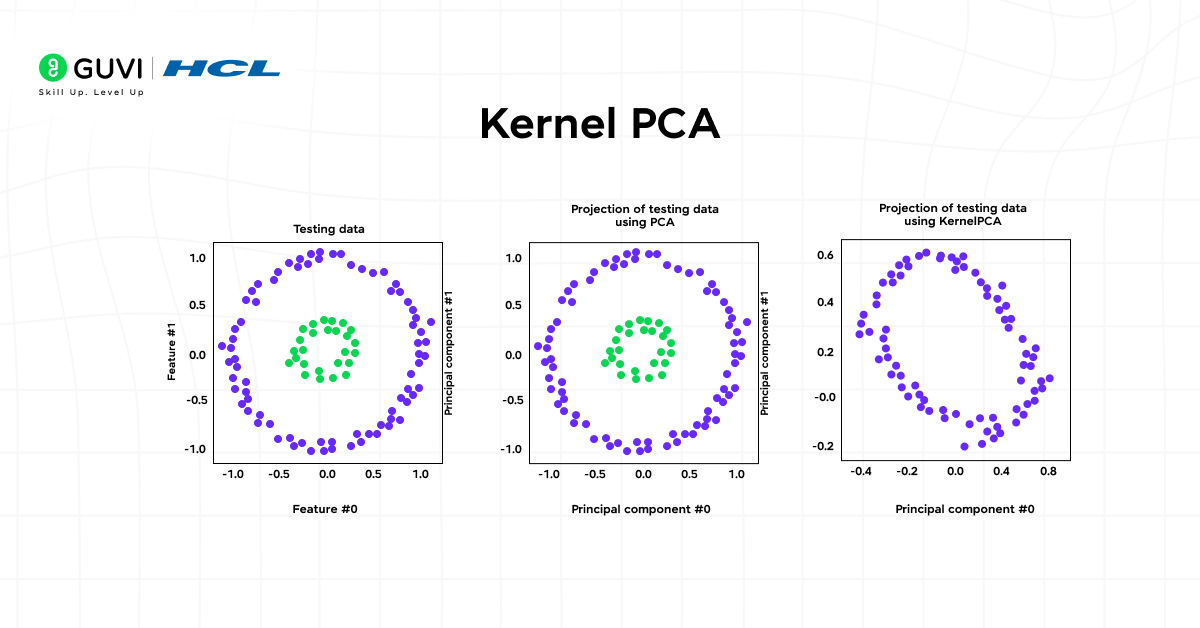
- Kernel PCA extends traditional PCA to handle nonlinear data patterns. It applies kernel methods to project data into a higher-dimensional space where complex relationships become linearly separable—similar to the approach used in Support Vector Machines.
- The “kernel trick” allows calculations in this high-dimensional space without explicitly computing the transformation, making it computationally feasible. Popular kernel functions include linear, polynomial, and radial basis function (RBF), with the choice significantly impacting performance.
- Kernel PCA provides advantages over linear PCA, primarily in capturing non-linear patterns and being more robust to outliers. Nevertheless, it comes with challenges like selecting appropriate kernel functions and parameters, plus higher computational demands for large datasets.
How to Choose the Right Dimensionality Reduction Method
Selecting an appropriate dimensionality reduction method requires careful consideration of multiple factors. After mastering various techniques, the next challenge lies in determining which one best suits your specific scenario.
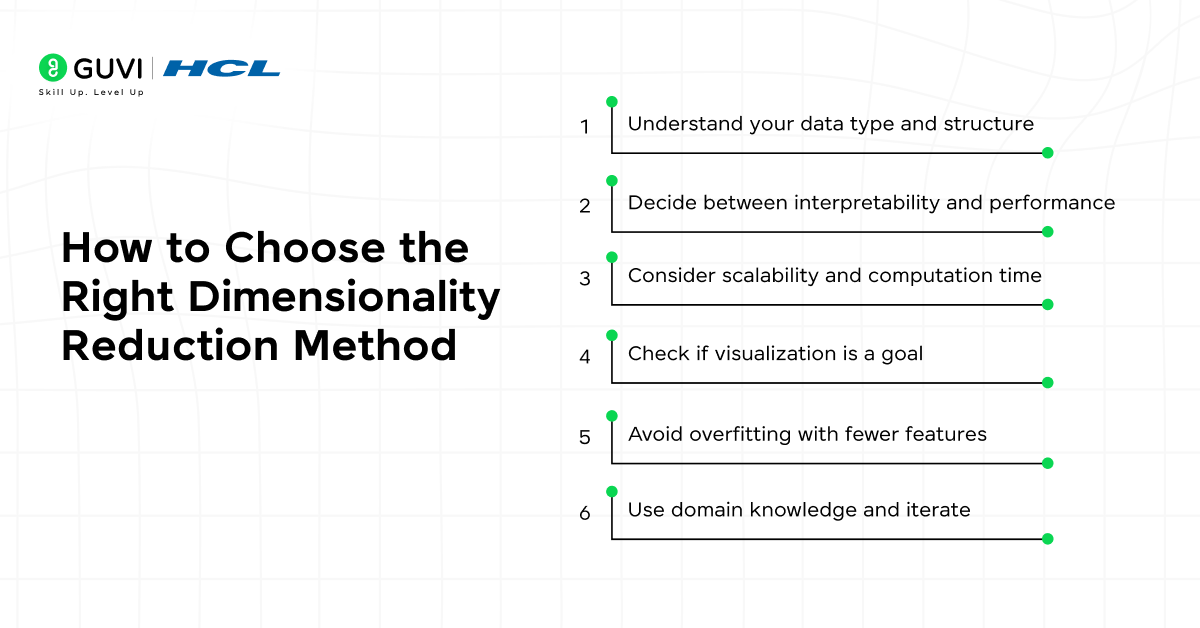
1) Understand your data type and structure
Initially, examine whether your data has linear or non-linear relationships. Linear methods like PCA work well for datasets with linear correlations, whereas non-linear techniques such as Kernel PCA or t-SNE excel at capturing complex patterns. Consider these data characteristics:
- Data distribution – Is your data normally distributed? Some methods assume normality.
- Noise levels – Methods like Autoencoders can handle noisy data better due to their learning capabilities.
- Feature types – Are your features numerical, categorical, or mixed? This affects compatibility with certain techniques.
2) Decide between interpretability and performance
One critical trade-off exists between model interpretability and performance. PCA creates entirely new features that might lack clear interpretation despite excellent variance preservation. Consequently, if stakeholder understanding is crucial, feature selection methods might be preferable to feature extraction, even with slightly reduced accuracy.
3) Consider scalability and computation time
Computational efficiency becomes increasingly important with larger datasets. Among popular methods, PCA typically offers the fastest performance, followed by UMAP for datasets with over 10,000 samples. In contrast, t-SNE and LDA become noticeably more computationally expensive as the number of data points increases.

4) Check if visualization is a goal
If your primary objective is visualization, methods preserving different structural aspects yield varying results. For global structure preservation (maintaining overall data relationships), PCA and MDS typically perform better. Alternatively, for revealing clusters or local patterns, t-SNE and UMAP excel at preserving neighborhood relationships.
5) Avoid overfitting with fewer features
Dimensionality reduction serves as an effective technique to mitigate overfitting. With fewer features, models become less complex and less likely to memorize noise in the training data. Principal Component Analysis, for instance, can increase model performance by removing noise while retaining essential information.
6) Use domain knowledge and iterate
Above all, domain expertise should guide your selection process. Collaborating with subject matter experts throughout the feature engineering process proves vital. Furthermore, experimentation with multiple techniques often yields the best results. Try different methods, compare their outputs, and evaluate which best preserves the meaningful aspects of your data for your specific goals.
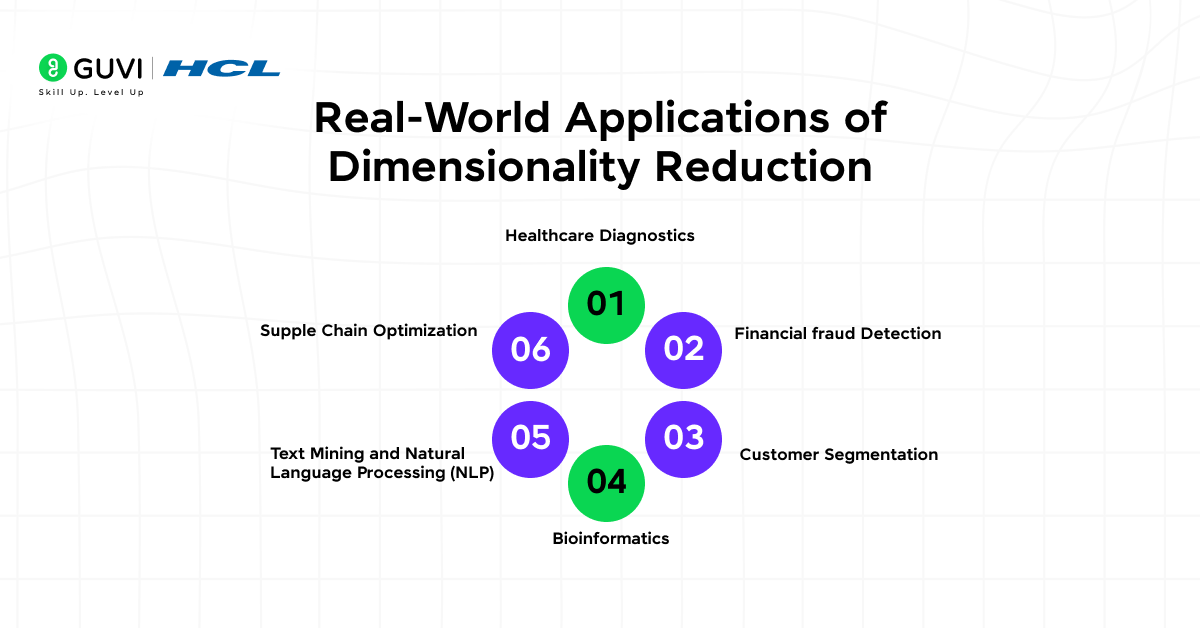
Real-World Applications of Dimensionality Reduction
Dimensionality reduction techniques power numerous real-world applications across diverse industries. Let’s explore how these methods tackle complex problems in various domains.
1) Image and video processing
- Dimensionality reduction serves as a cornerstone in computer vision by extracting essential features from high-dimensional pixel arrays. In medical imaging, pre-trained deep neural networks act as feature extractors before applying dimensionality reduction techniques to optimize classification tasks. This approach proves particularly valuable when processing large volumes of visual data while maintaining critical information.
- For radiologists who must interpret images within 3-4 seconds while working 8-hour shifts, dimensionality reduction techniques help mitigate fatigue-induced errors by simplifying complex visual data. Accordingly, these methods enable more efficient image compression and pattern recognition.
2) Natural language processing (NLP)
- In NLP, transformer models encode text’s meaning as contextual vectors in high-dimensional spaces. Dimensionality reduction techniques subsequently help uncover hidden semantic relationships between words and documents.
- Semantic search systems store pre-computed embeddings to avoid repeatedly generating them for each query. By reducing embedding dimensions, you can dramatically decrease storage requirements and increase computation speed for operations like calculating cosine similarity between vectors. This becomes increasingly important as information volumes grow, helping reduce energy consumption and carbon footprints.
3) Genomics and bioinformatics
- Biology faces unprecedented challenges with noisy, high-dimensional data. Techniques like Principal Component Analysis (PCA) help unveil relationships between principal components and underlying biological variations across samples.
- Notably, research shows that later principal components often carry significant biological information. For instance, in brain tissue analysis, PC5 can differentiate basal ganglia from other tissues. This insight allows researchers to better visualize global structure in RNA-seq data and understand biological drivers in datasets.
4) Finance and fraud detection
Financial applications benefit from dimensionality reduction through:
- Building factor models for risk management
- Generating financial scenarios by applying stresses to principal components
- Estimating Value at Risk (VaR) through Monte-Carlo simulation
- Portfolio immunization against movements in principal components
Studies demonstrate that spectral reduction methods provide reliable estimates of systemic risk in financial markets, particularly when handling heterogeneous networks.
5) Healthcare and medical imaging
- Medical big data from electronic health records, genomics, and imaging requires efficient processing for personalized healthcare. Dimensionality reduction techniques address challenges like computational inefficiency and overfitting in high-dimensional medical datasets.
- Feature extraction methods like PCA and feature selection through metaheuristic algorithms (including Genetic Algorithms and Particle Swarm Optimization) enhance machine learning model accuracy while reducing computational costs. These approaches prove crucial for medical image classification, diagnosis, and treatment prediction.
6) Recommender systems
- Recommender systems frequently encounter data sparsity since users typically interact with only a small subset of available items. Dimensional reduction techniques transform sparse matrices into more condensed yet informative representations.
- Matrix Factorization models emerge as the leading choice in contemporary recommender systems. By applying techniques like Singular Value Decomposition (SVD), these systems improve prediction accuracy and overcome scalability issues. This approach enhances everything from product recommendations to personalized learning experiences.
Dimensionality reduction isn’t a new concept — it dates back to 1901, when Karl Pearson introduced Principal Component Analysis (PCA), over a century before “machine learning” became a buzzword!
Interestingly, PCA isn’t just used in data science — NASA has applied it to compress satellite images and detect anomalies in spacecraft systems.
And here’s a mind-bender: reducing dimensions can increase accuracy. By eliminating noisy or redundant features, models often perform better — proving that sometimes, less really is more in machine learning!
Python Implementation: A Simple PCA Example
Let’s put theory into practice with a hands-on PCA example using Python. This tutorial demonstrates how to implement dimensionality reduction on a real dataset.
Step 1: Load and scale your data
Firstly, standardization is crucial before applying PCA as the technique is sensitive to scale. Without proper scaling, features with larger ranges would dominate the principal components.
from sklearn.preprocessing import StandardScaler
import pandas as pd
# Load your dataset (using the wine dataset as an example)
from sklearn.datasets import load_wine
X, y = load_wine(return_X_y=True, as_frame=True)
# Standardize features (zero mean and unit variance)
scaler = StandardScaler()
X_scaled = scaler.fit_transform(X)
Step 2: Apply PCA using scikit-learn
After standardization, you can apply PCA using scikit-learn’s implementation:
from sklearn.decomposition import PCA
# Create PCA instance with desired components
pca = PCA(n_components=2)
# Apply transformation
X_pca = pca.fit_transform(X_scaled)
Step 3: Visualize the reduced data
To demonstrate the effectiveness of dimensionality reduction, visualize the transformed data:
import matplotlib.pyplot as plt
# Create scatter plot of first two principal components
plt.figure(figsize=(8,6))
plt.scatter(X_pca[:, 0], X_pca[:, 1], c=y, cmap=’viridis’)
plt.xlabel(‘Principal Component 1’)
plt.ylabel(‘Principal Component 2’)
plt.title(‘PCA-Reduced Data’)
plt.colorbar(label=’Target’)
Step 4: Interpret the explained variance
The explained variance ratio tells you how much information each component retains. This helps determine how many components to keep:
# Check variance explained by components
print(“Explained variance ratio:”, pca.explained_variance_ratio_)
print(“Cumulative explained variance:”,
sum(pca.explained_variance_ratio_))
In this case, the first component might explain around 44.2% of the variance, while the second explains approximately 19%. Together, these two components capture about 63% of the total variance, effectively reducing dimensionality while preserving essential information.
Elevate your understanding of techniques like PCA and t-SNE by enrolling in HCL GUVI’s Intel & IITM Pravartak Certified Artificial Intelligence and Machine Learning Course, which blends theory with hands-on projects across dimensionality reduction and advanced ML topics. With live classes, expert mentorship, and career support, this course transforms your curiosity into deep technical skill and employability.
Concluding Thoughts…
Dimensionality reduction stands as a powerful tool in your machine learning toolkit, especially when dealing with complex, high-dimensional datasets. Throughout this guide, you’ve seen how reducing dimensions can solve multiple problems at once – from decreasing computational burden to improving model performance.
Additionally, these techniques help visualize complex data and mitigate overfitting issues that often plague high-dimensional spaces.
As you continue your machine learning journey, remember that dimensionality reduction is not merely a preprocessing step but rather a fundamental approach to understanding complex data. Start with simpler techniques like PCA, then gradually explore more sophisticated methods as your confidence grows.
After mastering these techniques, you’ll find yourself handling increasingly complex datasets with greater ease and effectiveness. Good Luck!
FAQs
Q1. What is dimensionality reduction in machine learning and why is it important?
Dimensionality reduction is a technique that simplifies complex datasets by reducing the number of features while preserving essential information. It’s important because it improves computational efficiency, reduces overfitting, and helps in visualizing high-dimensional data.
Q2. How does PCA differ from LDA in dimensionality reduction?
PCA (Principal Component Analysis) maximizes data variance and is unsupervised, while LDA (Linear Discriminant Analysis) maximizes class separability and is supervised. PCA is generally used for feature extraction, while LDA is specifically designed for classification tasks.
Q3. Can you implement PCA using Python?
Yes, PCA can be easily implemented in Python using libraries like scikit-learn. The process typically involves loading and scaling the data, applying PCA, and then visualizing the reduced data. It’s a powerful tool for data analysis and preprocessing in machine learning projects.
Q4. What are some real-world applications of dimensionality reduction?
Dimensionality reduction is widely used in image and video processing, natural language processing, genomics, finance for fraud detection, healthcare for medical imaging analysis, and in recommender systems. It helps in handling complex data across various industries.
Q5. How do you choose the right dimensionality reduction method for your data?
Choosing the right method depends on factors like your data type and structure, the balance between interpretability and performance, computational resources, visualization needs, and your specific goals. It’s often beneficial to experiment with multiple techniques and evaluate their effectiveness for your particular dataset and objectives.
Q6. What are the main techniques of dimensionality reduction?
The main techniques include Principal Component Analysis (PCA), Linear Discriminant Analysis (LDA), t-SNE, UMAP, autoencoders, and Kernel PCA. PCA is the most widely used for general preprocessing, while t-SNE and UMAP excel at visualization.guvi+2
Q7. Is PCA a dimensionality reduction technique?
Yes, PCA (Principal Component Analysis) is a dimensionality reduction technique. It is a linear, unsupervised method that finds orthogonal axes (principal components) capturing maximum variance in the data.guvi+2
Success Stories

About the Author
Vishalini Devarajan
An Aerospace Engineer turned content writer, I focus on making complex concepts easy to understand through well-structured, reader-friendly blogs. Whether it’s a technical topic or a non-technical one, I love creating content that is clear, engaging, and impactful.
View all posts by Vishalini Devarajan
Connect with me @


















Did you enjoy this article?