


Programming Languages Articles
Product Manager Portfolio: How to Build The Best One That Gets You Hired in 2026
Code Review Best Practices: How to Give and Receive Feedback Effectively


Get In Touch For Details! Request More Information
Breaking the Myth: Why Coding Without Math Is More Common Than You Think
Aug 03, 2026 6 Min Read 3885 Views
(Last Updated)
“I’d love to try coding, but I’ve never been good at math.”
If that thought has ever crossed your mind, you’re not alone. It’s one of the most common reasons people hesitate to explore programming, especially students from non-technical or non-math backgrounds. But it’s not what it looks like, as you don’t really need to be a math wizard to write good code. Most coding relies more on structure, logic, and creativity than on solving complex equations.
This blog is for anyone wondering if coding without math is actually doable, or still asking, “is math needed for coding?” And the short answer is: only in a few specific cases. We’ll unpack what real programming looks like, where math shows up, and how you can start building cool projects even if numbers were never your strength. You’ll also see how programming for non-math students can be fun, flexible, and full of possibilities. So if you’re someone from an arts background or just never enjoyed math class, this is your space to explore programming in a way that feels practical and beginner-friendly.
Table of contents
- Coding Without Math: What it Actually Involves
- Skills required for beginner programming
- Common coding activities vs. math tasks
- Logic vs Math in Programming: Clearing the Confusion
- What does logic mean in programming
- Why logic isn’t the same as math
- So, When Is Math Actually Needed in Programming?
- Scenarios where math matters
- How modern tools handle the math for you
- You’re Not Alone: Coders Who Never Liked Math
- How to Build and Strengthen Your Coding Skills Without the Math Pressure
- Start small by building useful mini projects
- Explore hands-on learning through guided courses
- Practice logic-based thinking through games and puzzles
- Try visual-first coding platforms for hands-on exposure
- Final Thoughts: Coding Has Room for You—Math or No Math
- Frequently Asked Questions
- Is it harder for arts students to learn programming?
- Can I skip learning math altogether in tech roles?
- Can I still learn data science without being good at math?
- What are some beginner projects I can try with zero math?
- Can someone from a commerce background succeed in programming?
Coding Without Math: What it Actually Involves
When people picture programming, they often imagine complex calculations, but that’s rarely the case. Let’s look at what coding truly involves for beginners:
Skills required for beginner programming
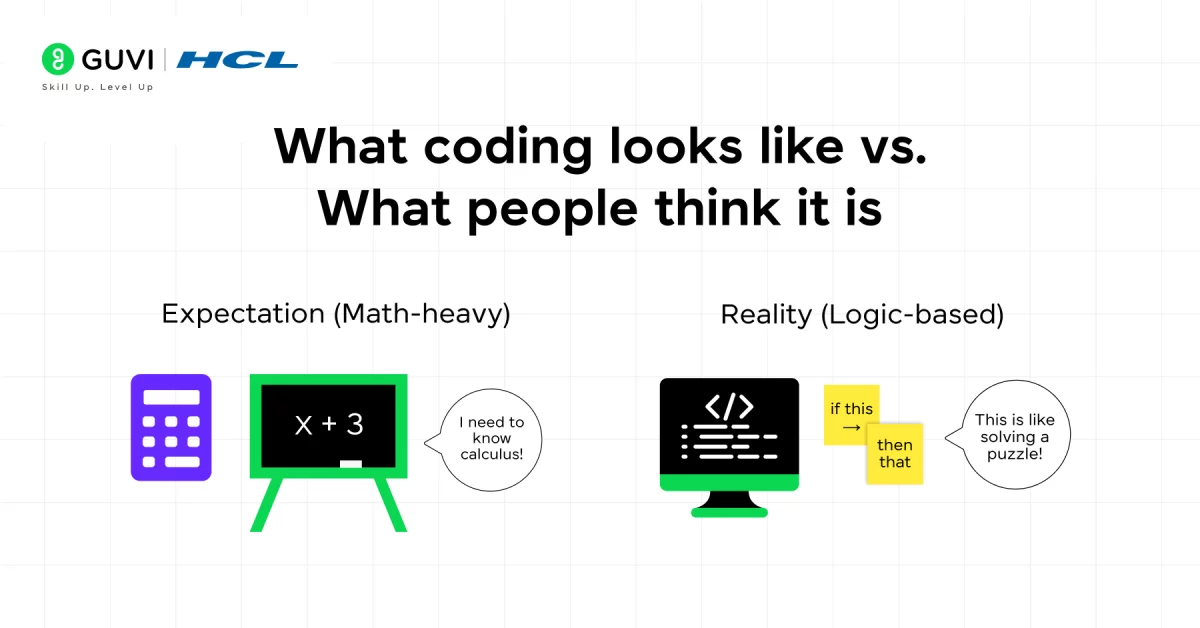
When you start learning to code, you’ll quickly notice that it’s less about crunching numbers and more about thinking in steps. Programming is like giving instructions to a computer, step-by-step, in plain logic. You don’t need algebra to tell a website what to do when someone clicks a button. What you really need is a basic understanding of how code is written, how different parts talk to each other, and how to structure your ideas in a way the computer can follow.
This is why so many beginners successfully learn to code without math. Most popular languages, like Python or JavaScript, are built to be approachable. They don’t throw you into a maze of formulas. Instead, they help you focus on breaking problems down, writing clean instructions, and testing what you build. These are practical math and programming skills, but ones that depend far more on logic and problem-solving than on equations.
Common coding activities vs. math tasks
Let’s break this down even more. When you write code, you’re often doing things like:
- Designing how a form works on a webpage
- Making a game keep score
Automating small tasks, like sending a message when someone signs up.
None of these requires solving equations or remembering what sine or cosine does. On the flip side, math tasks usually involve solving for unknown variables, calculating probabilities, or analyzing data sets with formulas. That’s a different skill set.
While math might sneak into specific areas like game physics or data science, most of what you’ll do as a beginner doesn’t depend on it. In fact, if you enjoy puzzles, checklists, or even planning your day step-by-step, you already are thinking like a programmer.
Logic vs Math in Programming: Clearing the Confusion
Before diving into code, a lot of people assume that programming is just math in disguise. It’s a fair assumption, especially with all the tech jargon floating around. But when you take a closer look at what coders actually do day-to-day, the difference becomes clear. They aren’t interchangeable, and understanding that difference can change how you feel about learning to code.
What does logic mean in programming
At its core, programming is about setting up rules. You tell the computer, “if this happens, then do that.” That’s logic. You’re building a set of instructions based on choices, outcomes, and conditions—not formulas. This makes programming for non-math students far more approachable than it’s often made out to be. If you’ve ever followed a recipe, organized a planner, or created a rule-based game, you’ve already used the kind of thinking coding requires.
Logic is the reason behind every action a program takes. Want your app to greet a user only if they’re logged in? That’s a simple condition. Want a site to show one layout on mobile and another on desktop? Another condition. You don’t need to solve equations; rather, you just need to think through decisions.
Why logic isn’t the same as math
There’s a common mix-up when it comes to logic and math in programming. While both are structured, they serve different roles. Logic is about flow and relationships, that is, what happens next based on what’s happening now. Math, on the other hand, is about quantities, measurements, and solving for unknowns.
You’ll find that logic shows up everywhere in code: loops that repeat actions, functions that handle specific tasks, and conditions that change outcomes. These are skills you can build without touching a single math formula. And once you get the hang of it, coding starts to feel more like solving a puzzle than sitting in a math class.
The article’s whole point is that coding is about logic and structure, not equations. HCL GUVI’s Code Kata gives you beginner-friendly coding problems in approachable languages like Python and JavaScript, so you can prove to yourself that math was never the barrier.
So, When Is Math Actually Needed in Programming?
While most beginner-level coding doesn’t rely on heavy math, there are a few specific domains where mathematical thinking becomes useful. But even in those areas, you won’t necessarily need to do the hard math yourself. Today’s tools and libraries do a lot of the heavy lifting, making it easier than ever to explore advanced tech, even if you’re more comfortable with logic than equations.
Scenarios where math matters
Some fields in tech are more math-driven than others. If you’re curious about these areas, it’s helpful to understand where math plays a role, but that doesn’t mean you need to start there. You can begin coding without math and grow into these spaces over time.
Game Development
Creating games often involves geometry, physics, and linear algebra. These help calculate things like object movement, collision detection, and camera angles, especially in 3D environments.
Machine Learning & AI
This space leans on statistics, probability, and calculus to train models, find patterns, and make predictions. However, most of the math happens under the hood using pre-built libraries.
Scientific or Engineering Applications
Fields like aerospace, biology, or civil engineering use coding to run simulations, solve equations, and analyze physical systems, often with math that’s specific to the domain.
How modern tools handle the math for you
Even in technical fields, most programmers aren’t calculating derivatives or writing algorithms from scratch. Instead, they’re using tools that simplify the math which allows them to stay focused on functionality, logic, and user experience. This is exactly why so many learners confidently learn to code without math first.
Libraries like NumPy or TensorFlow
These provide ready-to-use functions for complex operations, data transformations, and number crunching while saving hours of manual effort.
Game engines like Unity or Unreal
Game logic, physics, lighting, and animation are all handled behind the scenes. You focus on what the game should do, not the formulas behind it.

APIs and Pre-trained Models
Instead of writing your own algorithms, you can plug in existing models for tasks like face detection, voice recognition, or data analysis, and that too, with minimal math exposure.
You’re Not Alone: Coders Who Never Liked Math
A lot of people assume you need a math degree or some hidden talent with numbers to become a programmer. But in reality, many successful coders started out just like you—with doubts, creative backgrounds, and very little love for math class. Some came from writing, art, design, or even teaching, and still built thriving careers in tech. What helped them move forward was a willingness to learn by doing, not memorizing equations.
The world of tech is filled with real examples that prove you can start coding without math and still build powerful, impactful things. Many well-known coders didn’t come from math or engineering backgrounds. For example, Alexis Ohanian, co-founder of Reddit, studied history. Similarly, Linda Liukas, the creator of Hello Ruby, came from a humanities background. Another brilliant mind, Chris Coyier, known for CSS-Tricks, is a self-taught developer who didn’t follow a traditional CS path. And then there are thousands of others just like you who are curious and are ready to build some solid coding skills through consistent practice.
Employers today care more about what you can build than what you studied. A working project, a clear understanding of logic, and the curiosity to learn on the go count far more than your high school math scores.
Also Explore: Top High-Paying Non-Coding Jobs in Data Science in 2025
How to Build and Strengthen Your Coding Skills Without the Math Pressure
If you’ve been waiting for the “right” way to start coding, here’s the truth: there isn’t just one. The best way to learn is to actually try things out. You don’t need a math background to begin, and you certainly don’t need to know it all upfront. In case you’re starting from zero or looking to level up, here are a few practical ways that’ll surely help you learn to code without math while you build your confidence and grow your skills.
Choose beginner-friendly programming languages
Some languages are easier to pick up because they’re written in a way that feels more human. Python is a great place to start because its syntax is clean, readable, and logic-focused. HTML and CSS help you build websites visually, which makes them ideal for creative learners. These languages let you build real things while learning the foundations without diving into mathematical functions.
Start small by building useful mini projects
You don’t need to wait until you’ve “mastered” coding to create something. Begin with simple, practical projects like calculators, to-do lists, quote generators, or portfolio websites. These help you get hands-on experience and apply logic without needing any deep math. As your confidence grows, so will the complexity of what you’re able to build.
Explore hands-on learning through guided courses
If self-learning feels overwhelming, structured programs can help a lot, especially those that focus on logic-building and project-based learning. You can check out HCL GUVI’s Programming Courses which are meant to support beginners from all backgrounds. The courses are available in multiple vernacular languages and focus more on solving real-world problems than solving equations, making them a great way to get into coding without math.
Practice logic-based thinking through games and puzzles
Your brain already uses logic every day while you organize a playlist or plan a trip. You can strengthen that skill further through games that require patterns, decision-making, or rule-based outcomes. Logic puzzles, coding challenges, and even simple board games can sharpen your problem-solving instincts in a way that naturally supports your coding journey.
Try visual-first coding platforms for hands-on exposure
If typing lines of code still feels intimidating, visual coding tools are a great place to get your hands dirty. HCL GUVI’s HackerKID platform is designed primarily for students aged 7–17, but even absolute beginners outside that range can benefit from it. The platform offers fun and beginner-friendly games like Turtle, Zombieland, and WebKata that teach you how to think like a coder while keeping things interactive and playful. It’s a low-pressure way to get a feel for how programming works with no math anxiety involved.
Final Thoughts: Coding Has Room for You—Math or No Math
The truth is, coding rewards curiosity more than calculation. If you’re someone who likes figuring things out, building things from scratch, or solving problems step by step, you’re already wired for it. Math might play a role in some areas, but it’s not the entry ticket.
You can absolutely thrive in coding without math being involved in it, if you focus on logic, practice, and your creativity. Start with tools that match your pace, follow what feels fun, and let your confidence build bit by bit. The path is flexible, and it’s wide open for you.
Frequently Asked Questions
Is it harder for arts students to learn programming?
Not at all. In fact, coding for arts students can be easier because they’re often strong in creative thinking, pattern recognition, and communication, which are key traits in development.
Can I skip learning math altogether in tech roles?
You can skip it for many roles, especially in web development, QA, and frontend. Coding without math is common in these spaces where logic outweighs formulas.
Can I still learn data science without being good at math?
You can get started with basic data analysis and tools like Excel, Python libraries, and pre-trained models. Math helps later, but it’s not needed on day one.
What are some beginner projects I can try with zero math?
Try building a digital to-do list, a quiz app, or a random quote generator. These don’t need math but will improve your coding logic.
Can someone from a commerce background succeed in programming?
Absolutely. Many from commerce and business streams have built careers in tech. Programming for non-math students is not just possible; in fact, it’s increasingly common.
Success Stories









Did you enjoy this article?