


Artificial Intelligence and Machine Learning Articles
AI/ML Skills Gap 2026: Why Companies Can't Find Job-Ready Talent
20 AI/ML Interview Questions Recruiters Can Use Without a Tech Background - Best Guide
How Industry-Backed AI/ML Bootcamps Are Changing the AI/ML Hiring Pipeline - Best Guide 2026
From IT Support to AI Engineer: A Realistic Career Switch Guide 2026


Get In Touch For Details! Request More Information

The Machine Learning Cheat Sheet [2026 Guide]
Jun 09, 2026 6 Min Read 5542 Views
(Last Updated)
A machine learning cheat sheet is invaluable when you’re navigating the complex world of algorithms and techniques. Actually, machine learning is an incredible technology that you use more often than you think today, with the potential to do even more tomorrow. When starting, the sheer volume of concepts can feel overwhelming.
Looking for a machine learning for dummies approach? This machine learning algorithms cheat sheet breaks down essential concepts into digestible tables and quick-reference guides. You’ll discover how machine learning algorithms can be divided into three main groups: Supervised learning, Unsupervised learning, and Reinforcement learning.
Throughout this machine learning cheat sheet, you’ll find concise explanations, essential formulas, and practical examples organized in easy-to-reference tables—the perfect companion for your machine learning journey. Let’s begin!
Quick Answer:
A machine learning cheat sheet covers the three core learning paradigms (supervised, unsupervised, and reinforcement learning), the ML pipeline steps, essential algorithms with their strengths and use cases, data preprocessing techniques, model evaluation metrics (accuracy, F1, RMSE, R²), regularization methods, top tools, and algorithm selection guidance. Bookmark this machine learning cheat sheet for quick reference throughout your ML journey.
Table of contents
- Quick Start: ML Learning Types and Workflow
- Supervised vs Unsupervised vs Reinforcement
- Typical ML Pipeline Steps
- Data Preprocessing Essentials
- Supervised algorithms
- Unsupervised Learning Algorithms
- Deep Learning Quick Reference
- Model Evaluation and Selection
- Confusion Matrix and Classification Metrics
- Regression Metrics: R², MAE, MSE
- Cross-Validation and Train-Test Split
- Regularization: Lasso, Ridge, Elastic Net
- How to Choose the Right Algorithm
- Python Code Snippets Quick Reference
- Top Tools
- Concluding Thoughts...
- FAQs
- Q1. What is the difference between supervised and unsupervised learning?
- Q2. How do I choose the right machine learning algorithm for my problem?
- Q3. What are some common evaluation metrics for machine learning models?
- Q4. How can I prevent overfitting in my machine learning models?
- Q5. What are some popular tools for implementing machine learning algorithms?
Quick Start: ML Learning Types and Workflow
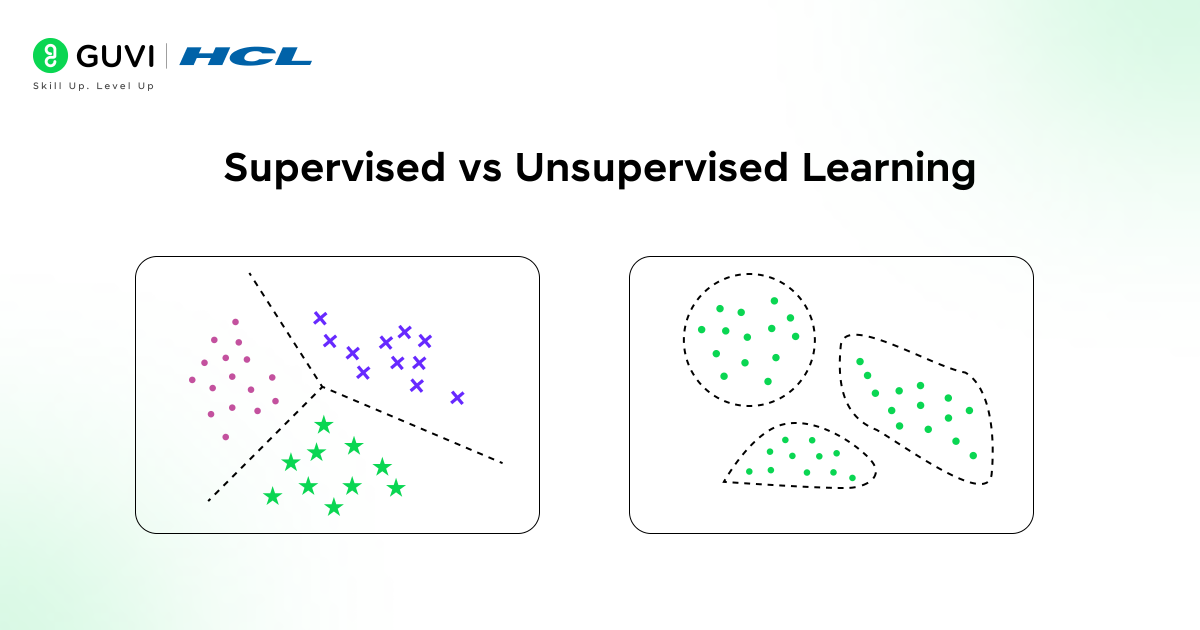
The foundation of any machine learning cheat sheet begins with understanding the three fundamental learning paradigms. Let’s break down these essential concepts in table format for quick reference.
Supervised vs Unsupervised vs Reinforcement
| Criteria | Supervised Learning | Unsupervised Learning | Reinforcement Learning |
| Definition | Learns from labeled data with known output | Discovers patterns in unlabeled data | Learns through trial and error with rewards |
| Input Data | Labeled datasets | Unlabeled datasets | No predefined data, acts according to a policy |
| Problem Types | Built and trained before testing | Clustering, Association | Exploration, Exploitation |
| Algorithms | Linear/Logistic Regression, Decision Trees, SVM, KNN | K-means, Hierarchical Clustering, PCA | Q-Learning, SARSA, Deep Q Networks |
| Applications | Price prediction, Image detection | Customer segmentation, Anomaly detection | Self-driving cars, Gaming, Robotics |
| Model Building | Built and trained before testing | Built and trained prior to testing | Trained and tested simultaneously |
According to industry analysts, supervised learning remains “the backbone of today’s economy”. In supervised learning, the model learns from input-output pairs, consequently making it ideal for prediction tasks where historical data exists.
Typical ML Pipeline Steps
A complete machine learning workflow follows a sequential process from raw data to deployed model. Here’s the standard ML pipeline that forms the backbone of any successful project:
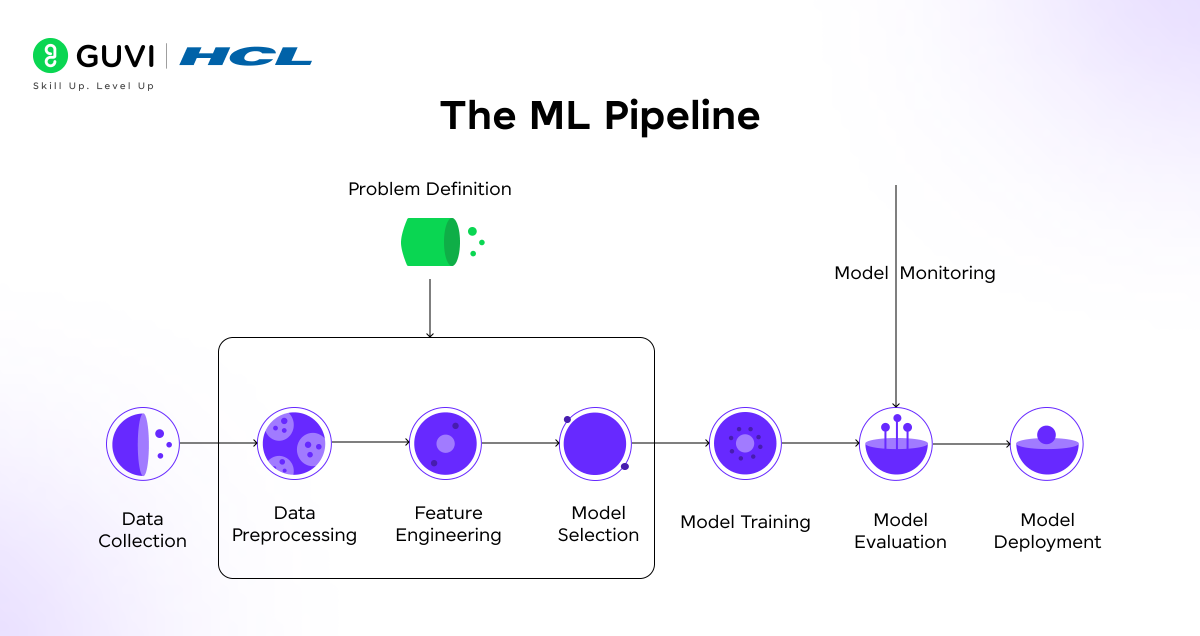
- Problem Definition: Clearly define what you’re trying to solve
- Data Collection: Gather relevant data from various sources
- Data Preprocessing: Clean, transform, and prepare data (more details below)
- Feature Engineering: Select and create meaningful features
- Model Selection: Choose appropriate algorithms based on your problem
- Model Training: Train multiple models using prepared data
- Model Evaluation: Assess performance using appropriate metrics
- Model Deployment: Deploy the best-performing model to production
- Model Monitoring: Track performance and update as needed
Furthermore, machine learning pipelines help “standardize the best practices of producing a machine learning model, enable the team to execute at scale, and improve the model-building efficiency”. Essentially, breaking down the ML process into manageable components allows each step to be “developed, optimized, configured, and automated individually”.
Data Preprocessing Essentials
Data preprocessing represents approximately 80% of a data scientist’s time. This crucial stage transforms raw data into a format suitable for machine learning algorithms.

| Preprocessing Technique | Purpose | Methods |
| Data Cleaning | Remove inconsistencies | Replace missing values, remove outliers and duplicates |
| Data Partitioning | Prevent overfitting | Split into train, validation, and test sets |
| Scaling | Prevent bias toward the majority class | Min-max scaling, standardization |
| Feature Encoding | Convert categorical variables | Label encoding, one-hot encoding, binary encoding |
| Handling Imbalanced Data | Prevent bias toward the majority class | Oversampling, undersampling, SMOTE |
| Dimensionality Reduction | Reduce feature complexity | PCA, SVD, feature selection |
This quick-start guide serves as your ml algorithms cheat sheet, providing the fundamental framework for approaching any machine learning project methodically.
Supervised algorithms
Supervised learning algorithms form the backbone of many machine learning applications, where models learn from labeled examples to make predictions on new data. Let’s break down the key algorithm types that should be part of your machine learning cheat sheet.
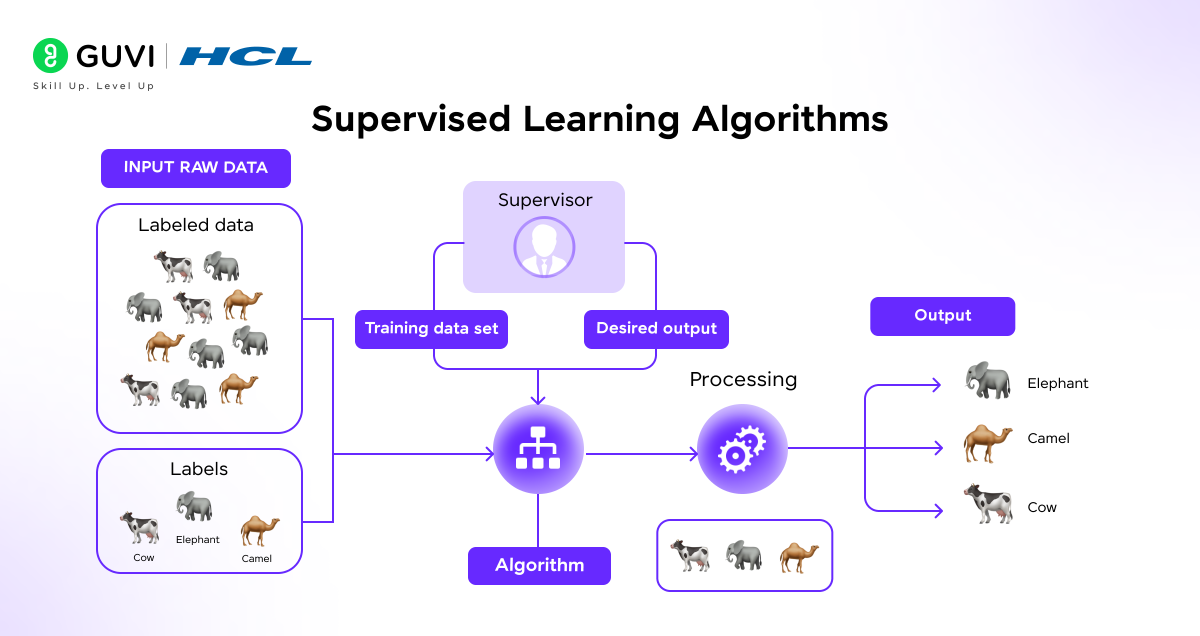
| Algorithm | Type | Strengths | Weaknesses | Use Cases |
|---|---|---|---|---|
| Linear Regression | Regression | Fast, interpretable, can extrapolate | Assumes linear relationships | Revenue prediction, price forecasting |
| Logistic Regression | Classification | Probabilistic output, efficient | Not ideal for non-linear boundaries | Spam detection, sentiment analysis |
| Decision Trees | Both | Handles heterogeneous data, easy to interpret | Prone to overfitting | Customer segmentation, medical diagnosis |
| Random Forests | Both | Reduces overfitting, handles missing values | Slower, harder to interpret | Image recognition, financial forecasting |
| SVM | Both | Works well with high dimensions | Slow on large datasets | Text classification, image recognition |
| KNN | Both | Simple implementation, no training required | Slow at prediction time | Recommendation systems, anomaly detection |
| Gradient Boosting (XGBoost) | Both | High accuracy, handles missing data | Requires tuning | Fraud detection, ranking, Kaggle competitions |
| Naive Bayes | Classification | Fast, good for text | Assumes feature independence | Spam filters, document classification |
| Neural Networks | Both | Learns complex patterns, flexible | Needs large data, computationally heavy | Image recognition, NLP, speech |
Include this machine learning formulas cheat sheet in your toolkit to quickly identify which algorithm best suits your specific problem.
Unsupervised Learning Algorithms
Unsupervised learning algorithms discover patterns in unlabeled data, making them essential tools for exploring datasets when you don’t know what you’re looking for. Unlike their supervised counterparts, these methods work without predefined outputs, letting the data speak for itself.

| Algorithm | Type | Description | Best For | Limitations |
|---|---|---|---|---|
| K-Means | Clustering | Assigns data to K clusters based on distance to centroids | Large datasets, spherical clusters | Requires predefined K, sensitive to initialization |
| Hierarchical | Clustering | Creates nested cluster tree (dendrogram) | Finding natural hierarchies, no predefined clusters needed | Computationally expensive for large datasets |
| DBSCAN | Clustering | Density-based clustering, finds arbitrary-shaped clusters | Noisy data, geographic clustering | Struggles with varying density |
| GMM | Clustering | Probabilistic soft clustering using Gaussian distributions | Non-circular clusters, soft clustering | Sensitive to initialization |
| PCA | Dimensionality Reduction | Linear technique preserving variance | Linear data relationships, preprocessing | Less effective with non-linear relationships |
| t-SNE | Dimensionality Reduction | Non-linear technique preserving local similarities | Visualization, complex data structures | Computationally expensive, primarily for visualization |
| Autoencoders | Dimensionality Reduction | Neural network that compresses and reconstructs data | Feature learning, anomaly detection | Requires more data and tuning |
| Apriori | Association | Identifies frequent itemsets using iterative approach | Market basket analysis, recommendation systems | Inefficient with large datasets |
Deep Learning Quick Reference
No machine learning cheat sheet in 2026 is complete without a section on deep learning, which now powers the majority of state-of-the-art ML applications. Deep learning architectures are increasingly part of every serious machine learning cheat sheet used by practitioners.
| Architecture | Full Name | Best Used For | Key Libraries |
|---|---|---|---|
| CNN | Convolutional Neural Network | Image classification, object detection | TensorFlow, PyTorch, Keras |
| RNN | Recurrent Neural Network | Sequential data, time series | TensorFlow, PyTorch |
| LSTM | Long Short-Term Memory | Long sequences, NLP, speech | TensorFlow, PyTorch |
| Transformer | Attention-based architecture | NLP, translation, GPT-style models | Hugging Face, PyTorch |
| GAN | Generative Adversarial Network | Image generation, data augmentation | TensorFlow, PyTorch |
| Autoencoder | Encoder-Decoder Network | Anomaly detection, compression | Keras, PyTorch |
| Diffusion Model | Noise-based generative model | Image synthesis, GenAI | Hugging Face Diffusers, PyTorch |
Think about this: supervised and unsupervised algorithms were the machine learning cheat sheet of 2015. In 2026, a complete machine learning cheat sheet also needs transformers, LLMs, and generative models. The field has expanded that fast.
Model Evaluation and Selection
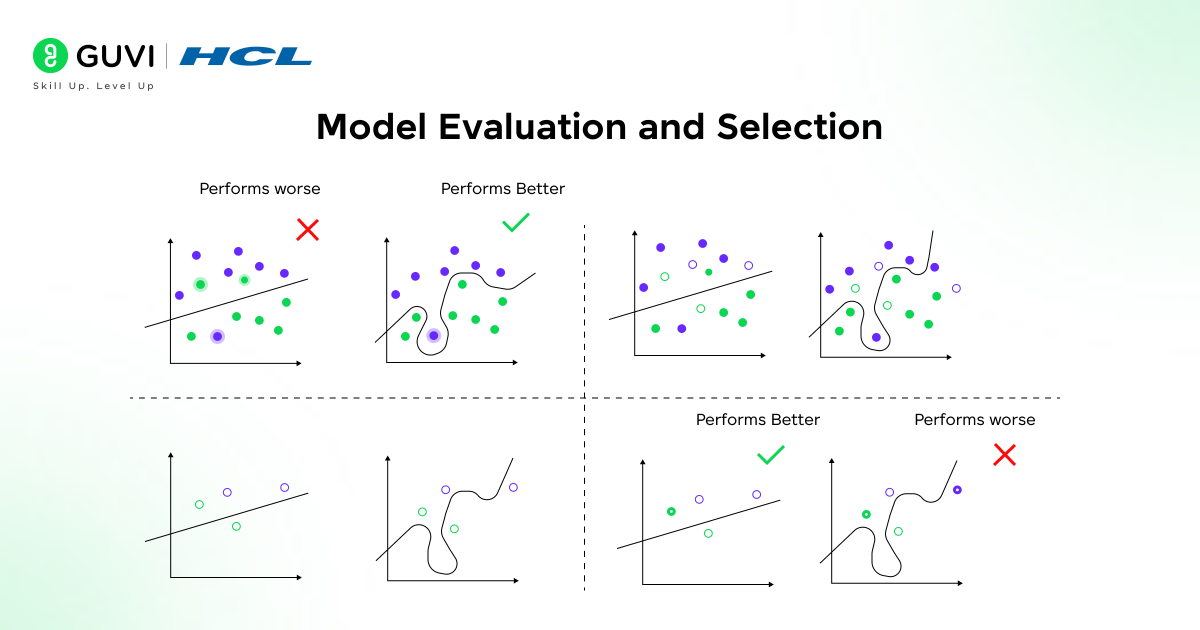
Evaluating your machine learning models is essential for ensuring they perform well on new, unseen data. Without proper evaluation, you risk deploying models that look great in training but fail in production.
Confusion Matrix and Classification Metrics
The confusion matrix provides a complete picture of your classification model’s performance by comparing predicted versus actual values.
| Term | Description | Formula |
|---|---|---|
| True Positive (TP) | Correctly predicted positive | — |
| True Negative (TN) | Correctly predicted negative | — |
| False Positive (FP) | Incorrectly predicted positive (Type I Error) | — |
| False Negative (FN) | Incorrectly predicted negative (Type II Error) | — |
| Accuracy | Overall correctness | (TP+TN)/(TP+TN+FP+FN) |
| Precision | Positive predictive value | TP/(TP+FP) |
| Recall (Sensitivity) | True positive rate | TP/(TP+FN) |
| F1 Score | Harmonic mean of precision and recall | 2TP/(2TP+FP+FN) |
| AUC-ROC | Area under the ROC curve | Higher is better (1.0 = perfect) |
| Specificity | True negative rate | TN/(TN+FP) |
When to use which metric — a key addition to this machine learning cheat sheet:
- Use Accuracy when classes are balanced
- Use Precision when false positives are costly (spam detection)
- Use Recall when false negatives are costly (cancer screening)
- Use F1 Score when you need a balance between precision and recall
- Use AUC-ROC for ranking models on imbalanced datasets
Regression Metrics: R², MAE, MSE
| Metric | Description | Formula | Interpretation |
|---|---|---|---|
| R² | Variance explained by model | 1-(SSres/SStot) | Closer to 1 is better |
| MAE | Average absolute errors | (1/N)∑ | y-ŷ |
| MSE | Average squared errors | (1/N)∑(y-ŷ)² | Lower is better, penalizes large errors |
| RMSE | Root of MSE | √MSE | Same units as target, lower is better |

Cross-Validation and Train-Test Split
Splitting data into training and testing sets helps prevent overfitting. K-fold cross-validation divides data into k subsets, training on k-1 folds and validating on the remaining fold. This is one of the most important concepts in any machine learning cheat sheet because it governs whether your evaluation results are trustworthy. Keep this table from the machine learning cheat sheet nearby whenever you are setting up experiments:
| Method | Description | Best For |
|---|---|---|
| Hold-out Split | 80/20 or 70/30 train-test split | Large datasets, quick evaluation |
| K-Fold CV | Data split into k folds, rotated | Small-to-medium datasets |
| Stratified K-Fold | Preserves class distribution in each fold | Imbalanced datasets |
| Leave-One-Out | Each sample is a test set once | Very small datasets |
| Time Series Split | Respects chronological order | Time series data |
Regularization: Lasso, Ridge, Elastic Net
| Type | Description | Penalty Term |
| Lasso (L1) | Shrinks coefficients to zero | λ∑|w| |
| Ridge (L2) | Shrinks coefficients toward zero | λ∑w² |
| Elastic Net | Combines L1 and L2 | λ(α∑|w|+(1-α)∑w²) |
How to Choose the Right Algorithm
One of the most practical additions to a machine learning cheat sheet is an algorithm selection guide. The right algorithm depends on your data, your task, and your constraints. Use this table as the decision-making section of your machine learning cheat sheet whenever you are starting a new project:
| Situation | Recommended Algorithm |
|---|---|
| Small dataset, simple problem | Logistic Regression, Naive Bayes |
| Large dataset, structured data | Gradient Boosting (XGBoost, LightGBM) |
| Image classification | CNN (ResNet, EfficientNet) |
| Text classification or generation | Transformer (BERT, GPT) |
| Customer segmentation | K-Means, DBSCAN |
| Anomaly detection | Isolation Forest, Autoencoder |
| Time series forecasting | LSTM, ARIMA, Prophet |
| Recommendation system | Matrix Factorization, Neural Collaborative Filtering |
| Tabular data competition | XGBoost, LightGBM, CatBoost |
| Reinforcement learning problem | Q-Learning, PPO, A3C |
Python Code Snippets Quick Reference
Every machine learning cheat sheet should include the most commonly used code patterns so you can get started immediately without searching documentation. These snippets are the most copy-pasted section of any practical machine learning cheat sheet.
Loading and Splitting Data:
from sklearn.model_selection import train_test_split
X_train, X_test, y_train, y_test = train_test_split(X, y, test_size=0.2, random_state=42)
Scaling Features:
from sklearn.preprocessing import StandardScaler
scaler = StandardScaler()
X_train_scaled = scaler.fit_transform(X_train)
X_test_scaled = scaler.transform(X_test)
Training a Random Forest:
from sklearn.ensemble import RandomForestClassifier
model = RandomForestClassifier(n_estimators=100, random_state=42)
model.fit(X_train, y_train)
Evaluating a Classifier:
from sklearn.metrics import classification_report
print(classification_report(y_test, model.predict(X_test)))
Cross-Validation:
from sklearn.model_selection import cross_val_score
scores = cross_val_score(model, X, y, cv=5, scoring='accuracy')
print(scores.mean(), scores.std())To keep things light, here are some fascinating tidbits about machine learning you may not know:
The Term “Machine Learning” Dates Back to 1959: Arthur Samuel, a pioneer in AI, coined the phrase while working on computer programs that could play checkers and improve through experience.
Spam Filters Were Among the First Widely Used ML Applications: Long before self-driving cars and GPT models, machine learning quietly powered email spam detection—an everyday use case that billions still rely on.
These fun facts remind us that while machine learning feels cutting-edge, its foundations go back decades, and its everyday impact has been shaping our digital world for years.
Top Tools
The following table presents a quick reference to the most popular ML tools that should be part of your machine learning cheat sheet arsenal:
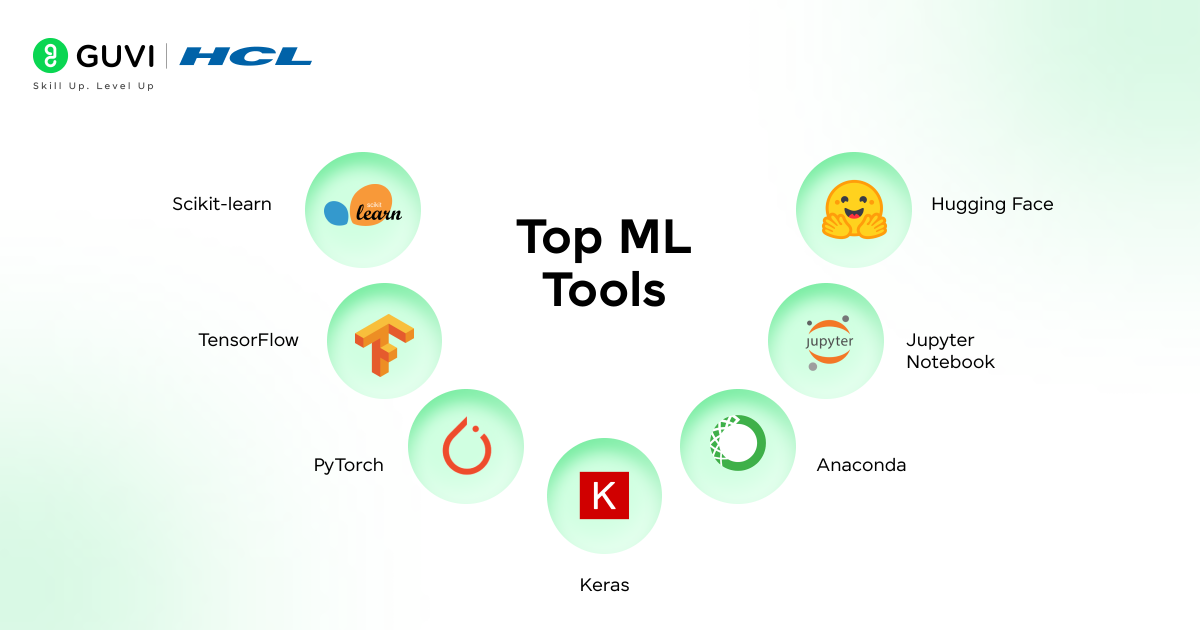
| Tool | Primary Purpose | Key Features | Best For |
| Scikit-learn | General ML | Extensive algorithms, data preprocessing tools | Beginners, structured data tasks |
| TensorFlow | Deep Learning | GPU acceleration, distributed computing, TensorBoard visualization | Production-ready models, large-scale applications |
| PyTorch | Deep Learning | Dynamic computation graph, TorchScript, TorchServe | Research, prototyping, NLP tasks |
| Keras | Neural Networks | High-level API, multiple backends, rapid prototyping | Quick model development, beginners |
| Anaconda | Environment | Pre-installed libraries, virtual environments | Package management, reproducible workflows |
| Jupyter Notebook | Development | Interactive coding, data visualization, Markdown support | Experimentation, sharing results |
| Hugging Face | NLP/Computer Vision | Pre-trained models, easy-to-use tools | Language processing, transformer models |
These tools collectively form an essential part of your machine learning cheat sheet, allowing you to move from theory to practice
Powered by Intel and backed by IIT-M Pravartak, HCL GUVI’s 6-month AI & ML Course provides live mentorship, real-world projects—including Generative and Agentic AI, MLOps, and cloud deployment to help aspiring professionals build a GitHub-ready portfolio and launch careers in high-demand fields.
Concluding Thoughts…
Machine learning cheat sheets serve as powerful tools for both beginners and experienced practitioners alike. Throughout this guide, you have seen how organized reference materials can transform your understanding of complex ML concepts. Having quick access to algorithms, formulas, evaluation metrics, and code snippets from a well-structured machine learning cheat sheet saves countless hours that would otherwise be spent searching through lengthy documentation or academic papers. Share this machine learning cheat sheet with your team or bookmark it for your next project.
Remember that machine learning is a rapidly evolving field. Consider updating your personal machine learning cheat sheet as new algorithms, tools, and best practices emerge. After all, the ultimate goal is to build a personalized machine learning cheat sheet that aligns with your specific needs and working style while keeping core ML concepts accessible whenever you need them. Good luck!
FAQs
Q1. What is the difference between supervised and unsupervised learning?
Supervised learning uses labeled data to train models that predict outputs, while unsupervised learning finds patterns in unlabeled data without predefined outputs. Supervised learning is used for tasks like classification and regression, whereas unsupervised learning is used for clustering and dimensionality reduction.
Q2. How do I choose the right machine learning algorithm for my problem?
Selecting the right algorithm depends on your data type, problem nature, and desired outcome. Consider factors like dataset size, feature complexity, and interpretability requirements. Refer to algorithm comparison tables and their strengths/weaknesses to make an informed decision based on your specific use case.
Q3. What are some common evaluation metrics for machine learning models?
Common evaluation metrics include accuracy, precision, recall, and F1 score for classification problems. For regression tasks, metrics like R-squared, Mean Absolute Error (MAE), and Root Mean Square Error (RMSE) are often used. The choice of metric depends on your specific problem and the importance of different types of errors.
Q4. How can I prevent overfitting in my machine learning models?
To prevent overfitting, you can use techniques like cross-validation, regularization (such as Lasso, Ridge, or Elastic Net), and early stopping. Additionally, ensuring you have sufficient training data, feature selection, and using ensemble methods like Random Forests can help create more generalized models.
Q5. What are some popular tools for implementing machine learning algorithms?
Popular tools for machine learning include Scikit-learn for general ML tasks, TensorFlow and PyTorch for deep learning, Keras for neural networks, and Jupyter Notebook for interactive development. These tools offer a range of features from data preprocessing to model deployment, catering to both beginners and experienced practitioners.
Success Stories

About the Author
Jebasta
I translate the language of data into stories that anyone can understand. As a writer with a data science background, I simplify analytics, AI, and decision-making so beginners and enthusiasts can confidently explore the world of data.
View all posts by Jebasta
Connect with me @











Did you enjoy this article?