


Artificial Intelligence and Machine Learning Articles
Finance Manager to Data Analytics: Career Growth, Salary and Seniority
How to Evaluate LLM Outputs in Production Deployments
AI/ML Skills Gap 2026: Why Companies Can't Find Job-Ready Talent
20 AI/ML Interview Questions Recruiters Can Use Without a Tech Background - Best Guide
Get In Touch For Details! Request More Information
A Beginner’s Guide to Artificial Intelligence, LLMs, and Prompting [2026]
Sep 17, 2026 5 Min Read 3575 Views
(Last Updated)
Ever wondered how a chatbot can write your emails, debug your code, and explain quantum physics, all from the same conversation window? That’s the combined power of Artificial Intelligence and Large Language Models at work.
Artificial Intelligence refers to machines simulating human-like thinking, while Large Language Models (LLMs) are a specific type of AI trained on massive text to understand and generate human-like language, guided by prompting. AI is transforming every industry, from chatbots to coding tools.
This guide breaks down the core ideas behind Artificial Intelligence, explains how prompting actually works, and covers what today’s LLMs like ChatGPT, Claude, and Gemini can genuinely do, and where they still fall short.
Table of contents
- TL;DR Summary
- What is Artificial Intelligence (AI)?
- What is Prompting in AI?
- Key AI Terminologies
- Types of AI: Where LLMs Actually Fit
- Understanding Large Language Models (LLMs)
- How LLMs Work:
- Comparing the Major LLMs
- Capabilities of Large Language Models (LLMs)
- Answer Questions Like a Chatbot
- Generate Code for Developers and Testers
- Write Emails, Reports, and Documentation
- Handle Multiple Content Types
- Best Practices for Effective Prompting
- Common Mistakes Beginners Make When Prompting
- Use Cases of LLMs
- Automation Code Generation
- Chat-Based User Support
- Email Drafting
- Educational Tutoring and Guidance
- Knowledge Summarization
- Limitations
- Concluding Thoughts…
TL;DR Summary
- What it is: AI simulates human-like thinking; LLMs are AI models trained on huge amounts of text to understand and generate language
- How you talk to it: prompting, giving clear instructions, questions, or context that shapes the AI’s response
- What LLMs can do well: answer questions, write code, draft documents, and summarize information at scale
- What actually changed the “can’t do” list: paired with agent frameworks and tools like MCP, modern LLMs can now browse, execute code, and call APIs, something base models alone still can’t do on their own
- Where it’s headed: the gap between “thinking” and “doing” is closing fast as agentic AI tools mature
What is Artificial Intelligence (AI)?
Artificial Intelligence refers to the simulation of human intelligence in machines. These systems are designed to think, respond, and act like humans. With the rise of AI tools, we now see machines that:
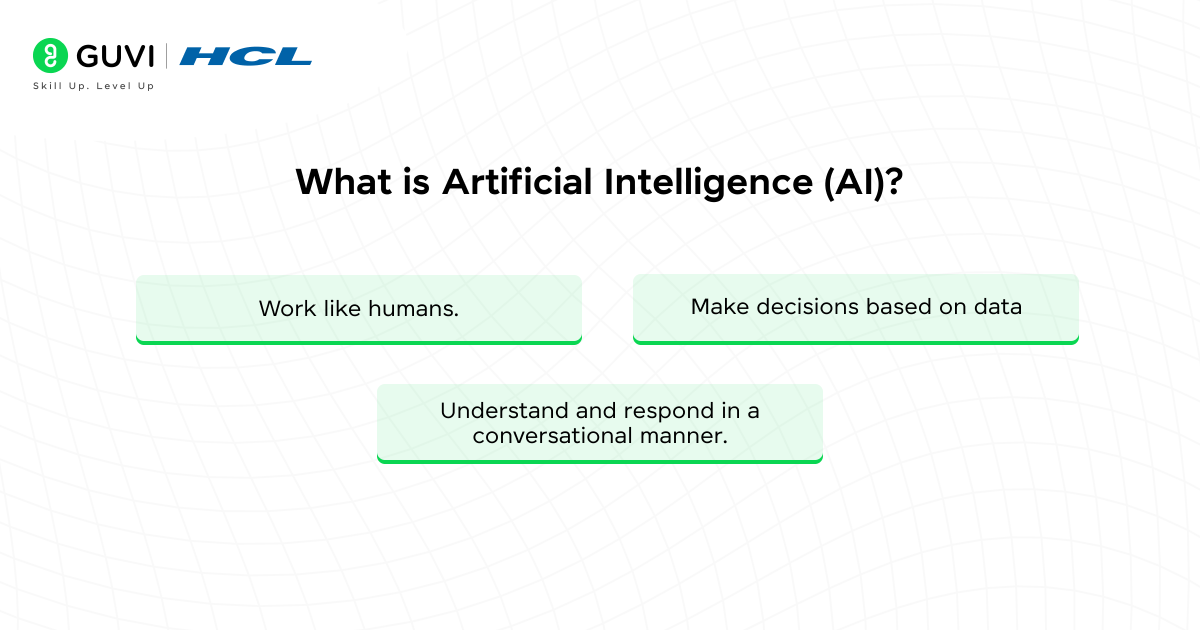
- Work like humans.
- Make decisions based on data.
- Understand and respond conversationally.
What is Prompting in AI?
Prompting is the way we communicate with Artificial Intelligence systems.
- It involves giving instructions, questions, or context to AI tools.
- AI responds based on the information or prompt it receives.
- Good prompts result in accurate and helpful responses.
Think of prompting like talking to a highly trained assistant, you give it a task, and it delivers based on what it knows.
Key AI Terminologies
Before diving deeper, let’s define some key terms:
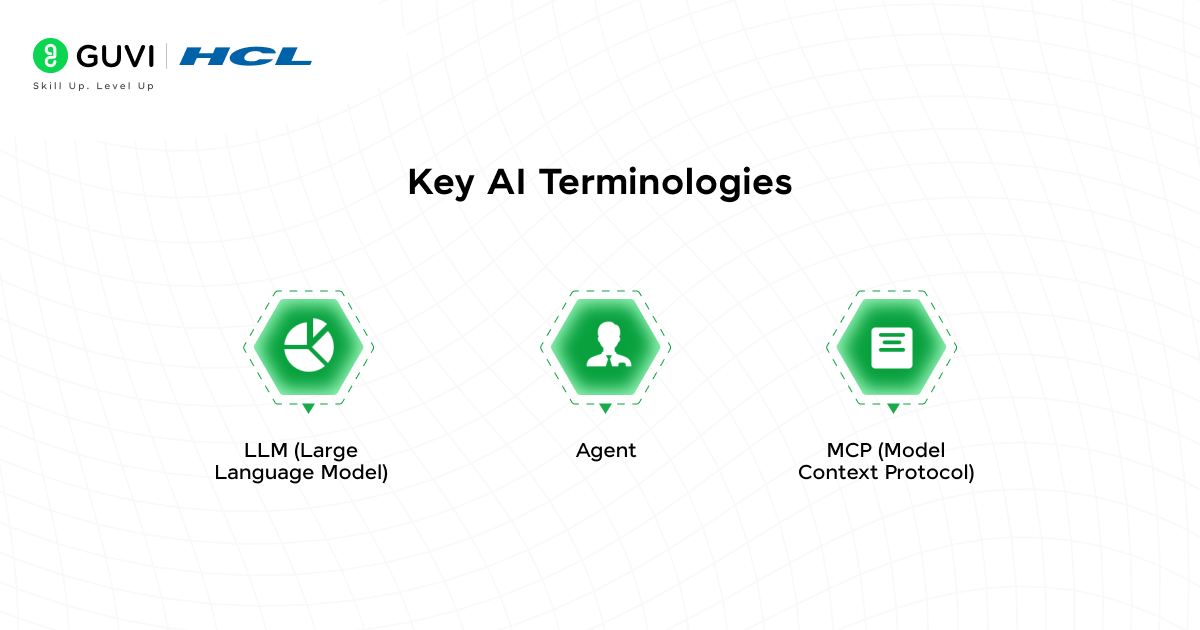
- LLM (Large Language Model): A system trained on massive datasets from the internet, capable of generating human-like text.
- Agent: A tool that works with LLMs to perform real-world actions.
- MCP (Model Context Protocol): A framework that connects AI models to real tools like browsers, APIs, and databases.
Types of AI: Where LLMs Actually Fit
Before going deeper into LLMs specifically, it helps to know where they sit within the broader Artificial Intelligence landscape, since these terms get used loosely and interchangeably.
| Type | What It Means | Real-World Example |
|---|---|---|
| Narrow AI | Built for one specific task, can’t generalize beyond it | Spam filters, recommendation engines, voice assistants |
| General AI (AGI) | Hypothetical AI matching human-level reasoning across any task | Doesn’t exist yet, still a research goal |
| Generative AI | AI that creates new content, text, images, audio, rather than just classifying or predicting | LLMs like ChatGPT, Claude, and Gemini fall here |
LLMs are a specific application of Generative AI, they’re still Narrow AI in the technical sense (extremely good at language tasks, not general reasoning across every domain), even though their output can feel remarkably general-purpose. Keeping this distinction in mind helps set realistic expectations for what these tools can and can’t reliably do.
Understanding Large Language Models (LLMs)
An LLM is a type of Artificial Intelligence model trained on enormous volumes of text data from sources like websites, books, and forums.
Popular LLMs include:
- ChatGPT
- Google Gemini
- Claude
- DeepSeek
How LLMs Work:
LLMs don’t think or reason like humans. Instead, they:
- Use training data to predict the best response.
- Respond based on patterns they’ve seen before.
Comparing the Major LLMs
Each major Artificial Intelligence provider takes a slightly different approach with their LLMs, and it’s worth knowing the general shape of each before picking one for a task.
| LLM | Developer | Known For |
|---|---|---|
| ChatGPT | OpenAI | Broad general-purpose use, one of the most widely adopted chat interfaces |
| Gemini | Deep integration with Google’s own products and search | |
| Claude | Anthropic | Strong instruction-following and careful, safety-focused responses |
| DeepSeek | DeepSeek | Open, cost-efficient models popular for research and experimentation |
Specific model versions and benchmark scores change too often to list reliably here, when comparing tools for a real project, it’s worth checking each provider’s current documentation directly rather than relying on a snapshot comparison.
Capabilities of Large Language Models (LLMs)
Large Language Models (LLMs) have evolved into versatile digital assistants capable of performing a wide range of cognitive tasks. Below is an in-depth look at what LLMs can do:
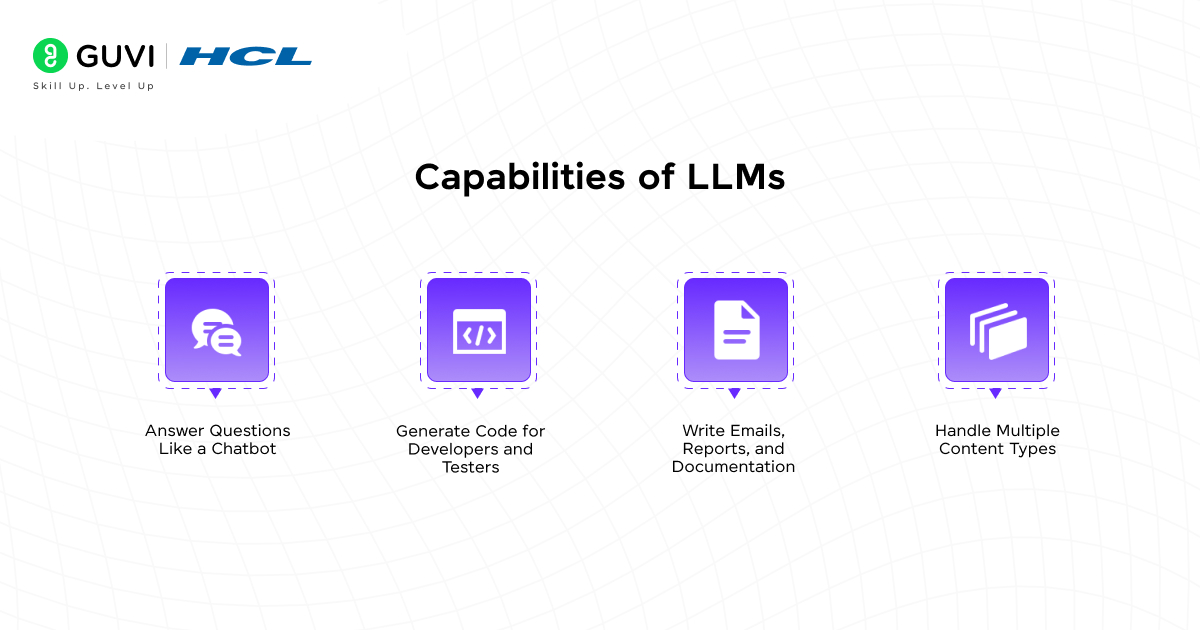
1. Answer Questions Like a Chatbot
LLMs excel at conversational interactions. They can:
- Respond to factual questions, such as “What is the capital of France?” or “Explain quantum computing.”
- Provide step-by-step explanations or instructions.
- Offer suggestions, summaries, and alternatives based on user intent.
- Maintain contextual continuity over multiple messages to simulate natural human-like conversation.
Unlike traditional chatbots that follow rigid scripts, LLMs dynamically generate responses, making interactions more fluid and intelligent.
2. Generate Code for Developers and Testers
LLMs like ChatGPT, GitHub Copilot, and Claude can:
- Write code snippets in various programming languages (Python, JavaScript, Java, C++, etc.).
- Refactor or optimize existing code.
- Generate test cases, automation scripts, and validation checks.
- Assist in writing SQL queries, API calls, and backend logic.
Developers and QA engineers can describe a coding task in natural language, and the LLM translates it into functional code, saving hours of manual effort.
3. Write Emails, Reports, and Documentation
LLMs are powerful tools for professional and business communication. They can:
- Draft emails tailored to tone (formal, persuasive, informative, friendly, etc.).
- Create structured reports with headings, subheadings, and bullet points.
- Summarize long-form documents into executive summaries.
- Generate technical documentation, how-to guides, and release notes.
This significantly boosts productivity for professionals who regularly produce written content.
4. Handle Multiple Content Types
Different LLMs support various data modalities:
- Text-only models: Generate and understand written language (e.g., GPT-3.5).
- Multimodal models: Accept and produce content in more than one format, such as:
- Text + Images (e.g., GPT-4o, Gemini): Analyze images, generate image captions, perform visual Q&A.
- Text + Audio/Video (e.g., Sora by OpenAI): Summarize spoken content, transcribe audio, describe video scenes.
- Text + Images (e.g., GPT-4o, Gemini): Analyze images, generate image captions, perform visual Q&A.
Multimodal LLMs expand Artificial Intelligence capabilities beyond language, enabling richer interactions and use in creative industries.

Best Practices for Effective Prompting
Since prompting is literally how you communicate with any Artificial Intelligence model, getting better at it directly improves the quality of everything you get back.
- Be specific about the output you want. “Write a product description” gets a generic result. “Write a 100-word product description for a wireless keyboard, targeting remote workers, in a friendly tone” gets something usable.
- Give context before asking the question. Explain who the response is for, what it’s being used for, and any constraints (length, format, tone) upfront.
- Break complex tasks into steps. Asking for a full research report in one prompt often produces shallow results; asking for an outline first, then expanding each section, usually works better.
- Iterate rather than expecting perfection on the first try. Treat the first response as a draft, then refine it with follow-up instructions.
- Provide examples when the format matters. Showing the AI one example of the output style you want is often more effective than describing it in words.
Common Mistakes Beginners Make When Prompting
Even with the best practices covered earlier, a few recurring habits trip up new users specifically.
- Being too vague and expecting a mind-reading result. “Make this better” gives the model nothing to work with. Specify what “better” actually means, shorter, more formal, more persuasive.
- Cramming everything into one massive prompt. Complex, multi-part requests often produce shallow, unfocused answers. Break the task into stages instead.
- Treating the first response as final. The real value of prompting shows up in the back-and-forth, refining, correcting, and narrowing down what you actually meant.
- Not specifying the format you need. If you want a table, a bulleted list, or a specific word count, say so explicitly, don’t assume the model will guess correctly.
- Trusting factual claims without verification. Especially for niche, recent, or high-stakes information, treat LLM output as a strong first draft, not a confirmed fact.
Use Cases of LLMs
LLMs are being applied across various industries and workflows. Here are some of the most impactful real-world applications:
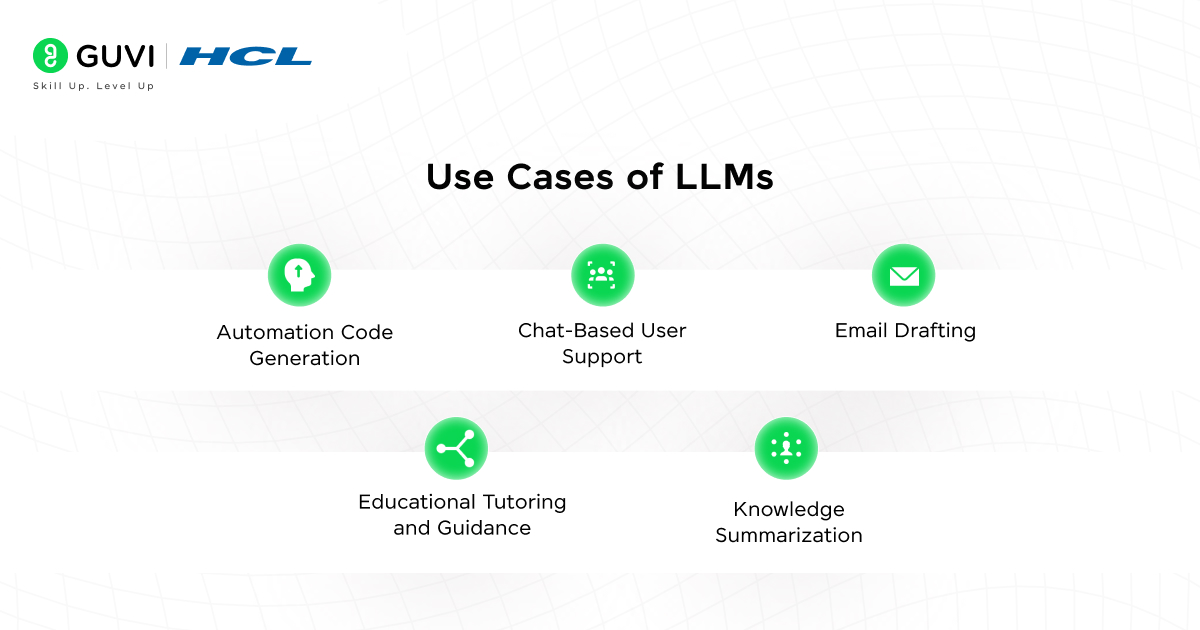
1. Automation Code Generation
LLMs can:
- Generate frontend and backend code from natural language requirements.
- Build UI components, validation scripts, and configuration files.
- Assist in DevOps automation (e.g., writing Dockerfiles, YAML configs).
Example: A QA engineer can prompt an LLM to “generate a Selenium test script to verify the login page,” and receive a working script instantly.
2. Chat-Based User Support
LLMs are transforming customer service by powering Artificial Intelligence chatbots that:
- Resolve common queries 24/7.
- Provide product recommendations based on user needs.
- Troubleshoot technical issues using historical knowledge and context.
Example: E-commerce websites use LLMs to help customers track orders, file complaints, or understand return policies—all via intelligent chat.
3. Email Drafting
For professionals, drafting emails is a daily task. LLMs help by:
- Creating personalized, professional email drafts based on brief prompts.
- Translating emails into different languages.
- Converting bullet points or notes into polished email messages.
Example: You can say, “Write a follow-up email thanking HR for the interview and requesting feedback,” and the LLM will generate a ready-to-send draft.
4. Educational Tutoring and Guidance
LLMs are revolutionizing personalized learning by:
- Explaining complex topics in simple terms.
- Offering quiz questions, flashcards, or summaries of chapters.
- Assisting with math problems, scientific explanations, or historical facts.
Example: A student can ask, “Explain Newton’s Second Law with examples,” and receive a tailored response with analogies and diagrams.
5. Knowledge Summarization
LLMs can distill large volumes of information into concise, digestible summaries:
- Summarize articles, research papers, legal documents, or meeting notes.
- Highlight key points and action items.
- Translate dense technical data into layman’s terms.
Example: Upload a 20-page technical report and ask the LLM to summarize the key findings for a presentation.
Limitations
Despite their power, LLMs:
- Can’t execute code or test cases.
- Can’t open browsers, click buttons, or connect to databases.
- Can’t access your local files or send API requests.
In short: LLMs are great at “thinking,” but not “doing.”
If you’re inspired to go beyond just using AI tools and want to build them yourself along with a 30 LPA career, GUVI’s IIT-M Certified Artificial Intelligence and Machine Learning Course is your ideal starting point. Learn core AI concepts, master real-world LLM applications, and gain hands-on experience with industry projects—no prior experience needed.
Concluding Thoughts…
As we’ve explored, Artificial Intelligence and Large Language Models aren’t just buzzwords—they’re foundational technologies driving the next wave of digital transformation. Whether you’re drafting emails, writing code, summarizing research, or building automation tools, LLMs offer scalable, intelligent support that enhances productivity across domains.
While these tools have limitations, their evolving capabilities promise a future where human-AI collaboration becomes the norm. By understanding how Artificial Intelligence and prompting work, you position yourself to use these tools effectively, not just as a user, but as a strategic thinker in the age of intelligent systems. Good Luck!
Success Stories

About the Author
Jebasta
I translate the language of data into stories that anyone can understand. As a writer with a data science background, I simplify analytics, AI, and decision-making so beginners and enthusiasts can confidently explore the world of data.
View all posts by Jebasta
Connect with me @














Did you enjoy this article?