


Project Articles
Automated Resume Screener: NLP-Based Python Project with Source Code
Business Analysis in Digital Transformation Projects - Best Guide
Build No-Code AI Agents with Flowise AI: Step-by-Step Beginner Guide


Get In Touch For Details! Request More Information

Data Structures and Algorithms Projects: 10 Ideas to Build Real Skills
Sep 17, 2026 5 Min Read 46206 Views
(Last Updated)
Data Structures and Algorithms Project Ideas give you a starting point, but building them is what turns theory into skills that stick. The ten picks in this guide range from beginner-friendly to genuinely challenging, so there’s something here whether you’re just starting out or prepping for interviews.
Most people learn DSA the hard way, watching tutorials, solving isolated problems, then forgetting half of it a month later. Projects fix that by forcing you to apply concepts together instead of in isolation, which is exactly what this list is built around.
Table of contents
- TL;DR Summary
- Top 10 Data Structure and AlgorithmsProject Ideas
- Social Media Friend Recommendation System
- Real-Time Stock Price Analysis
- Library Management System
- Movie Recommendation System Using Collaborative Filtering
- URL Shortener Service
- E-commerce Inventory Management System
- Data Compression Using Huffman Encoding
- Predictive Text Input Using Trie
- Job Scheduling Algorithm
- Chatbot with Real-Time Response Analysis
- Compare Data Structures and Algorithms Project Ideas by Complexity, Time & Concepts
- Conclusion
- FAQs
- What are some good Data Structures and Algorithms Project Ideas for beginners?
- How long does it take to complete a DSA project?
- Which programming languages are best for DSA projects?
- Are these DSA projects useful for interview preparation?
- Which Data Structures and Algorithms Project Ideas are best for advanced learners?
TL;DR Summary
- These Data Structures and Algorithms Project Ideas move you from just reading about DSA to actually applying it, which is where the real learning happens.
- The list covers a mix of beginner, intermediate, and advanced projects, so there’s an entry point no matter your current skill level.
- Several projects lean on graphs, hashing, and stacks in ways that mirror real products you already use.
- Advanced picks push you into trees, priority queues, and search algorithms for a deeper challenge.
- Each project comes with time estimates, complexity level, and source code, so you can pick one and start building right away.

Top 10 Data Structure and Algorithms Project Ideas
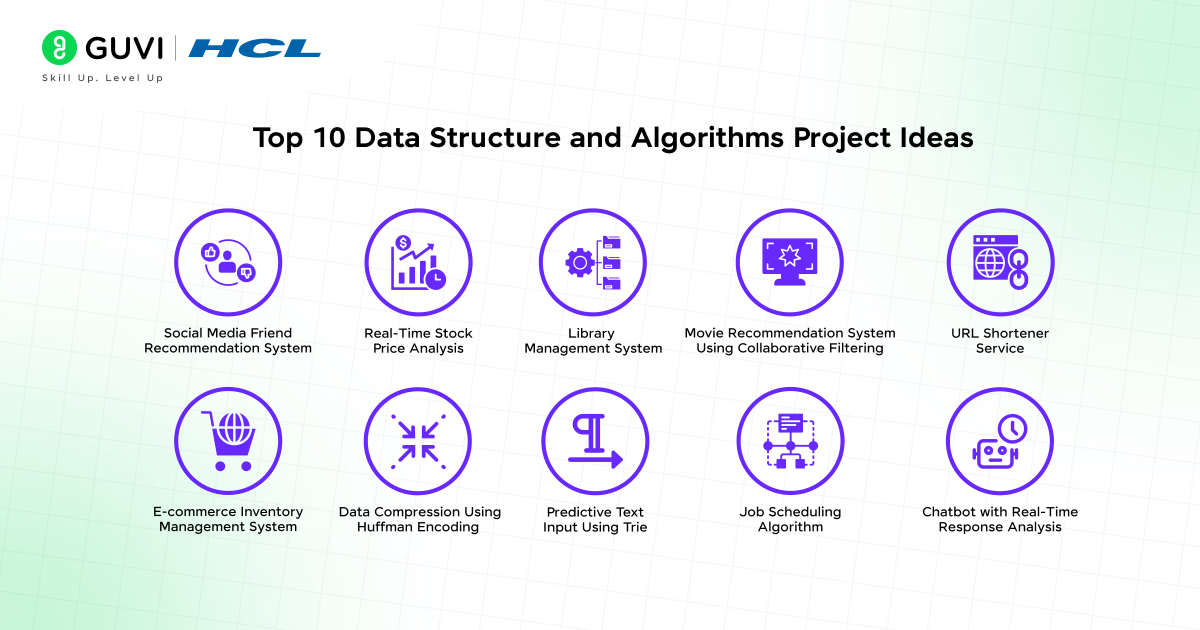
To make sure you don’t get stranded along the way, we’ve curated data structures and algorithms project ideas with varying complexities, learning outcomes, and programming languages to suit your skill level.
1. Social Media Friend Recommendation System
Social media platforms thrive on connections, and a friend recommendation system adds a personal touch by suggesting new people to connect with. This project involves implementing graph structures and algorithms that help find the shortest path between users and identify mutual connections and similar interests.
Time Taken: 1–2 weeks
Project Complexity: Intermediate
Learning Outcomes: This project will deepen your understanding of graph data structures, especially in terms of traversing nodes, calculating shortest paths, and analyzing relationship networks.
Features of the Project:
- Uses graph traversal and pathfinding algorithms
- Analyzes connections to provide friend recommendations
- Can be extended to include user preferences and interests
Programming Languages Used: Python, Java
Real-world Applications: This system replicates the recommendation engine behind platforms like Facebook and LinkedIn, where friend suggestions help users expand their network.
Source Code: Social Media Friend Recommendation System
Building real DSA projects is a strong start. HCL GUVI’s Software and AI Engineer Programme takes it further with hands-on training, mentor support from professionals at top companies, mock interviews, and placement guidance. Take the next step toward your tech career, enroll today!
2. Real-Time Stock Price Analysis

This project is designed to analyze real-time stock prices by processing incoming data, updating prices, and providing users with immediate feedback. Using heaps and sorting algorithms, you’ll create an application that efficiently tracks and displays live stock data, helping users monitor stock price trends.
Time Taken: 2–3 weeks
Project Complexity: Advanced
Learning Outcomes: This project will teach you how to work with heaps and sorting algorithms for real-time data handling. Additionally, you’ll gain experience managing large datasets and learn techniques for effective data filtering and sorting.
Features of the Project:
- Real-time stock price updates and analysis
- Sorting and filtering for trend analysis
- Option to set price alerts for significant changes
Programming Languages Used: Python, JavaScript
Real-world Applications: The project is ideal for applications in stock market analysis, e-commerce price tracking, and any industry that relies on real-time data monitoring.
Source Code: Real-Time Stock Price Analysis
Want to strengthen your DSA fundamentals before building these projects? Explore HCL GUVI’s Data Structures and Algorithms Handbook and build a strong foundation for coding interviews and real-world problem-solving.
3. Library Management System
Libraries depend on systematic organization and an efficient way to track books and users. This project involves designing a library management system that handles book borrow and return actions using stacks and queues, making it a simple yet practical project for DSA practice.
Time Taken: 1 week
Project Complexity: Beginner
Learning Outcomes: You’ll gain foundational knowledge of stacks and queues, as well as their practical applications in organizing and managing data.
Features of the Project:
- Tracks borrowed and available books
- Manages book borrow and return transactions
- Supports user and inventory management
Programming Languages Used: Java, C++
Real-world Applications: This project can be applied to small libraries, bookstores, or any scenario that requires organized inventory management.
Source Code: Library Management System
Also Read: Best DSA Roadmap Beginners Should Know
Preparing for coding interviews and product-based companies? Strengthen your problem-solving skills with the HCL GUVI’s Data Structures & Algorithms Tutorial covering searching, sorting, trees, graphs, recursion, time complexity, and real-world DSA concepts designed for aspiring software developers.
4. Movie Recommendation System Using Collaborative Filtering
Recommendation systems are everywhere, from Netflix to e-commerce sites. This project uses collaborative filtering and DSA principles like hash maps and arrays to develop a system that recommends movies based on user preferences and past behaviors.
Time Taken: 1–2 weeks
Project Complexity: Intermediate
Learning Outcomes: This project enhances your understanding of collaborative filtering, arrays, and hash maps while teaching you how to implement a basic recommendation engine.
Features of the Project:
- Recommends movies based on user interests
- Incorporates collaborative filtering techniques
- Scalable to include more recommendation parameters
Programming Languages Used: Python
Real-world Applications: Similar to recommendation engines used by platforms like Netflix and Amazon, this system personalizes content recommendations, enhancing user engagement.
Source Code: Movie Recommendation System
5. URL Shortener Service
With the popularity of platforms like Twitter, URL shorteners have become essential. This project will help you build a URL shortener service, which takes long URLs and converts them into shorter, easily shareable links using hash functions and stack operations.
Time Taken: 1–2 weeks
Project Complexity: Intermediate
Learning Outcomes: You’ll learn how to use hash functions, manage URL data with stacks, and understand how to handle data storage for quick retrieval.
Features of the Project:
- Converts long URLs to short, unique identifiers
- Supports URL tracking and expiration
- Provides analytics on URL usage
Programming Languages Used: JavaScript, Python
Real-world Applications: Commonly used in social media platforms and marketing campaigns, where easily shareable, trackable links are essential.
Source Code: URL Shortener Service
6. E-commerce Inventory Management System
Managing inventory is a crucial part of any e-commerce platform, and this project helps you build a system that organizes, tracks and updates inventory levels efficiently.
By implementing binary search trees and hashing, you’ll create a system that manages products and stock levels, making it easy to search and update inventory.
Time Taken: 2–3 weeks
Project Complexity: Advanced
Learning Outcomes: This project will strengthen your understanding of binary search trees, hashing, and efficient data storage. You’ll learn how to manage large datasets and perform quick lookups to enhance inventory management.

Features of the Project:
- Keeps track of product quantities and categories
- Efficiently searches for items and updates stock levels
- Can be extended with additional features like reorder alerts
Programming Languages Used: C++, Python
Real-world Applications: Ideal for e-commerce platforms, retail, and warehouse management where inventory must be kept updated in real-time.
Source Code: E-commerce Inventory Management System
Explore: 30 Sureshot DSA Interview Questions And Answers
7. Data Compression Using Huffman Encoding
Data compression is essential for saving storage and improving transfer times. This project involves implementing Huffman encoding, a tree-based compression algorithm that reduces data size.
You’ll develop a tool that compresses and decompresses text files, making them smaller and easier to store or transfer.
Time Taken: 1–2 weeks
Project Complexity: Advanced
Learning Outcomes: Through this project, you’ll gain an understanding of tree structures, encoding algorithms, and the principles behind data compression.
Features of the Project:
- Compresses text files using Huffman encoding
- Supports file decompression to the original size
- Optimizes storage usage and transfer speed
Programming Languages Used: C++, Python
Real-world Applications: Widely used in file compression (e.g., ZIP files) and image compression for reduced storage requirements.
Source Code: Data Compression Using Huffman Encoding
8. Predictive Text Input Using Trie
Predictive text input is a feature in search engines, text editors, and messaging apps. This project involves building a predictive text input system using the Trie data structure, enabling fast data retrieval based on the user’s input. Tries are ideal for this project because they efficiently store and search strings.
Time Taken: 1 week
Project Complexity: Intermediate
Learning Outcomes: This project will teach you about the Trie data structure and its applications in predictive text and autocomplete functionality.
Features of the Project:
- Predicts and suggests text based on partial input
- Supports dynamic text updates and additions
- Highly efficient for large word datasets
Programming Languages Used: Python, Java
Real-world Applications: Commonly used in search bars, mobile keyboards, and code editors to improve typing speed and accuracy.
Source Code: Predictive Text Input Using Trie
9. Job Scheduling Algorithm
Efficient task management is crucial in both operating systems and cloud applications. This project involves creating a job scheduling algorithm that assigns priorities and resources to various tasks using priority queues and sorting techniques, ensuring that tasks are completed in an optimized order.
Time Taken: 1–2 weeks
Project Complexity: Intermediate
Learning Outcomes: You’ll understand the importance of scheduling algorithms, priority queues, and efficient resource management in applications.
Features of the Project:
- Prioritizes tasks based on deadlines or resource needs
- Implements sorting and priority queue algorithms
- Scalable to handle various types of tasks and priorities
Programming Languages Used: C
Real-world Applications: Used in operating systems, cloud computing, and applications that require optimal resource allocation.
Source Code: Job Scheduling Algorithm
10. Chatbot with Real-Time Response Analysis
Chatbots are increasingly popular in customer service, and this project lets you create a bot with real-time response capabilities.
Using tree structures, priority queues, and search algorithms, you’ll build a chatbot that can analyze and respond to user queries instantly, offering relevant suggestions and support.
Time Taken: 2–3 weeks
Project Complexity: Advanced
Learning Outcomes: This project will enhance your understanding of real-time search algorithms, response prioritization, and the application of trees in building decision-making systems.
Features of the Project:
- Real-time query handling and response generation
- Learns and improves responses over time
- Can be extended with a knowledge base or FAQ integration
Programming Languages Used: Python, JavaScript
Real-world Applications: Used in customer support, e-commerce, and social media to provide quick and automated assistance.
Source Code: Chatbot with Real-Time Response Analysis
Compare Data Structures and Algorithms Project Ideas by Complexity, Time & Concepts
| Project | Complexity | Time Taken | Key Concepts Used | Languages | Best For |
|---|---|---|---|---|---|
| Social Media Friend Recommendation System | Intermediate | 1-2 weeks | Graph traversal, shortest path | Python, Java | Understanding graphs and network relationships |
| Real-Time Stock Price Analysis | Advanced | 2-3 weeks | Heaps, sorting algorithms | Python, JavaScript | Handling real-time data and trend analysis |
| Library Management System | Beginner | 1 week | Stacks, queues | Java, C++ | First-time DSA project practice |
| Movie Recommendation System Using Collaborative Filtering | Intermediate | 1-2 weeks | Hash maps, arrays | Python | Learning recommendation engine logic |
| URL Shortener Service | Intermediate | 1-2 weeks | Hash functions, stack operations | JavaScript, Python | Practicing hashing and data storage |
| E-commerce Inventory Management System | Advanced | 2-3 weeks | Binary search trees, hashing | C++, Python | Managing large datasets efficiently |
| Data Compression Using Huffman Encoding | Advanced | 1-2 weeks | Tree structures, encoding algorithms | C++, Python | Deep-diving into tree-based algorithms |
| Predictive Text Input Using Trie | Intermediate | 1 week | Trie data structure | Python, Java | Learning string search and storage |
| Job Scheduling Algorithm | Intermediate | 1-2 weeks | Priority queues, sorting | C | Understanding resource scheduling logic |
| Chatbot with Real-Time Response Analysis | Advanced | 2-3 weeks | Trees, priority queues, search algorithms | Python, JavaScript | Building decision-making systems |
Conclusion
These Data Structures and Algorithms Project Ideas give you a practical way to move from theory to real, applied skill. Pick one that matches where you are right now, whether that’s a beginner-friendly project like the Library Management System or something more advanced like the Chatbot with Real-Time Response Analysis, and build it end to end.
That hands-on process is what actually prepares you for interviews and real-world problem-solving, far more than passively reading about DSA ever will.
FAQs
1. What are some good Data Structures and Algorithms Project Ideas for beginners?
The Library Management System is a great beginner-friendly pick, using stacks and queues to manage book tracking.
2. How long does it take to complete a DSA project?
Most Data Structures and Algorithms Project Ideas take 1 to 3 weeks, depending on complexity.
3. Which programming languages are best for DSA projects?
Python, Java, and C++ are the most commonly used languages across these Data Structures and Algorithms Project Ideas.
4. Are these DSA projects useful for interview preparation?
Yes, building real projects strengthens problem-solving skills far more than just solving isolated coding problems
5. Which Data Structures and Algorithms Project Ideas are best for advanced learners?
Projects like Huffman Encoding and the Real-Time Chatbot are ideal for advanced learners looking for a bigger challenge.
Success Stories













Did you enjoy this article?