


Artificial Intelligence and Machine Learning Articles
Finance Manager to Data Analytics: Career Growth, Salary and Seniority
How to Evaluate LLM Outputs in Production Deployments
AI/ML Skills Gap 2026: Why Companies Can't Find Job-Ready Talent
20 AI/ML Interview Questions Recruiters Can Use Without a Tech Background - Best Guide


Get In Touch For Details! Request More Information
How to Become a Generative AI Engineer in 2026: Complete Roadmap
Sep 02, 2026 11 Min Read 17760 Views
(Last Updated)
Table of contents
- TL;DR Summary
- Understanding Generative AI Engineering
- What is Generative AI?
- Core Concepts
- Important Generative AI Model Types Beginners Should Know
- GANs
- VAEs
- Autoregressive Models
- Transformers
- What Should You Focus on in 2026?
- How Generative AI Works
- Data Preprocessing
- AI Model Training
- Identifying Patterns
- Probabilistic Data Generation
- Iterative Training with Feedback
- What is a Generative AI Engineer?
- Generative AI Engineer Responsibilities:
- Generative AI Technologies You Should Know in 2026
- Large Language Models
- Retrieval-Augmented Generation
- AI Agents
- Multimodal Models
- Small Language Models
- LLMOps
- Evaluation
- GenAI Engineer vs ML Engineer vs Data Scientist — How Roles Differ
- GenAI Engineer Salary in India 2026 by Experience
- Skills Required to Become a Generative AI Engineer in 2026.
- Programming Languages
- Understanding of Machine Learning Algorithms
- Deep Learning Techniques
- Natural Language Processing
- Strong Mathematical and Statistical Skills
- Experience with Data Engineering
- Model Deployment and Scaling
- Generative AI Engineer Education and Career Path
- Formal Education
- Online Courses and Certifications
- Career Path
- GenAI Engineer Roadmap: Month 1 Python + ML to Month 6 LLM Deployment
- Month 1: Learn Python, Math, and ML Basics
- Month 2: Learn Deep Learning and NLP Foundations
- Month 3: Learn LLMs and Prompt Engineering
- Month 4: Build RAG Systems and Use Vector Databases
- Month 5: Learn Fine-Tuning, Evaluation, and Responsible AI
- Month 6: Deploy Your LLM App and Learn LLMOps
- 6-Month GenAI Engineer Roadmap Summary
- Common Mistakes to Avoid While Becoming a GenAI Engineer
- Learning Only Prompt Engineering
- Skipping Machine Learning Basics
- Building Only Demo Chatbots
- Ignoring Evaluation and Hallucination Testing
- Not Learning Deployment
- Build GenAI Engineering Skills With HCL GUVI
- Conclusion
- FAQs
- What is the salary of a generative AI engineer?
- What is generative AI engineering?
- How do you become a generative AI engineer?
- What programming language is used in generative AI?
- Is there any certification for Generative AI?
- What is the best roadmap to become a Generative AI Engineer in 2026?
- How much does a GenAI Engineer earn in India in 2026?
- Is a GenAI Engineer different from an ML Engineer?
- Do I need deep learning to become a Generative AI Engineer?
- What projects should I build to become a GenAI Engineer?
- Can freshers become Generative AI Engineers?
TL;DR Summary
To become a Generative AI Engineer in 2026, start with Python, statistics, machine learning, and deep learning basics. Then learn LLMs, prompt engineering, embeddings, vector databases, RAG, LangChain or LlamaIndex, model evaluation, APIs, cloud deployment, and responsible AI. Build projects like a RAG chatbot, AI document assistant, code review assistant, or GenAI customer support bot. In India, Generative AI engineers can earn higher salaries when they have hands-on LLM, RAG, fine-tuning, and deployment experience.
Generative AI Engineer has become one of the most in-demand AI career paths in 2026 because companies now want professionals who can build, customize, evaluate, and deploy LLM-powered applications.
This role is not only about knowing machine learning. You also need Python, ML basics, prompt engineering, RAG, vector databases, APIs, cloud deployment, and responsible AI practices.
In this updated roadmap, you will learn the exact skills, monthly learning path, salary range in India, role differences, and project ideas needed to become a Generative AI Engineer in 2026.
Understanding Generative AI Engineering
What is Generative AI?
Generative AI refers to a category of artificial intelligence models designed to generate new content, such as images, text, or music, that mimics human creation.
Unlike traditional AI systems that focus on analysis and prediction, generative AI models are designed to produce original outputs based on patterns in existing data.
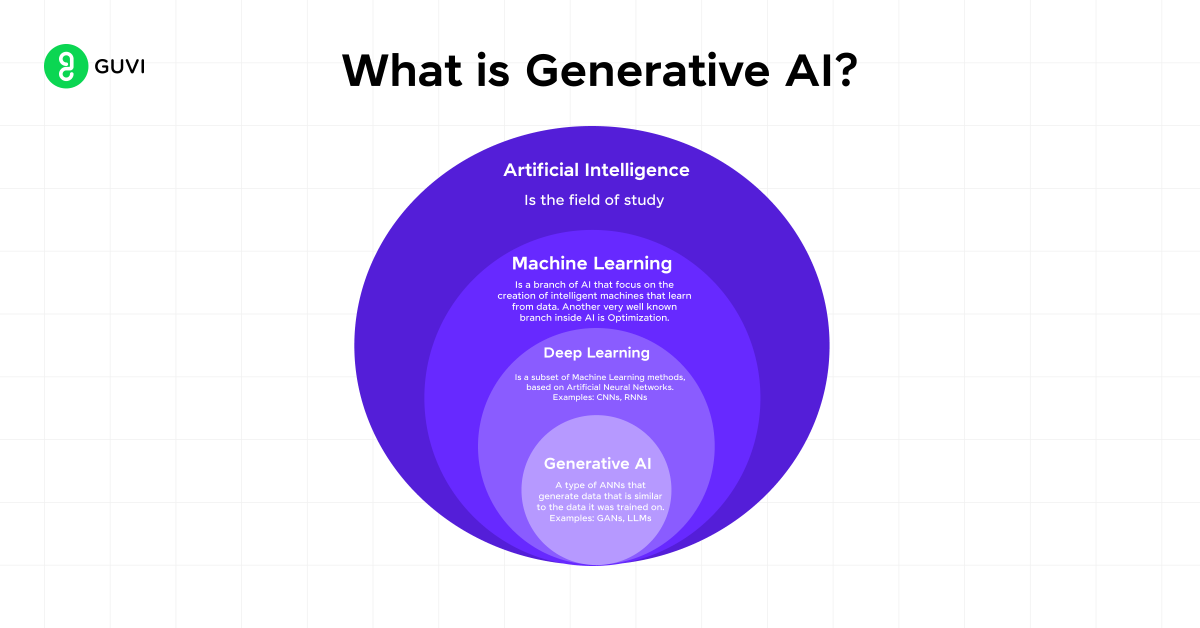
These models learn patterns from existing data and then use this knowledge to produce new outputs that are often indistinguishable from human-made content.
Core Concepts
- Generative Models: Algorithms that generate new data instances from an existing dataset. Common examples include Generative Adversarial Networks (GANs), Variational Autoencoders (VAEs), and transformer-based models.
- Training and Inference: Generative AI models undergo training where they learn to map input data to output data, followed by inference where they generate new data based on the learned patterns.
Would you like to master Generative AI with top experts in the field and build real-world projects? Then HCL GUVI’s Generative AI course will be the perfect resource for you!
Important Generative AI Model Types Beginners Should Know
Before learning modern GenAI engineering tools, it helps to understand a few basic model types. You do not need to go too deep into these as a beginner, but knowing what they mean will help you understand how Generative AI evolved.
1. GANs
GANs, or Generative Adversarial Networks, use two neural networks that work against each other. One network creates new output, while the other checks whether the output looks real or fake.
GANs are commonly used for image generation, image enhancement, and synthetic data creation.
2. VAEs
VAEs, or Variational Autoencoders, learn patterns from data and generate new outputs that are similar to the original data.
They are often used in image generation, data compression, anomaly detection, and creative AI tasks.
3. Autoregressive Models
Autoregressive models generate output one step at a time by predicting the next part based on previous parts.
For example, in text generation, the model predicts the next word or token based on the words that came before it.
4. Transformers
Transformers are one of the most important architectures behind modern Generative AI. They help models understand context, relationships, and meaning in text or other data.
Many modern Large Language Models, or LLMs, are based on transformer architecture.
What Should You Focus on in 2026?
GANs, VAEs, autoregressive models, and transformers are useful foundations. However, if your goal is to become a Generative AI Engineer in 2026, you should spend more time learning practical technologies like LLMs, RAG, AI agents, multimodal models, small language models, LLMOps, and evaluation.
How Generative AI Works
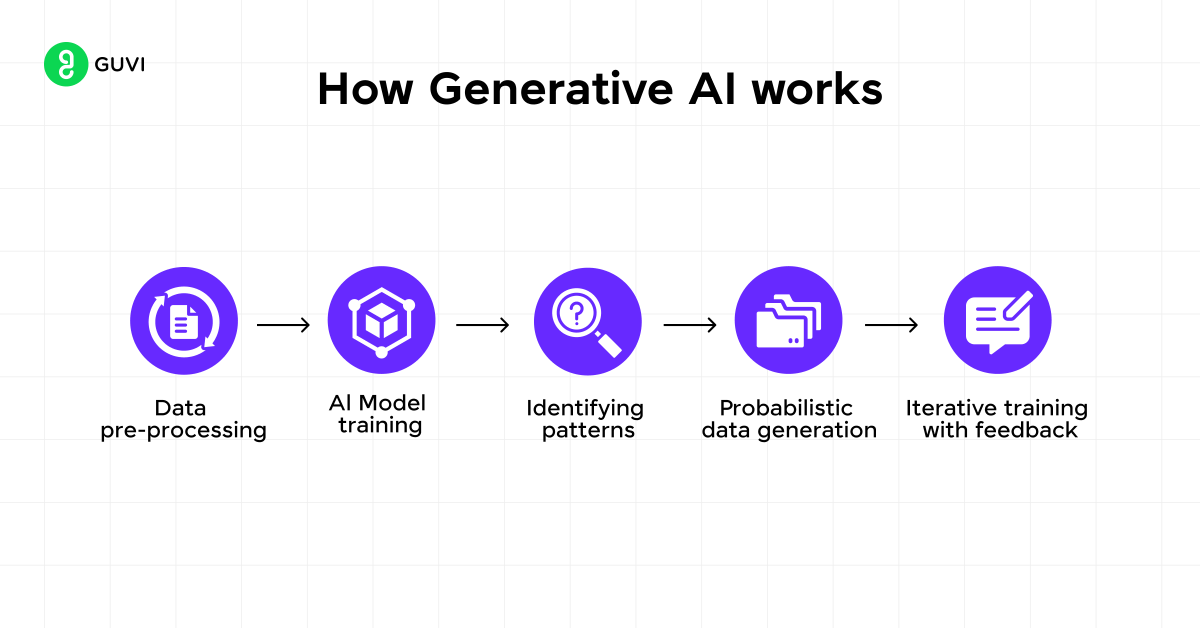
1. Data Preprocessing
Data preprocessing is the foundational step in generative AI that involves cleaning, transforming, and organizing raw data into a format suitable for training AI models. This step includes tasks such as data normalization, handling missing values, and feature extraction.
For generative AI models, especially those dealing with images, text, or audio, preprocessing ensures that the input data is consistent, reducing noise and enhancing the model’s ability to learn relevant patterns. Techniques like tokenization for text data, resizing and normalization for images, and filtering for audio are commonly employed.
2. AI Model Training
AI model training is the core phase where the generative model learns to map input data to output data by adjusting its parameters through iterative optimization. In generative models like GANs (Generative Adversarial Networks) or VAEs (Variational Autoencoders), the training involves two networks: a generator and a discriminator for GANs, or an encoder and a decoder for VAEs.
The model uses backpropagation and gradient descent to minimize the loss function, which measures the difference between the generated output and the actual data. The model continuously updates its weights to improve its accuracy in generating new, realistic data.
3. Identifying Patterns
Once trained, the AI model identifies complex patterns and structures within the data. For instance, in image generation, the model recognizes spatial hierarchies and textures, while in text generation, it captures syntactic and semantic relationships.
This pattern identification is crucial as it allows the model to understand the underlying distribution of the data, enabling it to generate outputs that are not just random but meaningful and contextually accurate. Deep neural networks, especially those with multiple layers, are adept at capturing such intricate patterns.
4. Probabilistic Data Generation
Generative AI models rely on probabilistic methods to generate new data samples. Instead of producing deterministic outputs, these models use learned probability distributions to create variations of the input data. For example, in text generation, models like GPT (Generative Pre-trained Transformer) use probability distributions over vocabulary tokens to predict the next word in a sequence.
In GANs, the generator creates data samples from a latent space (a compressed representation of the data) and tries to make them indistinguishable from real data. This probabilistic approach allows for diverse and creative outputs.
5. Iterative Training with Feedback
In iterative training, the model is continuously refined through feedback loops. For instance, in GANs, the discriminator provides feedback to the generator on how realistic its outputs are, prompting the generator to improve. This feedback-driven process is repeated over many iterations, allowing the model to enhance its performance gradually.
The iterative nature of this training ensures that the model not only learns from the initial data but also adapts and improves over time, leading to more accurate and realistic generative outputs. Additionally, techniques like reinforcement learning can be integrated to optimize the model further based on the rewards or penalties received during training.
What is a Generative AI Engineer?
A Generative AI Engineer is a specialized professional who designs, implements, and optimizes generative models. These engineers work at the intersection of machine learning, data science, and software engineering to create AI systems that can autonomously generate new content.
Generative AI Engineer Responsibilities:
- Model Development: Creating and fine-tuning generative models such as GANs, VAEs, and transformers.
- Data Management: Handling large datasets required for training generative models, including data preprocessing and augmentation.
- Model Deployment: Integrating generative AI models into production environments, ensuring scalability and efficiency.
- Optimization: Continuously improving model performance through techniques like hyperparameter tuning and model pruning.
- Collaboration: Working with data scientists, software developers, and domain experts to align AI models with business goals.
Generative AI Technologies You Should Know in 2026
Earlier, Generative AI learning focused on GANs, VAEs, autoregressive models, and transformers. These are still useful basics, but a Generative AI Engineer in 2026 should focus more on practical technologies used in real AI products.
1. Large Language Models
LLMs generate text, code, summaries, answers, and instructions. A Generative AI Engineer should understand tokens, context windows, prompts, structured outputs, and hallucinations.
2. Retrieval-Augmented Generation
RAG helps AI systems answer using trusted documents or private business data. It is important for building chatbots, document assistants, and enterprise AI tools.
3. AI Agents
AI agents can follow steps, use tools, call APIs, and complete tasks with human supervision. Beginners should first learn simple tool-calling workflows.
4. Multimodal Models
Multimodal models can work with text, images, audio, video, or documents. They are useful for invoice reading, document automation, healthcare, education, and customer support.
5. Small Language Models
Small Language Models are faster, cheaper, and easier to run for specific use cases. They are useful when a large model is not required.
6. LLMOps
LLMOps covers deployment, monitoring, logging, cost tracking, prompt versioning, and performance checks. It helps GenAI apps work reliably for real users.
7. Evaluation
Evaluation checks whether a GenAI system gives accurate, useful, safe, and relevant answers. This is what separates a basic demo from a production-ready AI application.
GenAI Engineer vs ML Engineer vs Data Scientist — How Roles Differ
A GenAI Engineer, ML Engineer, and Data Scientist may all work with AI, but their day-to-day work is different.
A Generative AI Engineer focuses on building LLM-powered applications, RAG systems, AI agents, prompt workflows, and deployed GenAI products. An ML Engineer focuses on training, optimizing, and deploying machine learning models. A Data Scientist focuses on extracting insights, testing hypotheses, and helping businesses make data-driven decisions.
| Role | Main Focus | Common Work | Tools Used | Best For |
| GenAI Engineer | LLM-powered applications | RAG apps, AI agents, prompt workflows, LLM APIs, evaluation | Python, LangChain, LlamaIndex, vector DBs, FastAPI, cloud | Building AI products with LLMs |
| ML Engineer | Machine learning systems | Model training, feature engineering, model deployment, MLOps | Python, Scikit-learn, PyTorch, TensorFlow, MLflow, Docker | Building and scaling ML models |
| Data Scientist | Business insights and predictions | Data analysis, dashboards, experiments, predictive models | SQL, Python, R, Power BI, Tableau | Solving business problems with data |
GenAI Engineer Salary in India 2026 by Experience
Generative AI engineer salary in India depends on experience, project portfolio, company type, city, and production skills such as RAG, LLMOps, cloud deployment, and fine-tuning.
Salary ranges can change based on hiring demand and company budgets, so use these figures as practical market benchmarks, not fixed guarantees.
| Experience Level | Expected Salary Range in India | What Employers Usually Expect |
| Fresher / 0–1 year | ₹6–12 LPA | Python, ML basics, prompt engineering, 1–2 GenAI projects |
| Junior GenAI Engineer / 1–3 years | ₹10–20 LPA | RAG projects, APIs, vector databases, deployment basics |
| Mid-Level GenAI Engineer / 3–5 years | ₹18–35 LPA | LLM app development, evaluation, cloud deployment, production experience |
| Senior GenAI Engineer / 5–8 years | ₹35–60 LPA | Architecture, LLMOps, fine-tuning, cost optimization, team ownership |
| Lead / Architect Level / 8+ years | ₹60 LPA+ | AI strategy, enterprise architecture, governance, scalable GenAI systems |
Taggd’s 2026 AI salary guide reports that Generative AI engineers in India earn ₹20–70 LPA across mid-to-senior levels, while entry-level GenAI roles start around ₹8–12 LPA for freshers with relevant project exposure.
Skills Required to Become a Generative AI Engineer in 2026.
To become a generative AI engineer, you need to develop a strong foundation in various technical areas. Let’s explore the key skills and knowledge required to excel in this field.
| Skill | Foundational/Advanced | Time to Learn | Resources |
| Python Programming | Foundational | 4–6 weeks | Python basics, functions, OOP, APIs |
| Statistics and Probability | Foundational | 3–4 weeks | Distributions, regression, evaluation metrics |
| Machine Learning Basics | Foundational | 6–8 weeks | Supervised learning, unsupervised learning, model evaluation |
| Deep Learning | Foundational to Advanced | 6–8 weeks | Neural networks, transformers, PyTorch or TensorFlow |
| NLP Fundamentals | Foundational | 4–6 weeks | Tokenization, embeddings, text classification |
| LLM Concepts | Advanced | 3–4 weeks | Tokens, context windows, temperature, model selection |
| Prompt Engineering | Foundational | 2–3 weeks | Prompt patterns, few-shot prompting, structured outputs |
| RAG Systems | Advanced | 4–6 weeks | Embeddings, vector databases, retrieval pipelines |
| LangChain or LlamaIndex | Advanced | 3–4 weeks | LLM workflows, document loaders, chains, agents |
| Vector Databases | Advanced | 2–3 weeks | FAISS, Chroma, Pinecone, Weaviate |
| Fine-Tuning Basics | Advanced | 4–6 weeks | LoRA, PEFT, instruction tuning, dataset preparation |
| Model Evaluation | Advanced | 3–4 weeks | Hallucination checks, answer quality, latency, cost |
| APIs and Backend Development | Foundational | 4–6 weeks | FastAPI, Flask, REST APIs |
| Cloud and Deployment | Advanced | 4–6 weeks | Docker, AWS, Azure, GCP, model serving |
| Responsible AI | Foundational | 2–3 weeks | Bias, privacy, safety, explainability |
1. Programming Languages
Proficiency in programming languages is crucial for generative AI engineering.
- Python: Python is the most widely used language in AI and machine learning, thanks to its extensive libraries like TensorFlow, PyTorch, and Keras. Python is essential for implementing and experimenting with generative models.
- C++/Java: These languages are important for performance optimization and integrating AI models into production systems where speed and efficiency are critical.
- R: Useful for statistical analysis and data manipulation, especially in the initial stages of data preprocessing.
2. Understanding of Machine Learning Algorithms
- Supervised and Unsupervised Learning: Understanding the basics of these algorithms is crucial for building and refining models.
- Reinforcement Learning: Essential for certain types of generative models, especially in game theory and decision-making processes.
- Generative Models: Profound knowledge of models like GANs, VAEs, and Diffusion Models, and how they are constructed and fine-tuned.
3. Deep Learning Techniques
Deep learning plays a vital role in generative AI, enabling the creation of complex models capable of learning intricate patterns. You should have a solid understanding of neural network architectures, including:
- Convolutional Neural Networks (CNNs) for image-related tasks
- Recurrent Neural Networks (RNNs) for sequential data processing
- Long Short-Term Memory Networks (LSTMs) for handling long-term dependencies
- Transformer Networks for natural language processing tasks
4. Natural Language Processing
As a generative AI engineer, you’ll often work with text data, making Natural Language Processing (NLP) skills crucial.
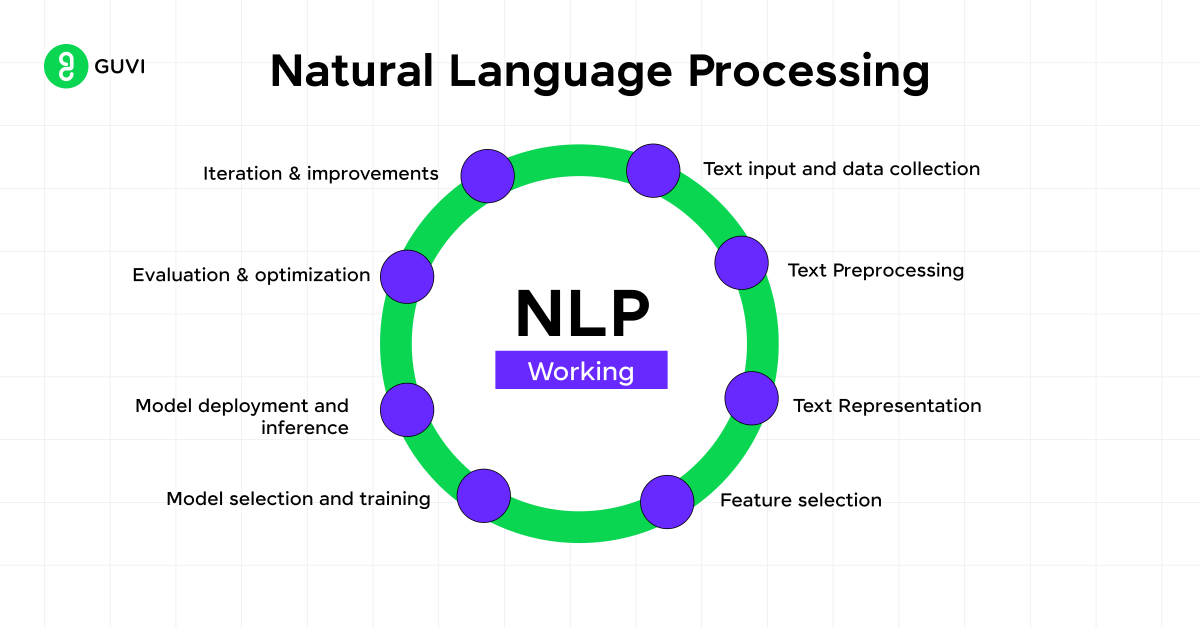
NLP enables machines to comprehend, interpret, and respond to human language. Key areas to focus on include:
- Text classification and sentiment analysis
- Named entity recognition
- Machine translation
- Text generation and summarization
5. Strong Mathematical and Statistical Skills
- Linear Algebra and Calculus: These are the backbones of machine learning algorithms. Understanding matrix operations, differentiation, and integration is essential for model development.
- Probability and Statistics: Key to understanding data distributions, which is critical when designing generative models.
- Optimization Techniques: Knowledge of gradient descent, backpropagation, and other optimization algorithms used in training AI models.
6. Experience with Data Engineering
- Data Preprocessing: Skills in cleaning, transforming, and organizing large datasets are vital since generative models often require vast amounts of data for training.
- Big Data Technologies: Familiarity with tools like Hadoop, Spark, and Apache Kafka for handling and processing big data efficiently.
7. Model Deployment and Scaling
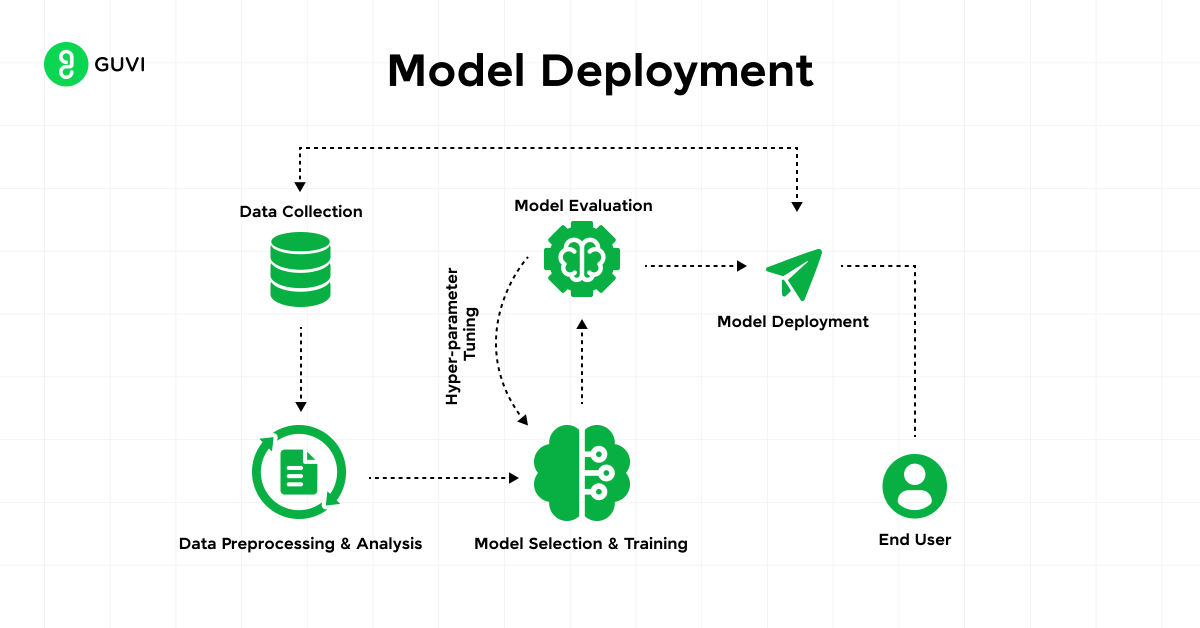
- Cloud Platforms: Experience with AWS, Google Cloud, or Azure for deploying models in a scalable and efficient manner.
- Containerization: Knowledge of Docker and Kubernetes to ensure that AI models are portable and can be easily deployed across different environments.
- APIs: Proficiency in building and consuming APIs, enabling integration of AI models into applications and systems.
By mastering these essential skills and knowledge areas, you’ll be well-equipped to tackle the challenges and opportunities in generative AI engineering.
IBM explains that generative AI can create original content such as text, images, video, audio, or software code in response to a prompt. It also notes that Gartner projected more than 80% of organizations would have deployed generative AI applications or used GenAI APIs by 2026.
Generative AI Engineer Education and Career Path
To become a generative AI engineer, you’ll need to follow a structured educational path and gain relevant experience. Here’s a breakdown of the key steps:

1. Formal Education
Bachelor’s Degree:
- Most Generative AI Engineers begin with a Bachelor’s degree in Computer Science, Data Science, Artificial Intelligence, Electrical Engineering, or a related field. These programs provide a strong foundation in programming, mathematics, and core AI concepts.
- Alternatively, a degree in mathematics or statistics can also be beneficial, especially for roles focused on the theoretical aspects of AI.
- The focus is on courses like Data Structures, Algorithms, Linear Algebra, Probability, and Statistics. Additionally, courses in Machine Learning, Deep Learning, and Neural Networks as we discussed in the skills section are highly recommended.
Master’s Degree (Optional but Advantageous):
- Pursuing a Master’s degree in AI, Machine Learning, or a specialized field such as Computational Neuroscience or Robotics can significantly enhance your expertise and job prospects.
- A Master’s program often offers opportunities to engage in research, where you can work on cutting-edge AI projects, contribute to academic papers, and deepen your understanding of generative models.
2. Online Courses and Certifications
To enhance your skills and credentials, consider pursuing relevant certifications:
- HCL GUVI AI/ML Career Program: This online AI/ML course can be accessed from anywhere, making it ideal for learners with varying schedules. The course is designed and delivered by industry experts, where you gain real-world skills, build capstone projects, and get extensive placement support.
- Google AI Certification: Google offers professional certifications in Machine Learning and AI, which are well-regarded in the industry and can enhance your resume.
- IBM AI Engineering: This certification covers various aspects of AI, including generative models and their applications in the industry.
- Certified Generative AI Specialist (CGAI): This certification focuses on the practical aspects of generative AI, including the development and deployment of generative models. It’s a valuable credential for showcasing specialized skills in generative AI.
These certifications validate your knowledge and can make you more attractive to employers.
3. Career Path
a. Entry-Level Positions
- Roles: Start as a Machine Learning Engineer, Data Scientist, or AI Developer. Focus on learning the practical aspects of AI, including data preprocessing, model building, and deployment.
- Skills: During this phase, you’ll gain experience in coding, working with AI frameworks, and understanding real-world data challenges.
b. Mid-Level Positions
- Roles: Progress to roles like Generative AI Engineer, AI/ML Developer, or Senior Data Scientist, where you’ll take on more complex projects and lead AI model development.
- Skills: Expertise in deep learning, generative models, and big data technologies. Leadership and project management skills become increasingly important.
c. Senior-Level Positions
- Roles: Advance to positions like AI Research Scientist, Lead AI Engineer, or AI Architect, where you’ll be responsible for pioneering new AI technologies, managing teams, and driving AI strategy within organizations.
- Skills: At this stage, a deep understanding of AI ethics, scalability, and the business impact of AI solutions is essential.
GenAI Engineer Roadmap: Month 1 Python + ML to Month 6 LLM Deployment
A good roadmap to become a generative AI engineer should move from foundations to real deployment. The goal is not just to learn AI concepts, but to build GenAI applications that can work reliably for real users.
Month 1: Learn Python, Math, and ML Basics
Start with Python and basic machine learning. A generative AI engineer does not need to become a math expert first, but you should understand how models learn from data.
Focus on:
- Python functions, loops, OOP, and file handling
- NumPy, Pandas, and data cleaning
- Basic statistics and probability
- Regression and classification
- Model evaluation basics
- Git and GitHub basics
Project to build:
Create a customer review sentiment classifier using Python and machine learning.
You can also strengthen your base with GUVI’s guide on how much coding is required for AI and LLM jobs.
Month 2: Learn Deep Learning and NLP Foundations
Once your Python and ML basics are clear, move to deep learning and NLP. This helps you understand how modern GenAI systems process language.
Focus on:
- Neural networks
- PyTorch or TensorFlow basics
- Tokenization
- Embeddings
- Attention mechanism basics
- Transformer architecture basics
- Text classification and summarization
Project to build:
Create a text summarizer or FAQ classification model.
This month builds the foundation for understanding LLMs, RAG, and AI agents later.
Month 3: Learn LLMs and Prompt Engineering
Now start learning how Large Language Models work. This is where your journey becomes more specific to becoming a generative AI engineer.
Focus on:
- Tokens and context windows
- Temperature and top-p
- System prompts
- Few-shot prompting
- Chain-of-thought style reasoning prompts
- Structured outputs
- JSON responses
- Tool calling basics
Project to build:
Build an AI writing assistant that takes a topic and returns output in a fixed format, such as title, outline, summary, and FAQs.
For deeper practice, use GUVI’s guide on Python prompt engineering techniques and the beginner-friendly guide on artificial intelligence, LLMs, and prompting.
Month 4: Build RAG Systems and Use Vector Databases
In real companies, GenAI apps often need to answer from private documents, product manuals, policies, reports, or customer data. This is where Retrieval-Augmented Generation, or RAG, becomes important.
Focus on:
- Embeddings
- Chunking documents
- Vector search
- Vector databases like FAISS, Chroma, Pinecone, or Weaviate
- LangChain or LlamaIndex
- PDF/document loaders
- Retrieval quality
- Source-based answers
Project to build:
Create a RAG chatbot that answers questions from PDFs, company documents, or course material.
You can link this section with GUVI’s guide on building a RAG app with Python and LangChain.
Month 5: Learn Fine-Tuning, Evaluation, and Responsible AI
By Month 5, you should learn how to improve and test GenAI systems. Many beginners build chatbots, but very few know how to evaluate whether the output is correct, useful, safe, and consistent.
Focus on:
- When to use fine-tuning vs RAG
- LoRA and PEFT basics
- Dataset preparation
- Prompt testing
- LLM evaluation
- Hallucination checks
- Bias and safety checks
- Cost and latency tracking
Project to build:
Create a domain-specific assistant and add an evaluation report that checks answer quality, hallucinations, and response consistency.
For extra depth, add GUVI’s guide on fine-tuning a small LLM with Python and Hugging Face and LLM evaluation framework.
Month 6: Deploy Your LLM App and Learn LLMOps
The final month should focus on deployment. A generative AI engineer must know how to move a project from notebook or local testing to a usable application.
Focus on:
- FastAPI or Flask
- REST APIs
- Docker basics
- Cloud deployment
- API security
- Logging and monitoring
- Prompt versioning
- User feedback loops
- Cost and latency monitoring
- Basic LLMOps workflow
Project to build:
Deploy a production-style RAG app with an API, simple frontend, authentication, logging, and monitoring.
For practical project inspiration, you can also explore GUVI’s guide on custom LLM-powered chat app using Chainlit and project ideas using large language models.
6-Month GenAI Engineer Roadmap Summary
| Month | What to Learn | Main Outcome | Project to Build |
| Month 1 | Python, math, ML basics | Understand data and ML fundamentals | Sentiment classifier |
| Month 2 | Deep learning and NLP | Understand language processing | Text summarizer |
| Month 3 | LLMs and prompting | Control LLM outputs better | AI writing assistant |
| Month 4 | RAG and vector databases | Build document-based AI apps | PDF RAG chatbot |
| Month 5 | Fine-tuning and evaluation | Improve and test GenAI systems | Domain assistant with evaluation |
| Month 6 | Deployment and LLMOps | Ship a usable AI application | Deployed RAG app |
By the end of this roadmap, you should have at least 3–4 portfolio projects, one deployed GenAI application, and a clear understanding of how LLM-based systems are built, tested, and improved. This is the kind of practical proof that helps you stand out for generative AI engineer roles.
Common Mistakes to Avoid While Becoming a GenAI Engineer
1. Learning Only Prompt Engineering
Prompt engineering is useful, but it is not enough for a GenAI engineering role.
Fix it by learning Python, APIs, RAG, vector databases, deployment, and evaluation.
2. Skipping Machine Learning Basics
Many beginners jump directly into LLM tools without understanding ML fundamentals.
Fix it by learning supervised learning, model evaluation, overfitting, embeddings, and basic deep learning concepts.
3. Building Only Demo Chatbots
A chatbot demo is not enough unless it solves a real problem.
Fix it by building projects with real documents, retrieval, authentication, feedback collection, and deployment.
4. Ignoring Evaluation and Hallucination Testing
GenAI apps can produce incorrect but confident answers.
Fix it by adding evaluation checks, source citations, fallback responses, and human review for sensitive use cases.
IBM also highlights hallucinations and inconsistent outputs as key risks in generative AI systems.
5. Not Learning Deployment
Many learners build GenAI projects in notebooks but never deploy them.
Fix it by learning FastAPI, Docker, cloud hosting, logging, monitoring, and API security.
Build GenAI Engineering Skills With HCL GUVI
To become a Generative AI Engineer in 2026, you need practical skills in GenAI tools, RAG workflows, system design, deployment, and real-world projects.
HCL GUVI’s Professional Certificate in AI Software Development by IITM Pravartak & MongoDB covers Java, DSA, system design, OpenAI, Gemini, AI-powered development, RAG capstones, and hands-on projects with placement support.
Explore HCL GUVI’s Professional Certificate in AI Software Development:
Conclusion
Becoming a generative AI engineer in 2026 requires more than learning basic AI concepts. You need Python, machine learning, deep learning, LLMs, prompt engineering, RAG, vector databases, evaluation, deployment, and responsible AI skills. The best way to grow is to follow a clear roadmap and build practical projects that solve real problems. A strong portfolio with RAG apps, AI assistants, deployed projects, and evaluation reports can help you stand out in interviews. Start with the fundamentals, build consistently, and keep improving your GenAI skills as tools and industry needs evolve.
FAQs
1. What is the salary of a generative AI engineer?
The average salary of a Generative AI engineer in India ranges from ₹12 to ₹30 lakhs per annum, depending on experience and skills.
2. What is generative AI engineering?
Generative AI engineering involves developing AI models that can create new content, such as text, images, and code, by learning patterns from existing data.
3. How do you become a generative AI engineer?
To become a generative AI engineer, you’ll need to:
1. Gain a strong foundation in computer science, mathematics, machine learning,
2. and expertise in deep learning frameworks like TensorFlow or PyTorch,
3. Work on projects involving generative models such as GANs, VAEs, or transformers,
4. Advanced education like a master’s or Ph.D. in AI is often beneficial.
4. What programming language is used in generative AI?
Python is the most commonly used programming language in Generative AI due to its rich ecosystem of AI libraries like TensorFlow, PyTorch, and Keras.
5. Is there any certification for Generative AI?
Yes, several platforms offer certifications in Generative AI such as HCL GUVI offers a Generative AI course that provides practical skills in AI-driven content creation and model development, making it a valuable certification for aspiring professionals.
6. What is the best roadmap to become a Generative AI Engineer in 2026?
The best roadmap is to learn Python, ML basics, deep learning, NLP, LLMs, prompt engineering, RAG, vector databases, APIs, deployment, and evaluation. A 6-month roadmap can take you from Python and ML basics to deploying a production-style LLM application.
7. How much does a GenAI Engineer earn in India in 2026?
A fresher GenAI Engineer in India may earn around ₹6–12 LPA, while mid-level professionals can earn ₹18–35 LPA. Senior GenAI engineers with production experience, RAG, LLMOps, and deployment skills can earn ₹35–60 LPA or more, depending on company and location.
8. Is a GenAI Engineer different from an ML Engineer?
Yes. A GenAI Engineer focuses on LLM-powered applications, prompts, RAG, AI agents, and deployed GenAI products. An ML Engineer focuses more on training, optimizing, and deploying machine learning models.
9. Do I need deep learning to become a Generative AI Engineer?
Yes, you should understand deep learning basics, especially transformers, embeddings, and model behavior. You do not need to train large models from scratch as a beginner, but you should know how LLMs work and how to use them responsibly.
10. What projects should I build to become a GenAI Engineer?
Build projects like a RAG chatbot, AI document assistant, AI resume analyzer, AI support bot, code review assistant, or LLM evaluation dashboard. At least one project should be deployed and documented on GitHub.
11. Can freshers become Generative AI Engineers?
Yes, freshers can start with GenAI roles if they have strong Python skills, ML basics, LLM projects, RAG experience, API knowledge, and a portfolio. Freshers without hands-on projects may need to start with AI/ML intern, data analyst, or junior developer roles first.
Success Stories

About the Author
Reemsha Khan
Always been a storyteller at heart. Now, I turn complex topics into simple, easy-to-understand stories through content. Hope you find it helpful.
View all posts by Reemsha Khan
Connect with me @








Did you enjoy this article?