


Python Articles
Freelancing as a Python Developer: Getting Your First Client
Common Python Mistakes Beginners Make And How to Fix Them
Python Best Practices: Writing Clean, Maintainable Code Like a Pro
How to Build a Python Developer Portfolio That Gets You Hired


Get In Touch For Details! Request More Information
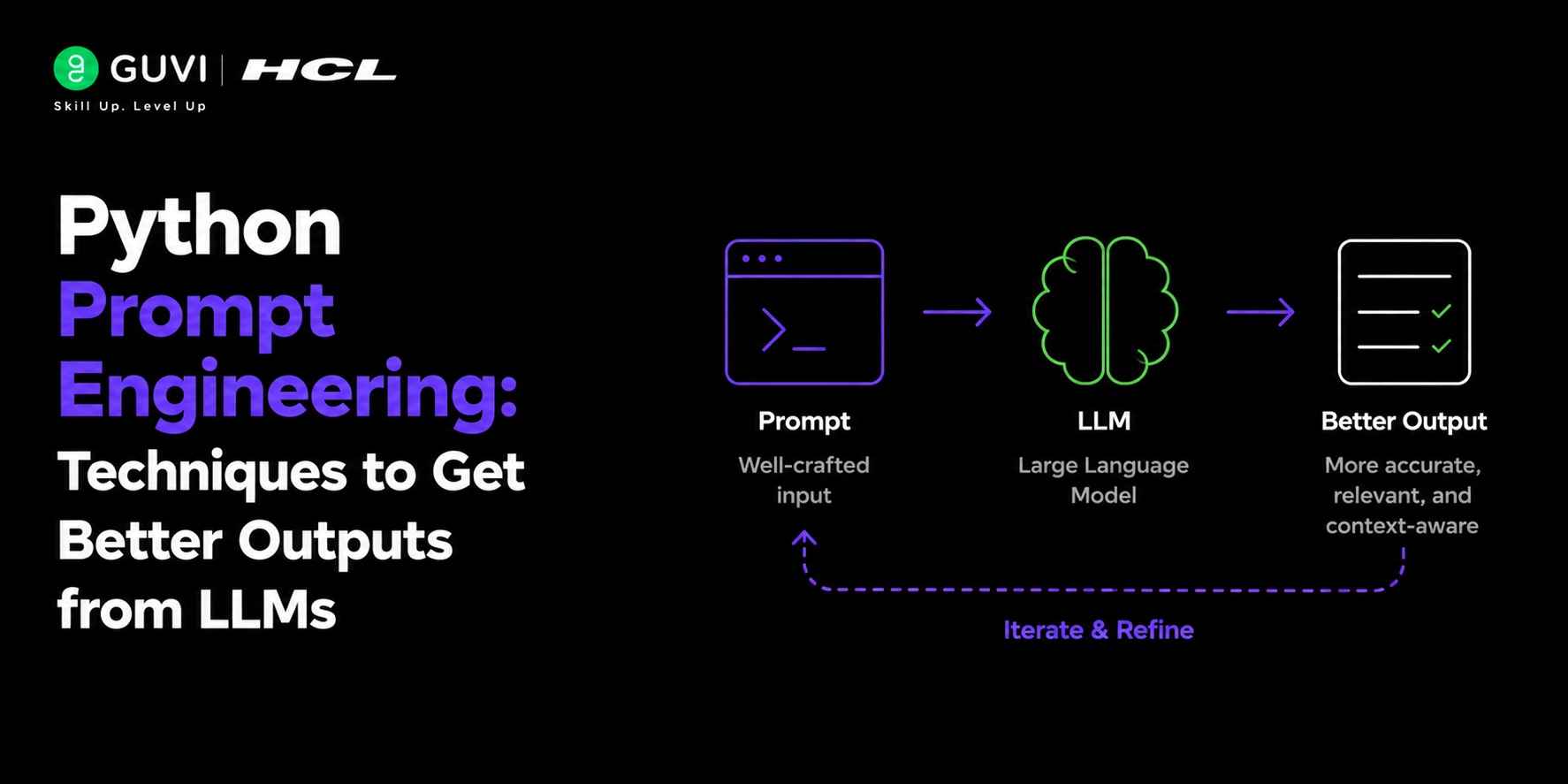
Python Prompt Engineering: Techniques to Get Better Outputs from LLMs
Jun 29, 2026 4 Min Read 376 Views
(Last Updated)
What if a single sentence could improve your AI application’s output quality by 50% or more? In the era of Large Language Models (LLMs), the difference between mediocre and exceptional results often comes down to prompt engineering.
Many Python developers focus heavily on model selection while overlooking the prompts that guide those models. Yet even the most advanced LLM can produce inaccurate, inconsistent, or incomplete responses when given poorly structured instructions. In this article, you’ll learn how Python prompt engineering works, proven techniques for improving LLM outputs, practical implementation examples, common mistakes to avoid, and best practices for building production-ready AI applications.
Table of contents
- TL;DR Summary
- What Is Python Prompt Engineering?
- Why Does Prompt Engineering Matter for LLM Applications?
- How Do LLMs Interpret Prompts?
- What Are the Most Effective Prompt Engineering Techniques?
- Role Prompting
- Few-Shot Prompting
- Why It Works
- Chain-of-Thought Prompting
- Structured Output Prompting
- Example Output
- Constraint-Based Prompting
- How to Use Prompt Engineering in Python
- Step 1: Install Required Libraries
- Step 2: Create a Prompt Template
- Step 3: Inject Dynamic Variables
- Step 4: Send the Prompt to the LLM
- Prompt Engineering Techniques Comparison
- Prompt Engineering vs Fine-Tuning
- Real-World Use Cases
- Common Prompt Engineering Mistakes
- Conclusion
- FAQs
- What is prompt engineering in Python?
- Why is prompt engineering important?
- What is few-shot prompting?
- What is chain-of-thought prompting?
- Is prompt engineering better than fine-tuning?
- Which Python libraries are used for prompt engineering?
- Can prompt engineering reduce hallucinations?
TL;DR Summary
- Prompt engineering directly impacts LLM output quality.
- Clear instructions outperform vague requests.
- Few-shot examples help models understand expected responses.
- Structured outputs improve automation and reliability.
- Python makes it easy to create reusable prompt templates for production applications.
Ready to improve your AI applications? Start by auditing your current prompts and implementing structured prompt templates to achieve better outputs from LLMs today. Start your AI & ML journey here
What Is Python Prompt Engineering?
Python prompt engineering is the practice of designing, testing, and optimizing prompts to improve the quality, accuracy, and consistency of outputs generated by large language models (LLMs). Using Python together with AI frameworks and APIs, developers implement techniques such as role prompting, few-shot learning, chain-of-thought prompting, structured output formatting, and reusable prompt templates to guide model behavior. Effective prompt engineering helps build more reliable AI applications by improving response relevance, reducing hallucinations, minimizing unnecessary API costs, and producing outputs that are easier to integrate into real-world software systems.
What Is Python Prompt Engineering?
- Python prompt engineering refers to creating, testing, and optimizing prompts used with Large Language Models such as GPT, Claude, Gemini, and open-source models. The goal is to guide the model toward generating more accurate and useful responses.
- Prompt engineering is not simply asking better questions. It involves designing instructions, context, examples, constraints, and output formats that help an AI model understand exactly what you need.
- For developers, prompt engineering is often the fastest and most cost-effective way to improve application performance without retraining models.
Why Does Prompt Engineering Matter for LLM Applications?
Prompt engineering matters because LLMs predict text based on context. Better context produces better predictions. Poor prompts often lead to hallucinations, incomplete answers, inconsistent formatting, and irrelevant content.
Effective prompt engineering helps you:
- Improve response accuracy
- Reduce hallucinations
- Generate consistent outputs
- Lower token consumption
- Enhance user experience
- Increase automation reliability
Data Point: Research from major AI providers consistently shows that prompt quality can dramatically affect model performance, often producing larger gains than upgrading to a newer model version for specific tasks.
How Do LLMs Interpret Prompts?
Large Language Models process prompts as context windows containing instructions, examples, and conversation history. The model analyzes patterns and predicts the most likely next tokens based on the information provided.
A typical prompt contains:
- Instructions
- Context
- Examples
- Constraints
- Output requirements
The clearer these components are, the more predictable the model’s response becomes.
What Are the Most Effective Prompt Engineering Techniques?
1. Role Prompting
Role prompting assigns a specific identity or expertise level to the model. This technique improves response quality by narrowing the model’s behavior.
Example
| prompt = “”” You are a senior Python developer. Explain decorators to a beginner using simple examples. “”” |
Instead of receiving a generic explanation, you often get a more focused and expert-level response.
💡 Pro Tip
Specify both expertise and audience level. For example, “Senior Python instructor teaching complete beginners.”
2. Few-Shot Prompting
Few-shot prompting provides examples within the prompt so the model can learn the desired response pattern before generating new outputs.
Example
prompt = """

Input: Python

Output: Programming Language

Input: Pandas

Output: Data Analysis Library

Input: FastAPI

Output:

"""
The model infers the pattern and produces a similar classification.
Why It Works
Few-shot examples reduce ambiguity and improve consistency across outputs.
3. Chain-of-Thought Prompting
Chain-of-thought prompting encourages the model to reason through a problem step by step before producing an answer.
Example
prompt = """

Solve the problem step by step.

A store sells 5 books at $12 each.

What is the total cost?

"""
This approach is particularly effective for:
- Math problems
- Logical reasoning
- Multi-step workflows
- Complex decision-making tasks
⚠️ Warning
Not every task benefits from chain-of-thought prompting. For simple classification or extraction tasks, it can increase latency and token usage unnecessarily.
4. Structured Output Prompting
Structured output prompting instructs the model to return data in a predictable format such as JSON, XML, or Markdown.

Example
prompt = """

Return the response as JSON.

Product: Laptop

Fields:

- name

- category

- description

"""
Example Output
{

  "name": "Laptop",

  "category": "Electronics",

  "description": "Portable computing device"

}
Structured outputs are essential for production AI systems.
5. Constraint-Based Prompting
Constraint-based prompting limits what the model can generate, improving focus and reducing irrelevant content.
Example
prompt = """

Explain Python lists.

Requirements:

- Maximum 100 words

- Beginner-friendly

- Include one example

"""
This technique improves consistency across large-scale applications.
How to Use Prompt Engineering in Python
Step 1: Install Required Libraries
pip install openaiStep 2: Create a Prompt Template
PROMPT_TEMPLATE = """

You are a Python tutor.

Explain the following concept:

{topic}

Requirements:

- Beginner-friendly

- Include example

- Maximum 150 words

"""
Step 3: Inject Dynamic Variables
prompt = PROMPT_TEMPLATE.format( topic=”Python Dictionaries” )This creates reusable prompts for multiple topics.
Step 4: Send the Prompt to the LLM
from openai import OpenAI

client = OpenAI()

response = client.responses.create(

    model="gpt-4.1",

    input=prompt

)

print(response.output_text)
✅ Best Practice
Store prompts separately from application logic to simplify testing and version control.
Ready to improve your AI applications? Start by auditing your current prompts and implementing structured prompt templates to achieve better outputs from LLMs today. Start your AI & ML journey here
Prompt Engineering Techniques Comparison
| Technique | Difficulty | Best For | Reliability |
| Zero-Shot Prompting | Easy | Simple tasks | Medium |
| Role Prompting | Easy | Expert responses | High |
| Few-Shot Prompting | Medium | Pattern learning | High |
| Chain-of-Thought | Medium | Reasoning tasks | High |
| Structured Output | Medium | Automation | Very High |
| Constraint-Based | Easy | Consistency | High |
Prompt Engineering vs Fine-Tuning
| Factor | Prompt Engineering | Fine-Tuning |
| Cost | Low | Higher |
| Setup Time | Fast | Longer |
| Maintenance | Easy | Complex |
| Flexibility | High | Moderate |
| Infrastructure | Minimal | Additional Resources |
For most business applications, prompt engineering should be the first optimization step. Fine-tuning becomes valuable only when prompt improvements no longer deliver the desired performance.
Real-World Use Cases
- AI Customer Support
Prompt templates ensure consistent support responses across thousands of user interactions.
- Content Generation
Structured prompts improve blog outlines, summaries, and marketing copy.
- Data Extraction
LLMs can extract entities, product details, and customer information into structured formats.
- Code Generation
Developers use prompt engineering to generate cleaner and more reliable Python code.
Common Prompt Engineering Mistakes
- Being Too Vague
Bad Prompt:
Explain Python.
Better Prompt:
Explain Python for beginner web developers in under 200 words with one example.
- Missing Output Requirements
Without format instructions, responses become inconsistent.
Always specify:
- Format
- Length
- Audience
- Tone
- Constraints
Overloading Context
Too much information can confuse the model and increase costs.
Provide only the context necessary for the task.
Conclusion
Python prompt engineering has become a core skill for developers building AI-powered applications. While modern LLMs are incredibly capable, their outputs depend heavily on the quality of the instructions they receive.
By applying techniques such as role prompting, few-shot learning, chain-of-thought reasoning, structured outputs, and prompt templates, you can dramatically improve AI performance without additional model training costs.
Whether you’re building chatbots, content generation systems, coding assistants, or enterprise automation workflows, mastering prompt engineering will help you get more reliable, accurate, and scalable results from Large Language Models.
FAQs
What is prompt engineering in Python?
Prompt engineering in Python involves designing prompts that improve the quality, accuracy, and consistency of outputs generated by Large Language Models.
Why is prompt engineering important?
Prompt engineering helps reduce hallucinations, improve response quality, and make AI applications more reliable without retraining models.
What is few-shot prompting?
Few-shot prompting provides examples inside the prompt to teach the model the desired response format or behavior.
What is chain-of-thought prompting?
Chain-of-thought prompting encourages the model to reason step by step before producing an answer, improving performance on complex tasks.
Is prompt engineering better than fine-tuning?
For many applications, prompt engineering is faster, cheaper, and easier to maintain. Fine-tuning is usually considered after prompt optimization.
Which Python libraries are used for prompt engineering?
Common libraries include OpenAI SDK, LangChain, LlamaIndex, DSPy, and various prompt management frameworks.
Can prompt engineering reduce hallucinations?
Yes. Clear instructions, constraints, examples, and structured outputs can significantly reduce hallucinations and improve factual accuracy.
Success Stories

About the Author
Vishalini Devarajan
An Aerospace Engineer turned content writer, I focus on making complex concepts easy to understand through well-structured, reader-friendly blogs. Whether it’s a technical topic or a non-technical one, I love creating content that is clear, engaging, and impactful.
View all posts by Vishalini Devarajan
Connect with me @












Did you enjoy this article?