


Project Articles
Automated Resume Screener: NLP-Based Python Project with Source Code
Business Analysis in Digital Transformation Projects - Best Guide
Build No-Code AI Agents with Flowise AI: Step-by-Step Beginner Guide


Get In Touch For Details! Request More Information
The Ultimate Project Ideas for Final Year B.Tech Students (2026 Edition)
Aug 04, 2026 13 Min Read 165753 Views
(Last Updated)
The computer science project you choose today can influence the first direction your career takes.
A strong final-year project does more than help you complete your degree. It shows recruiters how you approach a real problem and apply technical knowledge. Interviewers may also use your project to assess your coding skills and decision-making ability.
AI engineers, data specialists, software developers, and cloud professionals continue to attract strong interest among technology students. Projects involving artificial intelligence or data science can therefore add considerable value to a fresher’s portfolio.
This article covers modern computer science project ideas across several domains. Each idea focuses on technologies that remain relevant in the AI and GenAI era.
Table of contents
- TL;DR
- How to Choose the Right Final-Year Project
- Final-Year Project Comparison Table
- Categorized Project Ideas for Final Year B.Tech Students
- 1) Artificial Intelligence & Machine Learning Projects
- 1) AI-Based Career Recommendation System
- 2) AI-Powered Learning Assistant
- 3) Resume Screening Bot for HR Teams
- 4) Sentiment Analysis of Social Media Posts
- 5) AI Chatbot for Customer Service
- 2) Internet of Things (IoT) Projects
- 1) Smart Home Automation System
- 2) Health Monitoring System with IoT Sensors
- 3) Smart Traffic Management System
- 4) IoT-Based Air Quality Monitoring
- 5) IoT-Based Smart Energy Meter
- 3) Software Development & Web-based Projects
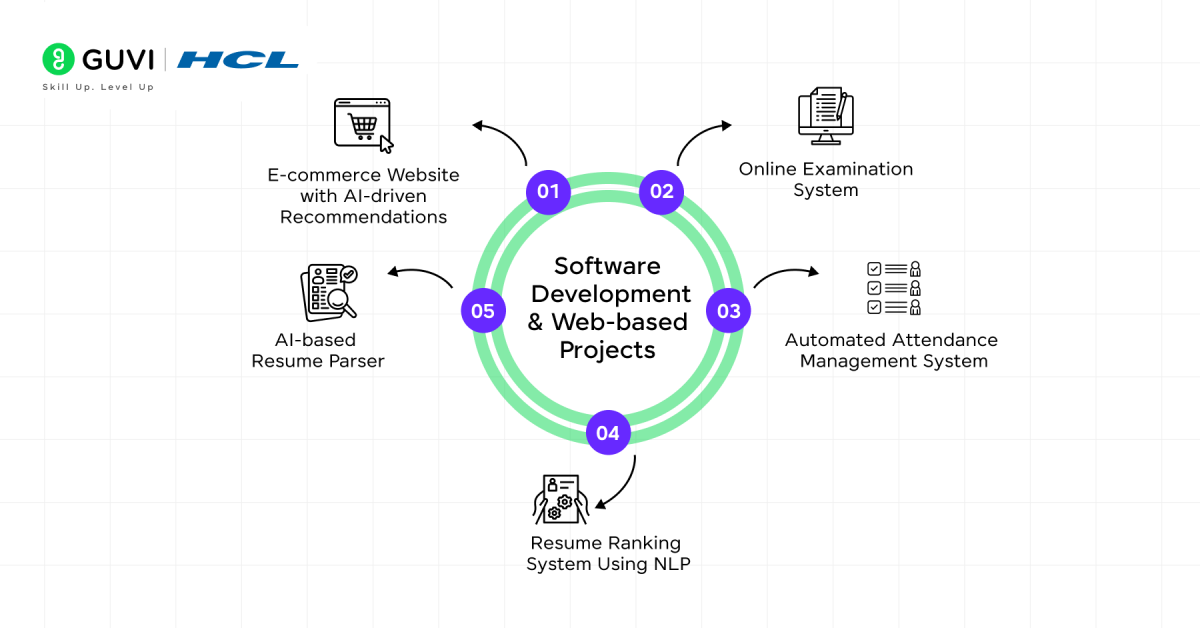
- 1) E-commerce Website with AI-driven Recommendations
- 2) Online Examination System
- 3) Automated Attendance Management System
- 4) Resume Ranking System Using NLP
- 5) AI-based Resume Parser
- 4) Cybersecurity & Blockchain Projects
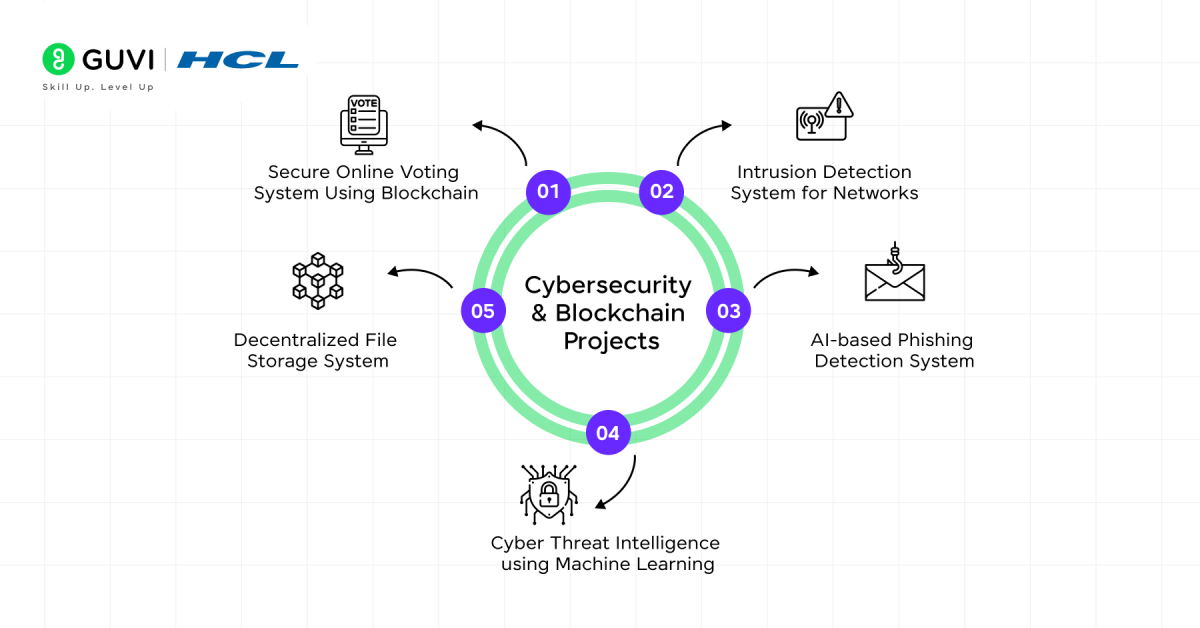
- 1) Secure Online Voting System Using Blockchain
- 2) Intrusion Detection System for Networks
- 3) Blockchain-Based Certificate Verification
- 4) Secure Chat App with End-to-End Encryption
- 5) Decentralized File Storage System
- 5) Cloud Computing and DevOps Projects
- 1) CI/CD Pipeline for a Microservices Application
- 2) Kubernetes-Based Application Deployment and Scaling
- 3) Cloud-Native Microservices Demo Application
- 4) Infrastructure as Code with Terraform on AWS
- 5) Dockerized Voting Application with Real-Time Results
- 💡 Did You Know?
- Final-Year Projects That Get Published in Journals
- What Makes a Project Publishable?
- Project Ideas With Strong Journal Potential
- Suggested Paper Structure
- Final-Year AI Projects Using ChatGPT API and Gemini API: 2026 Trend
- Multilingual Placement Interview Simulator
- Research Paper Comparison Assistant
- AI-Based Code Documentation Generator
- Multimodal Laboratory Assistant
- AI Lecture-to-Study-Pack Generator
- LLM Cost and Hallucination Benchmarking Platform
- Important API Project Practices
- GitHub Template Structure for Final-Year Projects
- Recommended Master Template
- GitHub Link Formats by Category
- What Every Project README Should Include
- Takeaways
- FAQs
- Q1. How do I choose the right final year project for my B.Tech?
- Q2. What are some innovative project ideas for computer science students?
- Q3. How important is the final year project for my future career?
- Q4. What should I consider when planning my final year project?
- Q5. How can I ensure my final year project stands out?
TL;DR
The best final-year computer science projects in 2026 combine real-world problem-solving with technologies such as AI, GenAI, IoT, data science, and TinyML. Students should choose projects that match their career goals and include measurable results. A deployed prototype, clear GitHub documentation, and original research can make a project more valuable for placements and journal publication.
- Choose modern projects across AI/ML, intelligent web apps, IoT, data science, or embedded systems.
- Replace outdated project ideas with RAG tools, GenAI applications, edge AI, and explainable models.
- Use the OpenAI API or Gemini API to build specialised tools instead of basic chatbot interfaces.
- Improve publication potential through original datasets, baseline comparisons, and clear evaluation metrics.
- Maintain a structured GitHub repository with setup instructions, results, limitations, and team contributions.
How to Choose the Right Final-Year Project
Your final-year project can shape your career path and demonstrate your technical abilities. It allows you to combine the knowledge gained during your degree into one practical solution.
Start by identifying the topics you genuinely enjoyed during your course. A difficult project aligned with your interests is usually better than an easy project selected only for convenience.
Your project should solve a clearly defined problem. It should also produce results that can be tested or measured.
Consider the following factors before finalising an idea:
- Availability of suitable datasets
- Hardware and software requirements
- Expected development time
- Skills available within the team
- Deployment cost
- Scope for future improvement
- Research or publication potential
Regular reviews with your project guide can help control the project scope. They also make it easier to identify technical problems before the final submission.
Final-Year Project Comparison Table
The following table compares modern project ideas across the five requested domains. “Paper potential” refers to the possibility of turning the project into a research paper after adding original experiments and measurable results.
| Project | Domain | Tech Stack | Complexity | Paper Potential |
|---|---|---|---|---|
| Multimodal Research Assistant Using RAG | AI/ML | Python, vector database, LLM API, FastAPI | High | High with retrieval benchmarking |
| AI Career and Skill-Gap Copilot | AI/ML | Python, NLP, React, PostgreSQL | Medium | Medium to high |
| Deepfake and AI-Content Detector | AI/ML | PyTorch, OpenCV, transformers | High | Very high with an original dataset |
| AI Code Review Platform | Web App | Next.js, Node.js, LLM API, Docker | High | Medium |
| Adaptive Learning Web App | Web App | React, FastAPI, PostgreSQL, ML | Medium | High with learner testing |
| AI Website Accessibility Auditor | Web App | React, Node.js, Playwright, computer vision | Medium | Medium |
| Smart Energy Optimisation System | IoT | ESP32, MQTT, Python, TensorFlow Lite | High | High |
| IoT Predictive Maintenance Network | IoT | Sensors, Raspberry Pi, MQTT, cloud dashboard | High | Very high |
| AI Waste Segregation System | IoT | Camera, Raspberry Pi, OpenCV, servomotor | High | High |
| Urban Heat-Risk Forecasting | Data Science | Python, GeoPandas, XGBoost, Streamlit | High | Very high |
| Retail Demand Forecasting | Data Science | Python, time-series models, Power BI | Medium | High |
| Misinformation Spread Analysis | Data Science | Python, graph analytics, NLP, NetworkX | High | Very high |
| TinyML Gesture Recognition Device | Embedded | Arduino Nano 33 BLE, TinyML, C++ | High | High |
| Offline Embedded Voice Assistant | Embedded | ESP32-S3, microphone, TensorFlow Lite Micro | High | High |
| Embedded Machine Fault Detector | Embedded | Vibration sensors, microcontroller, TinyML | High | Very high |
Categorized Project Ideas for Final Year B.Tech Students
Your final year B.Tech project choice can shape your career path. We have put together a range of project ideas from different domains. These ideas align with current industry trends and give you a chance to highlight your skills and breakthroughs.
These project ideas cover many technologies and applications. You can take a closer look at areas that interest you most. A successful final year project depends on its execution and your problem-solving skills.
Your project selection should match current industry trends and help develop valuable skills. This final year project serves as your stepping stone into technology’s future.
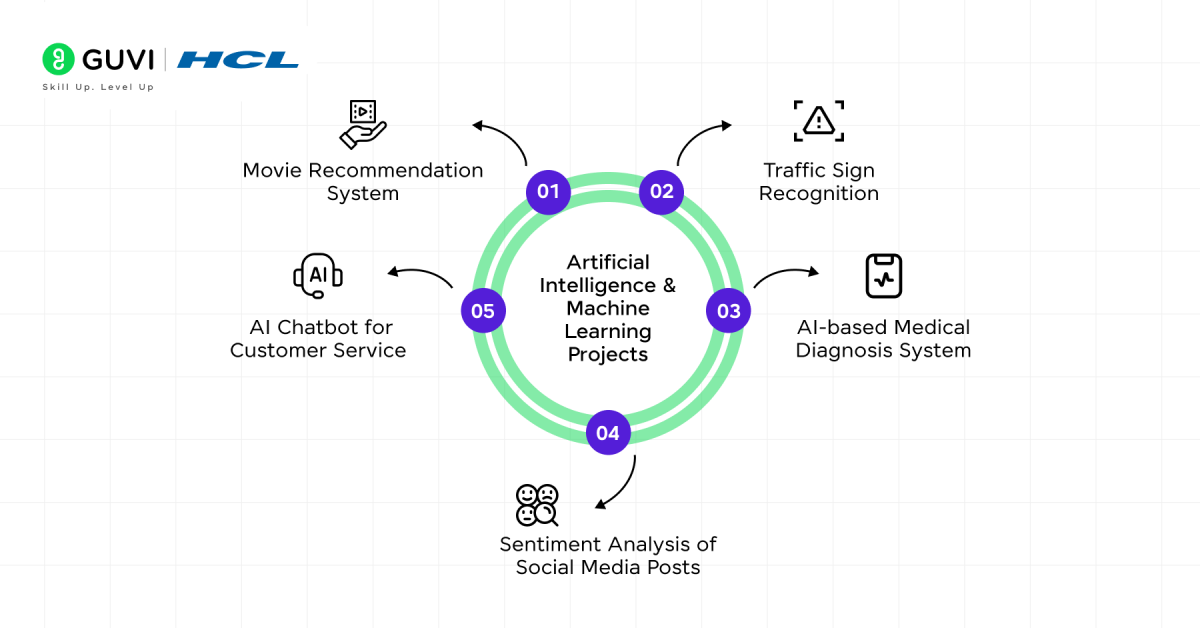
1) Artificial Intelligence & Machine Learning Projects
AI and Machine Learning projects are leading technological breakthroughs that give final year students amazing opportunities. Here are some state-of-the-art project ideas to show off your technical skills.
1.1) AI-Based Career Recommendation System
A career recommendation system uses artificial intelligence to match students with potential career paths based on their skills, interests, and market demands.
Time taken: 3-4 months for a comprehensive implementation
Key features:
- Personalized career path recommendations based on user profiles
- Skill gap analysis that identifies missing competencies
- Integration with job market data to prioritize in-demand careers
- Learning resource recommendations to bridge skill gaps
- Interactive dashboard with visualization of career progression paths
Tech stack needed:
- Python for backend development and data processing
- TensorFlow or PyTorch for implementing recommendation algorithms
- Flask or Django for a web application framework
- MongoDB or PostgreSQL for database management
- React.js for the frontend interface
What You Learn:
- Building recommendation engines
- Applying ML for career guidance
- Data preprocessing & analysis
GitHub Repo: AI-Based Career Recommendation System
Also Read: AI Tools for Students
1.2) AI-Powered Learning Assistant
Personalized education tools are becoming essential as learning moves increasingly online. An AI-powered learning assistant helps students master concepts more effectively.
Time taken: 4-6 months
Key features:
- Natural language understanding for student queries
- Personalized learning path creation
- Concept mastery tracking
- Question generation based on learning material
- Adaptive difficulty adjustment
- Progress visualization and analytics
- Integration with existing learning management systems
Tech stack needed:
- Python for backend development
- TensorFlow or PyTorch for machine learning models
- Transformers library for NLP capabilities
- Django or Flask for a web framework
- PostgreSQL for the database
- React for frontend
- Docker for containerization
What You Learn:
- Building AI-based tutors
- NLP for question answering
- EdTech applications of AI
GitHub Repo: AI-Powered Learning Assistant
1.3) Resume Screening Bot for HR Teams
Automating the initial resume screening process helps HR departments save countless hours while improving hiring efficiency.
Time taken: 2-3 months
Key features:
- Automated resume parsing and information extraction
- Skill matching against job descriptions
- Experience level classification
- Candidate ranking system
- Keyword analysis and recommendation
- Integration with applicant tracking systems
Tech stack needed:
- Python for core functionality
- TensorFlow or PyTorch for machine learning models
- SpaCy or NLTK for natural language processing
- Flask or FastAPI for API development
- SQL or MongoDB for database
- React for HR dashboard interface
What You Learn:
- Automated resume parsing
- Applying ML in recruitment
- Improving HR efficiency with AI
GitHub Repo: Resume Screening Bot for HR Teams
Related Reads: AI Tool for Resume Building
1.4) Sentiment Analysis of Social Media Posts
Companies learn what people think through sentiment analysis of social media. This project involves analyzing social media posts to determine the sentiment (positive, negative, or neutral) using NLP techniques. It helps businesses and organizations understand public opinion. This makes it one of the most intuitive project ideas for final year B.Tech students.
Time Taken: 3–5 weeks
Key Features:
- Real-time text analysis
- Emotion classification
- Insightful business applications
Tech Stack Used:
- Python, NLTK, TextBlob, Scikit-learn
- LSTM/BERT models
- Web scraping tools
What You Learn:
- Natural Language Processing
- Sentiment classification
- Business intelligence from text data
GitHub Repo: Sentiment Analysis of Social Media Posts
1.5) AI Chatbot for Customer Service
AI chatbots are reshaping customer service. They solve 80% of customer issues on their own. We all know them and have interacted with them; let’s see what it’s like building one.
Time Taken: 4–6 weeks
Key Features:
- Multilingual support
- Conversational AI
- API integrations with services
Tech Stack Used:
- Python, spaCy/NLTK
- Rasa/Dialogflow frameworks
- Transformer models, APIs
What You Learn:
- Building conversational flows
- NLP for chatbots
- Integration with messaging platforms
GitHub Repo: AI Chatbot for Customer Service
These projects each bring their own challenges and chances to learn. Pick your final year project based on data you can get, computing power you need, and real-life applications. Keep good records of your work and stay in touch with your project guide to get the best results.
Take your ChatGPT skills to the next level at absolutely no cost! Through HCL GUVI’s Bharat AI Initiative, powered by OpenAI, you can now learn advanced ChatGPT skills, like better prompting techniques, in English, Hindi, Tamil, Telugu, and Marathi.
Looking for a practical AI mini-project? Build a Movie Recommendation System using content-based filtering and understand how real-world recommendation engines work.
2) Internet of Things (IoT) Projects
IoT technology is reshaping industries with innovative applications. These project ideas show how IoT creates practical solutions for real-life challenges.
Also Read: IOT Project Ideas
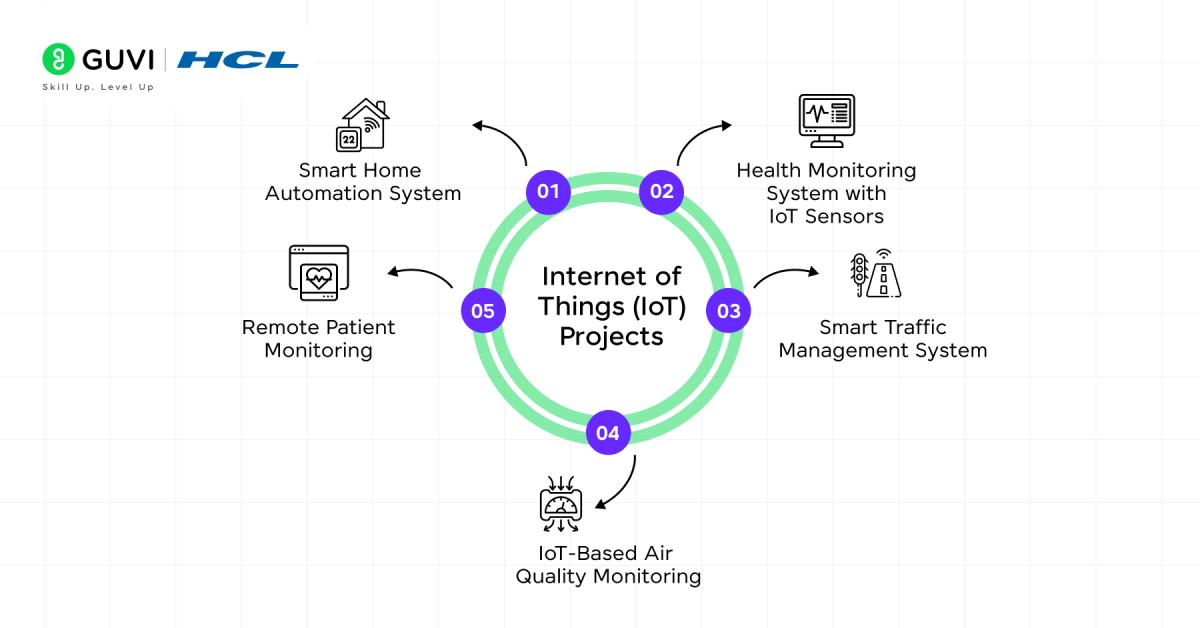
2.1) Smart Home Automation System
Home automation with IoT gives you complete control over household appliances through wireless connections.
Time Taken: 4–6 weeks
Key Features:
- Smart thermostats & lighting
- Remote appliance control
- Energy monitoring
Tech Stack Used:
- Arduino/Raspberry Pi
- IoT protocols (MQTT, HTTP)
- Mobile app (Flutter/Android)
What You Learn:
- IoT communication protocols
- Embedded programming
- Smart home applications
GitHub Repo: Smart Home Automation System
2.2) Health Monitoring System with IoT Sensors
Modern healthcare needs continuous patient monitoring. Health monitoring systems with IoT merge different sensors to track vital signs.
Time Taken: 6–8 weeks
Key Features:
- Tracks temperature, BP, heart rate, SpO2
- Cloud data visualization
- Alerts for anomalies
Tech Stack Used:
- ECG, SpO2, temperature sensors
- AWS IoT, Firebase
- Power BI, Matplotlib
What You Learn:
- IoT in healthcare
- Sensor integration
- Data visualization
GitHub Repo: Health Monitoring Systems with IoT Sensors
2.3) Smart Traffic Management System
IoT technology helps solve urban congestion problems. The smart traffic management market will reach USD 19.91 billion by 2028. Isn’t this so intriguing to build? This smart traffic management system was rated amongst the top in our list of project ideas for final year B.Tech students.
Time Taken: 8–10 weeks
Key Features:
- Vehicle detection sensors
- Dynamic signal control
- Emergency vehicle priority
Tech Stack Used:
- ESP8266, Raspberry Pi
- OpenCV, TensorFlow
- AWS/Google Cloud
What You Learn:
- IoT for smart cities
- Real-time traffic monitoring
- Cloud integration
GitHub Repo: Smart Traffic Management System
2.4) IoT-Based Air Quality Monitoring
Environmental monitoring systems use IoT to measure and analyze air quality. Let’s see how they’re built.
Time Taken: 5–7 weeks
Key Features:
- Detects CO, SO2, NOx, PM
- Cloud-based visualization
- Pollution source detection
Tech Stack Used:
- MQ-135, DHT11 sensors
- ThingSpeak, InfluxDB
- Azure IoT, Firebase
What You Learn:
- IoT for environmental monitoring
- Cloud dashboards
- Wireless networking
GitHub Repo: IoT-Based Air Quality Monitoring
2.5) IoT-Based Smart Energy Meter
With the push toward sustainability, smart energy monitoring systems have become increasingly important for both residential and commercial applications.
Time taken: 3-5 months
Key features:
- Real-time energy consumption monitoring
- Appliance-specific usage tracking
- Anomaly detection for potential issues
- Predictive billing based on usage patterns
Tech stack needed:
- Arduino or Raspberry Pi for hardware interface
- C/C++ for embedded programming
- MQTT protocol for IoT communication
- Node.js for backend server
- React Native for mobile applications
- InfluxDB for time-series data storage
- TensorFlow Lite for edge analytics
What You Learn:
- IoT sensor integration
- Cloud-based monitoring
- Smart energy management solutions
GitHub Repo: IoT-Based Smart Energy Meter
Take your ChatGPT skills to the next level at absolutely no cost! Through HCL GUVI’s Bharat AI Initiative, powered by OpenAI, you can now learn advanced ChatGPT skills, like better prompting techniques, in English, Hindi, Tamil, Telugu, and Marathi. Start Your Free AI Journey
3) Software Development & Web-based Projects
Software development projects evolve alongside emerging technologies that create trailblazing solutions for ground challenges. These project ideas for final year B.Tech students demonstrate technical expertise through practical implementations that address specific industry needs.
3.1) E-commerce Website with AI-driven Recommendations
Modern e-commerce platforms use AI capabilities to improve customer experience through individual-specific product suggestions. The systems analyze customer data points that include browsing patterns, purchase history, and demographic information to generate relevant recommendations. AI-powered recommendation engines boost business profitability by increasing purchase likelihood and basket sizes.
Time Taken: 6–8 weeks
Key Features:
- Dynamic recommendations
- Automated inventory management
- Cross-selling & upselling
Tech Stack Used:
- React/Angular, Node.js/Django
- MySQL/MongoDB
- TensorFlow, Scikit-learn
What You Learn:
- Web dev (frontend & backend)
- Recommendation systems
- API integration for payments & AI
GitHub Repo: E-Commerce Website with AI
3.2) Online Examination System
Digital education needs robust online examination platforms. These systems provide detailed solutions to conduct remote assessments securely. Studies show computer-based testing achieves cost savings through quick result analysis and presentation.
Time Taken: 5–7 weeks
Key Features:
- Automated grading
- Proctoring & monitoring
- Result generation
Tech Stack Used:
- React/Angular, Node.js/PHP/Django
- MySQL/PostgreSQL
- WebSockets, AI-based proctoring
What You Learn:
- Secure web platforms
- Authentication & monitoring
- Online education systems
GitHub Repo: Online Examination System
3.3) Automated Attendance Management System
Digital attendance tracking systems make traditional processes efficient through advanced automation. These platforms benefit educational institutions and organizations significantly. Research proves automated systems minimize manual errors and save time for HR personnel.
Time Taken: 6–8 weeks
Key Features:
- Real-time attendance tracking
- Face recognition login
- Payroll integration
Tech Stack Used:
- React, Flutter
- Node.js, Firebase, MySQL
- OpenCV, TensorFlow
What You Learn:
- Computer vision
- Web & mobile app dev
- Cloud deployment
GitHub Repo: Automated Attendance Management System
3.4) Resume Ranking System Using NLP
Natural Language Processing changes traditional hiring methods by automating candidate evaluation processes. The system extracts valuable information from resumes and ranks them based on job requirements. Studies reveal that manual resume screening doesn’t deal very well with increasing growth in online recruitment.
Time Taken: 5–6 weeks
Key Features:
- Converts unstructured resumes
- Extracts key skills/experience
- Ranks candidates automatically
Tech Stack Used:
- Python, NLTK, SpaCy, BERT
- Flask/Django
- PostgreSQL, MongoDB
What You Learn:
- NLP for text extraction
- Resume parsing techniques
- Recruitment automation
GitHub Repo: Resume Ranking System Using NLP
3.5) AI-based Resume Parser
Advanced resume parsing solutions use artificial intelligence to make recruitment workflows efficient. These systems support over 56 languages and extract more than 100 data fields accurately.
Time Taken: 6–8 weeks
Key Features:
- Supports 56+ languages
- Extracts 100+ fields
- High accuracy parsing
Tech Stack Used:
- SpaCy, BERT, OCR (Tesseract)
- TensorFlow, Scikit-learn
- React, Django/Flask
What You Learn:
- NLP & OCR techniques
- Data extraction & entity recognition
- AI for recruitment workflows
GitHub Repo: AI-Based Resume Parser
Also Read: AI Tool for Software Development
If you’re a final-year B.Tech student looking to build industry-ready projects like these and kickstart a successful tech career, then HCL GUVI’s Full Stack Development Course is the perfect choice. This course equips you with in-demand skills like MERN stack, AI integration, and hands-on project experience, ensuring you stand out in placements.
Take your ChatGPT skills to the next level at absolutely no cost!
Through HCL GUVI’s Bharat AI Initiative, powered by OpenAI, you can now learn advanced ChatGPT skills, like better prompting techniques, in English, Hindi, Tamil, Telugu, and Marathi.
Want to build real-world frontend projects with complete implementation guidance? Explore HCL GUVI’s ReactJS Projects Handbook and start building portfolio-ready applications.
4) Cybersecurity & Blockchain Projects
Cybersecurity and blockchain technologies create ground-breaking opportunities for final year projects that tackle key digital challenges, making them amazing project ideas for final year B.Tech students. Students can build robust solutions by combining advanced security with decentralized systems.
4.1) Secure Online Voting System Using Blockchain
A blockchain voting system makes tampering impossible and keeps records transparent through decentralized storage. The system uses cryptographic techniques and zero-knowledge proofs to protect voter privacy. Blockchain helps make voting:
- Tamper-proof through distributed ledger technology
- Transparent yet private for voters
- Automatically verifiable without manual counting
- Resistant to distributed denial-of-service attacks
Skills you must have to build this project:
- Blockchain development (Ethereum, Hyperledger)
- Smart contract programming (Solidity)
- Cryptography and hashing algorithms
- Web development (React, Node.js)
- Distributed ledger technology (DLT)
GitHub Repo: Secure Online Voting System Using Blockchain
4.2) Intrusion Detection System for Networks
New intrusion detection systems use advanced algorithms to guard networks against unauthorized access. The technology processes huge amounts of data to spot potential threats.
Time Taken: 6–8 weeks
Key Features:
- Monitors traffic in real-time
- Pattern & anomaly detection
- Automated incident response
Tech Stack Used:
- Wireshark, Snort
- Python, Scikit-learn, TensorFlow
- TCP/IP protocols
What You Learn:
- Cybersecurity threat analysis
- AI for anomaly detection
- Network monitoring
GitHub Repo: Intrusion Detection System
4.3) Blockchain-Based Certificate Verification
Academic credential fraud is a growing concern for employers. A blockchain-based verification system offers a tamper-proof solution to this problem.
Time taken: 3-5 months
Key features:
- Immutable certificate issuance and storage
- QR code generation for easy verification
- Multi-stakeholder access control (institutions, students, employers)
- Certificate revocation mechanisms
- Digital signature authentication
- Comprehensive audit trail
Tech stack needed:
- Solidity for smart contract development
- Ethereum, Hyperledger, or Polygon network
- Web3.js for blockchain interaction
- Node.js backend
- React for frontend interface
- IPFS for certificate storage
What You Learn:
- Blockchain applications in education
- Writing & deploying smart contracts
- Secure digital verification systems
GitHub Repo: Blockchain-Based Certificate Verification
4.4) Secure Chat App with End-to-End Encryption
With privacy concerns growing, secure communication apps have become extremely relevant in today’s digital landscape.

Time taken: 2-3 months
Key features:
- End-to-end encryption using industry-standard protocols
- Self-destructing messages with configurable timers
- Multi-device synchronization
- File transfer with encryption
- Message read receipts and typing indicators
- Offline message queueing
Tech stack needed:
- Java/Kotlin for Android or Swift for iOS native app development
- Firebase or AWS for backend services
- Signal Protocol for encryption implementation
- WebRTC for secure real-time communication
- SQLite for local storage
What You Learn:
- Secure communication protocols
- Real-time web socket programming
- Implementing user privacy features
GitHub Repo: Secure Chat App with End-to-End Encryption
4.5) Decentralized File Storage System
Blockchain storage offers new ways to manage data securely. Files spread across multiple nodes improve security and access.
Time Taken: 8–10 weeks
Key Features:
- Encrypted file sharing
- Immutable records
- Token-based incentives
Tech Stack Used:
- Blockchain (IPFS, Ethereum)
- Smart contracts (Solidity)
- Distributed ledger systems
What You Learn:
- Blockchain storage systems
- Secure file sharing
- Decentralization principles
GitHub Repo: Decentralized File Storing System
These ideas let students explore state-of-the-art technologies while solving real cybersecurity challenges. AI, machine learning, and blockchain work together to create strong defenses against evolving digital threats.
5) Cloud Computing and DevOps Projects
Cloud Computing and DevOps have become some of the most sought-after skills in the Indian tech industry. Roles like Cloud Engineer, Site Reliability Engineer, and DevOps Developer consistently rank among the highest-paying entry-level positions in 2026. Building a project in this domain shows recruiters that you can work with infrastructure, automation, and deployment pipelines — skills that go well beyond writing application code.
5.1) CI/CD Pipeline for a Microservices Application
A Continuous Integration and Continuous Deployment (CI/CD) pipeline automates the process of building, testing, and deploying software. This project involves setting up a fully automated DevOps pipeline for a multi-service application, giving you hands-on experience with one of the most in-demand engineering practices in the industry.
Time Taken: 4-6 weeks
Key Features:
- Automated build triggers on code push
- Unit and integration test automation
- Docker container image builds and registry push
- Staged deployments (dev, staging, production)
- Rollback mechanisms on failed deployments
- Slack or email notifications for pipeline events
Tech Stack Used:
- GitHub Actions or Jenkins for pipeline orchestration
- Docker for containerization
- Kubernetes for container orchestration
- AWS, GCP, or Azure for cloud hosting
- SonarQube for code quality checks
- Prometheus and Grafana for monitoring
What You Learn:
- End-to-end DevOps workflow automation
- Container management with Docker and Kubernetes
- Cloud deployment and environment management
- Monitoring and alerting for production systems
GitHub Repo: CI/CD Pipeline Projects
5.2) Kubernetes-Based Application Deployment and Scaling
Kubernetes has become the industry standard for managing containerized applications at scale. This project involves deploying a real multi-tier application on a Kubernetes cluster, configuring auto-scaling, and managing rolling updates with zero downtime.
Time Taken: 5-7 weeks
Key Features:
- Multi-node Kubernetes cluster setup
- Deployment manifests and service configurations
- Horizontal Pod Autoscaler for traffic-based scaling
- ConfigMaps and Secrets management
- Persistent volume claims for stateful services
- Ingress controller and load balancing
Tech Stack Used:
- Kubernetes (kubectl, kubeadm or managed EKS/GKE/AKS)
- Docker for container images
- Helm for package management
- Prometheus and Grafana for cluster monitoring
- NGINX Ingress Controller
What You Learn:
- Kubernetes architecture and cluster management
- Declarative infrastructure using YAML manifests
- High availability and fault tolerance in containerized apps
- Real-world production deployment practices
GitHub Repo: Kubernetes Application Deployment
5.3) Cloud-Native Microservices Demo Application
This project involves building and deploying a full cloud-native application made up of multiple microservices, each handling a distinct function like product catalog, cart, payment, and recommendation. The services communicate over gRPC and REST, and the entire system is deployed on a cloud platform using Kubernetes.
Time Taken: 6-8 weeks
Key Features:
- 10+ independently deployable microservices
- gRPC-based inter-service communication
- Frontend served via a load-balanced Kubernetes service
- Integrated distributed tracing with OpenTelemetry
- Cloud-native logging and monitoring stack
- Horizontal scaling per service based on demand
Tech Stack Used:
- Go, Python, Java, Node.js (polyglot microservices)
- Kubernetes on GKE, EKS, or AKS
- gRPC and REST for service communication
- OpenTelemetry, Jaeger for distributed tracing
- Istio service mesh for traffic management
What You Learn:
- Microservices architecture design
- Polyglot programming in a distributed system
- Cloud-native observability and tracing
- Service mesh concepts and traffic management
GitHub Repo: Cloud-Native Microservices Demo
5.4) Infrastructure as Code with Terraform on AWS
Infrastructure as Code (IaC) is the practice of managing and provisioning cloud resources through configuration files rather than manual clicks. This project involves using Terraform to define, deploy, and manage a complete AWS infrastructure including VPCs, EC2 instances, S3 buckets, RDS databases, and IAM roles.
Time Taken: 4-5 weeks
Key Features:
- VPC with public and private subnets
- EC2 auto-scaling groups with launch templates
- RDS instance provisioning and configuration
- S3 buckets with lifecycle policies
- IAM roles and security group management
- Remote state management using S3 and DynamoDB
Tech Stack Used:
- Terraform for IaC
- AWS (EC2, S3, RDS, VPC, IAM)
- GitHub Actions for automated Terraform apply
- AWS CloudWatch for infrastructure monitoring
What You Learn:
- Infrastructure as Code principles and best practices
- AWS cloud resource management
- Version-controlled infrastructure changes
- Cost estimation and resource optimization on cloud
GitHub Repo: Terraform AWS Provider
5.5) Dockerized Voting Application with Real-Time Results
This project involves building a distributed voting application made up of multiple containers — a frontend for submitting votes, a worker service that processes them, a Redis queue, a PostgreSQL database, and a real-time results dashboard. It is one of the most popular hands-on DevOps projects used in interviews and workshops globally.
Time Taken: 3-4 weeks
Key Features:
- Multi-container application managed with Docker Compose
- Real-time vote processing through Redis message queue
- Live results dashboard updating without page refresh
- Separate frontend and backend containers
- PostgreSQL for persistent vote storage
- Deployable on Docker Swarm or Kubernetes
Tech Stack Used:
- Docker and Docker Compose
- Python (Flask) for the voting frontend
- Node.js for the results dashboard
- Redis as the message queue
- PostgreSQL for data persistence
- .NET for the worker service
What You Learn:
- Multi-container application architecture
- Docker Compose for local orchestration
- Message queue patterns with Redis
- Deploying distributed apps on Docker Swarm or Kubernetes
GitHub Repo: Dockerized Voting Application
Dreaming of a career in IT?
Start your journey with our Learn Hub and gain in-demand technical skills.
Learn Python, Java, C++, and other trending technologies from beginner to advanced with structured handbooks.
💡 Did You Know?
- India is the second-largest talent pool for cloud computing skills globally, and demand for certified AWS, Azure, and GCP engineers has grown by over 60% in Indian job postings between 2023 and 2026.
- AI and ML projects that use pre-trained transformer models like BERT or GPT have become significantly more accessible for students since 2023, thanks to open-source libraries like HuggingFace Transformers, which now has over 500,000 models available for free.
- Blockchain-based certificate verification is already being piloted by several Indian universities and IITs, meaning projects in this space are not just academic exercises but real solutions being evaluated for institutional adoption.
Final-Year Projects That Get Published in Journals
Building a working application does not automatically make a project suitable for publication. A journal paper needs a clear research question and evidence supporting the proposed solution.
What Makes a Project Publishable?
1. A Clearly Defined Research Gap
The project should address a limitation in existing research. For example, a student could study why an existing deepfake detector performs poorly on compressed regional-language videos.
2. An Original Dataset or Experimental Setting
A locally collected dataset can increase the academic value of a project. The data should be documented and collected with suitable consent.
3. Comparison With Baseline Methods
Do not report the result of only one model. Compare the proposed method with relevant traditional models or simpler algorithms.
4. Suitable Evaluation Metrics
Accuracy alone may not explain model quality. Select metrics that match the problem, such as precision and recall for imbalanced classification.
5. Reproducible Implementation
The paper should clearly describe the dataset, preprocessing steps, model configuration, and evaluation method. The repository should contain instructions for reproducing the results.
Turn your final-year B.Tech project ideas into real, portfolio-ready applications with HCL GUVI’s Full Stack Development Course. Learn HTML, CSS, JavaScript, frontend development, backend development, APIs, databases, and real-world project building through structured training designed for aspiring full-stack developers.
Project Ideas With Strong Journal Potential
| Research Project | Possible Research Contribution |
|---|---|
| Multilingual RAG Assistant | Compare retrieval quality across English and Indian-language documents |
| Deepfake Detector | Evaluate performance on compressed mobile and social-media videos |
| Edge Predictive Maintenance | Compare cloud inference with on-device inference |
| Urban Heat Forecasting | Combine satellite and neighbourhood-level exposure data |
| Smart Agriculture System | Study irrigation savings under different prediction methods |
| TinyML Fault Detector | Compare model size, latency, and classification accuracy |
| Accessibility Auditor | Measure agreement between automated findings and expert reviews |
Suggested Paper Structure
- Abstract
- Problem statement
- Literature review
- Research gap
- Proposed methodology
- Dataset and preprocessing
- Experimental setup
- Results
- Limitations
- Conclusion and future work
Students should maintain experiment logs throughout the project. Reconstructing model settings and results at the end can lead to mistakes.
Final-Year AI Projects Using ChatGPT API and Gemini API: 2026 Trend
Students often use the phrase “ChatGPT API,” but applications are technically built through the OpenAI API. OpenAI provides an SDK and Responses API for application development.
Google provides the Gemini API and Google GenAI SDK for building applications using Gemini models. The platform supports different interaction methods and development tools.
These APIs allow students to build GenAI projects without training a large language model from the beginning. However, the project still needs its own workflow, validation method, and user interface.
1. Multilingual Placement Interview Simulator
The platform conducts role-based mock interviews and provides feedback on each answer. It can support English and selected Indian languages.
Possible APIs:
- OpenAI API
- Gemini API
Research Direction:
Compare feedback consistency across different prompt structures and languages.
2. Research Paper Comparison Assistant
The tool accepts multiple research papers and creates a structured comparison of their methods, datasets, results, and limitations.
Possible APIs:
- OpenAI API
- Gemini API
Research Direction:
Measure whether RAG improves factual accuracy compared with direct document prompting.
3. AI-Based Code Documentation Generator
The application reads a repository and produces documentation for files, functions, APIs, and setup requirements.
Possible APIs:
- OpenAI API
- Gemini API
Research Direction:
Compare generated documentation with developer-written documentation through expert evaluation.
4. Multimodal Laboratory Assistant
Students can upload an experiment image, graph, or observation sheet. The system organises the information into a structured laboratory record.
Possible APIs:
- Gemini API
- Another multimodal model API
Research Direction:
Test performance across handwritten notes, printed tables, and low-quality images.
5. AI Lecture-to-Study-Pack Generator
The application converts a lecture transcript into notes, flashcards, and practice questions. It links each generated item to the relevant source segment.
Possible APIs:
- OpenAI API
- Gemini API
Research Direction:
Measure factual grounding and usefulness through student feedback.
6. LLM Cost and Hallucination Benchmarking Platform
This platform sends the same tasks to different models. It compares answer accuracy, latency, token usage, and estimated cost.
Possible APIs:
- OpenAI API
- Gemini API
Research Direction:
Create a domain-specific test set and study the trade-off between cost and answer reliability.
Important API Project Practices
- Keep secret keys on the server.
- Never expose API keys in frontend code.
- Add usage limits.
- Store only necessary user data.
- Validate generated output.
- Show sources for factual answers.
- Track latency and API cost.
- Add fallback handling for failed requests.
GitHub Template Structure for Final-Year Projects
GitHub allows a repository owner to mark an existing repository as a template. Other users can then create a new repository with the same files and directory structure by selecting “Use this template.”
Recommended Master Template
project-name/
│
├── README.md
├── LICENSE
├── requirements.txt
├── .env.example
├── .gitignore
│
├── data/
│   ├── raw/
│   └── processed/
│
├── src/
│   ├── preprocessing/
│   ├── models/
│   ├── services/
│   └── utils/
│
├── frontend/
├── backend/
├── hardware/
├── notebooks/
├── tests/
├── results/
├── screenshots/
├── docs/
│   ├── architecture.md
│   ├── setup.md
│   └── api-documentation.md
│
└── paper/
    ├── literature-review.md
    ├── experiments.csv
    └── final-paper.pdf
GitHub Link Formats by Category
- AI/ML:
https://github.com/<username>/ai-ml-final-year-project-template - Web Application:
https://github.com/<username>/ai-web-app-final-year-template - IoT:
https://github.com/<username>/iot-edge-ai-final-year-template - Data Science:
https://github.com/<username>/data-science-research-project-template - Embedded Systems:
https://github.com/<username>/embedded-tinyml-final-year-template
Replace <username> with the repository owner’s GitHub username. Create the repository first and enable the “Template repository” option in its settings.
What Every Project README Should Include
- Problem statement
- Proposed solution
- System architecture
- Technology stack
- Dataset details
- Installation instructions
- Environment-variable setup
- Screenshots or demonstration video
- Evaluation results
- Known limitations
- Future improvements
- Team-member contributions
Takeaways
Finding the right final-year project can improve your career prospects as a B.Tech student. The project should align with your preferred technical domain and solve a meaningful problem.
Projects from the pre-GenAI period should not be copied without substantial improvement. A basic chatbot, attendance portal, or e-commerce website is unlikely to stand out by itself.
Modern projects can combine AI with web applications or connected devices. Data science projects can focus on explainable results and original datasets. Embedded projects can use TinyML for offline intelligence.
The quality of execution matters more than the project title. Build a working prototype and test it under realistic conditions. Document the limitations honestly.
A well-maintained GitHub repository can help recruiters understand your individual contribution. A research-focused evaluation may also turn the project into a publishable paper.
FAQs
Q1. How do I choose the right final year project for my B.Tech?
Consider your interests, strengths, and career goals. Research current trends in your field, assess available resources, and consult with your project guide. Choose a project that addresses real-world problems and aligns with emerging technologies.
Q2. What are some innovative project ideas for computer science students?
Some cutting-edge ideas include AI-powered medical diagnosis systems, blockchain-based secure voting systems, IoT-enabled smart home automation, AI chatbots for customer service, and drone-based object detection systems. These projects combine emerging technologies to solve real-world challenges.
Q3. How important is the final year project for my future career?
Your final year project is crucial as it demonstrates your practical skills, problem-solving abilities, and technical expertise to potential employers. It can significantly impact your GPA and serve as a valuable addition to your portfolio, potentially opening doors to job opportunities or further studies.
Q4. What should I consider when planning my final year project?
Create a comprehensive project plan including clear objectives, research methodology, resource requirements, cost estimations, and implementation timeline. Maintain regular communication with your project guide, break down the project into manageable phases, and set realistic deadlines for each component.
Q5. How can I ensure my final year project stands out?
Focus on innovation and addressing unique problems in your field. Incorporate cutting-edge technologies, consider practical applications, and strive for originality in your approach. Thorough documentation, proper testing, and a well-presented final product will help your project stand out to potential employers or academic institutions.
Success Stories

About the Author
Vaishali
I'm a seasoned writer with four years of experience across technical, non-technical, and just about every genre or niche you can imagine. Adaptable and curious, I enjoy exploring new topics and making information engaging and easy to understand. Fueled by a steady stream of tea, I approach each project with creativity, reliability, and genuine enthusiasm for storytelling.
View all posts by Vaishali
Connect with me @

Did you enjoy this article?
Comments













Good
More interesting and connetive and easy content
I am intrusted this project.
Yes , I am reading for this projects