


Career Articles
Accountant vs Data Analyst Salary in India After Switching Careers - Best Guide
Finance Managers: Could Data Science Be Your Next Career Move?
Insurance Claims Executive to Data Analyst: Is It a Good Switch?
Banking Executive (Loans, KYC) to Data Analyst: Skills and Career Path


Get In Touch For Details! Request More Information
Best Software Engineering Career Paths in 2026: Roles, Salaries & Growth
Aug 12, 2026 9 Min Read 42470 Views
(Last Updated)
While some graduates are accepting ₹4 LPA roles and others are preparing for careers that pay ₹40 LPA and more, you may be asking yourself, “Which software path will actually last?” Because the career you choose today will not just decide your first job, it will define your long-term growth, stability, and earning potential.
That is why this guide breaks down the best software engineering careers in India for 2026, based on real market trends, salary ranges, AI impact, and required skills. If you are a fresh B.Tech graduate, planning a career switch, or upgrading your current role, this guide helps you choose a software career that grows with AI, not one that gets left behind.
Quick Answer:
The best software engineering careers in 2026 include AI/ML Engineer, Cloud Solutions Architect, DevOps Engineer, Cybersecurity Engineer, MLOps Engineer, and Full Stack Developer, with salaries ranging from ₹4 LPA to ₹35+ LPA depending on your role, skills, and experience. AI/ML and cloud-focused software engineering careers currently offer the fastest growth and highest demand in India.
Yes, absolutely you can. Here is a success story from one of our alumni.
Meet Bharat Kumar Gurappa, an Electrical Engineer who dreamed of working in AI and building real-world AI solutions. Although switching from electronics to machine learning felt like a big challenge, he didn’t give up on his goal.
He joined the ML program at HCL GUVI, learned consistently with the support of expert mentors, and successfully transitioned into tech.
Today, Bharat works as a Junior ML Engineer, received a 50% salary hike, and actively builds real AI projects.
Table of contents
- Why Software Engineering is More Future-Proof Than Ever in 2026
- Market Growth That Will Continue
- What Is Driving the Growth of Software Engineering Jobs in 2026?
- AI Paradox: Creating More Software Engineering Jobs in 2026
- Skills-Based Hiring in Software Engineering Jobs in 2026
- Compensation Continues Rising
- Software Engineering Career Comparison (2026)
- Top Software Engineering Career Opportunities in 2026
- AI/Machine Learning Engineer
- Prompt Engineer
- MLOps Engineer
- Full Stack Developer
- Cloud Solutions Architect
- DevOps Engineer
- Cybersecurity Engineer
- Mobile App Developer
- Game Developer
- QA Engineer
- Software Engineering Specializations with Highest Demand in India
- Which Software Engineering Career is Safest from AI Automation?
- 7 Common Career Mistakes Holding Software Engineers Back
- Mistake #1: Tutorial
- Mistake #2: Perfectionism Paralysis
- Mistake #3: Ignoring Fundamentals
- Mistake #4: No Portfolio/GitHub Presence
- Mistake #5: Over-Specialization Too Early
- Mistake #6: Neglecting Soft Skills
- Mistake #7: Not Networking
- Conclusion
- FAQs
- Which software engineering career has the highest salary in 2026?
- Is AI going to replace software engineering jobs?
- Which software engineering path is best for beginners?
- Do I need a coding background for Prompt Engineering?
- How long does it take to become job-ready in software engineering?
- Which software engineering role is safest from automation?
- Can I switch software engineering specializations later in my career?
Why Software Engineering is More Future-Proof Than Ever in 2026
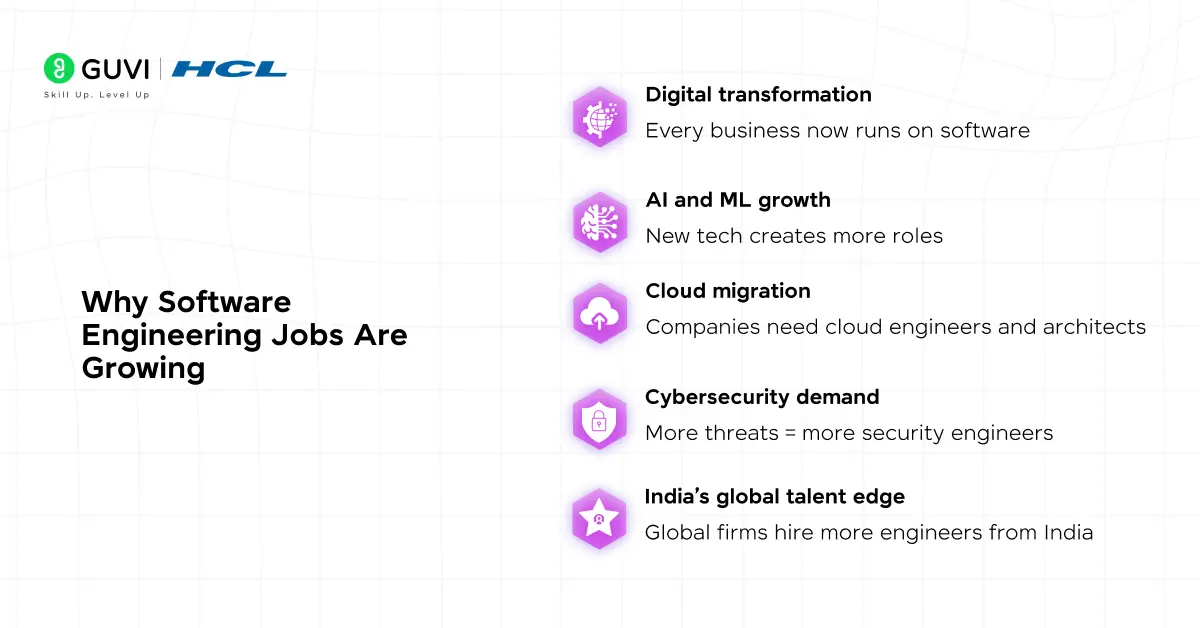
Despite concerns about AI automation, software engineering remains one of the most secure career choices. Here is why.
Market Growth That Will Continue
The software engineering job market is growing very fast. According to the U.S. Bureau of Labor Statistics, software development roles are expected to grow by 25 percent through 2031, which is much faster than most other careers.
India shows a similar trend. About 371,000 new tech jobs are expected in 2026 alone, based on a forecast by CompTIA.
Also Read: Is Machine Learning Market Saturated in 2026?
Ready to turn interest into a career? If AI/ML Engineering is the path you want, the HCL GUVI’s Artificial Intelligence and Machine Learning Course can get you there faster. With 120+ hours of live sessions, 25+ modules covering everything from Python to LLMs and AI agents, 10+ real-world projects, and dedicated placement support with mock interviews, it’s built for freshers and career switchers alike. Enroll today & boost your career growth!
What Is Driving the Growth of Software Engineering Jobs in 2026?
- Digital transformation acceleration: Every company is becoming a software company
- AI/ML expansion: New technologies create more engineering roles, not fewer
- Cloud migration: Organizations moving to the cloud need architects and engineers
- Cybersecurity urgency: Threats growing 38% YoY, creating insatiable demand
- India’s tech advantage: Global companies sourcing engineering talent from India
AI Paradox: Creating More Software Engineering Jobs in 2026
Contrary to fears, AI is creating engineering opportunities:
- AI augments, doesn’t replace: Tools like GitHub Copilot make engineers more productive, not obsolete
- New specializations emerging: LLM Engineers, AI Integration Specialists, Prompt Engineers
- System complexity increasing: AI-powered systems need human architects, security experts, and ethicists
- Quality assurance critical: AI-generated code requires expert review and testing
Skills-Based Hiring in Software Engineering Jobs in 2026
2026 marks a watershed moment: 81% of tech companies now use skills-based hiring over degree requirements. This opens software engineering to more people:
- Bootcamp graduates: 45% of tech hiring managers actively hire bootcamp grads
- Self-taught developers: Strong portfolio + GitHub = credibility
- Career switchers: Domain expertise (finance, healthcare) + coding skills = highly valuable
- Non-traditional backgrounds: Diverse perspectives increasingly valued
Compensation Continues Rising
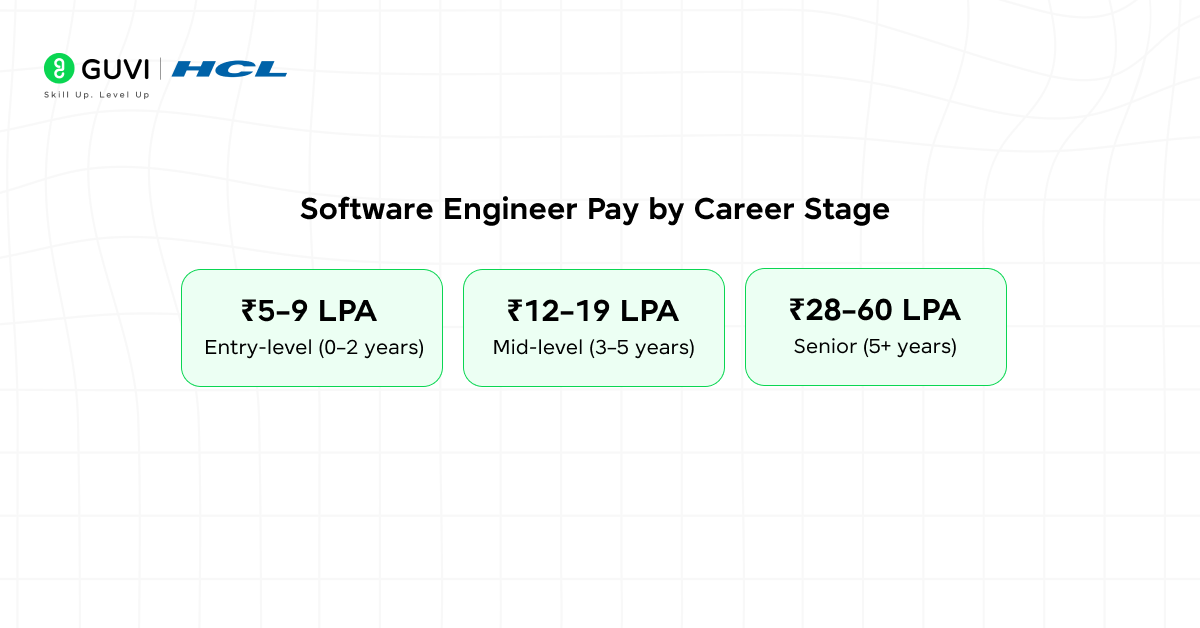
Software engineering salaries in India have grown 12-15% annually over the past 3 years:
- Entry-level: ₹5-9 LPA
- Mid-level: ₹12-19LPA
- Senior: ₹28-60 LPA
Top performers at FAANG/unicorn startups earn 2-3x market rates, with total compensation reaching ₹50-80 LPA.
Software Engineering Career Comparison (2026)
| Career Path | Entry Salary | 5yr Salary | Skills | Demand 2026 |
|---|---|---|---|---|
| AI/ML Engineer | ₹6–10 LPA | ₹25–35 LPA | Python, TensorFlow/PyTorch, ML pipelines, LLM fine-tuning | Very High |
| Prompt Engineer | ₹4–8 LPA | ₹20–30 LPA | LLM prompting, RAG, Python, LangChain, eval frameworks | High |
| MLOps Engineer | ₹6–10 LPA | ₹20–28 LPA | Kubeflow, MLflow, SageMaker, CI/CD for ML, cloud infra | Very High |
| Full Stack Developer | ₹4–7 LPA | ₹15–22 LPA | React/Angular, Node.js, REST APIs, SQL/NoSQL, cloud basics | High |
| Cloud Solutions Architect | ₹8–12 LPA | ₹28–35 LPA | AWS/Azure/GCP, Terraform, Kubernetes, security architecture | Very High |
| DevOps Engineer | ₹4–6 LPA | ₹18–22 LPA | CI/CD, Docker, Kubernetes, Terraform, cloud platforms | Very High |
| Cybersecurity Engineer | ₹5–8 LPA | ₹18–25 LPA | SIEM tools, penetration testing, cloud security, CISSP/CEH | Very High |
| Mobile App Developer | ₹4–6 LPA | ₹15–20 LPA | Kotlin/Swift, Flutter/React Native, app architecture | Medium-High |
| Game Developer | ₹3–6 LPA | ₹12–15 LPA | Unity/Unreal Engine, C++/C#, 3D math, shipped titles | Medium |
| QA Engineer | ₹3.5–5 LPA | ₹10–14 LPA | Selenium/Playwright, test automation, API testing, CI/CD | Medium |
Top Software Engineering Career Opportunities in 2026
The world of software engineering has changed a lot. Getting a B.Tech degree or a software engineering certificate does not lock you into one career. Instead, it opens doors to many well-paying jobs.
Below are the most in-demand software engineering careers, along with realistic salary ranges and how much each field is expected to grow.
1. AI/Machine Learning Engineer
Role Snapshot: Think of AI/ML engineers as the people who teach machines to notice patterns humans might miss — whether that’s a Netflix recommendation, a fraud alert on your bank app, or a self-driving car spotting a pedestrian. With every industry racing to bolt AI onto their products in 2026, this is easily the hottest software engineering career on the list right now.
What You’ll Actually Do:
- Build and train models that get smarter as they see more data
- Turn raw ideas into working AI features — chatbots, recommendation engines, image recognition tools
- Constantly tweak and tune models so they run faster and predict better
- Sit in the same room as data scientists, engineers, and product folks to actually ship the thing
- Spend a good chunk of your time cleaning messy datasets (yes, really — it’s most of the job)
Essential Skills: Python (TensorFlow, PyTorch, Scikit-learn) • Machine learning fundamentals • Deep learning & neural networks • Statistics & linear algebra • Cloud ML tools (AWS SageMaker, Azure ML) • Data cleaning • Basic MLOps
Best For: People who like puzzles more than they like small talk — math-minded thinkers who’d rather test an idea ten times than guess once.
Entry Path:
- Education: B.Tech CS/IT with an ML focus, a bootcamp, or solid self-teaching with real projects
- Timeline: 6–12 months to become job-ready if you’re consistent
- First Job: Junior ML Engineer / AI Developer — ₹6–10 LPA
- 3-Year Track: ML Engineer — ₹15–20 LPA
- 5+ Year Track: Senior ML Engineer, AI Architect — ₹25–35 LPA
Average Salary: ₹19 LPA
2. Prompt Engineer
Role Snapshot: A prompt engineer’s job is basically translation — turning a fuzzy human request into instructions an AI model can actually understand and act on well. It’s one of the newest job titles on this list, born entirely out of the ChatGPT-and-beyond era, and it’s already evolving fast.
What You’ll Actually Do:
- Write, test, and refine prompts that get consistent, accurate answers out of AI models
- Build and improve retrieval systems (RAG) so AI tools pull from real, trustworthy data instead of guessing
- Set up ways to measure whether an AI’s answers are actually good, not just confident-sounding
- Work closely with product teams to bake AI features into apps people use every day
- Keep up with new models almost monthly — this field moves fast
Essential Skills: Prompt design & iteration • Retrieval-Augmented Generation (RAG) • Python basics • LangChain or similar frameworks • Evaluation and testing of AI outputs • Clear written communication
Best For: Curious communicators who enjoy language and logic equally — you don’t need to be a hardcore coder, but comfort with tools and testing helps a lot.
Entry Path:
- Education: Any degree + a generative AI certification, or a strong self-built portfolio of prompt/RAG projects
- Timeline: 3–6 months if you’re focused
- First Job: Prompt Engineer / AI Content Specialist — ₹4–8 LPA
- 3-Year Track: GenAI Engineer — ₹12–18 LPA
- 5+ Year Track: Senior Prompt/GenAI Lead — ₹20–30 LPA
Average Salary: ₹15 LPA
3. MLOps Engineer
Role Snapshot: Building an AI model is one thing — keeping it alive, accurate, and running smoothly for millions of users is a whole different job. That’s what MLOps engineers do: they’re the reason a machine learning model doesn’t quietly break at 2 AM without anyone noticing.
What You’ll Actually Do:
- Automate the process of getting ML models from a data scientist’s laptop into a live product
- Monitor models in production and catch it early when accuracy starts slipping
- Build pipelines that retrain and redeploy models without much manual effort
- Manage the cloud infrastructure models run on
- Work as the bridge between data science teams and traditional engineering/DevOps teams
Essential Skills: Docker & Kubernetes • CI/CD pipelines • MLflow, Kubeflow, or SageMaker Pipelines • Cloud platforms (AWS, GCP, Azure) • Python scripting • Monitoring & logging tools
Best For: People who like the “engineering” side of AI more than the “research” side — those who enjoy building reliable systems rather than experimenting with algorithms.
Entry Path:
- Education: B.Tech CS/IT + DevOps or cloud certification, often as a step up from a DevOps role
- Timeline: 6–9 months, faster if you already know DevOps basics
- First Job: Junior MLOps Engineer — ₹6–10 LPA
- 3-Year Track: MLOps Engineer — ₹14–18 LPA
- 5+ Year Track: Senior MLOps Engineer — ₹20–28 LPA
Average Salary: ₹16 LPA
4. Full Stack Developer
Role Snapshot: Full stack developers are the do-it-all builders of the software world — equally comfortable designing what a user clicks on and writing the code that quietly runs the show behind the scenes. If you like seeing your work come to life as an actual product people use, this is a natural fit.
What You’ll Actually Do:
- Build both the front-end (what users see and click) and back-end (servers, databases, logic) of web apps
- Design databases and APIs that hold everything together
- Create interfaces using frameworks like React, Vue, or Angular
- Make sure everything works just as well on a phone as it does on a laptop
- Work closely with designers and product managers to turn ideas into real features
Essential Skills: HTML/CSS/JavaScript • React or Vue.js • Node.js or Python/Django • MongoDB or PostgreSQL • REST APIs • Git • Responsive design • Basic cloud knowledge
Best For: Generalists who like variety — if doing the same thing every day sounds boring, full stack keeps things fresh.
Entry Path:
- Education: B.Tech + a full stack bootcamp (GUVI, Scaler) or self-taught with a strong project portfolio
- Timeline: 4–6 months of focused learning
- First Job: Junior Full Stack Developer — ₹4–7 LPA
- 3-Year Track: Full Stack Developer — ₹10–15 LPA
- 5+ Year Track: Senior Developer, Tech Lead — ₹15–22 LPA
Average Salary: ₹12 LPA
5. Cloud Solutions Architect
Role Snapshot: Every company running on the cloud needs someone to design how all the pieces fit together — securely, cheaply, and without falling over during a traffic spike. That’s the cloud architect’s job, and it’s one of the highest-paying, most senior-leaning roles on this list.
What You’ll Actually Do:
- Design how an entire company’s cloud infrastructure should be structured
- Choose the right mix of services across AWS, Azure, or Google Cloud
- Keep systems secure, cost-efficient, and able to scale when demand suddenly spikes
- Guide engineering teams on best practices for cloud deployment
- Review and improve existing cloud setups that have grown messy over time
Essential Skills: AWS / Azure / GCP (deep expertise in at least one) • Terraform / Infrastructure as Code • Kubernetes • Networking & security fundamentals • Cost optimization
Best For: Experienced engineers who like the big picture — system design, trade-offs, and long-term thinking over day-to-day coding.
Entry Path:
- Education: B.Tech + cloud certifications (AWS Solutions Architect, Azure Architect Expert), usually after a few years as a developer or DevOps engineer
- Timeline: Typically 3–5 years of hands-on experience before stepping into this title
- First Job: Cloud Engineer / Associate Architect — ₹8–12 LPA
- 3-Year Track: Cloud Architect — ₹18–24 LPA
- 5+ Year Track: Senior Cloud Solutions Architect — ₹28–35 LPA
Average Salary: ₹21 LPA
6. DevOps Engineer
Role Snapshot: DevOps engineers are the ones who make sure code moves smoothly from a developer’s laptop to millions of users — without anything breaking along the way. It’s part automation, part firefighting, and one of the fastest-growing roles in Indian tech.

What You’ll Actually Do:
- Build and maintain CI/CD pipelines so code ships faster and safer
- Automate repetitive infrastructure tasks instead of doing them by hand
- Monitor systems and jump in quickly when something goes wrong
- Manage cloud infrastructure using tools like Docker, Kubernetes, and Terraform
- Work closely with developers to remove friction between “it works on my machine” and “it works in production”
Essential Skills: Linux & scripting (Bash/Python) • Docker & Kubernetes • CI/CD tools (Jenkins, GitHub Actions) • Terraform / Ansible • AWS, Azure, or GCP
Best For: Problem-solvers who like automation and don’t mind being the one who gets paged when things break.
Entry Path:
- Education: B.Tech + DevOps certification or bootcamp; strong Linux and scripting fundamentals matter more than a specific degree
- Timeline: 4–8 months to become job-ready
- First Job: Junior DevOps Engineer — ₹4–6 LPA
- 3-Year Track: DevOps Engineer — ₹12–16 LPA
- 5+ Year Track: Senior DevOps Engineer — ₹18–22 LPA
Average Salary: ₹13 LPA
7. Cybersecurity Engineer
Role Snapshot: Cybersecurity engineers exist because someone, somewhere, is always trying to break in. Their job is to think like an attacker before an actual attacker does — spotting weak points and shutting them down first.
What You’ll Actually Do:
- Monitor systems for suspicious activity and respond fast when something looks off
- Test networks and applications for vulnerabilities before hackers find them
- Set up firewalls, encryption, and access controls to keep data safe
- Investigate security incidents and figure out what went wrong (and how to stop it next time)
- Stay updated on new threats — this field never really lets you relax
Essential Skills: Network security fundamentals • SIEM tools • Penetration testing • Cloud security (AWS/Azure security services) • Certifications like CEH, CISSP, or Security+
Best For: Detail-obsessed, slightly suspicious minds — people who enjoy thinking about how things could go wrong.
Entry Path:
- Education: B.Tech CS/IT + a security certification (CEH, Security+); a cybersecurity specialization helps but isn’t mandatory
- Timeline: 6–9 months, especially if certifications are involved
- First Job: SOC Analyst / Junior Security Engineer — ₹5–8 LPA
- 3-Year Track: Cybersecurity Engineer — ₹12–16 LPA
- 5+ Year Track: Senior Security Engineer, Cloud Security Specialist — ₹18–25 LPA
Average Salary: ₹14.5 LPA
8. Mobile App Developer
Role Snapshot: Mobile app developers build the apps sitting on your home screen right now. With smartphones being how most of India accesses the internet, this remains one of the most practical, always-in-demand engineering careers.
What You’ll Actually Do:
- Build apps for Android, iOS, or both using native or cross-platform tools
- Design smooth, responsive interfaces that feel natural to use
- Connect apps to backend servers and APIs to pull in real data
- Fix bugs and optimize performance so apps don’t drain battery or lag
- Publish and maintain apps on the Play Store or App Store
Essential Skills: Kotlin or Swift • Flutter or React Native • App architecture patterns (MVVM) • REST APIs • Git • Basic UI/UX sense
Best For: People who like tangible, visible work — there’s something satisfying about seeing your app live on someone’s actual phone.
Entry Path:
- Education: B.Tech + a mobile development course or self-taught with published apps as proof of work
- Timeline: 4–6 months
- First Job: Junior Mobile Developer — ₹4–6 LPA
- 3-Year Track: Mobile App Developer — ₹10–14 LPA
- 5+ Year Track: Senior Mobile Developer — ₹15–20 LPA
Average Salary: ₹11.5 LPA
9. Game Developer
Role Snapshot: Game developers turn ideas into playable worlds — from a quick mobile puzzle game to a fully rendered 3D adventure. It’s one of the more creative paths on this list, blending storytelling with hardcore programming.
What You’ll Actually Do:
- Write the code that controls how a game behaves — physics, movement, interactions
- Build gameplay mechanics using engines like Unity or Unreal Engine
- Optimize games so they run smoothly across different devices
- Collaborate with artists, designers, and sound teams to bring a game to life
- Test and debug constantly — games break in extremely creative ways
Essential Skills: Unity or Unreal Engine • C# or C++ • 3D math basics • Game physics • Version control (Git) • A portfolio of shipped or playable projects
Best For: Creative problem-solvers who grew up loving games and want to build them instead of just playing them.
Entry Path:
- Education: B.Tech + game development coursework, or self-taught with a strong portfolio (portfolio matters more here than almost any other role on this list)
- Timeline: 6–12 months to build a portfolio worth showing
- First Job: Junior Game Developer — ₹3–6 LPA
- 3-Year Track: Game Developer — ₹8–10 LPA
- 5+ Year Track: Senior Game Developer — ₹12–15 LPA
Average Salary: ₹8.5 LPA
10. QA Engineer
Role Snapshot: QA engineers are the last line of defense before software reaches real users. Their job is to break things on purpose — finding bugs before customers do — and increasingly, to build automated systems that catch bugs on their own.
What You’ll Actually Do:
- Write and run test cases to catch bugs before release
- Build automated testing frameworks so tests run without manual effort every time
- Report bugs clearly so developers can fix them fast
- Test APIs, performance, and user experience across devices
- Work closely with developers throughout the build process, not just at the end
Essential Skills: Selenium or Playwright • Test automation frameworks • API testing (Postman) • Basic programming (Java/Python) • CI/CD familiarity
Best For: Patient, detail-focused people who genuinely enjoy finding what’s wrong before it becomes a bigger problem.
Entry Path:
- Education: B.Tech + QA/testing certification, or self-taught with hands-on automation projects
- Timeline: 3–5 months
- First Job: Junior QA Engineer — ₹3.5–5 LPA
- 3-Year Track: QA Automation Engineer — ₹7–9 LPA
- 5+ Year Track: Senior QA Engineer, SDET — ₹10–14 LPA
Average Salary: ₹7.5 LPA
Software Engineering Specializations with Highest Demand in India
Not every software engineering path is growing at the same speed. Some are short on people right now. Others are steady but already have plenty of engineers competing for the same roles.
Right now, anything close to AI or cloud is where the jobs are piling up fastest in software engineering.
- AI/ML Engineer — the most searched skill on hiring platforms today, and companies simply can’t find enough trained people fast enough
- Cloud Solutions Architect — as businesses move everything to the cloud, they need experienced people to design it properly, and that pool is small
- DevOps Engineer — every team wants faster releases and fewer breakdowns, so this role stays busy year-round
- MLOps Engineer — a fairly new specialization in software engineering that’s growing fast because building an AI model is easy, keeping it running well is not
- Cybersecurity Engineer — with cyberattacks rising and stricter data laws like India’s DPDP Act, companies now need dedicated security hires
- Prompt Engineer — still a young title, but working with AI tools well is turning into a skill most software engineering jobs expect anyway
Full Stack Development, Mobile App Development, QA, and Game Development are still solid choices with steady openings. They’re just not growing as fast as the AI and cloud roles above.
Which Software Engineering Career is Safest from AI Automation?
No software engineering job is fully safe from AI. Anyone who says otherwise is skipping the fine print. But some roles depend on judgment, decision-making, and understanding the bigger picture — things AI tools still aren’t good at — so they’re much harder to replace than others.
Roles like Cloud Solutions Architect, DevOps Engineer, and Cybersecurity Engineer tend to hold up well. AI/ML Engineering also stays fairly safe, since someone still has to build and manage the AI systems doing all this automating.
Roles built around repetitive, predictable tasks, like manual QA testing or basic game scripting, are the ones already losing ground to AI tools. The real safety net in software engineering isn’t the job title. It’s whether your daily work involves messy, real problems or just following a checklist.
7 Common Career Mistakes Holding Software Engineers Back
Mistake #1: Tutorial
The trap: Endlessly watching courses without building anything
The fix: Build 1 project after every 10 hours of learning. Learn by doing, not just watching.
Mistake #2: Perfectionism Paralysis
The trap: I’ll apply when I’m 100% ready
The fix: Apply at 70% readiness. Learn remaining 30% on the job. Rejection is part of the process, 10 rejections before 1 offer is normal.
Mistake #3: Ignoring Fundamentals
The trap: Jumping straight to advanced frameworks (React, Django)
The fix: Master basics first like data structures, algorithms, design patterns. Frameworks change; fundamentals don’t.
Mistake #4: No Portfolio/GitHub Presence
The trap: I have a degree, that’s enough
The fix: Build and deploy 5-10 projects. Contribute to open source. GitHub commits speak louder than degrees.
Mistake #5: Over-Specialization Too Early
The trap: I only want to do React development.
The fix: Develop T-shaped skills (broad knowledge + deep expertise in 1-2 areas). Flexibility = more opportunities.
Mistake #6: Neglecting Soft Skills
The trap: Code is all that matter
The fix: Communication, teamwork, and problem-solving matter equally. 50% of senior engineer work is non-coding (meetings, code reviews, mentoring).
Mistake #7: Not Networking
The trap: Just applying through job portals
The fix: 70% of jobs are filled through referrals. Network on LinkedIn, attend meetups, participate in hackathons, message alumni.
Conclusion
Software engineering in 2026 isn’t one path anymore, it’s dozens. Whether you lean toward AI/ML, cloud, cybersecurity, or full stack development, the money and growth are real if you pick a lane and build actual skills, not just a degree.
The safest software engineering careers are the ones tied to judgment and problem-solving, not repetitive tasks. Start with what genuinely interests you, stay consistent, and let your skills do the talking when it’s time to negotiate that first offer.
FAQs
1. Which software engineering career has the highest salary in 2026?
Cloud Solutions Architect and AI/ML Engineer lead software engineering salaries in India, with senior professionals earning ₹28–35 LPA.
2. Is AI going to replace software engineering jobs?
No, AI is changing software engineering, not replacing it, roles built on judgment and system design remain in high demand.
3. Which software engineering path is best for beginners?
Full Stack Development is one of the easiest software engineering careers to break into, with a shorter learning curve and strong entry-level demand.
4. Do I need a coding background for Prompt Engineering?
Not necessarily, but pairing prompt skills with basic coding significantly boosts pay in this software engineering specialization.
5. How long does it take to become job-ready in software engineering?
Most specializations take 4–9 months of focused learning, depending on the role and your starting point.
6. Which software engineering role is safest from automation?
Roles like DevOps, Cloud Architecture, and Cybersecurity are safer since they rely on judgment AI tools can’t fully replicate yet.
7. Can I switch software engineering specializations later in my career?
Yes, many engineers move between software engineering paths, like DevOps to MLOps, as skills often overlap.
Success Stories

Did you enjoy this article?
Comments












would like to read more about this article