


Full Stack Development Articles
Full Stack Development for Career Changers: A Practical 6-Month Learning Plan
Full Stack Development Course Fees in India: What Does the Cost Include?
How to Move from Frontend Development to Full Stack Development Without Quitting Your Job
How to Move from Backend Development to Full Stack Development

Get In Touch For Details! Request More Information
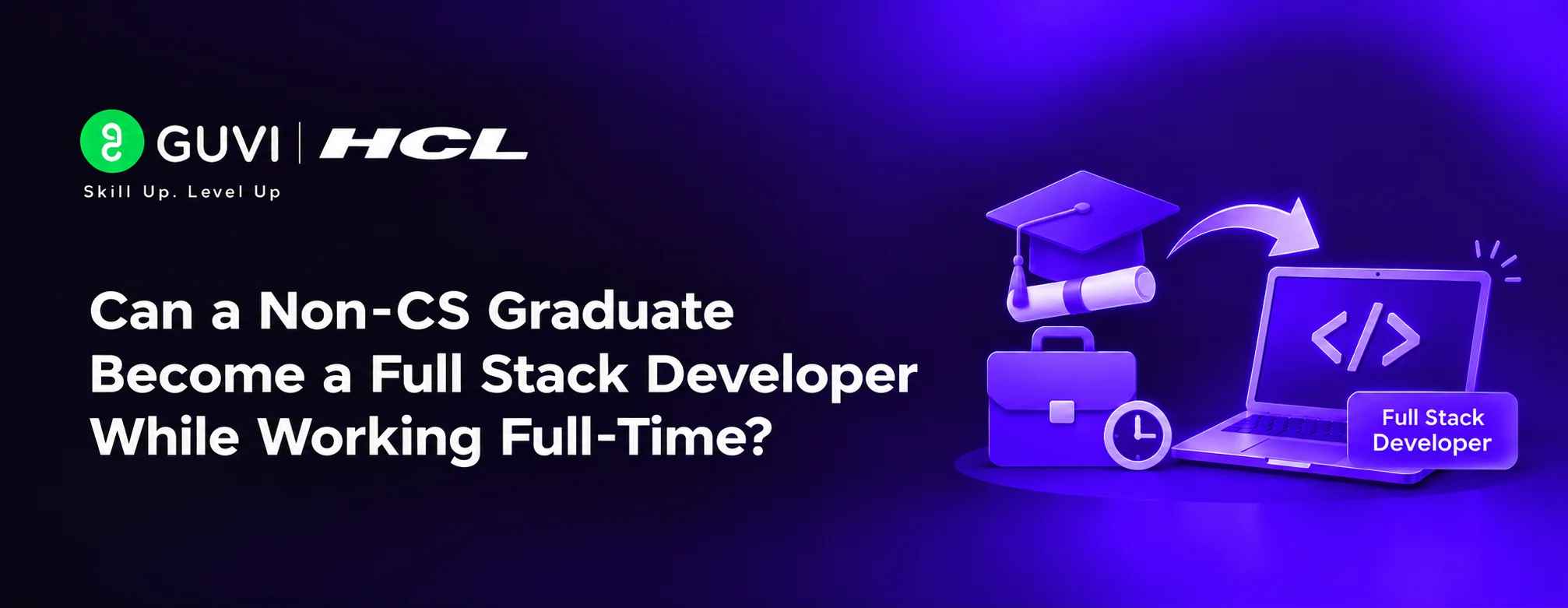
Can a Non-CS Graduate Become a Full Stack Developer While Working Full-Time?
Nov 11, 2026 4 Min Read 33 Views
(Last Updated)
You finish a long day at work, open your laptop, and the first tutorial you see is titled “for computer science students”. You close the tab and wonder if this field was built for someone with a different degree.
So can a non CS graduate to full stack developer switch really happen while you hold a full time job? Yes. Developers come from commerce, mechanical, science, and arts backgrounds, and many employers weigh projects and interviews heavily. Plan for about six to nine months at ten or more hours a week.
In this guide, you will find what a CS degree covers and how to cover it yourself, a weekly schedule built around work, a 36 week full stack developer roadmap, projects that use your own degree, and how to explain your background in interviews.
Table of contents
- TL;DR Summary
- What is Non CS Graduate to Full Stack Developer?
- How Most Developers Actually Learn
- What a CS Degree Covers and How You Cover It
- Your Degree Is an Edge, Not a Gap
- A Weekly Schedule to Learn Full Stack Development While Working
- A 36 Week Full Stack Developer Roadmap
- Weeks 1 to 8: Web Basics
- Weeks 9 to 16: React and Git
- Weeks 17 to 26: Back End and Database
- Weeks 27 to 36: Projects, DSA, and Interviews
- Protect Your Job and Your Energy
- 💡 Did You Know?
- How to Talk About a Non CS Degree
- What HCL GUVI's Full Stack Development Course Offers Working Learners
- Common Mistakes in Non CS Graduate to Full Stack Developer Moves
- Conclusion
- FAQs
- Can a non CS graduate to full stack developer switch happen in a year?
- Do I need DSA as a non CS graduate to full stack developer?
- Which degree is best for full stack development without computer science degree?
- How many hours do I need to learn full stack development while working?
- Is a certificate enough for a non CS graduate to full stack developer jobs?
TL;DR Summary
- What it is: Non CS graduate to full stack developer means moving into web development from any degree other than computer science.
- Your edge: A non CS graduate to full stack developer brings knowledge of another field, which makes for original projects.
- Time needed: About ten hours a week, split across weekdays and weekends.
- Roadmap: Four phases over 36 weeks, from web basics to interviews.
- Gaps to cover: In non CS graduate to full stack developer plans, DSA, databases, and a little networking are taken one at a time.
- Next step: Start non CS graduate to full stack developer with one hour of HTML after work this week.
What is Non CS Graduate to Full Stack Developer?
Non CS graduate to full stack developer is the journey of a commerce, science, arts, or engineering graduate into building complete web apps. A full stack developer handles the screen people see, the server behind it, and the database that stores the data.
The usual worry is full stack development without computer science degree. Some listings do ask for CS, but many employers weigh projects and interview answers more. To see how the job is built, read what full stack development involves, and whether full stack jobs depend on CS degrees at all.
Time is the real hurdle when you work full time. HCL GUVI’s Full Stack Development course offers live weekday and weekend batches with recordings, so you can learn after work and rewatch a class you missed.
How Most Developers Actually Learn
Your path may look different from the textbook one, and that is normal. In the 2024 Stack Overflow Developer Survey, 82% of respondents said they used online resources to learn to code, while 49% said they learned at school.
Many developers also hold degrees, so degrees still matter. The point is that coding is learned in many places, which makes non CS graduate to full stack developer moves common, not unusual.
What a CS Degree Covers and How You Cover It
You do not need the whole syllabus. You need the parts that web developers use, and this table maps them for a non CS graduate to full stack developer plan.
| CS Subject | Why It Matters | How to Cover It |
|---|---|---|
| Data structures and algorithms | Coding rounds in many interviews | Practise arrays, strings, and hash maps in the last phase |
| Databases | Every app stores data | Learn SQL and one NoSQL option while building the back end |
| Operating systems | Helps you understand how programs run | Learn the command line and what a process is |
| Computer networks | The web runs on requests and responses | Learn HTTP, status codes, and APIs |
| Object oriented ideas | Keeps larger code organised | Learn classes and modules in JavaScript |
For the DSA part, these reasons to learn data structures and algorithms show why interviews test it.
Your Degree Is an Edge, Not a Gap
Full stack development without computer science degree gives you something CS graduates often lack: knowledge of another field. A non CS graduate to full stack developer can use it to build projects nobody else has.
| Your Degree | A Project to Build | What It Shows |
|---|---|---|
| Commerce | Expense and invoice tracker | You understand accounts and reports |
| Mechanical or electrical | Equipment maintenance log | You understand real machines and schedules |
| Science | Lab inventory or booking app | You understand lab workflows |
| Arts or design | A portfolio site with strong layout | You have an eye for design |
| Education | Quiz or attendance app | You understand learners |
Use sample data only, never records from your employer.
A Weekly Schedule to Learn Full Stack Development While Working
To learn full stack development while working, protect fixed slots instead of waiting for free time. Here is one non CS graduate to full stack developer week that adds up to ten hours.
| Day | Time | Focus |
|---|---|---|
| Monday, Tuesday | 1 hour each | New concept and small exercise |
| Wednesday | Rest | Let your brain recover |
| Thursday, Friday | 1 hour each | Revise and fix bugs |
| Saturday | 4 hours | Build your project |
| Sunday | 2 hours | Review the week and plan the next one |
- Same slot daily: A fixed time turns study into a habit.
- Hard topics on weekends: Keep long sessions for new ideas.
- Light weeks at work peaks: Do a short revision and return to the plan.
A 36 Week Full Stack Developer Roadmap
This full stack developer roadmap suits non CS graduate to full stack developer learners who study about ten hours a week. Read how long it takes to become a full stack developer to adjust it to your pace.
Weeks 1 to 8: Web Basics
Learn HTML, CSS, and JavaScript, and build one small page every week. This HTML and CSS guide for beginners is a gentle start.
Weeks 9 to 16: React and Git
Build screens from components, and save every project in Git. This walkthrough shows how to upload your project to GitHub.
Weeks 17 to 26: Back End and Database
Add Node.js, Express, and a database so your app stores real data. This guide to the best way to learn backend development helps you plan.

Weeks 27 to 36: Projects, DSA, and Interviews
Finish two or three apps, deploy them, practise DSA daily, and do mock interviews. Get ideas from these full stack project ideas, and see the full full stack developer roadmap for each stage in detail.
Protect Your Job and Your Energy
A non CS graduate to full stack developer switch beside a job needs a few rules.
- Check your contract: Some employers have rules on outside projects, so read yours before you publish work.
- Use your own laptop: Keep study and company work apart.
- Never use company data: Build with sample data.
- Watch your energy: Sleep matters more than one extra late night.
- Stay in your job: Keep it until you have projects to show.
💡 Did You Know?
- The first computer science department in the United States opened at Purdue University in October 1962, so the earliest programmers came from other fields.
How to Talk About a Non CS Degree
Recruiters read your degree in seconds, so in non CS graduate to full stack developer applications, make your proof easy to find.
- Projects first: Put deployed apps and live links above your education.
- State your degree plainly: List it without apology.
- One line on why: For example, “I moved from accounts to development to build the tools I used.”
- Link GitHub: Show your code.
This guide to a full stack developer portfolio shows what to include.
What HCL GUVI’s Full Stack Development Course Offers Working Learners
| If You Worry About | What the Program Offers |
|---|---|
| Not knowing code yet | It begins with programming fundamentals, then HTML, CSS, JavaScript, React, Node.js, Express.js, and MongoDB |
| Fitting classes around work | 130+ hours of live online classes in weekday or weekend batches, with recordings |
| Getting stuck alone | Live mentors and one to one doubt solving |
| Having nothing to show | An e-commerce web application, an order management system, a cloud deployment pipeline, and an AI powered document Q and A chatbot |
| Interviews | One to one mock interviews, resume review, and portfolio and GitHub guidance |
| Proof of learning | An IITM Pravartak certification and a complimentary MongoDB certification |
Classes run in English, Tamil, Hindi, and Telugu, which suits a non CS graduate to full stack developer who wants lessons in a familiar language. Check the syllabus and choose a batch on the Full Stack Development course page.
Common Mistakes in Non CS Graduate to Full Stack Developer Moves
- Trying to learn the whole CS degree: For non CS graduate to full stack developer plans, cover only the parts web developers use.
- Studying only on free days: A fixed weekly slot beats rare long sessions.
- Watching without building: In non CS graduate to full stack developer prep, build something every week.
- Hiding your degree: In non CS graduate to full stack developer stories, your field is a strength.
- Skipping DSA: Many interviews include coding rounds.
Conclusion
Non CS graduate to full stack developer is possible beside a full time job because the path rewards steady hours and visible projects. Cover the gaps, build with your own field in mind, and put your work online.
Follow the 36 weeks, guard your weekly slots, and keep one project moving. A patient switch to full stack development without computer science degree beats a rushed one.
HCL GUVI’s Full Stack Development course gives you live mentors, projects to deploy, and mock interviews, with IITM Pravartak and MongoDB certificates at the end. Pick a batch and begin your non CS graduate to full stack developer plan this week.
FAQs
1. Can a non CS graduate to full stack developer switch happen in a year?
Yes, for many people. For non CS graduate to full stack developer learners at about ten hours a week, six to nine months is a fair plan, and a year gives room for busy weeks.
2. Do I need DSA as a non CS graduate to full stack developer?
Many product company interviews include coding rounds, so yes, practise arrays, strings, and hash maps. Other employers weigh projects more.
3. Which degree is best for full stack development without computer science degree?
None is required. As a non CS graduate to full stack developer, pick projects that match your own field, since that gives you a story to tell.
4. How many hours do I need to learn full stack development while working?
Around ten hours a week is a good target. Fewer hours stretch the timeline, so adjust the roadmap instead of quitting.
5. Is a certificate enough for a non CS graduate to full stack developer jobs?
It helps, but deployed projects and interview practice matter more. For non CS graduate to full stack developer jobs, pair any certificate with a tidy GitHub profile.
Success Stories

About the Author
Jebasta
I translate the language of data into stories that anyone can understand. As a writer with a data science background, I simplify analytics, AI, and decision-making so beginners and enthusiasts can confidently explore the world of data.
View all posts by Jebasta
Connect with me @



















Did you enjoy this article?