


Forward Deployed Engineer Articles
Excalidraw and Whiteboarding: How FDEs Communicate Technical Solutions
How to Fine-Tune Open-Source Models as a Forward Deployed Engineer
Rate Limiting, Retries, and Caching: Production AI Patterns for FDEs
How to Run a Great Client Demo as a Forward Deployed Engineer


Get In Touch For Details! Request More Information

Measuring Success: KPIs Every Forward Deployed Engineer Should Track
Sep 28, 2026 3 Min Read 32 Views
(Last Updated)
A Forward Deployed Engineer (FDE) can build a technically strong solution and still fail to create meaningful customer value. The right KPIs connect engineering work with adoption, workflow improvement, reliability, and business outcomes. They show whether the deployed solution actually works for the customer.
Table of contents
- TL;DR Summary
- Why Do KPIs Matter for FDEs?
- What Makes FDE Measurement Different?
- What Should a Good KPI Do?
- KPI 1: Customer Adoption
- How Many People Actually Use the Solution?
- Why Does Adoption Matter?
- KPI 2: Workflow Improvement
- Is the Customer's Process Actually Better?
- KPI 3: Task Success Rate
- Are Users Completing the Intended Task?
- KPI 4: Reliability and Availability
- Does the System Work Consistently?
- KPI 5: Latency and Performance
- How Quickly Does the System Respond?
- KPI 6: Quality and Accuracy
- Does the Solution Produce Useful Results?
- KPI 7: Automation Rate
- How Much Manual Work Is Removed?
- KPI 8: Deployment and Delivery Metrics
- How Efficiently Can the Solution Reach Production?
- KPI 9: Customer Satisfaction and Feedback
- Does the Customer Believe the Solution Helps?
- KPI 10: Business or Operational Impact
- Did the Deployment Create Measurable Value?
- How Should FDEs Choose the Right KPIs?
- Should Every Deployment Use the Same Metrics?
- What Should You Avoid Measuring?
- Real-World Example
- How Can You Build Stronger KPI-Driven FDE Skills?
- Start Measuring Your Projects
- Conclusion
- FAQs
- What KPIs should an FDE track?
- Should FDEs measure customer adoption?
- How can an FDE measure AI solution quality?
- Why are baselines important for FDE KPIs?
- Are technical metrics enough to measure FDE success?
- How many KPIs should an FDE track?
- What is the most important FDE KPI?
TL;DR Summary
- FDE KPIs should connect technical performance with customer outcomes.
- Adoption, reliability, workflow improvement, and solution quality are key measurement areas.
- Metrics should be defined before deployment whenever possible.
- The best KPIs show whether a solution creates measurable value in production.
Quick Answer
| FDEs should track KPIs across adoption, reliability, workflow impact, and delivery effectiveness. Useful measures include active users, task completion, error rates, latency, uptime, automation rate, time saved, accuracy, deployment success, and customer outcomes. The exact metrics should depend on the customer’s problem rather than using the same dashboard for every deployment. |
Why Do KPIs Matter for FDEs?
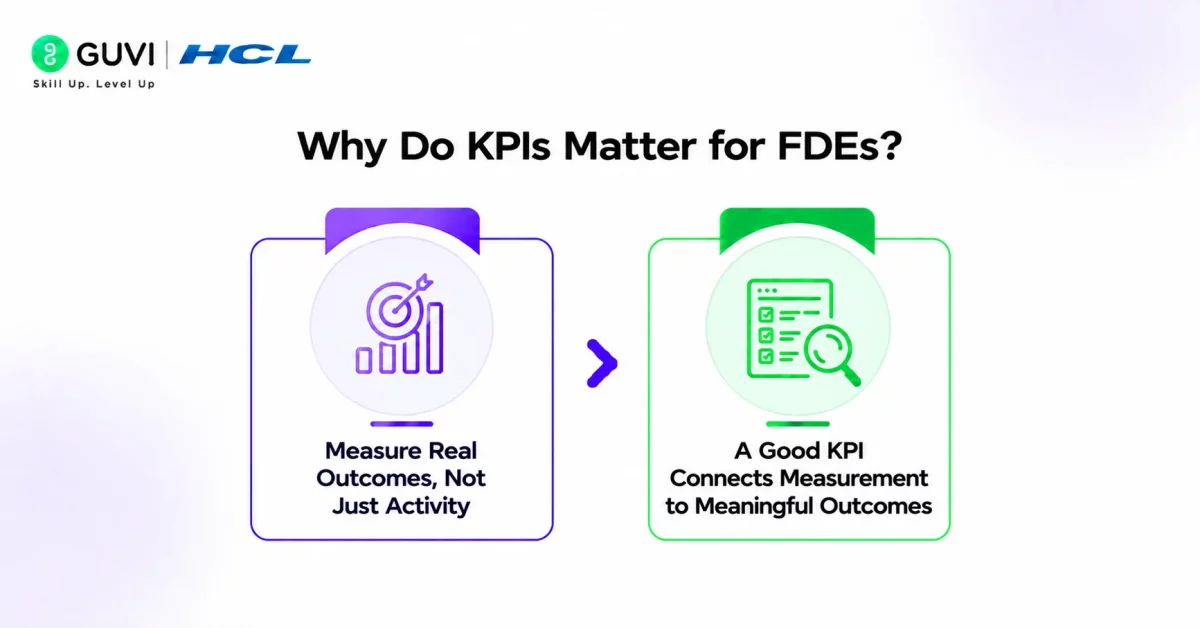
1. What Makes FDE Measurement Different?
FDEs work across discovery, implementation, evaluation, production rollout, and adoption. Success cannot be measured only by code, tickets, or deployment dates.
A solution should be evaluated against the problem it was created to solve. If an application is deployed but nobody uses it, deployment alone is not evidence of success.
2. What Should a Good KPI Do?
A useful KPI connects an observable measurement to a meaningful outcome and has a clear definition, measurement period, data source, and owner.
KPI 1: Customer Adoption
1. How Many People Actually Use the Solution?
Track active users, usage frequency, feature adoption, and completion of the intended workflow. Adoption shows whether the solution has moved beyond technical deployment into real usage.
2. Why Does Adoption Matter?
Low adoption can indicate usability problems, poor workflow fit, insufficient training, or limited perceived value. Investigate the reason rather than assuming users need more features.
KPI 2: Workflow Improvement
Is the Customer’s Process Actually Better?
Measure the change in the workflow the solution was designed to improve. This could mean lower processing time, fewer manual steps, faster resolution, or higher throughput.
Capture a baseline before deployment. Without one, it is difficult to demonstrate meaningful improvement.
KPI 3: Task Success Rate
Are Users Completing the Intended Task?
Measure how often users complete the workflow without failure, unnecessary intervention, or abandonment.
For an AI system, task success might mean retrieving correct information, completing a permitted action, or producing an output that meets predefined criteria.
KPI 4: Reliability and Availability
Does the System Work Consistently?
Track uptime, error rate, failed requests, incident frequency, and recovery time. Even a valuable application becomes difficult to trust when customers cannot depend on it.
KPI 5: Latency and Performance
How Quickly Does the System Respond?
Track response time using averages and useful percentiles such as p95 or p99. A reasonable average can hide slow requests that affect users.
KPI 6: Quality and Accuracy
Does the Solution Produce Useful Results?
Quality metrics depend on the application. They might include classification accuracy, retrieval relevance, successful recommendations, human acceptance rate, or evaluation scores.
For AI systems, combine automated evaluation with human review where appropriate. A fast system is not successful if its outputs are consistently incorrect.
KPI 7: Automation Rate
How Much Manual Work Is Removed?
Measure the percentage of eligible work completed automatically or with reduced human intervention.
KPI 8: Deployment and Delivery Metrics
How Efficiently Can the Solution Reach Production?
Track deployment success rate, time from approved design to production, rollback frequency, and time required to resolve deployment issues.
These measures help FDEs identify delivery bottlenecks and improve repeatability across customer environments.
KPI 9: Customer Satisfaction and Feedback
Does the Customer Believe the Solution Helps?
Customer feedback can reveal problems technical dashboards miss. Track structured satisfaction measures, qualitative feedback, support requests, and recurring complaints.
KPI 10: Business or Operational Impact
Did the Deployment Create Measurable Value?
The strongest KPI is often connected to the customer’s original objective. This could involve reduced operating time, increased throughput, lower support workload, improved conversion, or fewer errors.

How Should FDEs Choose the Right KPIs?
1. Should Every Deployment Use the Same Metrics?
No. Start with the customer’s desired outcome and work backward. Choose a small group of metrics that directly indicate whether that outcome is being achieved.
An AI support system might track resolution time, task success, adoption, escalation rate, and response quality. An integration project may focus on successful transactions, failure rate, latency, and reconciliation accuracy.
2. What Should You Avoid Measuring?
Avoid vanity metrics that are easy to report but disconnected from value. Features shipped, hours worked, or lines of code describe activity without showing whether the customer’s situation improved.
A deployment can be technically successful while being operationally unsuccessful. Production availability only tells you that a system is running. Adoption, workflow improvement, quality, and customer outcomes reveal whether it is useful.
Real-World Example
Suppose an FDE deploys an AI assistant for an enterprise support team. The dashboard shows 99.9% availability and low latency, suggesting strong technical performance.
However, adoption remains low and agents continue searching documentation manually. Investigation shows that answers are inconsistent because important knowledge sources are missing. The team improves retrieval coverage and measures task success and agent usage alongside reliability.
How Can You Build Stronger KPI-Driven FDE Skills?
Start Measuring Your Projects
When building a portfolio project, define a baseline before making improvements. Measure response time, successful task completion, error rate, or another outcome matching the project’s purpose.
HCL GUVI’s Artificial Intelligence & Machine Learning Certification Bundle can strengthen the technical foundation needed to build and evaluate modern AI applications.
Conclusion
KPIs help FDEs connect engineering work with measurable customer value. Useful metrics cover adoption, workflow improvement, task success, reliability, performance, quality, automation, delivery, feedback, and business impact.
The goal is not a massive dashboard. Identify the few measurements that answer one question: did the solution improve the customer’s real-world problem? When FDEs establish baselines, measure production behavior, and learn from results, they can make deployments more useful and repeatable.
FAQs
1. What KPIs should an FDE track?
Common KPIs include adoption, task success, workflow improvement, reliability, latency, quality, automation, deployment performance, customer feedback, and business impact.
2. Should FDEs measure customer adoption?
Yes. Adoption shows whether users are actually incorporating the deployed solution into their workflows.
3. How can an FDE measure AI solution quality?
Use application-specific evaluation metrics, automated tests, acceptance criteria, and human review when appropriate.
4. Why are baselines important for FDE KPIs?
A baseline makes it possible to determine whether the deployment improved the original workflow.
5. Are technical metrics enough to measure FDE success?
No. Technical reliability matters, but FDE success also depends on adoption, workflow improvement, and customer-defined outcomes.
6. How many KPIs should an FDE track?
There is no fixed number. A small set of directly relevant metrics is usually more useful than a large dashboard full of disconnected measurements.
7. What is the most important FDE KPI?
There is no universal KPI. The most meaningful measure depends on the customer’s original problem and how success was defined.
Success Stories

About the Author
HCL GUVI
This article was selected and published as part of the HCL GUVI AI Blogathon 2026, an initiative designed to encourage students, AI enthusiasts, and aspiring tech writers to simplify complex AI concepts through impactful technical content. The contest recognized high-quality, original, and insightful AI-focused blogs, with selected authors receiving publication opportunities on the HCL GUVI blog platform along with official author credits and recognition.
View all posts by HCL GUVI
Connect with me @










Did you enjoy this article?