


Forward Deployed Engineer Articles
Excalidraw and Whiteboarding: How FDEs Communicate Technical Solutions
Rate Limiting, Retries, and Caching: Production AI Patterns for FDEs
How to Run a Great Client Demo as a Forward Deployed Engineer
Handling a Failed Deployment: A Forward Deployed Engineer's Recovery Playbook


Get In Touch For Details! Request More Information

How to Fine-Tune Open-Source Models as a Forward Deployed Engineer
Sep 28, 2026 4 Min Read 40 Views
(Last Updated)
Fine-tuning open-source models as a forward deployed engineer can help organizations adapt AI systems to specific business requirements, workflows, and datasets. Unlike generic AI applications, customer deployments may require models to understand specialized terminology, follow particular response patterns, or perform well on domain-specific tasks.
FDEs need to balance model performance with practical considerations such as data quality, training costs, latency, security, and deployment requirements. Depending on the use case, they may evaluate prompting or retrieval-augmented generation before deciding that fine-tuning is necessary.
This article explains how FDEs can approach open-source model fine-tuning, from selecting a suitable model and preparing datasets to choosing fine-tuning techniques, evaluating results, and deploying the model for real-world use.
Table of contents
- TL;DR Summary
- What Does Fine-Tuning Open-Source Models Mean for an FDE?
- When Should an FDE Fine-Tune an Open-Source Model?
- What Steps Should an FDE Follow to Fine-Tune a Model?
- Understand the Customer Requirement
- Select an Appropriate Model
- Prepare the Dataset
- Configure Fine-Tuning
- Train a Small Experiment
- Evaluate the Results
- Iterate
- Which Fine-Tuning Techniques Should FDEs Know?
- Full Fine-Tuning
- LoRA
- Quantized Fine-Tuning
- How Should FDEs Evaluate a Fine-Tuned Model?
- How Can FDEs Deploy Fine-Tuned Models?
- Common Mistakes to Avoid
- Start Your Learning Journey with HCL GUVI
- Conclusion
- FAQs
- Why should a forward deployed engineer learn to fine-tune open-source models?
- Should FDEs always fine-tune an open-source model?
- What is LoRA fine-tuning?
- How much data is needed for fine-tuning?
- How should an FDE evaluate a fine-tuned model?
- What skills are useful for fine-tuning open-source models?
TL;DR Summary
- Fine-tuning open-source models allows a forward deployed engineer to adapt AI models to specific customer requirements.
- FDEs need to understand dataset preparation, model selection, training configuration, evaluation, and deployment.
- Parameter-efficient techniques such as LoRA can reduce the compute and memory required for customization.
- Fine-tuning should be considered only when prompting, retrieval, or other simpler approaches cannot meet the customer’s requirements.
- Strong FDEs evaluate model quality using customer-specific data and measurable performance criteria.
- The final solution must balance model accuracy, latency, cost, security, and maintainability.
What Does Fine-Tuning Open-Source Models Mean for an FDE?
Fine-tuning an open-source model means adapting an existing pretrained model using a customer-specific dataset so it performs better for a particular task, domain, or response style.
For a fine-tune open-source models forward deployed engineer workflow, the goal is not simply to train a model. The FDE needs to understand the customer’s problem, determine whether fine-tuning is appropriate, prepare useful data, evaluate the results, and deploy the solution into the customer’s environment.
For example, a customer may want an open-source language model to classify internal support requests according to company-specific categories. Instead of building a model from scratch, an FDE can start with an existing model and fine-tune it using labeled examples from the customer’s workflows.
Want to build practical AI skills? HCL GUVI’s Artificial Intelligence & Machine Learning Course helps you learn AI, machine learning, and real-world model development through hands-on projects and industry-focused training.
When Should an FDE Fine-Tune an Open-Source Model?
Fine-tuning is useful when a customer needs consistent behavior that cannot be achieved effectively through prompting or retrieval alone.
Common use cases include:
- Domain-specific classification
- Specialized text generation
- Custom response formats
- Industry-specific terminology
- Instruction following
- Structured output
- Specialized summarization
- Customer-specific language or style
However, fine-tuning should not automatically be the first solution.
If the problem is mainly about giving a model access to changing customer information, retrieval-augmented generation may be more appropriate. If the issue can be solved with better instructions, prompt engineering may be sufficient.
Best Practice: Before fine-tuning, compare it with prompting, retrieval, tool use, and other simpler approaches. Choose the least complex method that reliably solves the customer’s problem.
What Steps Should an FDE Follow to Fine-Tune a Model?
1. Understand the Customer Requirement
Start by defining what the model needs to do.
Ask:
- What task should the model perform?
- What does success look like?
- What data is available?
- What accuracy or quality is required?
- Where will the model be deployed?
A clear objective prevents unnecessary experimentation.
2. Select an Appropriate Model
Choose an open-source model based on:
- Task requirements
- Model size
- License
- Hardware availability
- Inference latency
- Language support
- Existing ecosystem
A smaller model may be preferable when the customer’s priority is low latency or lower infrastructure costs.
3. Prepare the Dataset
Data quality is one of the most important factors in fine-tuning.
An FDE may need to:
- Remove duplicate examples
- Fix incorrect labels
- Remove sensitive information where appropriate
- Standardize formats
- Create training and evaluation datasets
- Balance different categories
- Validate examples with domain experts
For example, if a customer wants an intent-classification model, each training example should have a clear and reliable intent label.
4. Configure Fine-Tuning
Training configuration can include:
- Learning rate
- Batch size
- Number of epochs
- Maximum sequence length
- Evaluation frequency
- Checkpoint strategy
The correct settings depend on the model, dataset, hardware, and task.
5. Train a Small Experiment
Do not begin with the largest possible training run.
Start with a smaller experiment to verify that the dataset, training pipeline, and evaluation process work correctly.
This can save significant compute and development time.
6. Evaluate the Results
Compare the fine-tuned model with the original model.
Use customer-specific evaluation datasets and metrics that match the actual task.
For classification, this might include accuracy, precision, recall, or F1 score. For generative applications, human evaluation and task-specific quality criteria may be more useful.
7. Iterate
If the model performs poorly, investigate the cause.
The problem may come from:
- Poor training data
- Incorrect labels
- Insufficient examples
- Overfitting
- Inappropriate model selection
- Incorrect training configuration
Improve the relevant part rather than simply increasing training time.
Which Fine-Tuning Techniques Should FDEs Know?
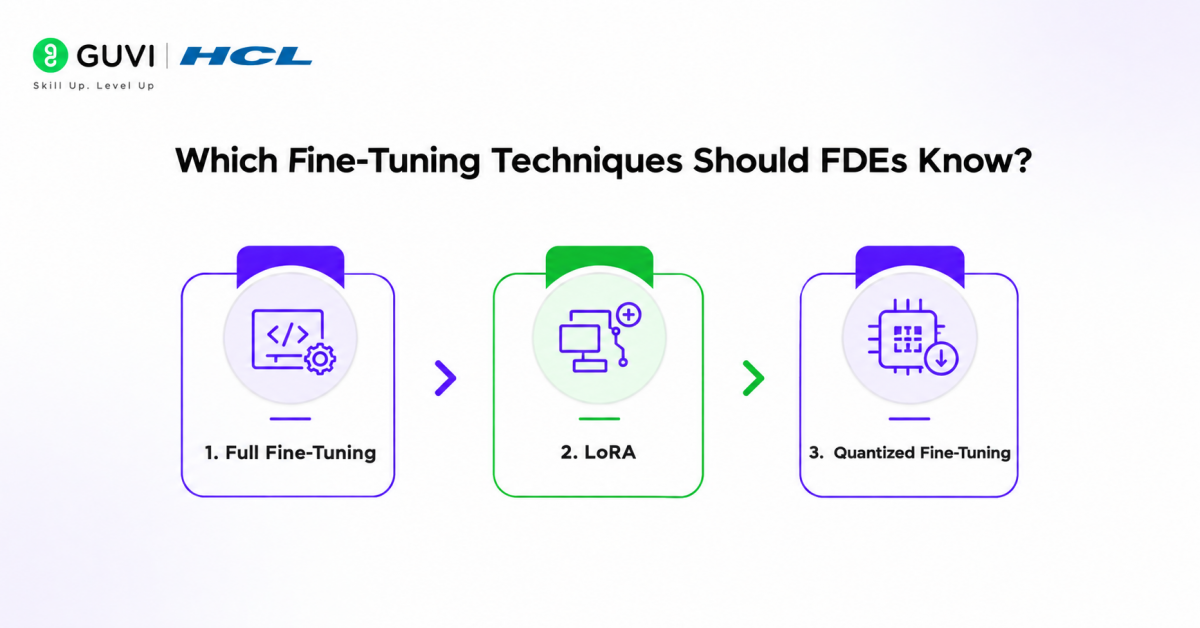
FDEs should understand both full fine-tuning and parameter-efficient approaches.
1. Full Fine-Tuning
Full fine-tuning updates many or all model parameters.
It can provide strong customization but generally requires more computational resources and can be expensive for large models.

2. LoRA
Low-Rank Adaptation, or LoRA, trains smaller adapter components rather than updating the entire model.
This can significantly reduce the resources required for customization and is particularly useful when an FDE needs to adapt a large open-source model for a specific customer task.
3. Quantized Fine-Tuning
Quantization reduces the numerical precision used by a model, which can reduce memory requirements.
Techniques such as QLoRA combine quantization with LoRA-style parameter-efficient training.
These approaches can make model customization more practical when hardware resources are limited.
Parameter-efficient fine-tuning allows organizations to customize large models without maintaining a completely separate full set of model parameters for every task.
How Should FDEs Evaluate a Fine-Tuned Model?
Evaluation should reflect the customer’s actual workflow rather than relying only on generic benchmarks.
Create a test set containing realistic examples and edge cases.
For example, an FDE deploying a customer-support classification model could test:
- Common requests
- Ambiguous requests
- Rare categories
- Misspelled inputs
- Long messages
- Unexpected inputs
Also compare the fine-tuned model against a baseline.
A useful evaluation process might be:
Baseline → Fine-tuned model → Customer evaluation → Error analysis → IterationThe FDE should also measure operational factors such as inference latency, memory usage, infrastructure cost, and reliability.
How Can FDEs Deploy Fine-Tuned Models?
Once the model meets the customer’s requirements, the FDE needs to integrate it into the customer’s workflow.
Deployment may involve:
- Packaging the model and dependencies
- Creating an inference API
- Deploying on cloud infrastructure
- Connecting the model to existing applications
- Adding authentication
- Monitoring inference performance
- Tracking errors and resource usage
For customer environments with strict data requirements, deployment may need to occur within private infrastructure rather than through a public API.
Monitoring is also important because model quality and infrastructure performance can change after deployment.
Common Mistakes to Avoid
FDEs should avoid several common mistakes when fine-tuning open-source models:
- Fine-tuning too early: Try simpler approaches first.
- Using poor-quality data: More examples do not compensate for unreliable training data.
- Ignoring model licensing: Confirm that the model can legally be used for the customer’s intended purpose.
- Skipping baseline evaluation: Without a baseline, it is difficult to determine whether fine-tuning actually helped.
- Overfitting the model: Excessive training can make the model perform well on training examples but poorly on new inputs.
- Ignoring deployment costs: A model that performs well but is too expensive or slow for production may not be a practical solution.
Start Your Learning Journey with HCL GUVI
Want to build practical AI skills? HCL GUVI’s Artificial Intelligence & Machine Learning Course helps you learn AI, machine learning, and real-world model development through hands-on projects and industry-focused training.
Conclusion
Learning to fine-tune open-source models as a forward deployed engineer can help you build AI solutions tailored to real customer problems. However, successful fine-tuning involves much more than running a training script. You need to understand the customer’s requirements, prepare high-quality data, choose an appropriate model, evaluate improvements, and deploy the result reliably.
The strongest approach is to treat fine-tuning as one tool within a broader AI engineering workflow. When you combine model customization with APIs, data pipelines, evaluation, cloud infrastructure, and customer communication, you can build AI solutions that are not only technically impressive but also useful in real-world environments.
FAQs
Why should a forward deployed engineer learn to fine-tune open-source models?
Fine-tuning helps FDEs customize existing models for specific customer tasks, domains, workflows, and response requirements without building models from scratch.
Should FDEs always fine-tune an open-source model?
No. Prompt engineering, retrieval-augmented generation, tool use, or other approaches may solve the problem with less complexity and lower cost.
What is LoRA fine-tuning?
LoRA is a parameter-efficient fine-tuning technique that trains small adapter components instead of updating the full model, reducing computational and memory requirements.
How much data is needed for fine-tuning?
There is no universal number. The amount depends on the model, task complexity, data quality, and desired behavior. High-quality, representative examples are generally more valuable than simply collecting large quantities of data.
How should an FDE evaluate a fine-tuned model?
An FDE should compare the fine-tuned model against a baseline using customer-specific test cases and relevant metrics. Evaluation should also consider latency, cost, reliability, and other production requirements.
What skills are useful for fine-tuning open-source models?
FDEs benefit from knowledge of Python, machine learning, datasets, model evaluation, APIs, cloud infrastructure, deployment, and AI frameworks, along with strong customer-facing problem-solving skills.
Success Stories

About the Author
HCL GUVI
This article was selected and published as part of the HCL GUVI AI Blogathon 2026, an initiative designed to encourage students, AI enthusiasts, and aspiring tech writers to simplify complex AI concepts through impactful technical content. The contest recognized high-quality, original, and insightful AI-focused blogs, with selected authors receiving publication opportunities on the HCL GUVI blog platform along with official author credits and recognition.
View all posts by HCL GUVI
Connect with me @










Did you enjoy this article?