


Forward Deployed Engineer Articles
Excalidraw and Whiteboarding: How FDEs Communicate Technical Solutions
How to Fine-Tune Open-Source Models as a Forward Deployed Engineer
Rate Limiting, Retries, and Caching: Production AI Patterns for FDEs
How to Run a Great Client Demo as a Forward Deployed Engineer


Get In Touch For Details! Request More Information
Is Forward Deployed Engineering a Real Engineering Discipline?
Sep 08, 2026 4 Min Read 452 Views
(Last Updated)
With AI automation transforming analytics roles in 2026, the required skill set for analysts is evolving rapidly. Data analysts are no longer expected to work only with spreadsheets and basic reporting. Companies increasingly look for professionals who can work with data, understand business problems, and use modern analytics and AI tools effectively.
If you’re planning to become a data analyst, understanding the right skills can help you focus your learning and prepare for real-world roles. Core skills such as SQL, Excel, statistics, data visualization, and Python remain important, while AI literacy, automation, and critical thinking are becoming increasingly valuable.
Table of contents
- TL;DR Summary
- Is Forward Deployed Engineering Real Engineering?
- What Does a Forward Deployed Engineer Actually Build?
- What Does an FDE Project Look Like?
- How Is FDE Different From Software Engineering?
- What Technical Skills Does an FDE Need?
- Is FDE More Like Consulting?
- How Can You Identify a Truly Technical FDE Role?
- What Are the Advantages of FDE Work?
- What Are the Challenges of Being an FDE?
- Is FDE a Good Career Path?
- How Can You Prepare for an FDE Role?
- What Should You Look for in an FDE Job Description?
- Key Takeaways
- Start Your Learning Journey with GUVI
- Conclusion
- FAQs
- Is forward deployed engineering real engineering?
- Do Forward Deployed Engineers code?
- Is FDE the same as a software engineer?
- Is Forward Deployed Engineering difficult?
- Is FDE a good career for beginners?
- What technologies should an FDE learn?
TL;DR Summary
- Forward deployed engineering is real engineering when the role involves coding, system design, integrations, deployment, and debugging.
- FDEs solve real customer problems instead of only working from predefined product requirements.
- The role combines software engineering, cloud, APIs, data, AI, and customer collaboration.
- FDEs may build production applications, automation workflows, data pipelines, and AI solutions.
- The technical depth varies by company, so always check the actual job responsibilities.
- FDE can be a strong career path if you enjoy engineering, problem-solving, variety, and working with customers.
Is Forward Deployed Engineering Real Engineering?
Yes. When the role involves hands-on development and technical ownership, it is genuine engineering work.
An FDE may write production code, design APIs, build data pipelines, configure cloud infrastructure, create applications, and troubleshoot systems.
The difference is not whether the person engineers. It is where the engineering problem comes from.
A traditional software engineer may receive a requirement such as:
“Build a document-upload feature.”
An FDE might receive:
“Our analysts spend hours every day finding information across five internal systems.”
The FDE must figure out what the technical solution should look like.
That can require software development, system design, data engineering, cloud deployment, and testing.
Ready to build practical skills for emerging AI engineering roles? HCL GUVI’s Artificial Intelligence & Machine Learning Course helps you learn AI, machine learning, and real-world application development through hands-on projects and industry-focused training.
What Does a Forward Deployed Engineer Actually Build?
FDEs can build anything from small automations to complete production applications, depending on the company and customer problem.
Common examples include:
- API integrations
- Internal applications
- Data pipelines
- Automation workflows
- AI applications
- Dashboards
- Cloud deployments
- Data-processing systems
- Custom software tools
What Does an FDE Project Look Like?
Imagine a company wants an AI assistant that can answer questions about its internal documents.
The FDE might build:
Documents → Data Processing → Embeddings → Vector Database → Retrieval → LLM → User InterfaceBut the engineering doesn’t stop there.
They may also implement authentication, connect existing systems, evaluate AI responses, monitor failures, and deploy the application.
So, the job is not simply “talking to customers about technology.” The engineer may own a significant portion of the actual implementation.
Forward Deployed Engineers can work across software development, cloud infrastructure, APIs, data pipelines, and AI systems, making the role highly technical despite its customer-facing nature.
How Is FDE Different From Software Engineering?
The biggest difference is the working environment and source of requirements, not whether engineering happens.
| Software Engineer | Forward Deployed Engineer |
| Usually product-focused | Usually customer/problem-focused |
| Often works from defined requirements | May discover requirements |
| Works primarily with internal teams | Works closely with customers |
| Often owns a product area | May work across customer environments |
| Builds reusable product capabilities | May build customized solutions |
Neither role is inherently better.
If you enjoy deep specialization and working on one product for a long period, traditional software engineering may suit you.
If you enjoy variety, customer interaction, and solving unfamiliar problems, FDE work may be more appealing.
FDEs often build and deploy production-ready solutions for specific customer problems, rather than working only on predefined features for a single product.
What Technical Skills Does an FDE Need?
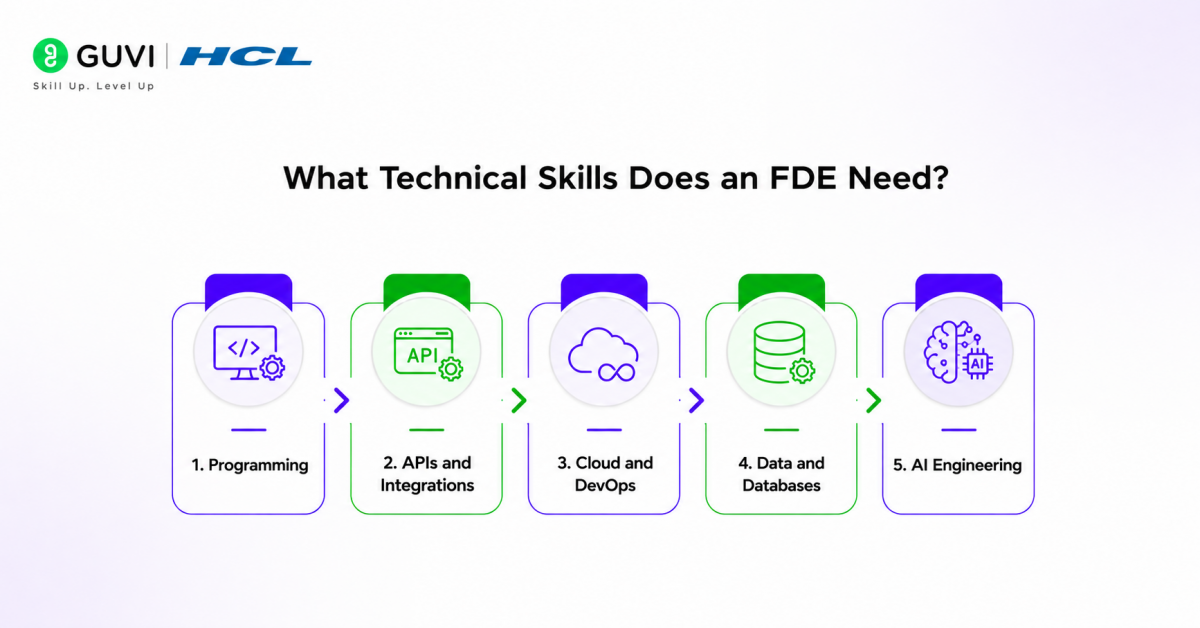
The required skills depend on the role, but strong software fundamentals are usually the starting point.
- Programming
Useful languages include:
- Python
- JavaScript
- TypeScript
- Java
- Go
You should be comfortable writing, testing, debugging, and maintaining code.
- APIs and Integrations
Because customers often use different systems, FDEs benefit from understanding:
- REST APIs
- JSON
- Authentication
- Webhooks
- API testing
- Third-party integrations
- Cloud and DevOps
Cloud knowledge can be valuable for deployment and troubleshooting.
Common technologies include:
- AWS
- Azure
- Google Cloud
- Docker
- Kubernetes
- CI/CD
- Linux
- Data and Databases
Many customer problems involve large amounts of data, making SQL, databases, data pipelines, and data processing useful skills.
- AI Engineering
For AI-focused FDE roles, additional skills may include:
- Large language models
- RAG
- Embeddings
- Vector databases
- AI agents
- Model evaluation
- Prompt engineering
Pro Tip: You don’t need to become an expert in every technology. FDEs are often valued for their ability to learn unfamiliar systems quickly and use them to solve practical problems.
Is FDE More Like Consulting?
FDE has some similarities to consulting, but an engineering-focused FDE goes beyond recommendations.
A consultant might analyze a business problem and recommend an approach.
An FDE may:
Understand → Design → Code → Integrate → Deploy → DebugFor example, a consultant could recommend automating a manual process.
An FDE might actually build the automation, connect it to the customer’s systems, deploy it, and fix problems after launch.
However, not every company defines FDE in the same way.
Some positions may lean heavily toward consulting, while others are deeply hands-on.
How Can You Identify a Truly Technical FDE Role?
Look at the responsibilities, not the job title.
Strong engineering signals include:
- Production coding
- System design
- Software development
- API development
- Cloud infrastructure
- Database work
- Testing
- Debugging
- Deployment
- CI/CD
- Application architecture
On the other hand, a role focused mainly on product demonstrations, sales support, presentations, and account management may be closer to solutions engineering.
Warning: “Forward Deployed Engineer” is not a standardized job title. Two companies can use the same title for roles with very different technical expectations.

What Are the Advantages of FDE Work?
The biggest advantage is exposure to real problems across different technologies and business environments.
- You Learn Through Real Projects
Instead of working only with artificial project requirements, you solve problems that organizations actually care about.
- You Develop Broad Skills
One project could involve Python, APIs, databases, cloud infrastructure, and AI.
- You Build Product Sense
You learn why customers need something rather than simply implementing a specification.
- You See Your Work in Action
Your solution can directly change how a team operates.
Data Point: FDE work can expose engineers to the complete development cycle, from discovering a problem to deploying and improving the final solution.
What Are the Challenges of Being an FDE?
The same variety that makes FDE attractive can also make the role demanding.
You may experience:
- Frequent context switching
- Ambiguous requirements
- Tight customer deadlines
- Production incidents
- Customer meetings
- Travel in some organizations
- Pressure to deliver quickly
You may also need to learn unfamiliar technologies on short notice.
So, if you prefer predictable work and long-term ownership of one codebase, another engineering specialization may be a better fit.
Is FDE a Good Career Path?
Yes, FDE can be a strong career path if you enjoy both engineering and problem-solving with people.
The experience can lead toward roles such as:
- Senior Forward Deployed Engineer
- Software Engineer
- Solutions Architect
- Solutions Engineer
- AI Engineer
- Technical Product Manager
- Engineering Manager
The transferable skills become especially valuable when you have substantial experience building and deploying production systems.
How Can You Prepare for an FDE Role?
Start with a strong technical foundation:
Programming → APIs → Databases → Cloud → Deployment → AI → Customer Problem-SolvingThen build end-to-end projects.
For example, don’t stop at creating an AI chatbot. Add an API, database, authentication, Docker, cloud deployment, and monitoring.
This demonstrates that you can take a technical idea beyond a demo.
What Should You Look for in an FDE Job Description?
Before applying, ask yourself:
Will I actually build things?
Look for words such as:
- Build
- Develop
- Deploy
- Integrate
- Architect
- Debug
- Automate
- Code
- Prototype
Then check how much time is expected to be spent with customers.
A good FDE role should make the engineering expectations clear.
Key Takeaways
- Yes, forward deployed engineering can be real engineering.
- FDEs can write production code and build complete technical solutions.
- The role combines engineering with customer-facing problem-solving.
- Programming, APIs, cloud, databases, and deployment skills are valuable.
- AI-focused FDEs may also work with LLMs, RAG, embeddings, and AI agents.
- Technical depth varies between companies.
- Always evaluate the actual responsibilities instead of relying on the job title.
Start Your Learning Journey with GUVI
Ready to build practical skills for emerging AI engineering roles? HCL GUVI’s Artificial Intelligence & Machine Learning Course helps you learn AI, machine learning, and real-world application development through hands-on projects and industry-focused training.
Conclusion
So, is forward deployed engineering real engineering? Absolutely—provided the role involves genuine technical work such as coding, system design, integration, deployment, and debugging.
What makes FDE different is the starting point. Instead of receiving every requirement from a product team, you may begin with an unclear customer problem and figure out the solution yourself.
That combination makes FDE an interesting option for engineers who enjoy building software, working with modern technologies, understanding business problems, and interacting with customers. If you want variety rather than spending your entire career inside one product area, it is a career path worth exploring.
FAQs
Is forward deployed engineering real engineering?
Yes. Engineering-focused FDEs can write production code, design systems, build integrations, deploy infrastructure, and troubleshoot technical problems.
Do Forward Deployed Engineers code?
Yes. Coding is a major part of many FDE roles, although the amount of development work depends on the company.
Is FDE the same as a software engineer?
No. Both roles can involve software development, but FDEs generally work more closely with customers and solve customer-specific problems.
Is Forward Deployed Engineering difficult?
It can be challenging because requirements may be unclear and projects can involve unfamiliar technologies. Strong problem-solving and communication skills are important
Is FDE a good career for beginners?
It depends on the position. Many FDE roles expect solid software engineering skills, so building programming, cloud, API, and deployment experience first can improve your chances.
What technologies should an FDE learn?
Start with programming, Git, APIs, databases, Linux, and cloud fundamentals. For AI-focused roles, add LLMs, RAG, embeddings, and model evaluation.
Success Stories

About the Author
HCL GUVI
This article was selected and published as part of the HCL GUVI AI Blogathon 2026, an initiative designed to encourage students, AI enthusiasts, and aspiring tech writers to simplify complex AI concepts through impactful technical content. The contest recognized high-quality, original, and insightful AI-focused blogs, with selected authors receiving publication opportunities on the HCL GUVI blog platform along with official author credits and recognition.
View all posts by HCL GUVI
Connect with me @






Did you enjoy this article?