


Artificial Intelligence and Machine Learning Articles
Finance Manager to Data Analytics: Career Growth, Salary and Seniority
How to Evaluate LLM Outputs in Production Deployments
AI/ML Skills Gap 2026: Why Companies Can't Find Job-Ready Talent
20 AI/ML Interview Questions Recruiters Can Use Without a Tech Background - Best Guide


Get In Touch For Details! Request More Information
What is Actor-Critic Methods Explained
Sep 04, 2026 4 Min Read 249 Views
(Last Updated)
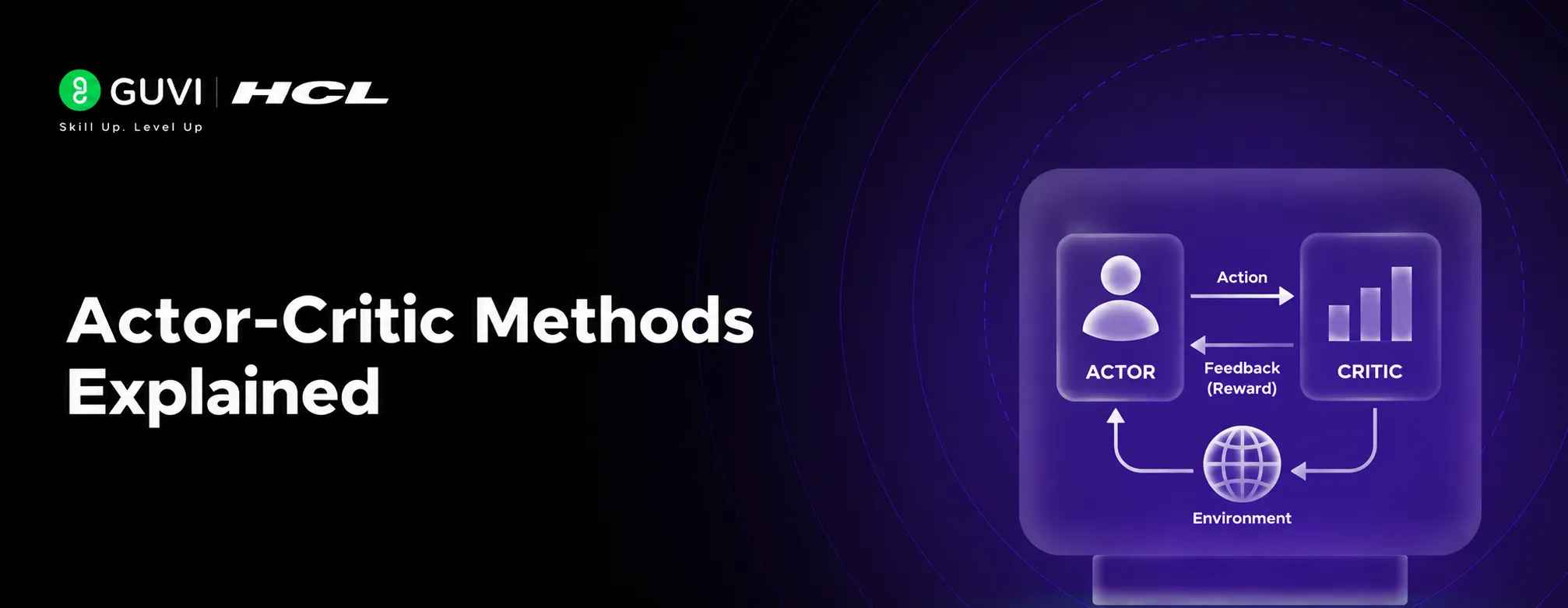
Reinforcement learning (RL) teaches an agent to make decisions by interacting with an environment and receiving rewards. One challenge is determining which actions are useful while simultaneously learning a good strategy for choosing future actions. Actor-Critic Methods address this challenge by combining two components: an actor that selects actions and a critic that evaluates them.
This combination provides a practical balance between policy-based and value-based reinforcement learning. Actor-Critic approaches are widely used in modern RL because they can learn complex policies while using value estimates to guide training.
Table of contents
- TL;DR Summary
- What Are Actor-Critic Methods?
- How Do Actor-Critic Methods Work?
- Understanding the Policy
- What Does the Critic Actually Learn?
- What Is the Advantage Function?
- Actor-Critic Training Example
- Common Actor-Critic Algorithms
- Actor-Critic in Continuous Action Spaces
- Advantages of Actor-Critic Methods
- A Simple Actor-Critic Architecture
- Key Takeaways
- Conclusion
- FAQs
- What are Actor-Critic Methods?
- What does the actor do?
- What does the critic do?
- What is the advantage function?
- What are examples of Actor-Critic algorithms?
TL;DR Summary
- Actor-Critic Methods combine policy learning and value estimation.
- The actor decides which action to take.
- The critic evaluates how good the current state or action is.
- The critic provides feedback that helps the actor improve its policy.
- Popular algorithms include A2C, A3C, PPO, and SAC.
What Are Actor-Critic Methods?
Actor-Critic Methods are reinforcement learning techniques that use two learning components.
- Actor
The actor represents the policy. It determines which action the agent should take given the current state.
For example, in a game, the actor might decide whether the agent should:
- Move left
- Move right
- Jump
- Stay still
The actor can learn a probability distribution over possible actions rather than always selecting the same action.
- Critic
The critic evaluates the actor’s decisions.
It estimates how valuable a state or action is based on expected future rewards. This evaluation provides feedback that helps the actor update its policy.
The two components work together:
Actor → Selects Action → Environment → Reward → Critic → Feedback → Actor UpdateRead More: Policy Gradient Methods in Reinforcement Learning
Master reinforcement learning with HCL GUVI’s Artificial Intelligence & Machine Learning Course. Learn deep learning, AI algorithms, and real-world machine learning through hands-on projects.
How Do Actor-Critic Methods Work?
A typical Actor-Critic training cycle looks like this:
- The agent observes the current state.
- The actor selects an action using its policy.
- The environment returns a reward and a new state.
- The critic evaluates the experience.
- An advantage or error signal is calculated.
- The actor updates its policy.
- The critic updates its value estimate.
- The process repeats.
The actor learns from the critic’s feedback rather than relying entirely on the final reward.
Actor-Critic Methods combine ideas from policy-gradient and value-based reinforcement learning, allowing an agent to learn both what to do and how good its decisions are.
Understanding the Policy
The actor represents a policy commonly written as:
π(a|s)This represents the probability of selecting action a given state s.
The actor attempts to increase the probability of actions that produce better outcomes while reducing the probability of less useful actions.
For example, if an action repeatedly produces high rewards in a particular state, the actor can gradually assign that action a higher probability.
What Does the Critic Actually Learn?
The critic typically estimates a value function.
One common function is the state-value function:
- V(s)
It estimates the expected future return from a particular state.
Another possibility is the action-value function:
- Q(s,a)
which estimates the expected return from taking action a in state s.
The critic’s estimate provides information about whether the actor’s chosen action performed better or worse than expected.
Pro Tip: Think of the actor as the decision-maker and the critic as the evaluator. Keeping these roles distinct makes Actor-Critic architectures much easier to understand.
What Is the Advantage Function?
The advantage function measures how much better or worse an action performs compared with the expected value of the current state.
It can be represented as:
A(s,a) = Q(s,a) − V(s)If the advantage is positive, the action performed better than expected.
If it is negative, the action performed worse than expected.
This signal can help the actor determine which actions should become more or less likely.
Actor-Critic Training Example
Imagine an autonomous robot learning to navigate a room.
The robot observes its surroundings, and the actor selects an action such as moving forward or turning.
Suppose the robot moves forward and receives a positive reward because it gets closer to its destination.
The critic evaluates this outcome and determines that the action was better than expected.
The actor then increases the likelihood of choosing similar actions in comparable situations.
If the robot instead moves toward an obstacle and receives a negative reward, the critic’s feedback can encourage the actor to avoid similar decisions in the future.
Best Practice: Use a well-designed reward function. Even a sophisticated Actor-Critic algorithm can learn undesirable behavior if rewards do not accurately represent the desired objective.
Common Actor-Critic Algorithms
Several important reinforcement learning algorithms use the Actor-Critic framework.
- Advantage Actor-Critic (A2C)
A2C uses advantage estimates to update the actor while the critic estimates state values.
It is relatively simple and can provide a strong starting point for understanding Actor-Critic learning.

- Asynchronous Advantage Actor-Critic (A3C)
A3C uses multiple agents or workers that interact with separate environments and contribute to learning.
The asynchronous setup can improve exploration and training efficiency.
- Proximal Policy Optimization (PPO)
PPO uses an Actor-Critic structure and restricts policy updates to avoid excessively large changes.
Its relative simplicity and strong practical performance have made it a popular reinforcement learning algorithm.
- Soft Actor-Critic (SAC)
SAC is designed for continuous action spaces and incorporates entropy into its objective to encourage exploration.
It is commonly used in robotics and continuous-control environments.
Actor-Critic in Continuous Action Spaces
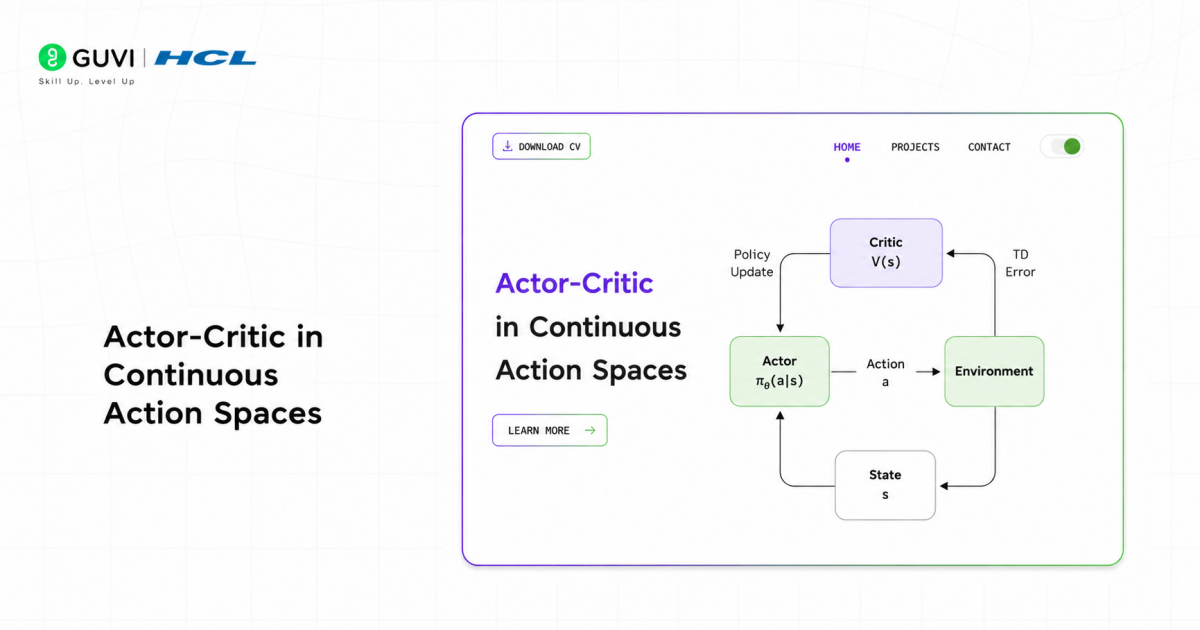
One important advantage of Actor-Critic Methods is their ability to work with continuous actions.
Consider a robotic arm. Instead of choosing from only a few discrete actions, the agent may need to determine continuous values such as:
- Joint angles
- Movement speed
- Force
- Rotation
The actor can directly produce a probability distribution over continuous actions, making Actor-Critic approaches useful for these environments.
Advantages of Actor-Critic Methods
Actor-Critic Methods offer several benefits:
- Combine policy and value learning.
- Can support discrete and continuous actions.
- Advantage estimates can reduce policy-gradient variance.
- Suitable for complex decision-making problems.
- Can be adapted to parallel training environments.
- Provide flexible policy representations.
Data Point: Many widely used modern RL algorithms, including PPO and SAC, use Actor-Critic ideas as part of their training architecture.
A Simple Actor-Critic Architecture
A neural Actor-Critic system can share an initial feature-extraction network and then split into two outputs:
              Environment

                   ↓

                State

                   ↓

           Shared Neural Network

              ↙           ↘

          Actor            Critic

            ↓                ↓

       Action Policy      Value Estimate

            ↓                ↓

            └──── Feedback ──┘
The actor produces the action distribution, while the critic estimates the value used to improve learning.
Key Takeaways
- Actor-Critic Methods use an actor and a critic.
- The actor learns the policy and selects actions.
- The critic estimates values and evaluates decisions.
- Advantage estimates help the actor learn which actions are better than expected.
- A2C, A3C, PPO, and SAC are prominent Actor-Critic algorithms.
- These methods work with both discrete and continuous action spaces.
- Reward design and training stability remain important challenges.
Master reinforcement learning with HCL GUVI’s Artificial Intelligence & Machine Learning Course. Learn deep learning, AI algorithms, and real-world machine learning through hands-on projects.
Conclusion
Actor-Critic Methods provide a powerful framework for reinforcement learning by combining policy optimization with value estimation. The actor learns how to act, while the critic evaluates those actions and provides feedback that guides future policy updates.
This combination makes Actor-Critic approaches suitable for complex environments, particularly those involving continuous actions and long-term decision-making. Understanding the roles of the actor, critic, value function, and advantage function provides a strong foundation for exploring algorithms such as A2C, PPO, and SAC.
FAQs
What are Actor-Critic Methods?
Actor-Critic Methods are reinforcement learning techniques that combine a policy-learning actor with a value-estimating critic.
What does the actor do?
The actor represents the policy and selects actions based on the current state.
What does the critic do?
The critic evaluates states or actions by estimating their expected future rewards and provides feedback to the actor.
What is the advantage function?
The advantage function measures how much better or worse an action performs compared with the expected value of the current state.
What are examples of Actor-Critic algorithms?
A2C, A3C, PPO, and SAC are well-known algorithms based on Actor-Critic principles.
Success Stories

About the Author
HCL GUVI
This article was selected and published as part of the HCL GUVI AI Blogathon 2026, an initiative designed to encourage students, AI enthusiasts, and aspiring tech writers to simplify complex AI concepts through impactful technical content. The contest recognized high-quality, original, and insightful AI-focused blogs, with selected authors receiving publication opportunities on the HCL GUVI blog platform along with official author credits and recognition.
View all posts by HCL GUVI
Connect with me @











Did you enjoy this article?