


Artificial Intelligence and Machine Learning Articles
What is Hidden Markov Models: Concepts and Applications
Dependency Parsing in NLP Explained


Get In Touch For Details! Request More Information
Spell Correction Algorithms in NLP
Aug 25, 2026 3 Min Read 21 Views
(Last Updated)
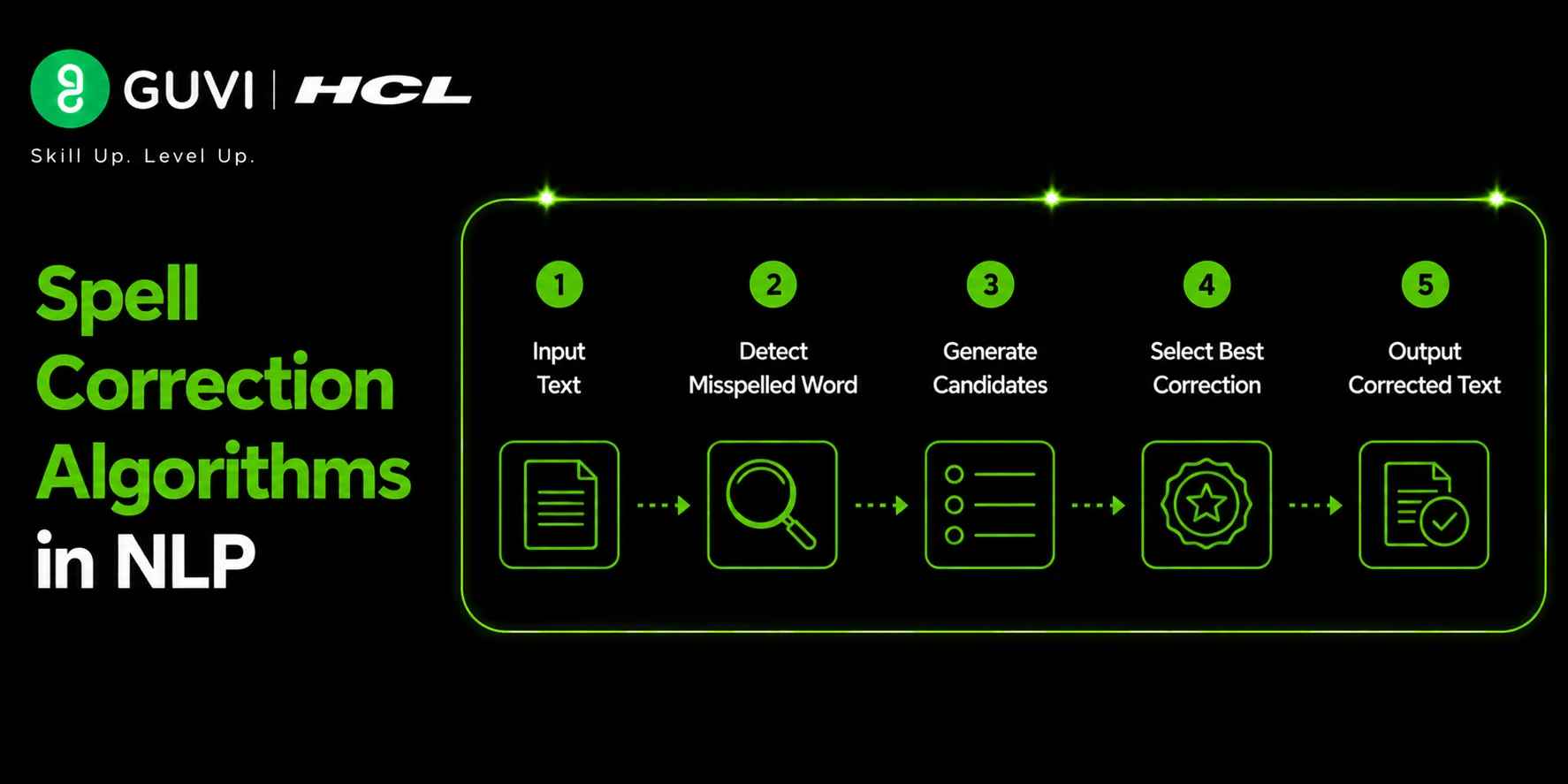
Spelling errors are common in text, especially in search queries, chat messages, and user-generated content. Spell Correction Algorithms in NLP help identify incorrectly spelled words and suggest or generate appropriate corrections. These systems can use dictionaries, edit distance, statistical models, or modern language models to determine the most likely intended word.
Table of contents
- TL;DR
- Quick Answer
- Why Spell Correction Matters
- How Spell Correction Works
- Step 1: Detect the Error
- Step 2: Generate Candidates
- Step 3: Measure Similarity
- Step 4: Consider Context
- Step 5: Rank Candidates
- Step 6: Select the Correction
- Common Spell Correction Algorithms
- Edit Distance
- Dictionary-Based Correction
- Frequency-Based Correction
- Context-Based Correction
- Language Model-Based Correction
- Example
- Key Concepts to Remember
- When Should You Use Spell Correction?
- Search Engines
- Text Editors
- Chat Applications
- Customer Support
- Document Processing
- Key Concepts to Remember
- A Practical Spell Correction Workflow
- Receive the Text
- Detect Potential Errors
- Generate Candidates
- Calculate Candidate Scores
- Analyze Context
- Rank the Candidates
- Apply or Suggest the Correction
- Real-World Applications
- Search Engines
- Text Editors
- Chatbots
- Customer Support
- Best Practices
- Conclusion
- FAQs
- What is spell correction in NLP?
- What is edit distance?
- Why is context important in spell correction?
- What are common spell correction techniques?
- Where is spell correction used?
- Can spell correction handle correctly spelled words used incorrectly?
- What makes a spell correction system effective?
TL;DR
- Spell correction identifies and fixes likely spelling errors.
- Edit distance measures how different two words are.
- Dictionary-based methods work well for known vocabulary.
- Statistical methods use word and language context.
- Modern NLP models can use broader context to improve corrections.
Quick Answer
| Spell correction in NLP is the process of detecting misspelled words and determining their most likely intended forms. Algorithms can compare words using measures such as edit distance, use dictionaries and frequency information, or consider the surrounding sentence context. Modern approaches can combine these techniques with language models to produce more context-aware corrections. |
Why Spell Correction Matters
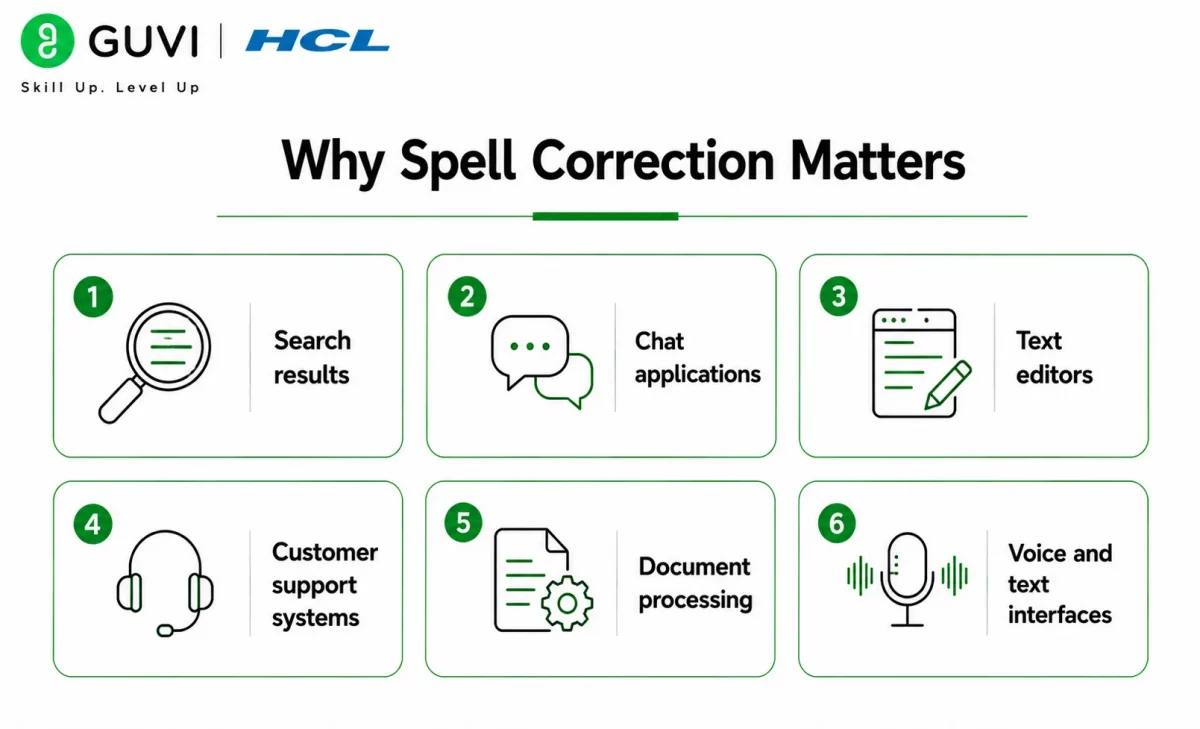
Spelling mistakes can affect how NLP systems understand and process text.
Spell correction can improve:
- Search results
- Chat applications
- Text editors
- Customer support systems
- Document processing
- Voice and text interfaces
How Spell Correction Works
A typical spell-correction system follows several steps.
Step 1: Detect the Error
The system identifies words that may be misspelled.
Step 2: Generate Candidates
Potential corrections are generated using a dictionary, vocabulary, or similarity method.
Step 3: Measure Similarity
The system compares the misspelled word with candidate words.
Step 4: Consider Context
The surrounding words can help determine which candidate makes the most sense.
Step 5: Rank Candidates
Possible corrections are ranked according to similarity, frequency, probability, or contextual relevance.
Step 6: Select the Correction
The highest-ranked suitable candidate is suggested or applied.
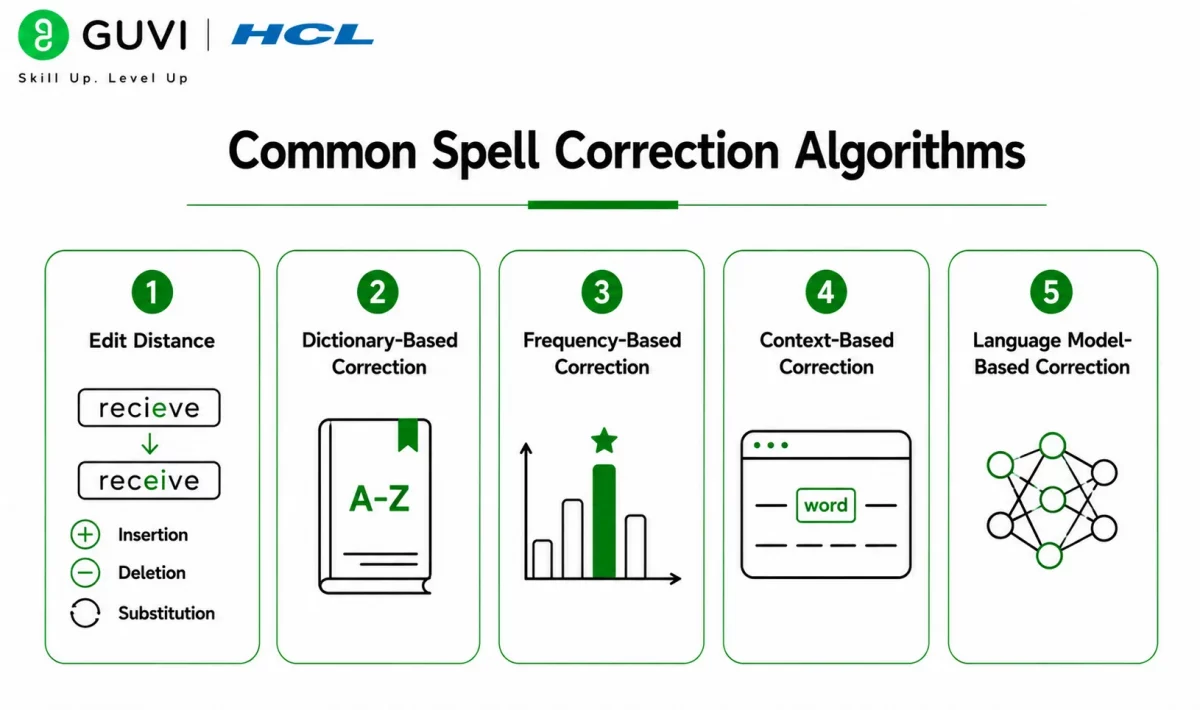
Common Spell Correction Algorithms
Edit Distance
Edit distance measures the minimum number of operations needed to transform one word into another.
Common operations include:
- Insertion
- Deletion
- Substitution
For example, transforming “recieve” into “receive” requires a small number of character changes.
Dictionary-Based Correction
The system compares words against a predefined vocabulary. Words not found in the dictionary can be flagged as potential errors.
Frequency-Based Correction
Common words can be given higher priority when multiple corrections are possible.
Context-Based Correction
The system considers surrounding words to determine which correction is more appropriate.
Language Model-Based Correction
Language models estimate how likely words or sequences are in context, helping select corrections that fit the sentence.
Example
Consider:
“I want to by a new phone.”
A basic spell checker may not flag “by” because it is a valid English word.
A context-aware system can recognize that “buy” is more appropriate in this sentence.
This shows why modern spell correction needs to consider context, not just whether a word exists in a dictionary.
A spell checker can miss errors when the incorrect word is itself a valid word. For example, “their” and “there” are both correctly spelled words but have different meanings. Context-aware NLP systems can help identify these types of errors.
Key Concepts to Remember
- Candidate generation creates possible corrections.
- Edit distance measures spelling similarity.
- Word frequency can help rank candidates.
- Context helps distinguish valid but incorrect words.
- Language models can provide contextual correction.
- Good spell correction balances accuracy with computational efficiency.
The HCL GUVI’s Artificial Intelligence eBook introduces artificial intelligence, machine learning, generative AI, and intelligent automation concepts, helping learners build a broader understanding of modern AI technologies.
When Should You Use Spell Correction?
Spell Correction Algorithms in NLP are useful whenever text quality and accurate language processing are important.
Search Engines
Correct spelling mistakes in user queries to improve search results.
Text Editors
Detect and suggest corrections while users write documents or messages.

Chat Applications
Handle common typing mistakes in user messages and improve downstream NLP processing.
Customer Support
Correct spelling errors in customer messages before classification or intent detection.
Document Processing
Improve the quality of text extracted from documents before further NLP analysis.
Professionals interested in artificial intelligence, NLP, and machine learning can strengthen their expertise through HCL GUVI’s Artificial Intelligence and Machine Learning Course.
Key Concepts to Remember
- Error detection identifies potentially misspelled words.
- Candidate generation creates possible corrections.
- Edit distance measures differences between words.
- Frequency can help rank likely corrections.
- Context helps resolve correctly spelled but incorrectly used words.
- Language models can improve context-aware correction.
A Practical Spell Correction Workflow
1. Receive the Text
Collect the user’s query, message, or document.
2. Detect Potential Errors
Identify words that may be misspelled or incorrectly used.
3. Generate Candidates
Find possible corrections using dictionaries, edit distance, or other methods.
4. Calculate Candidate Scores
Evaluate candidates based on spelling similarity, frequency, and other relevant factors.
5. Analyze Context
Use surrounding words to determine which candidate best fits the sentence.
6. Rank the Candidates
Order possible corrections according to their overall likelihood.
7. Apply or Suggest the Correction
Automatically replace the error or present the most suitable suggestion to the user.
Real-World Applications
Search Engines
Correct misspelled queries before retrieving search results.
Text Editors
Provide real-time spelling suggestions while users write.
Chatbots
Improve understanding of messages containing typing or spelling errors.
Customer Support
Clean incoming text before applying classification or intent-detection systems.
Best Practices
- Use context instead of relying only on dictionaries.
- Generate multiple candidates when an error is ambiguous.
- Consider word frequency when ranking candidates.
- Use language models for context-sensitive corrections.
- Preserve technical terms, names, and domain-specific vocabulary.
- Avoid automatically changing words when confidence is low.
- Evaluate correction accuracy using representative text.
Conclusion
Spell Correction Algorithms in NLP help systems identify spelling errors and determine likely corrections. Traditional methods such as dictionaries and edit distance remain useful, while frequency-based approaches and language models can improve candidate ranking and contextual accuracy. Effective spell correction should consider both the similarity of words and the meaning of the surrounding text.
FAQs
1. What is spell correction in NLP?
Spell correction is the process of identifying potentially incorrect words and suggesting or generating their most likely corrections.
2. What is edit distance?
Edit distance measures the minimum number of insertions, deletions, or substitutions required to transform one word into another.
3. Why is context important in spell correction?
Context helps identify errors where the incorrect word is itself valid, such as confusing “buy” with “by.”
4. What are common spell correction techniques?
Common techniques include dictionary-based methods, edit distance, word frequency, statistical approaches, and language models.
5. Where is spell correction used?
It is commonly used in search engines, text editors, chat applications, customer support, and document-processing systems.
6. Can spell correction handle correctly spelled words used incorrectly?
Yes. Context-aware systems can identify some contextual spelling errors, where the word itself is correctly spelled but inappropriate for the sentence.
7. What makes a spell correction system effective?
An effective system combines spelling similarity, word frequency, contextual information, and appropriate language models while avoiding unnecessary corrections.
Success Stories

About the Author
HCL GUVI
This article was selected and published as part of the HCL GUVI AI Blogathon 2026, an initiative designed to encourage students, AI enthusiasts, and aspiring tech writers to simplify complex AI concepts through impactful technical content. The contest recognized high-quality, original, and insightful AI-focused blogs, with selected authors receiving publication opportunities on the HCL GUVI blog platform along with official author credits and recognition.
View all posts by HCL GUVI
Connect with me @











Did you enjoy this article?