


Artificial Intelligence and Machine Learning Articles
Generative Adversarial Networks (GANs): The Complete Guide
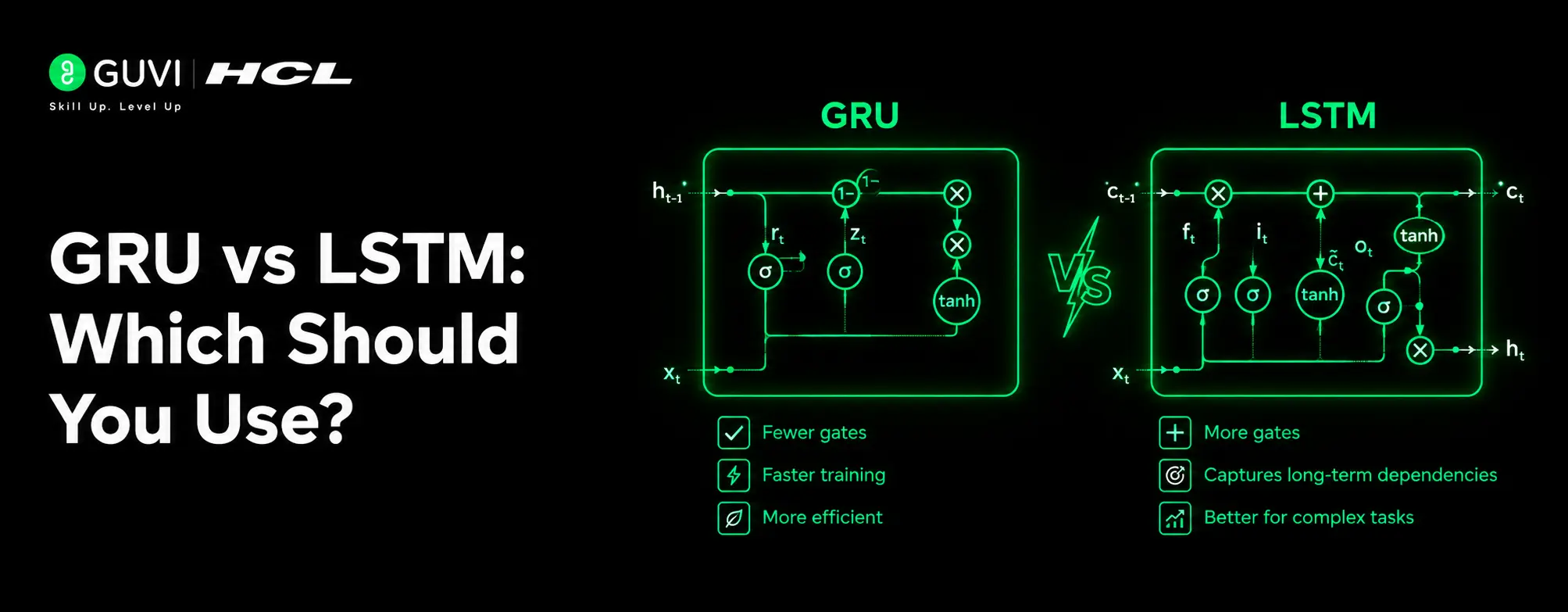
GRU vs LSTM: Which Should You Use?
LSTM Networks Explained: Solving the Vanishing Gradient Problem


Get In Touch For Details! Request More Information
Optical Character Recognition (OCR): How It Works
Aug 26, 2026 4 Min Read 20 Views
(Last Updated)
Optical Character Recognition (OCR) is the technology that converts images of printed or handwritten text into machine-readable digital text. OCR systems analyze the visual patterns in an image, identify individual characters or words, and output their text equivalents. Modern OCR combines computer vision for image preprocessing and character detection with deep learning models for recognition, enabling accurate text extraction from scanned documents, photographs, invoices, identity documents, and real-world signage.
Table of contents
- TL;DR
- The OCR Pipeline: From Image to Text
- Stage 1: Image Preprocessing
- Stage 2: Layout Analysis
- Stage 3: Text Line and Character Segmentation
- Deep Learning OCR: How Modern Systems Work
- Key OCR Challenges
- OCR Tools and APIs
- Conclusion
- FAQ
- What is Optical Character Recognition (OCR)?
- How does deep learning improve OCR over traditional approaches?
- What is CRNN and why is it used for OCR?
- Which OCR tool should I use for production?
- Why is handwriting recognition harder than printed text OCR?
- What preprocessing steps improve OCR accuracy most?
TL;DR
- Optical Character Recognition converts images containing text into editable, searchable digital text using computer vision and deep learning
- Traditional OCR follows a pipeline of image preprocessing, layout analysis, character segmentation, feature extraction, and character classification
- Modern deep learning OCR uses convolutional neural networks for feature extraction and sequence models like LSTM or Transformer for character sequence decoding
- CRNN (Convolutional Recurrent Neural Network) combined with CTC loss is the dominant architecture for text line recognition in production OCR systems
The OCR Pipeline: From Image to Text
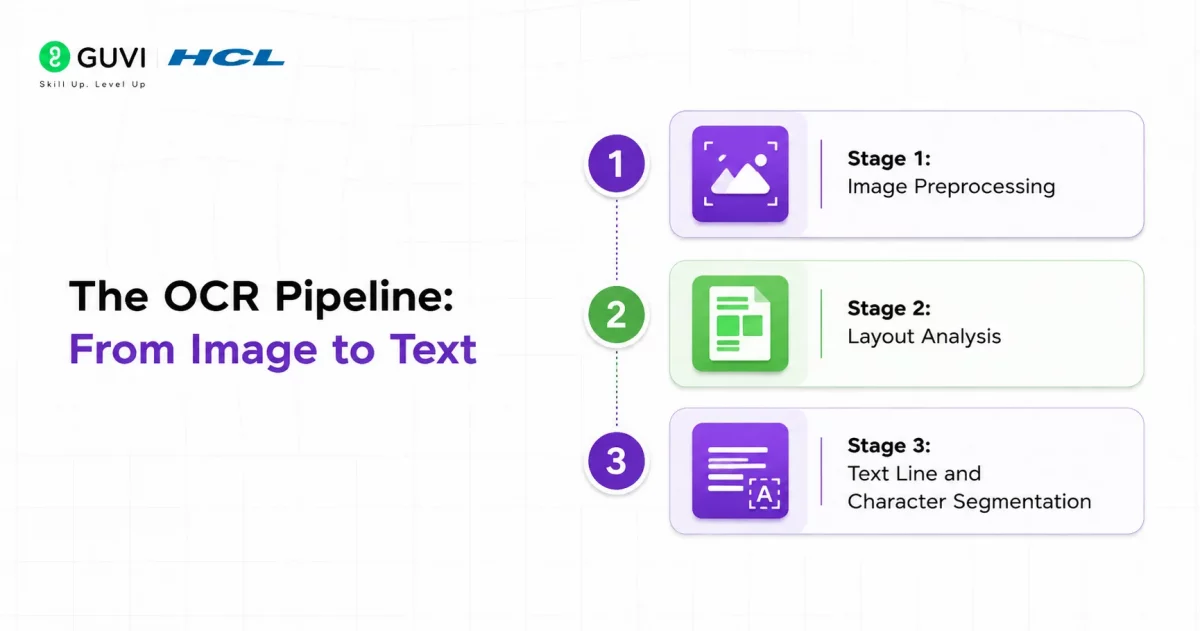
Traditional OCR processes images through a sequential pipeline where each stage prepares the output for the next.
Stage 1: Image Preprocessing
Raw images are rarely in a form that OCR can process directly. Preprocessing normalizes image quality to improve recognition accuracy.
Grayscale conversion reduces computational complexity by removing color information that is not relevant to text recognition. Most OCR preprocessing operates on single-channel grayscale images.
Binarization converts grayscale images to pure black and white using thresholding. Simple global thresholding applies a single intensity cutoff across the entire image. Adaptive thresholding, such as Otsu’s method, computes local thresholds based on pixel neighborhoods, producing better results for images with uneven lighting.
Noise removal using Gaussian blur or median filtering reduces salt-and-pepper noise from scanning artifacts without blurring text edges significantly.
Deskewing detects and corrects document rotation. Scanned documents often arrive at slight angles that degrade recognition accuracy. Deskewing algorithms detect the dominant text line angle using Hough transforms and rotate the image to align text horizontally.
Dewarping corrects perspective distortion in photographed documents, flattening curved pages that appear warped when photographed from an angle rather than directly above.
Read More: Claude Vision API: Analyzing Images Programmatically
Want to build strong computer vision and deep learning skills covering OCR, image recognition, and production AI system deployment? Explore HCL GUVI’s Artificial Intelligence & Machine Learning Course, designed to help you develop the practical deep learning foundations that modern AI engineering roles demand.
Stage 2: Layout Analysis
Layout analysis identifies the structure of the document before character recognition begins. It locates text regions, separates them from non-text regions like images and tables, and determines reading order.
Page segmentation algorithms identify column boundaries, paragraph blocks, headers, and footers. This structural analysis allows OCR to process text in the correct reading order and handle multi-column layouts correctly rather than merging text across columns.
Table detection identifies grid structures and processes cells individually, preserving tabular relationships that would be lost if the table content were processed as flowing text.
Stage 3: Text Line and Character Segmentation
Within identified text regions, the OCR system must locate individual text lines and segment them into recognizable units.
Connected component analysis groups pixels that are connected to each other, identifying candidate character blobs. Projection profiles compute the sum of dark pixels along horizontal and vertical axes, identifying gaps between text lines and spaces between characters.
For modern deep learning OCR, explicit character segmentation is often replaced by sequence-to-sequence recognition that reads entire text lines without requiring individual character boundaries, which is a significant architectural advantage for connected scripts and handwriting where character boundaries are ambiguous.
Deep Learning OCR: How Modern Systems Work
Traditional OCR relied on manually designed features and template matching for character classification. Modern OCR uses end-to-end deep learning pipelines that learn both feature extraction and recognition jointly from training data.
- CRNN: The Dominant Architecture
The Convolutional Recurrent Neural Network (CRNN) architecture is the most widely used approach for text line recognition in production OCR systems.
A CRNN consists of three components working in sequence. A convolutional neural network extracts visual features from the input text line image, producing a sequence of feature vectors corresponding to horizontal positions in the image. A bidirectional LSTM processes this feature sequence, capturing long-range dependencies between characters that are critical for handling ligatures, connected characters, and context-dependent recognition. A CTC (Connectionist Temporal Classification) decoder converts the LSTM output sequence into a character sequence without requiring explicit alignment between input positions and output characters.
CTC is particularly important for OCR because it handles the variable relationship between image width and text length. A wide image may contain the same number of characters as a narrow one depending on font size and character spacing. CTC learns to predict characters and blank tokens and merges consecutive predictions, producing the correct character sequence without needing to know in advance where each character starts and ends in the image.
- Transformer-Based OCR
Recent OCR systems have replaced the LSTM component of CRNN with Transformer encoder-decoder architectures. Transformers handle long-range dependencies through self-attention rather than sequential hidden state propagation, producing better recognition for long text lines where LSTM hidden states may not effectively carry information from early characters to late ones.
TrOCR, Microsoft’s Transformer-based OCR model, uses a Vision Transformer (ViT) encoder to extract image features and a BERT-style Transformer decoder to generate character sequences autoregressively. TrOCR achieves state-of-the-art results on handwritten text recognition benchmarks and is available as an open-source model through Hugging Face.

- Scene Text Detection
Before recognition can happen, text must be located in the image. Scene text detection, finding text in natural images like photographs of storefronts, street signs, and product packaging, is a separate deep learning task from recognition.
EAST (Efficient Accurate Scene Text Detector) uses a fully convolutional network to predict text region bounding boxes directly from image features, handling text at arbitrary orientations. DBNet (Differentiable Binarization Network) produces probability maps of text regions and applies a learned threshold to generate precise text region polygons, achieving strong performance on curved and irregular text.
Key OCR Challenges
Several real-world conditions make OCR significantly harder than recognition of clean, printed text on white backgrounds.
- Low image quality from poor scanning, camera shake, and low resolution degrades recognition accuracy across all OCR approaches. Image superresolution preprocessing can improve recognition on low-resolution inputs before the main OCR pipeline.
- Font variability across thousands of typefaces and sizes requires OCR models trained on diverse font distributions. While printed text recognition has largely solved the font variability problem through large-scale training data, rare or decorative fonts remain challenging.
- Handwriting recognition is substantially harder than printed text because handwriting varies continuously across individuals, writing implements, and conditions. Deep learning models trained on large handwriting datasets like IAM have improved handwriting OCR dramatically, but recognition rates remain lower than printed text.
- Complex backgrounds in scene text scenarios where text appears on textured surfaces, overlapping objects, or low-contrast backgrounds require robust text detection before recognition can succeed.
- Multilingual and mixed-script documents containing text in multiple languages or scripts in the same image require language identification and script-specific recognition models.
The first practical OCR machine, built by David Shepard in 1951, recognized only one font. Modern deep learning OCR can handle thousands of fonts, 100+ languages, handwriting, and scene text.
OCR Tools and APIs
| Tool | Type | Best For | Key Feature |
| Tesseract | Open-source | Printed documents, offline processing | Supports 100+ languages |
| Google Cloud Vision | Cloud API | Production scale, diverse documents | High accuracy, scene text |
| AWS Textract | Cloud API | Forms and tables, AWS integration | Structured data extraction |
| Azure AI Vision | Cloud API | Enterprise documents, Azure integration | Layout analysis |
| PaddleOCR | Open-source | Multilingual, production deployment | 80+ languages, fast inference |
| EasyOCR | Open-source | Quick prototyping, 80+ languages | Minimal setup, GPU support |
| TrOCR | Open-source model | Handwriting recognition | State-of-the-art handwriting |
Tesseract remains the most widely used open-source OCR engine, suitable for clean printed documents processed offline. For production systems requiring high accuracy on diverse real-world document types, cloud APIs from Google, AWS, and Azure provide better accuracy with minimal infrastructure management. PaddleOCR is the strongest open-source option for production deployment requiring multilingual support and competitive accuracy without cloud API costs.
Want to build strong computer vision and deep learning skills covering OCR, image recognition, and production AI system deployment? Explore HCL GUVI’s Artificial Intelligence & Machine Learning Course, designed to help you develop the practical deep learning foundations that modern AI engineering roles demand.
Conclusion
Optical Character Recognition has evolved from font-specific template matching to end-to-end deep learning systems that handle the full variability of real-world text in images.
The CRNN architecture combining convolutional feature extraction, LSTM sequence modeling, and CTC decoding underpins most production OCR systems, with Transformer-based models like TrOCR pushing state-of-the-art performance particularly for handwriting. Preprocessing quality remains a critical determinant of OCR accuracy regardless of model sophistication.
FAQ
What is Optical Character Recognition (OCR)?
OCR is the technology that converts images containing printed or handwritten text into machine-readable digital text using computer vision and deep learning models trained to recognize character patterns.
How does deep learning improve OCR over traditional approaches?
Deep learning models like CRNN learn feature extraction and character recognition jointly from data rather than using manually designed features, producing dramatically better accuracy on varied fonts, low image quality, and complex layouts.
What is CRNN and why is it used for OCR?
CRNN combines a CNN for visual feature extraction, bidirectional LSTM for sequence modeling, and CTC loss for alignment-free decoding, allowing end-to-end training for text line recognition without requiring explicit character boundary annotation.
Which OCR tool should I use for production?
Use Google Cloud Vision, AWS Textract, or Azure AI Vision for production systems needing high accuracy with minimal infrastructure. Use PaddleOCR or Tesseract for offline processing or when cloud API costs are prohibitive at your volume.
Why is handwriting recognition harder than printed text OCR?
Handwriting varies continuously in style, slant, character formation, and connections between letters across individuals. The variability is orders of magnitude greater than font variability in printed text, requiring models trained on large diverse handwriting datasets.
What preprocessing steps improve OCR accuracy most?
Binarization with adaptive thresholding, deskewing to correct document rotation, and noise removal provide the largest accuracy improvements for scanned document OCR. Dewarping is critical for photographed documents.
Success Stories

About the Author
HCL GUVI
This article was selected and published as part of the HCL GUVI AI Blogathon 2026, an initiative designed to encourage students, AI enthusiasts, and aspiring tech writers to simplify complex AI concepts through impactful technical content. The contest recognized high-quality, original, and insightful AI-focused blogs, with selected authors receiving publication opportunities on the HCL GUVI blog platform along with official author credits and recognition.
View all posts by HCL GUVI
Connect with me @






Did you enjoy this article?