


Artificial Intelligence and Machine Learning Articles
Attention Mechanism Explained: The Building Block of Transformers
Batch Normalization Explained: Why It Speeds Up Training


Get In Touch For Details! Request More Information
Claude API vs OpenAI API: Developer Perspective
Aug 18, 2026 4 Min Read 138 Views
(Last Updated)
Choosing the right AI API is essential for developers building modern AI-powered applications. Claude API vs OpenAI API are two leading platforms, each offering unique strengths for coding, automation, and intelligent workflows. Understanding their differences helps developers select the best API based on performance, features, scalability, and project requirements.
Table of contents
- TL;DR
- Direct Answer Box
- What Is Claude API?
- Claude API is commonly used for:
- What Is OpenAI API?
- OpenAI API is commonly used for:
- Claude API vs OpenAI API: Performance
- Claude API vs OpenAI API: Developer Experience
- Claude API vs OpenAI API: Best Use Cases
- Feature Comparison: Claude API vs OpenAI API
- Which API Should You Choose?
- Tasks You Can Automate with Claude API and OpenAI API
- Common tasks include:
- What AI APIs Should Not Replace
- AI APIs should not replace:
- Best Practices
- Conclusion
- FAQs
- What is the main difference between Claude API and OpenAI API?
- Which API is better for enterprise applications?
- Does OpenAI API support multimodal AI?
- Which API is better for coding assistants?
- Can I use both APIs in one application?
- Are Claude API and OpenAI API suitable for startups?
- How do I choose the right AI API?
TL;DR
- Claude API excels in reasoning and long-context tasks.
- OpenAI API offers multimodal models and a broad ecosystem.
- Both APIs support modern AI application development.
- The best choice depends on your technical requirements.
- Compare features, integrations, and pricing before deciding.
Data Point: AI APIs have become a fundamental part of modern software development, enabling developers to build chatbots, AI assistants, coding tools, document processing systems, customer support solutions, and business automation with significantly reduced development time.
Source: https://www.ibm.com/think/topics/ai-in-software-development
Direct Answer Box
| Claude API and OpenAI API are powerful platforms for building AI applications. Claude API excels in reasoning, long-context understanding, and document analysis, while OpenAI API offers multimodal capabilities, extensive integrations, and a mature developer ecosystem. Comparing their features, performance, pricing, and scalability helps developers choose the API that best fits their application requirements. |
What Is Claude API?
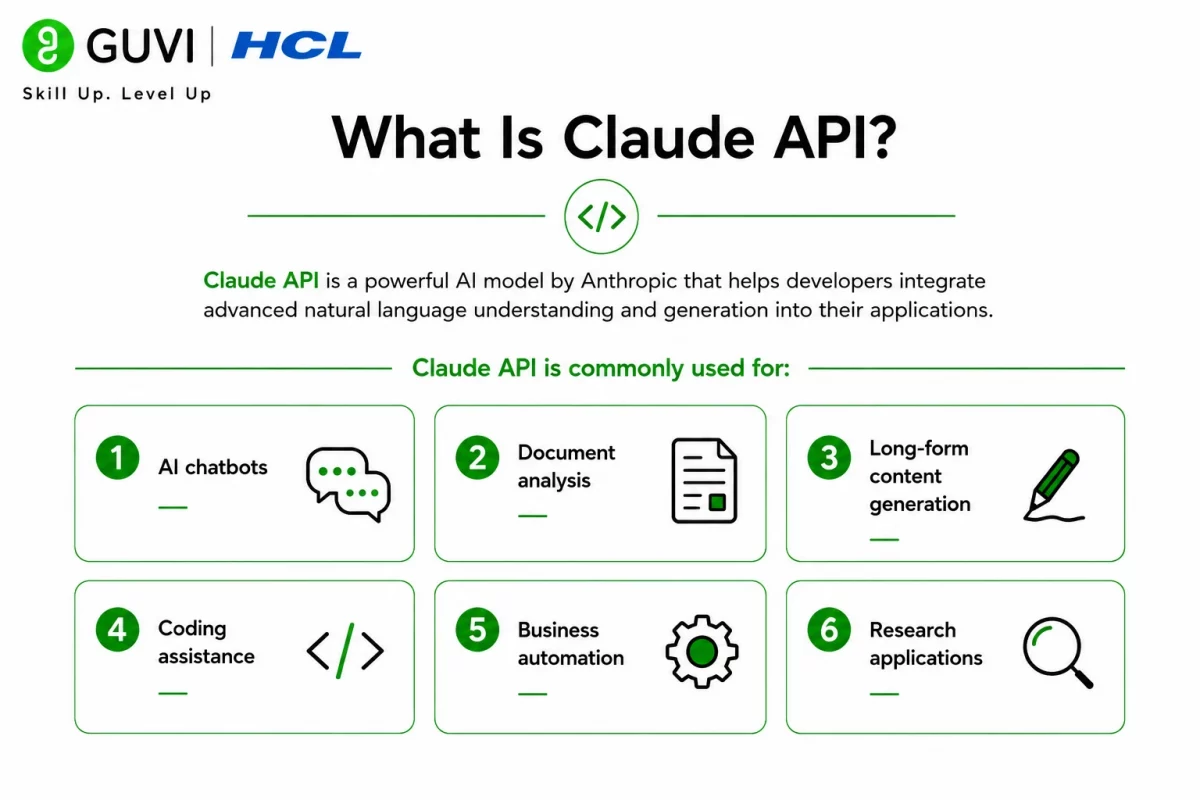
Claude API is Anthropic’s developer platform that allows businesses and developers to integrate Claude’s language models into their own applications. It supports tasks such as content generation, document analysis, coding assistance, conversational AI, summarization, and workflow automation.
One of Claude API’s biggest strengths is its ability to process large amounts of text while maintaining strong reasoning and contextual understanding. This makes it particularly useful for applications involving long documents, research, customer support, legal analysis, and enterprise knowledge management.
Claude API is commonly used for:
- AI chatbots
- Document analysis
- Long-form content generation
- Coding assistance
- Business automation
- Research applications
What Is OpenAI API?
OpenAI API enables developers to integrate OpenAI’s models into applications across multiple industries. It supports text generation, image understanding, speech capabilities, coding assistance, reasoning tasks, and AI-powered automation through a single developer platform.
Because OpenAI provides access to multiple model capabilities, developers can build chatbots, virtual assistants, content generation tools, coding applications, customer support systems, and multimodal AI experiences using one API ecosystem.
OpenAI API is commonly used for:
- AI assistants
- Chatbots
- Code generation
- Content creation
- Image and text processing
- Workflow automation
Claude API vs OpenAI API: Performance
Both APIs deliver high-quality AI responses, but they excel in different scenarios.
Claude API is recognized for its strong reasoning, long-context processing, and ability to analyze lengthy documents without losing context. Developers working with research platforms, legal documents, technical documentation, or enterprise knowledge bases often benefit from these capabilities.
OpenAI API offers excellent overall performance while supporting a wider range of multimodal use cases. Developers can build applications that work with text, images, audio, and code, making it suitable for diverse AI products requiring multiple input types.
Claude API vs OpenAI API: Developer Experience
Developer experience plays an important role when selecting an AI API.
Claude API provides straightforward integration, clear documentation, and features designed for reliable enterprise applications. It emphasizes safe AI interactions and predictable outputs, making it attractive for businesses handling sensitive workflows.
OpenAI API offers a mature ecosystem with extensive SDKs, documentation, community support, and integrations. Its broad range of developer tools makes it easier to prototype, scale, and deploy AI-powered applications across different environments.
Claude API vs OpenAI API: Best Use Cases
Choosing between Claude API and OpenAI API depends on the type of application you’re building.
Choose Claude API if you need:
- Long-context document analysis
- Research applications
- Knowledge management
- Enterprise AI assistants
- Technical documentation
- Complex reasoning tasks
Choose OpenAI API if you need:
- Multimodal AI applications
- AI chatbots
- Coding assistants
- Content generation
- Voice and image features
- General-purpose AI products
Feature Comparison: Claude API vs OpenAI API
| Feature | Claude API | OpenAI API |
| Best For | Long-context reasoning and document analysis | General-purpose and multimodal AI applications |
| Context Window | Excellent | Very Good |
| Reasoning | Excellent | Excellent |
| Coding Assistance | Very Good | Excellent |
| Multimodal Support | Good | Excellent |
| API Integrations | Very Good | Excellent |
| Enterprise Features | Excellent | Excellent |
| Ease of Integration | Very Good | Excellent |
Which API Should You Choose?
Selecting the right API depends on your application’s goals, technical requirements, and the type of user experience you want to deliver.
Choose Claude API if your application requires long-context understanding, document processing, enterprise knowledge management, research, or complex reasoning. Its ability to analyze large amounts of information makes it well suited for legal, healthcare, education, and business applications.

Choose OpenAI API if you want to build multimodal applications involving text, images, audio, or coding assistance. Its extensive ecosystem, flexible models, and broad developer support make it a strong option for chatbots, virtual assistants, automation tools, and AI-powered software.
Developers looking to build production-ready AI solutions can strengthen their expertise through HCL GUVI’s Artificial Intelligence and Machine Learning Course, which covers generative AI, machine learning, APIs, automation, and hands-on industry projects.
Many organizations use multiple AI APIs instead of relying on a single provider. For example, developers may use Claude API for document analysis and reasoning-intensive tasks while integrating OpenAI API for multimodal features, coding assistance, or image-based applications to build more capable AI solutions.
Tasks You Can Automate with Claude API and OpenAI API
Modern AI APIs can automate a wide range of development and business workflows.
Common tasks include:
- AI chatbot development
- Document summarization
- Code generation
- Customer support automation
- Workflow automation
- Content generation
- Data extraction
- Knowledge management
- Email automation
- Report generation
- Research assistance
- API-powered AI applications
The HCL GUVI’s Artificial Intelligence eBook introduces the fundamentals of generative AI, prompt engineering, machine learning, and AI-powered automation. It helps developers understand how AI APIs work while providing practical insights into building intelligent applications using modern AI technologies.
What AI APIs Should Not Replace
While AI APIs improve automation and productivity, they should complement human expertise rather than replace it.
AI APIs should not replace:
- Critical business decisions
- Human code reviews
- Security audits
- Legal advice
- Medical diagnosis
- Ethical decision-making
- Final quality assurance
- Human creativity
Developers should always validate AI-generated outputs before deploying them in production environments.
Warning: AI APIs can occasionally generate inaccurate, outdated, or misleading responses. Always implement validation, human oversight, and proper testing before using AI-generated outputs in production applications, especially for critical business or customer-facing systems.
Best Practices
- Choose the API that matches your project requirements.
- Write clear and structured prompts.
- Validate AI-generated outputs.
- Protect sensitive data and API keys.
- Monitor API usage and costs.
- Test responses before deployment.
- Combine AI capabilities with human expertise.
Conclusion
Claude API and OpenAI API are both powerful platforms for building intelligent applications, but they excel in different areas. Claude API stands out for reasoning and long-context processing, while OpenAI API offers a versatile ecosystem with multimodal capabilities. Evaluating your application’s goals, scalability needs, and development priorities will help you choose the API that delivers the best results.
FAQs
1. What is the main difference between Claude API and OpenAI API?
Claude API emphasizes reasoning and long-context understanding, whereas OpenAI API provides a broader ecosystem with multimodal capabilities and extensive developer tools.
2. Which API is better for enterprise applications?
Both support enterprise use cases, but Claude API is often preferred for document-heavy workflows and reasoning-intensive applications.
3. Does OpenAI API support multimodal AI?
Yes. OpenAI API supports text, images, audio, and other multimodal capabilities depending on the selected model.
4. Which API is better for coding assistants?
Both APIs can assist with coding, but OpenAI API offers a mature ecosystem for developer-focused applications.
5. Can I use both APIs in one application?
Yes. Many organizations combine Claude API and OpenAI API to leverage the strengths of each platform.
6. Are Claude API and OpenAI API suitable for startups?
Yes. Both APIs are widely used by startups to build chatbots, automation tools, AI assistants, and productivity applications.
7. How do I choose the right AI API?
Evaluate your project’s requirements, including reasoning ability, multimodal support, integrations, pricing, scalability, and the type of AI experience you want to provide.
Success Stories

About the Author
HCL GUVI
This article was selected and published as part of the HCL GUVI AI Blogathon 2026, an initiative designed to encourage students, AI enthusiasts, and aspiring tech writers to simplify complex AI concepts through impactful technical content. The contest recognized high-quality, original, and insightful AI-focused blogs, with selected authors receiving publication opportunities on the HCL GUVI blog platform along with official author credits and recognition.
View all posts by HCL GUVI
Connect with me @










Did you enjoy this article?