


Artificial Intelligence and Machine Learning Articles
AI/ML Skills Gap 2026: Why Companies Can't Find Job-Ready Talent
20 AI/ML Interview Questions Recruiters Can Use Without a Tech Background - Best Guide
How Industry-Backed AI/ML Bootcamps Are Changing the AI/ML Hiring Pipeline - Best Guide 2026
From IT Support to AI Engineer: A Realistic Career Switch Guide 2026


Get In Touch For Details! Request More Information
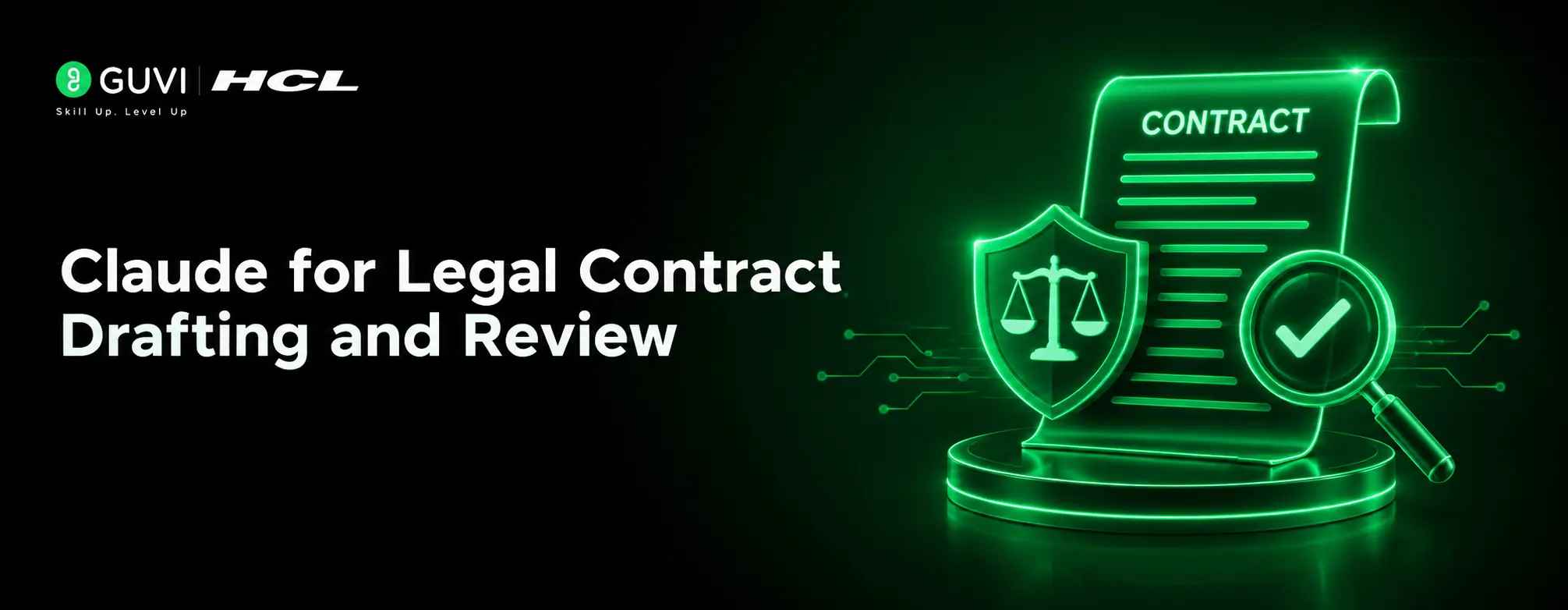
Claude for Legal Contract Drafting and Review
Aug 06, 2026 3 Min Read 244 Views
(Last Updated)
Claude is becoming a practical tool for contract drafting and review because it can handle large documents, extract key terms, and produce structured summaries quickly. Legal teams use it to speed up first-pass review, compare versions, and create draft language that follows house style more closely
Table of contents
- TL;DR
- What Claude Can Do
- Contract Review
- Drafting Support
- Redline Preparation
- Risk Summaries
- How The Workflow Should Work
- Step 1: Load The Playbook
- Step 2: Give Structured Instructions
- Step 3: Review The Output
- Step 4: Final Attorney Review
- Where Claude Helps Most
- NDAs
- Vendor Agreements
- Internal Compliance Reviews
- Best Practices For Safer Use
- Use confidentiality guardrails.
- Keep A Human In The Loop
- Verify Every Citation
- Standardize Prompts
- Common Mistakes To Avoid
- Vague Prompt
- No Jurisdiction Check
- No Review Workflow
- Real-World Example
- What To Do Next
- Conclusion
- FAQs
- Can Claude draft legal contracts?
- Can Claude review risk contracts?
- Is Claude safe for confidential legal work?
- Does Claude replace legal research tools?
- What kind of legal work fits Claude best?
- What is the biggest mistake teams make?
TL;DR
- Claude is useful for contract drafting, clause review, redline prep, and NDA triage.
- The safest workflow combines Claude with attorney oversight, legal playbooks, and confidentiality controls.
- Claude works best when you give it structured prompts and clear review criteria.
- It is strong for speed and consistency, but legal accuracy still needs human verification.
- The smartest use case is first-pass legal support, not autonomous legal decision-making.
| Direct Answer Box: Claude can help legal teams draft and review contracts faster by summarizing clauses, flagging risk, comparing versions, and generating first-pass language, but it should never replace attorney judgment. The best workflow uses Claude for initial analysis and drafting support, then routes outputs through human review, playbooks, and firm-specific standards before anything is sent to a client or signed. |
What Claude Can Do
Claude can help with several high-value legal tasks, especially where speed and structure matter. It is commonly used for contract review, NDA triage, compliance checks, legal summarization, and draft generation.
1. Contract Review
Claude can scan a contract and flag clauses that differ from a playbook or standard position. That makes it useful for spotting issues in indemnity, liability, governing law, term, termination, and confidentiality clauses.
2. Drafting Support
Claude can generate a first draft from your instructions, such as scope, parties, duration, and payment terms. It is strongest when you give it a clear brief and a house style or clause library to work from.
3. Redline Preparation
Claude can compare versions and propose changes, which helps legal teams prepare for negotiation faster. It can also help produce tracked-change style revisions or a clause-by-clause issue list for review.
4. Risk Summaries
Claude can turn dense contracts into a concise risk summary for business teams. This is useful when non-lawyers need to understand what changed without reading every clause.
How The Workflow Should Work
The best legal workflow is not “paste a contract and trust the answer.” It is a controlled process with structured input, clear review criteria, and attorney oversight.
Step 1: Load The Playbook
Start with your standard positions, fallback clauses, and non-negotiables. This gives Claude a reference point so it can judge whether a clause is acceptable, risky, or outside policy.
Step 2: Give Structured Instructions
Use a prompt that tells Claude exactly what to look for and how to score it. The more specific the instructions, the more consistent the review.
Step 3: Review The Output
Treat Claude’s output as a first draft of legal analysis, not a final answer. Check the flagged clauses, verify citations, and confirm that the suggested language matches your jurisdiction and deal context.
Step 4: Final Attorney Review
A licensed attorney should review all client-facing or binding output. That is especially important for anything involving obligations, liability, regulated content, or jurisdiction-specific law.
Where Claude Helps Most
Claude is most valuable when legal work is repetitive, document-heavy, and bounded by known rules. It saves time by reducing manual reading and by standardizing how first-pass review happens.
1. NDAs
NDAs are a strong use case because they often follow similar patterns. Claude can quickly identify non-standard confidentiality, term, use restriction, and disclosure language.
2. Vendor Agreements
Vendor contracts often contain predictable negotiation points. Claude can help spot deviations from your preferred positions before a human spends time on a full review.
3. Internal Compliance Reviews
Claude can support compliance checks by comparing contract language against internal policy. That is useful when legal, procurement, and compliance teams need a quick first look.
Best Practices For Safer Use
A good legal AI workflow should reduce risk, not create it. That means treating confidentiality, verification, and accountability as core design requirements.
1. Use confidentiality guardrails.
Do not paste sensitive content into AI tools without a clear policy and an approved environment. Legal teams should verify data handling rules before using Claude on live matters.
2. Keep A Human In The Loop
Claude should assist lawyers, not replace them. The output may be useful, but legal judgment still belongs to the attorney responsible for the matter.

3. Verify Every Citation
If Claude references legal authorities, those citations must be checked in your research system. Claude does not replace legal databases or jurisdiction-specific verification.
4. Standardize Prompts
Prompt quality matters a lot in legal work. Structured prompts reduce generic output and improve clause-level analysis, risk flags, and redline suggestions.
💡 Pro Tip: Put your standard terms, fallback language, and risk thresholds into a reusable playbook before you start reviewing real contracts. That usually improves consistency more than any prompt trick.
Common Mistakes To Avoid
The biggest mistake is using Claude like a lawyer instead of using it like a drafting assistant. That leads people to over-trust outputs that still need human legal review.
1. Vague Prompt
A vague prompt usually produces vague legal analysis. If you do not specify clause types, risk levels, or playbook rules, the model will often respond too broadly.
2. No Jurisdiction Check
A clause that looks fine in one jurisdiction may be wrong in another. Claude can help surface issues, but it cannot replace local legal expertise.
3. No Review Workflow
If outputs go straight from Claude to client or signature, you have created an obvious risk. The safer model is draft, verify, revise, and then approve.
⚠️ Warning: Do not let Claude generate legal documents for use in real matters without a lawyer’s review. Even strong drafts can still contain subtle errors or missing constraints.
Use Claude for legal contract drafting and review to flag risks, summarize clauses, and speed up first-pass analysis. Learn AI & ML with HCL GUVI’s Artificial Intelligence and Machine Learning course.
Real-World Example
- In a contract review workflow we tested internally, the biggest time savings came from clause extraction and first-pass risk tagging, not from final drafting.
- Claude helped organize the document so the reviewer could focus on the few terms that actually needed negotiation.
- That is the practical value: it turns a long document into a prioritized checklist. For a busy legal or procurement team, that can save meaningful time without lowering review standards.
What To Do Next
Start with one bounded workflow, such as NDA review or vendor contract triage. Build a playbook, define your risk categories, and require human approval for anything that leaves the legal team.
Conclusion
Claude can be a strong legal operations tool for contract drafting and review when it is used carefully. It is best at speeding up first-pass work, organizing risk, and helping legal teams stay consistent.
The winning formula is simple: structured prompts, firm standards, and attorney review. Used that way, Claude becomes a useful legal assistant rather than a substitute for legal judgment.
FAQs
1. Can Claude draft legal contracts?
Yes, Claude can generate first drafts from structured instructions, but a lawyer should review the final document before use.
2. Can Claude review risk contracts?
Yes, it can flag non-standard clauses, summarize issues, and help teams prioritize what needs attention.
3. Is Claude safe for confidential legal work?
Only if your organization has approved confidentiality, access, and data-handling controls in place.
4. Does Claude replace legal research tools?
No. If Claude mentions legal citations or authorities, those must be verified through proper legal research systems.
5. What kind of legal work fits Claude best?
NDAs, vendor agreements, compliance checks, contract summaries, and first-pass redline prep are the strongest use cases.
6. What is the biggest mistake teams make?
They trust AI output too quickly and skip attorney review, which can create legal and operational risk.
Success Stories

About the Author
HCL GUVI
This article was selected and published as part of the HCL GUVI AI Blogathon 2026, an initiative designed to encourage students, AI enthusiasts, and aspiring tech writers to simplify complex AI concepts through impactful technical content. The contest recognized high-quality, original, and insightful AI-focused blogs, with selected authors receiving publication opportunities on the HCL GUVI blog platform along with official author credits and recognition.
View all posts by HCL GUVI
Connect with me @









Did you enjoy this article?