


Business Analytics Articles
Using Claude for Personalized Content at Scale
How to Use Claude for YouTube Script writing


Get In Touch For Details! Request More Information
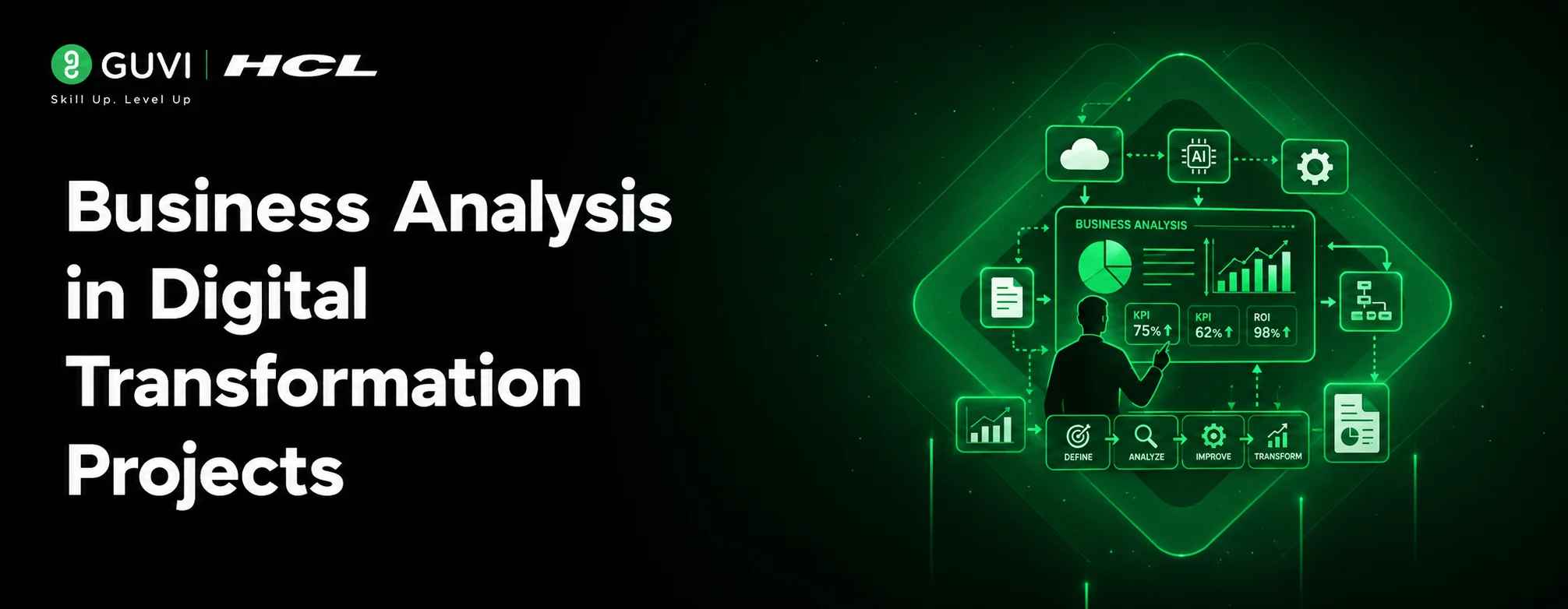
Business Analysis in Digital Transformation Projects – Best Guide
Aug 12, 2026 11 Min Read 1673 Views
(Last Updated)
Table of contents
- TL;DR
- What Is Business Analysis in Digital Transformation?
- What Does Business Analysis in Digital Transformation Achieve?
- How Is Digital Transformation Different From Ordinary Digitisation?
- Why Do Digital Transformation Projects Need Business Analysis?
- It Connects Strategy With Execution
- It Prevents Technology-First Decisions
- It Clarifies the Current and Future States
- It Keeps the Project Focused on Value
- What Is the Business Analyst Role Across a Transformation Project?
- Business Analyst Responsibilities by Stage
- How Does the Business Analyst Work With Other Roles?
- How Does the Business Analysis Process Work?
- Step 1: Define the Business Need
- Step 2: Identify Stakeholders and Decision Rights
- Step 3: Analyse the Current State
- Step 4: Define Outcomes and the Future State
- Step 5: Evaluate Solution Options
- Step 6: Elicit and Prioritise Requirements
- Step 7: Support Delivery and Validation
- Step 8: Support Adoption and Measure Value
- Which Business Requirements Matter in Transformation Projects?
- Business Requirements
- Stakeholder Requirements
- Functional Requirements
- Non-Functional Requirements
- Transition Requirements
- What Deliverables Does a Business Analyst Produce?
- How Do Business Analysts Support Technology and Data Decisions?
- Cloud and Enterprise Platforms
- Automation and Artificial Intelligence
- Data Readiness and Governance
- How Do Business Analysts Support Change and Adoption?
- Assess Organisational Impact
- Identify Adoption Risks
- Define Transition Support
- Use Feedback as Transformation Evidence
- How Is Transformation Value Measured?
- Match Metrics to the Intended Outcome
- Separate Outputs, Outcomes, and Benefits
- Review Leading and Lagging Indicators
- Real-World Business Analysis Examples
- Example 1: Omnichannel Transformation in Indian Retail
- Example 2: Digital Onboarding in Banking
- How Is the Role Changing in 2026?
- From Requirements Writer to Decision Partner
- From Fixed Scope to Continuous Discovery
- From Technology Awareness to Responsible Evaluation
- From Deliverables to Outcomes
- What Skills and Tools Do Business Analysts Need?
- Core Business Analysis Skills
- Digital and Data Skills
- Strategic and Human Skills
- Common Tools
- Common Mistakes to Avoid
- Starting With the Requested Technology
- Documenting the Current Process Without Challenging It
- Treating Requirements as a One-Time Handover
- Ignoring Data and Non-Functional Requirements
- Measuring Delivery Instead of Value
- Build Practical Analytics Skills With HCL GUVI
- Conclusion
- FAQs
- What is business analysis in digital transformation?
- What does a business analyst do in a digital transformation project?
- Why is business analysis important before choosing technology?
- What are the main stages of the business analysis process?
- Which requirements are important in digital transformation projects?
- Does a business analyst need technical skills?
- How does a business analyst support AI transformation?
- How is business analysis different from project management?
- How do business analysts measure transformation success?
- Which industries use business analysis in transformation projects?
TL;DR
Business analysis in digital transformation connects an organisation’s strategy, customer needs, processes, data, technology choices, and adoption plan. A business analyst studies the current state, defines measurable outcomes, identifies stakeholders, uncovers business requirements, evaluates solution options, supports delivery, and checks whether the change creates value. The role is not limited to writing documents or user stories. It reduces the risk of automating a weak process, buying unsuitable technology, solving the wrong problem, or launching a system that employees and customers do not adopt.
Business analysis in digital transformation prevents organisations from treating every new platform, automation tool, AI model, or cloud migration as a solution by default.
The analyst starts with the business problem, the people affected, the current workflow, and the value the organisation expects to create.
This guide explains the business analyst role across discovery, requirements, delivery, testing, adoption, and value measurement.
You will also see practical examples, key deliverables, 2026 trends, common mistakes, and the skills needed to contribute to enterprise transformation.
What Is Business Analysis in Digital Transformation?
The International Institute of Business Analysis defines business analysis as enabling change by defining needs and recommending solutions that deliver value to stakeholders within a given context.
Business analysis in digital transformation applies that discipline to changes involving digital products, data, automation, AI, cloud platforms, customer channels, operating models, and connected workflows.
The technology may be highly visible, but the analysis begins before a tool is selected. The analyst investigates what is happening, why it matters, who is affected, what outcome is required, and how success will be recognised.
The business analyst investigates what is happening, why it matters, who is affected, what outcome is required, and how success will be recognised.
What Does Business Analysis in Digital Transformation Achieve?
In simple terms, the business analyst helps an organisation move from:
“We should implement this technology.”
to:
“Here is the business problem, the evidence behind it, the outcome we need, the options available, the risks involved, and the way we will measure value.”
That shift is the core purpose of the discipline.
How Is Digital Transformation Different From Ordinary Digitisation?
Digitisation converts information from physical or analogue form into digital form. Scanning paper invoices is an example.
Digitalisation uses technology to improve an existing activity. Automating invoice approvals is an example.
Digital transformation changes how the organisation creates value, operates, serves customers, or competes. It may redesign the full procure-to-pay process, integrate suppliers, introduce predictive controls, and change decision rights.
Why Do Digital Transformation Projects Need Business Analysis?
Transformation programmes contain uncertainty. Stakeholders may agree that change is needed while disagreeing about the problem, priority, scope, customer outcome, process ownership, or technology.
Business analysis in digital transformation creates a structured way to resolve that uncertainty before it becomes expensive rework.
It Connects Strategy With Execution
A digital transformation strategy may promise faster service, lower operating costs, better decisions, or new revenue.
The analyst turns that broad ambition into specific capabilities, outcomes, process changes, business requirements, releases, and measures.
A digital transformation strategy often begins with broad goals such as improving customer experience, reducing operational effort, increasing automation, or becoming more data-driven. These goals are useful, but they are too general for delivery teams to act on directly.
Business analysis in digital transformation turns those ambitions into clear problem statements, prioritised capabilities, process changes, business requirements, decision criteria, and measurable outcomes. This helps every team understand what must change, why it matters, and how the proposed solution supports the organisation’s wider strategy.
It Prevents Technology-First Decisions
A company may request a chatbot when the actual problem is incomplete knowledge content.
It may request robotic process automation when frequent exceptions make the workflow unsuitable for simple automation.
The analyst tests the assumption before the organisation commits to a platform or implementation approach.
It Clarifies the Current and Future States
Teams need to understand:
- How work happens today
- Where delays, errors, duplication, and manual handoffs occur
- Which systems and data sources are involved
- Who owns each decision
- What the future experience should look like
- Which controls must remain
- Which changes depend on other initiatives
Without this baseline, teams can digitise existing waste instead of improving the process.
This baseline allows business analysis in digital transformation to separate necessary enterprise change from unnecessary digitisation.
It Keeps the Project Focused on Value
Digital transformation creates value only when the delivered technology improves a meaningful business outcome. A new platform may launch successfully but still fail to reduce delays, improve customer experience, increase adoption, or lower operating effort.
Business analysis in digital transformation keeps the initiative focused on these outcomes by connecting each requirement, feature, and process change with the original business need and measurable success criteria.
The same analysis emphasised the importance of connecting digital ambitions, technology investment, and organisational change with enterprise strategy.
This is why business analysis in digital transformation must continue after requirements approval. The analyst helps the team check whether the delivered change improves the outcome that justified the investment.
What Is the Business Analyst Role Across a Transformation Project?
The business analyst role changes as the initiative moves from strategy to adoption.
The analyst may work with executives in one phase, process owners and users in another, and architects, developers, data teams, testers, trainers, and operations teams later.
Business Analyst Responsibilities by Stage
| Transformation stage | Main business question | Business analyst activities | Evidence or deliverable |
| Strategy and framing | Why should the organisation change? | Clarify objectives, drivers, constraints, stakeholders, benefits, and risks | Problem statement, scope, objectives, business case |
| Current-state discovery | How does the organisation work now? | Interview users, map processes, study data, identify pain points and root causes | Current-state map, stakeholder map, pain-point analysis |
| Future-state design | What should become different? | Define target capabilities, journeys, processes, business rules, and outcomes | Future-state model, capability map, journey map |
| Option assessment | Which approach creates the best value? | Compare build, buy, configure, automate, integrate, or retire options | Feasibility assessment, cost-benefit analysis |
| Requirements and planning | What must the organisation and solution support? | Elicit, model, validate, prioritise, and trace requirements | Requirements catalogue, backlog, acceptance criteria |
| Delivery and testing | Is the solution being built correctly? | Clarify requirements, assess changes, support testing, and resolve gaps | Refined stories, decision log, UAT support |
| Adoption and transition | Can people use the new capability successfully? | Assess readiness, training, communication, support, and cutover needs | Readiness assessment, transition plan, user guidance |
| Value evaluation | Did the change improve the intended outcome? | Compare results with baselines and recommend improvements | KPI review, benefits analysis, optimisation backlog |
The table shows why business analysis in digital transformation is broader than requirement gathering. It supports strategic alignment, process redesign, solution evaluation, implementation, and benefit realisation.
These activities form part of the wider roles and responsibilities of a business analyst, including requirement analysis, stakeholder communication, process improvement, solution evaluation, testing support, and performance monitoring.
How Does the Business Analyst Work With Other Roles?
A business analyst does not replace the project manager, product manager, architect, data analyst, UX designer, change manager, or subject-matter expert.
Instead, the analyst connects their decisions:
- Project managers coordinate delivery constraints and dependencies.
- Product managers guide product direction and prioritisation.
- Architects assess technical structure and integration.
- Data professionals evaluate data quality, models, and reporting.
Understanding the difference between business analytics and data analytics also helps teams separate business-focused decision support from the technical examination and interpretation of datasets.
- UX teams research and design user experiences.
- Change managers coordinate organisational readiness.
- Business owners remain accountable for outcomes.
Effective business analysis in digital transformation creates shared understanding across these roles without blurring accountability.
How Does the Business Analysis Process Work?
There is no rigid sequence for every initiative. Agile product teams, platform migrations, regulatory programmes, and operating-model changes require different levels of analysis.
However, the following business analysis process gives beginners a practical structure.
Step 1: Define the Business Need
Start with the reason for change, not the requested system.
Ask:
- What problem or opportunity exists?
- Who experiences it?
- What evidence supports it?
- What happens if nothing changes?
- Which strategic objective does it affect?
- What outcome would justify investment?
A useful problem statement avoids assuming a particular solution.
Step 2: Identify Stakeholders and Decision Rights
List the people who use, fund, govern, build, support, regulate, or are affected by the change.
Then clarify:
- Who owns the business outcome?
- Who approves the scope?
- Who owns the data?
- Who resolves policy conflicts?
- Who must be consulted?
- Who may lose authority or control because of the change?
Stakeholder analysis is not just a contact list. It shows influence, impact, information needs, and decision authority.
Step 3: Analyse the Current State
Use interviews, workshops, observation, process mining, system data, customer feedback, policy review, and document analysis.
The objective is to separate symptoms from root causes.
For example, slow customer onboarding may result from repeated data entry, unclear policy, poor integration, manual risk checks, missing documents, or approval bottlenecks. Each cause requires a different response.
Step 4: Define Outcomes and the Future State
Describe what users, employees, processes, data, controls, and systems should be able to do after the change.
A future state should include measurable outcomes rather than only features.
Weak outcome:
Launch a self-service portal.
Stronger outcome:
Allow eligible customers to complete onboarding without branch assistance while maintaining identity, risk, accessibility, and audit controls.
Step 5: Evaluate Solution Options
Possible approaches include:
- Improving the existing process
- Configuring an existing platform
- Buying a commercial product
- Building a custom solution
- Integrating current systems
- Automating selected tasks
- Using AI for classification or assistance
- Retiring an unnecessary process
- Combining several approaches
Business analysis in digital transformation compares options against value, feasibility, risk, data readiness, user impact, architecture, compliance, cost, and time.
Step 6: Elicit and Prioritise Requirements
Elicitation may use interviews, workshops, prototypes, journey mapping, document analysis, observation, surveys, interface analysis, and data exploration.
Prioritisation should consider:
- Business value
- User impact
- Regulatory or safety need
- Risk reduction
- Dependencies
- Learning value
- Implementation effort
- Reversibility
- Urgency
Step 7: Support Delivery and Validation
Analysis continues while the solution is designed, built, configured, migrated, tested, and released.
The analyst clarifies assumptions, updates models, evaluates change requests, supports acceptance criteria, prepares user acceptance testing, and checks that the solution still serves the business need.
Step 8: Support Adoption and Measure Value
A technically working solution can fail when users do not trust it, understand it, or incorporate it into daily work.
The analyst helps define transition requirements, readiness measures, training needs, support content, operational ownership, and post-launch metrics.
Digital transformation rarely succeeds through technology implementation alone. Teams also need clear ownership, stakeholder alignment, realistic delivery plans, employee readiness, measurable outcomes, and continuous improvement after launch.
Business analysis in digital transformation connects these elements by keeping the business need, requirements, delivery decisions, adoption activities, and success measures aligned throughout the project.
Fewer than one in five organisations reported high maturity in any area of data readiness, even though reliable data is essential for AI and digital transformation. This makes business analysts important in defining data requirements, ownership, quality rules, governance, and the business outcomes that data must support.
Which Business Requirements Matter in Transformation Projects?
Digital initiatives need more than a list of screens and features.
Strong business analysis in digital transformation separates requirement levels so strategy, users, systems, and transition needs remain connected.
IIBA’s Business Analysis Standard identifies business, stakeholder, solution, and transition requirements. Solution requirements include functional and non-functional requirements.
Business Requirements
Business requirements explain the high-level need, objective, or intended outcome.
Examples include:
- Reduce onboarding time
- Improve first-contact resolution
- Lower manual reconciliation effort
- Increase self-service adoption
- Meet a new regulatory requirement
Stakeholder Requirements
Stakeholder requirements describe what a specific group needs to achieve the business objective.
Examples include:
- Customers need to see which documents remain incomplete.
- Service agents need a unified customer history.
- Compliance reviewers need an auditable decision trail.
- Operations managers need exception alerts.
Functional Requirements
Functional requirements define the behaviour a solution must provide.
Examples include:
- The system must validate identity information.
- Users must be able to save an incomplete application.
- The workflow must route high-risk cases for manual review.
- Managers must be able to approve policy exceptions.
Non-Functional Requirements
Non-functional requirements define quality, operational, and constraint expectations.
They may cover:
- Performance
- Availability
- Accessibility
- Security
- Privacy
- Scalability
- Reliability
- Auditability
- Data residency
- Maintainability
Transition Requirements
Transition requirements support movement from the current state to the future state.
Examples include data migration, parallel operations, user training, role changes, temporary reports, cutover controls, archival, and legacy-system retirement.
Transition planning is where business analysis in digital transformation connects solution delivery with operational readiness.
A team that ignores transition requirements may build the correct solution but still fail to introduce it safely.
What Deliverables Does a Business Analyst Produce?
A business analyst should create only the artefacts required to support decisions, delivery, traceability, and shared understanding.
The exact output depends on project size, risk, regulation, delivery method, and organisational standards.
| Deliverable | Purpose |
| Problem statement | Defines the issue without assuming a solution |
| Business case | Explains value, cost, risk, options, and investment rationale |
| Stakeholder map | Identifies affected groups, influence, impact, and engagement needs |
| Current-state process map | Shows how work, decisions, systems, and data interact today |
| Future-state process map | Describes the intended operating process |
| Capability map | Shows which organisational abilities must be created or improved |
| Customer journey | Connects goals, touchpoints, pain points, and expected experiences |
| Requirements catalogue | Records business, stakeholder, solution, and transition requirements |
| Product backlog | Organises incremental delivery work |
| Business rules | Defines decisions, policies, conditions, and exceptions |
| Data requirements | Clarifies sources, fields, quality, ownership, and usage |
| Traceability matrix | Connects objectives, requirements, designs, tests, and outcomes |
| Acceptance criteria | Defines observable conditions for accepting a capability |
| Decision log | Records major choices, rationale, owners, and dates |
| Benefits and KPI plan | Defines baselines, targets, owners, and review frequency |
The value of business analysis in digital transformation is not measured by document volume.
A short, validated model that enables a decision is more useful than a large specification that stakeholders do not understand or trust.
How Do Business Analysts Support Technology and Data Decisions?
Business analysts do not need to design every technical component, but they need enough digital fluency to ask useful questions and identify business implications.
Cloud and Enterprise Platforms
During a cloud migration or platform implementation, the analyst helps distinguish technical migration from business change.
Questions include:
- Which processes should remain unchanged?
- Which workflows should be standardised?
- Which customisations create real differentiation?
- What integrations are essential?
- Which data must move?
- Which controls depend on the legacy system?
- Who owns the process after implementation?
Here, business analysis in digital transformation helps teams decide what to standardise, integrate, migrate, configure, or retire.
Automation and Artificial Intelligence
An automation opportunity should be evaluated for rule stability, exception rates, data quality, user impact, compliance, and operational ownership.
AI introduces additional questions:
- What decision or task will AI support?
- What data is required?
- How will accuracy be evaluated?
- When is human review mandatory?
- How will bias, privacy, and security be addressed?
- What happens when confidence is low?
- Who monitors performance after launch?
Deloitte’s State of AI in the Enterprise 2026 found that 66% of surveyed organisations had achieved productivity or efficiency gains from AI. However, only 34% were using AI to create new products, services, processes, or business models, while 37% were applying it with little or no change to existing processes.

This shows why AI implementation alone is not digital transformation. Business analysis in digital transformation helps organisations redesign workflows, define measurable outcomes, prepare reliable data, establish human oversight, and connect AI initiatives with genuine business change.
The research also found workflow redesign to be strongly associated with meaningful value among high-performing organisations.
This gap between adoption and value makes business analysis in digital transformation especially important for AI initiatives. The analyst ensures the organisation redesigns the process instead of inserting AI into an unchanged workflow.
Data Readiness and Governance
Digital solutions depend on trustworthy data.
Understanding how business analytics turns data into decisions can help analysts connect data requirements, patterns, dashboards, forecasts, and performance measures with transformation outcomes.
The analyst works with data owners, architects, analysts, security teams, and users to clarify:
- Data sources
- Business definitions
- Ownership
- Quality rules
- Access rights
- Retention
- Consent
- Lineage
- Integration
- Reporting needs
- Decision use
A technically available dataset may still be unsuitable if definitions conflict, fields are incomplete, or the organisation lacks permission to use it for the proposed purpose.
A structured data cleaning process helps teams identify missing values, duplicate records, inconsistent formats, incorrect entries, and other quality problems before using the data for dashboards, automation, or AI.
How Do Business Analysts Support Change and Adoption?
Transformation changes how people work, make decisions, interact with customers, and measure performance.
Business analysis in digital transformation supports adoption by identifying these impacts early rather than treating training as a final launch task.
Assess Organisational Impact
The analyst examines changes to:
- Roles and responsibilities
- Skills
- Policies
- Approvals
- Controls
- Performance measures
- Team structures
- Customer interactions
- Support processes
- Incentives
Identify Adoption Risks
Users may resist because a new system creates extra work, removes autonomy, exposes performance, changes familiar routines, or fails to handle real exceptions.
These concerns should be analysed rather than dismissed as unwillingness to change.
Define Transition Support
Transition support can include:
- Role-based training
- Job aids
- Sandbox practice
- Updated procedures
- Floor support
- Communication
- Pilot groups
- Feedback channels
- Adoption dashboards
- Phased rollout
Use Feedback as Transformation Evidence
Support tickets, usage patterns, completion rates, workarounds, complaints, and user interviews reveal whether the new capability works in practice.
Feedback may lead to a product improvement, process change, policy clarification, training update, or revised requirement.
How Is Transformation Value Measured?
A project can be delivered on time and still fail to improve the business.
The analyst should help define value before development begins, establish a baseline, identify metric owners, and review results after implementation.
Match Metrics to the Intended Outcome
| Transformation goal | Useful measures |
| Improve customer onboarding | Completion, time to value, abandonment, first-time-right rate |
| Reduce operational effort | Handling time, automation rate, exceptions, cost per transaction |
| Improve customer service | First-contact resolution, response time, repeat contact, satisfaction |
| Modernise decisions | Data freshness, decision cycle time, forecast accuracy, adoption |
| Improve digital sales | Conversion, digital revenue, acquisition cost, retention |
| Strengthen compliance | Control exceptions, audit findings, review time, traceability |
| Improve employee experience | Task completion, tool adoption, errors, employee effort |
Understanding the difference between business intelligence and business analytics helps teams separate ongoing performance reporting from deeper investigation, forecasting, and decision support.
Separate Outputs, Outcomes, and Benefits
An output is what the project delivers, such as a portal.
An outcome is the resulting change in behaviour or performance, such as more customers completing onboarding digitally.
A benefit is the measurable value, such as lower service cost, faster revenue recognition, or improved retention.
This distinction keeps business analysis in digital transformation focused on why the organisation invested rather than only on what the team shipped.
Review Leading and Lagging Indicators
Leading indicators show whether adoption and process behaviour are moving in the right direction.
Lagging indicators show whether financial, customer, operational, or risk benefits appear later.
Both are necessary because enterprise value may take longer to emerge than product usage.
Real-World Business Analysis Examples
These are simplified business scenarios. They show how analysis changes an initiative without claiming that one tool alone produces transformation.
Example 1: Omnichannel Transformation in Indian Retail
A retail chain wants one experience across stores, its mobile app, website, loyalty programme, delivery partners, and customer support.
The initial request is to purchase a new customer relationship management platform.
The business analyst discovers that customer identities are duplicated, store returns follow different rules, product availability is delayed, loyalty points are calculated in separate systems, and no team owns the complete journey.
The analyst:
- Maps the current journeys across channels.
- Defines a unified customer and order view.
- Aligns return, promotion, and loyalty rules.
- Identifies integration and data-quality requirements.
- Prioritises a pilot around high-value journeys.
- Defines measures such as stock visibility, conversion, return resolution, and repeat purchases.
- Supports store and service-team adoption.
Here, business analysis in digital transformation changes the initiative from “install a CRM” to “create a consistent customer and operating model across channels.”
Exploring real-world applications of business analytics can help you understand how organisations use data, reporting, forecasting, and customer insights to support transformation decisions across industries.
Example 2: Digital Onboarding in Banking
A bank wants customers to open selected accounts without visiting a branch.
The analyst studies abandonment data, compliance reviews, document errors, fraud controls, accessibility needs, manual handoffs, and customer-support contacts.
The future-state design includes:
- Eligibility rules
- Identity and document validation
- Consent
- Risk-based routing
- Manual-review paths
- Save-and-resume capability
- Status updates
- Audit evidence
- Operational dashboards
- Assisted support
The analyst also defines failure scenarios, human-review thresholds, transition training, and measures such as completion, decision time, false rejection, manual review, complaint volume, and first-time-right rate.
This example shows how business analysis in digital transformation balances customer convenience with security, compliance, data, operations, and inclusion.
How Is the Role Changing in 2026?
The business analyst is moving beyond a documentation-centred role towards strategic analysis, product thinking, data interpretation, responsible AI adoption, and continuous value measurement.
From Requirements Writer to Decision Partner
Teams need analysts who can question investment assumptions, connect strategy with execution, and show how a proposed change will create measurable value.
IIBA’s 2026 trends analysis describes the discipline as moving towards strategic leadership, value orchestration, outcome-driven alignment, and responsible innovation.
From Fixed Scope to Continuous Discovery
Digital products and platforms continue evolving after launch.
The analyst supports research, experimentation, backlog refinement, feedback analysis, and benefit review instead of treating approved requirements as permanently fixed.
From Technology Awareness to Responsible Evaluation
Analysts need to understand what AI, automation, analytics, cloud, APIs, process mining, and enterprise platforms can and cannot do.
They must also identify data, ethics, security, accessibility, governance, and human-impact requirements.
Business analysis is not limited to employees with the job title “Business Analyst.” IIBA explains that anyone who performs business analysis activities can be considered a business analysis practitioner, including professionals working in product, process, systems, data, consulting, and project roles. This is especially relevant in digital transformation because analysing needs, requirements, and value is a shared responsibility across teams.
From Deliverables to Outcomes
Teams increasingly expect analysis to support adoption, performance measurement, and continuous improvement.
Requirements must therefore remain traceable to business objectives and metrics after release.
The future of business analysis in digital transformation will depend on strategic judgement, digital fluency, human-centred analysis, and evidence-based value management.
What Skills and Tools Do Business Analysts Need?
Successful business analysis in digital transformation combines business understanding, analytical thinking, facilitation, technology awareness, data literacy, and change capability.
Developing essential business analytics skills in business understanding, data interpretation, statistical reasoning, visualisation, and communication can strengthen your ability to support evidence-based transformation decisions.
Learners preparing for this field can follow a structured business analyst career roadmap covering foundational knowledge, analytical tools, practical projects, certifications, and entry-level job preparation
Core Business Analysis Skills
- Problem framing
- Stakeholder analysis
- Requirements elicitation
- Process modelling
- Root-cause analysis
- Facilitation
- Prioritisation
- Business-case development
- Option assessment
- Acceptance criteria
- Traceability
- Solution evaluation
Digital and Data Skills
- Data interpretation
- KPI design
- SQL fundamentals
- Dashboard literacy
- API and integration basics
- Cloud concepts
- Automation assessment
- AI use-case evaluation
- Data governance
- Cybersecurity and privacy awareness
Strategic and Human Skills
- Communication
- Negotiation
- Systems thinking
- Customer empathy
- Change-impact analysis
- Conflict resolution
- Decision facilitation
- Commercial awareness
- Ethical judgement
- Executive storytelling
Common Tools
| Purpose | Example tools |
| Process and journey modelling | Visio, Lucidchart, Miro, draw.io, BPMN tools |
| Requirements and backlog | Jira, Azure DevOps, Confluence |
| Data analysis | Excel, SQL, Python |
| Dashboards | Power BI, Tableau |
| Prototyping | Figma, Balsamiq |
| Collaboration | Microsoft Teams, Zoom, Miro |
| Documentation | Confluence, SharePoint |
| Testing and traceability | Requirements and test-management platforms |
Tools vary between organisations. The durable skill is applying the right technique to the decision the team needs to make.
Common Mistakes to Avoid
1. Starting With the Requested Technology
Teams may begin with “implement AI,” “move to cloud,” or “buy a CRM” before validating the business problem.
Fix: Define the need, outcome, users, constraints, baseline, and alternatives before selecting a solution.
2. Documenting the Current Process Without Challenging It
A detailed process map can still preserve unnecessary approvals, duplicate work, and outdated policies.
Fix: Ask why each step exists and whether the future process needs it.
3. Treating Requirements as a One-Time Handover
Requirements change as teams learn from prototypes, technical discovery, testing, data, and users.
Fix: Maintain traceability, decision history, priorities, and continuous stakeholder validation.
4. Ignoring Data and Non-Functional Requirements
A feature can work functionally while failing because of poor performance, security, accessibility, unreliable data, or limited scalability.
Fix: Analyse quality, data, control, operational, and transition requirements early.
5. Measuring Delivery Instead of Value
Completing features, migration, or training does not prove transformation success.
Fix: Establish outcome baselines, targets, metric owners, and post-launch reviews before development begins.
Avoiding these mistakes makes business analysis in digital transformation practical, testable, and connected to enterprise outcomes.
Build Practical Analytics Skills With HCL GUVI
Transformation teams need professionals who can understand business problems, work with data, communicate insights, create dashboards, and connect analysis with decisions.
HCL GUVI’s Business & Marketing Analytics Program provides structured learning across business analytics, Excel, SQL, Power BI, Tableau, market research, exploratory analysis, dashboards, and AI-supported workflows. Its current programme page also highlights practical projects and business scenarios.
The programme can strengthen the analytical side of business analysis in digital transformation. Combine the learning with process maps, requirements models, stakeholder case studies, KPI frameworks, and solution-evaluation exercises to build a broader transformation portfolio.
Conclusion
Business analysis in digital transformation keeps enterprise change connected to real needs, measurable outcomes, workable processes, reliable data, suitable technology, and successful adoption. The business analyst frames the problem, maps the current state, defines the future state, evaluates options, manages business requirements, supports delivery, and checks whether benefits appear after launch. As AI, automation, cloud, and analytics reshape organisations, the role is becoming more strategic and outcome-focused. Start with problem framing, stakeholder analysis, process modelling, requirements, data interpretation, and KPI design, then practise applying them to realistic transformation scenarios.
FAQs
1. What is business analysis in digital transformation?
Business analysis in digital transformation is the practice of defining transformation needs, analysing processes and stakeholders, evaluating digital solution options, managing requirements, and measuring whether the resulting change delivers business value.
2. What does a business analyst do in a digital transformation project?
A business analyst connects enterprise goals with customer needs, processes, data, technology, requirements, testing, adoption, and performance measures.
The role continues from discovery through post-launch value evaluation.
3. Why is business analysis important before choosing technology?
Business analysis confirms whether the requested technology addresses the actual problem.
It also reveals process, data, policy, integration, user, compliance, and adoption issues that technology alone cannot solve.
4. What are the main stages of the business analysis process?
The main stages are defining the need, identifying stakeholders, analysing the current state, designing the future state, evaluating options, eliciting requirements, supporting delivery, enabling adoption, and measuring outcomes.
5. Which requirements are important in digital transformation projects?
Transformation projects need business, stakeholder, functional, non-functional, data, integration, security, compliance, and transition requirements.
These requirements should remain traceable to objectives and measurable outcomes.
6. Does a business analyst need technical skills?
A business analyst does not need to perform every engineering task.
However, the analyst should understand data, APIs, cloud, automation, AI, security, integration, and system constraints well enough to analyze their business implications.
7. How does a business analyst support AI transformation?
The analyst defines the use case, workflow, data needs, expected value, evaluation measures, human-review rules, risks, controls, and adoption requirements.
This prevents teams from implementing AI without a clear business outcome.
8. How is business analysis different from project management?
Business analysis focuses on needs, requirements, options, value, and solution outcomes.
Project management primarily coordinates delivery through scope, schedules, resources, risks, dependencies, and governance.
9. How do business analysts measure transformation success?
They connect outputs with outcomes and benefits using baselines, targets, leading indicators, lagging indicators, user feedback, adoption data, operational measures, customer metrics, financial results, and risk indicators.
10. Which industries use business analysis in transformation projects?
Banking, retail, healthcare, manufacturing, insurance, telecom, logistics, education, government, and technology organisations use business analysis to redesign processes, adopt platforms, automate work, and create data-driven services.
Success Stories

About the Author
Reemsha Khan
Always been a storyteller at heart. Now, I turn complex topics into simple, easy-to-understand stories through content. Hope you find it helpful.
View all posts by Reemsha Khan
Connect with me @







Did you enjoy this article?